Driver fitness is one of the core components of FMCSA’s safety regulations because it determines whether a commercial driver is physically, mentally, and legally qualified to operate a commercial motor vehicle. Under 49 CFR Part 391, carriers must ensure that every CDL driver they employ meets the medical and qualification standards required for safe operation.
Introduction to Driver Fitness Violations (391 Subpart E)
Unlike drug and alcohol violations, which are event-based, driver fitness violations are typically discovered during roadside inspections, audits, or DQ File reviews. Once identified, they create immediate compliance liability for carriers.
FMCSA defines driver fitness violations as any instance where a driver does not meet the physical qualifications, lacks required documentation, or is medically unfit to operate a commercial vehicle. These violations often stem from expired medical certificates, incomplete documentation, unqualified drivers, and carriers failing to verify medical card authenticity.
Driver fitness violations directly affect your CSA Score (Driver Fitness BASIC). A single expired medical card is enough to trigger severe penalties, a failed audit item, or an Out-of-Service order during roadside inspections.
For fleet owners, owner-operators, and safety managers, understanding these regulations is essential. Many companies assume medical certificates and driver qualification files are simple paperwork tasks, but FMCSA audits show they are among the most common violation categories year after year.
Operating a CMV Without a Valid Medical Certificate – 391.41(a)
This is one of the most common and costly driver fitness violations. Under 391.41(a), a driver cannot operate a commercial motor vehicle unless they possess a valid, unexpired DOT medical certificate issued by a certified medical examiner. If a medical card is expired, invalid, or not properly documented with the state, the driver is considered disqualified.
Common reasons drivers lack a valid medical certificate:
- The driver forgot to renew the medical card before the expiration date
- The medical examiner was not listed in the National Registry
- The medical certificate was never submitted to the licensing agency
- The card was suspended due to a medical condition
- Incorrect information on the medical certificate
- Miscommunication between the driver and employer about expiration timelines
FMCSA takes this violation seriously because a valid medical certificate is proof that a driver is physically fit to operate a CMV safely. When a medical card expires, the driver must immediately cease operating until a new exam is completed.
Carriers also receive violations if they allow a driver to operate without a valid medical card. During audits, investigators request proof that every driver had an active medical certificate during the entire period of employment.
Expired or Incorrect Medical Examiner’s Certificate in DQ File – 391.51
Under 391.51, carriers must maintain an accurate and complete Driver Qualification File (DQF) for every CDL driver. One of the most common violations is having an expired, missing, or incorrectly filed Medical Examiner’s Certificate (MEC) in the DQ file.
A medical certificate may be considered invalid if:
- The expiration date is incorrect or overwritten
- The certificate does not match FMCSA formatting
- The ME’s National Registry Number is missing
- The form is outdated
- The examiner was removed from the registry
- Illegible handwriting makes fields unreadable
- The MEC does not match the driver’s MVR record
During audits, investigators compare DQF medical certificates with the MVR medical status. If they do not match, the carrier receives a violation, even if the driver technically had a valid card.
Expired medical certificates in the DQ file are one of the top reasons carriers fail audits. FMCSA expects precise documentation, and any inconsistency raises red flags about a carrier’s safety management processes.
Driving While Medically Unqualified – 391.41(b)
Under 391.41(b), a driver must meet all physical qualification requirements outlined by FMCSA. A driver is considered medically unqualified if they have a condition that may interfere with safe driving. Medical conditions that often trigger this classification include:
- Severe hypertension
- Uncontrolled diabetes
- Heart disease
- Sleep apnea
- Seizure disorders
- Vision or hearing impairments
- Drug or alcohol dependency
- Mental health conditions that impair judgment or alertness
Driving while medically unqualified is viewed as a high-risk violation because the driver may experience sudden incapacitation, which can cause catastrophic accidents.
Carriers may also receive violations if:
- They knowingly allow a medically disqualified driver to operate
- The driver fails to follow a medical examiner’s restrictions
- The driver does not comply with treatment or follow-up requirements
- The carrier lacks documentation showing medical compliance
FMCSA can impose civil penalties, downgraded safety ratings, and even Out-of-Service orders for repeated instances.
Failure to Provide Long-Form Medical Exam & Supporting Documents – 391.43
FMCSA requires carriers to maintain both the Medical Examiner’s Certificate (MEC) and the long-form medical examination report, also known as the MCSA-5875 form, under 391.43.
While drivers typically carry only the medical card, carriers must retain the long-form in their Driver Qualification File (DQF). Failing to keep this document is one of the most frequent audit violations because many carriers mistakenly believe the medical card alone is sufficient.
The long-form medical exam provides detailed health information, including diagnostic notes, examiner evaluations, restrictions, medical conditions, medications, and examiner signatures. During a compliance audit, investigators review the long-form to verify:
- The driver was evaluated by a certified medical examiner
- The examination followed FMCSA standards
- Medical conditions were properly disclosed
- Any medications that may impair driving were reviewed
- The examiner’s decisions align with the MEC certification length
Common violations include:
- Long-form missing entirely
- Incorrect version of the form used
- Long-form incomplete or missing signatures
- Examiner not listed in the FMCSA National Registry
- Medical notes inconsistent with the MEC certification duration
- Missing supporting documents such as vision waivers, insulin treatment forms, or sleep apnea reports
Carriers who cannot provide the long-form risk fines and CSA violations. Many fleets lose vital documents when relying on manual filing systems or paper binders.
Vision & Hearing Qualification Violations – 391.41(b)(2–3)
FMCSA requires drivers to meet specific vision and hearing standards outlined in 391.41(b)(2–3). Violations occur when a driver does not meet these minimum standards or when a carrier fails to maintain supporting documentation for exemptions or waivers.
Vision requirements include:
- Distant visual acuity of at least 20/40 in each eye, with or without corrective lenses
- At least 70 degrees of peripheral vision in the horizontal meridian
- Ability to recognize traffic signals and devices in standard red, green, and amber colors
Hearing requirements include:
- Ability to perceive a forced whisper at not less than 5 feet
- Or an average hearing loss of no more than 40 decibels in the better ear with or without a hearing aid
Common violations include:
- Driver operating with uncorrected visual impairment
- Missing proof of corrective lenses requirement
- Employer unaware of driver’s new vision problem
- No updated documentation for vision exemption program participants
- Drivers operating without required hearing aids
- Missing audiometric exam records in DQ file
- Failure to submit required documentation for medical variance approval
FMCSA implemented the Vision Exemption Program and updated the diabetes exemption rule to allow many drivers with medical conditions to qualify with proper documentation. However, exemptions require annual renewals, medical proof, and specialist evaluations. Missing even one renewal results in disqualification.
Disqualification Violations (Medically Disqualified Drivers Operating) – 383.51 and 391.15
Anytime a medically disqualified driver is allowed to operate a commercial motor vehicle, the carrier violates 391.15 and the driver violates 383.51. These are among the most severe FMCSA violations because they indicate the carrier knowingly permitted unsafe operation.
A driver may be disqualified for:
- Expired medical certificate
- Failure to meet medical exam standards
- Disqualifying medical condition (e.g., seizures, uncontrolled diabetes)
- Severe hypertension
- Failure to complete required medical follow-up evaluations
- Sleep apnea non-compliance
- Use of prohibited medications
- Missing documentation for medical variances
Additionally, if a driver receives a “Medically Disqualified” status on their MVR due to an expired or incorrect medical certificate, the carrier must immediately remove the driver from service.
Common reasons fleets get cited include:
- Carriers not checking MVR medical status
- Allowing a driver to operate during a medical suspension
- Overlooking medical restrictions listed on MEC
- Not tracking expiring medical variances
- Driver concealed disqualifying medical conditions
- Driver continued operating after receiving a restricted or short-term certificate
FMCSA treats these violations as major red flags because they directly relate to crash risk, sudden incapacitation, and public safety concerns. Carriers may face civil penalties, downgraded safety ratings, and in some cases, an Out-of-Service Order.
FMCSA Driver Fitness Violation Codes (Official List)
Below is a collection of common FMCSA driver fitness violations documented during inspections and audits. These codes affect the Driver Fitness BASIC and contribute to DOT audits, CSA scores, and potential enforcement actions.
Medical Certificate Violations
- 391.41(a) – Driver operating without a valid medical certificate
- 391.41(b) – Driver medically unqualified
- 391.41(b)(2) – Vision not meeting FMCSA standards
- 391.41(b)(3) – Hearing not meeting FMCSA standards
- 391.43(h) – Improper or missing long-form medical examination
Driver Qualification File Violations
- 391.51(b)(7) – Medical examiner’s certificate not in DQ file
- 391.51(a) – Incomplete or missing DQ file
- 391.51(b)(1–13) – Missing required DQF documents
Disqualification Violations
- 391.15(a) – Operating while disqualified
- 383.51(a) – Disqualified driver operating CMV
Medical Variance Violations
- Missing insulin treatment form
- Missing sleep apnea compliance proof
- Missing vision exemption renewal
- Outdated medical variance documentation
Administrative Violations
- Incorrect examiner listed
- Medical card mismatch between MEC and MVR
- Unverifiable examiner registry number
These violations frequently show up during:
- New entrant safety audits
- Compliance reviews
- Roadside inspections
- MVR audits
- Insurance audits
How Fleets Can Prevent Driver Fitness Violations
Preventing driver fitness violations requires a structured compliance system, consistent monitoring, and accurate recordkeeping. Many fleets assume maintaining medical cards is simple, but FMCSA enforcement shows that medical documentation is one of the most frequently mishandled components of a DQ file. The key is creating a proactive compliance program that eliminates gaps before they appear in audits.
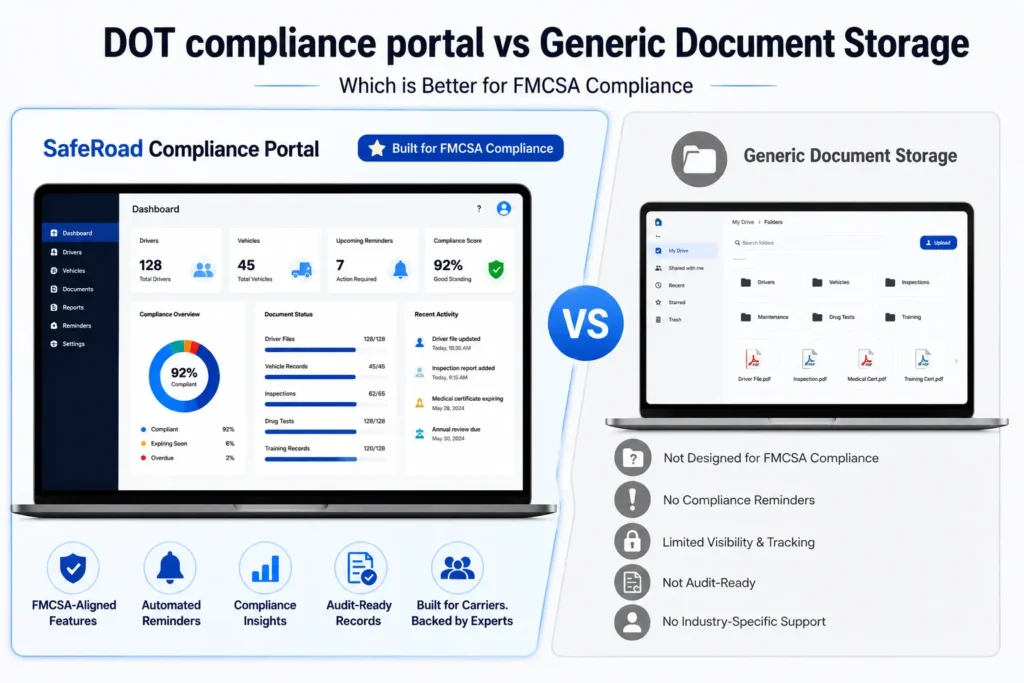
The first step is automated medical card tracking. Carriers must know exactly when every driver’s medical certificate expires, including short-term certifications such as 3-month or 1-year cards. Relying on drivers to self-report expiration dates leads to violations. A fleet-wide digital tracking system ensures timely reminders and prevents lapses.
Next, fleets must maintain complete and accurate Driver Qualification Files. This includes long-form exam documents, variances, specialist clearances, waivers, and medical restrictions. Every document must match the MVR record. A mismatch between MEC and MVR status is one of the fastest ways to get cited during a compliance review.
Carriers must also verify medical examiners through the National Registry of Certified Medical Examiners. Using an examiner who is not listed makes the MEC invalid and automatically disqualifies the driver.
Another critical step is ongoing medical monitoring. Drivers with chronic conditions like diabetes, hypertension, sleep apnea, or heart disease may require additional follow-up documentation. Fleets must track medical restrictions, treatment requirements, and any notes from the examiner that could affect future fitness evaluations.
Finally, implementing continuous MVR monitoring ensures carriers receive immediate alerts for changes in medical status. This prevents drivers from operating while medically disqualified without the carrier’s knowledge.
Key Takeaways
Driver fitness compliance is one of the most important components of FMCSA safety regulations. Violations under Part 391 are not only common but also highly damaging because they directly impact a fleet’s Driver Fitness BASIC score and overall safety rating. Even a single expired medical certificate can result in significant penalties and out-of-service orders.
Carriers must ensure that every driver is medically qualified before operating a commercial motor vehicle. This includes maintaining updated medical certificates, long-form examination reports, and any supporting medical variances or specialist evaluations. FMCSA expects full documentation, not partial or incomplete files.
Medical disqualification violations are among the most serious. Allowing a medically unqualified driver to operate exposes carriers to audit failure, federal penalties, and increased liability in the event of a crash. Many violations occur simply because fleets depend on outdated paper systems or fail to check MVR medical status regularly.
Preventing these violations requires proactive systems, automated reminders, continuous monitoring, and proper DQ file management. Carriers must also verify examiners, maintain accurate records, and monitor any chronic conditions affecting driver safety.
With SafeRoad Compliance, fleets are equipped with automated tools that eliminate guesswork. Our platform ensures fleets stay compliant year-round while avoiding costly violations.
FAQs
If the medical certificate expires, the driver becomes immediately disqualified. The carrier must remove them from service until a new exam is completed. Operating with an expired card results in violations for both the driver and the carrier.
FMCSA expects ongoing monitoring. Many fleets use annual MVR checks, but continuous monitoring is recommended to catch medical suspensions or changes immediately.
Yes. Medical examiners may issue 1-year or 3-month certificates depending on the medical condition. The carrier must track these more closely to avoid unexpected lapses.
Yes, but they must show compliance with CPAP or treatment requirements. Non-compliance or lack of documentation can result in medical disqualification.
Yes. FMCSA offers medical variances for certain conditions, but they require annual renewals and specialist documentation. Missing any component results in immediate disqualification.
The carrier, not the driver. Drivers may provide documents, but the carrier must keep and maintain the file according to 391.51.