Disclosure: Informational only. We are not FMCSA or USDOT. Always verify your status directly through official FMCSA systems.
Why Most Carriers Get IFTA Calculations Wrong
IFTA reporting looks simple on the surface, but this is where many carriers make expensive mistakes. A small error in mileage tracking, fuel reporting, or jurisdiction allocation can result in overpaying taxes, losing eligible fuel tax credits, or triggering audits.
The biggest issue is not complexity, it is inconsistency. Carriers often rely on rough estimates, incomplete fuel receipts, or outdated spreadsheets. This leads to inaccurate filings that affect compliance and cash flow.
Understanding how to calculate IFTA taxes correctly is essential for any interstate carrier operating in the United States. When done properly, IFTA calculations not only ensure compliance but also help you recover fuel tax credits and reduce unnecessary expenses.
This guide breaks down the entire process step by step, including real-world examples, so you can confidently calculate IFTA taxes and maximize your credits.
Why Accurate Tax Calculation Matters
The International Fuel Tax Agreement, commonly known as IFTA, is a cooperative agreement among US states and Canadian provinces that simplifies fuel tax reporting for interstate carriers. Instead of filing separate fuel tax reports for each state, carriers file a single quarterly return through their base jurisdiction.
However, the simplicity of filing does not mean the calculation process is easy. Accurate IFTA tax calculation requires precise tracking of:
- Total miles traveled
- Miles driven in each jurisdiction
- Fuel purchased in each jurisdiction
- Total fuel consumption
The purpose of IFTA is to ensure that each state receives its fair share of fuel tax based on actual road usage. If your calculations are incorrect, you may:
- Overpay taxes unnecessarily
- Miss out on fuel tax credits
- Trigger compliance audits
- Face penalties and interest
Accurate IFTA reporting is not just about compliance, it directly impacts your operational costs and profitability.
Key Components Required to Calculate IFTA Taxes
Before you calculate IFTA taxes, you need to gather accurate data. Missing or incorrect inputs will lead to incorrect results.
The key components include:
- Total miles traveled during the quarter
- Miles driven in each state or jurisdiction
- Total gallons of fuel purchased
- Fuel purchased per jurisdiction
- Applicable fuel tax rates per state
Each of these components plays a critical role in determining your tax liability or credit.
For example:
- Mileage determines how much of each state’s roads you used
- Fuel purchases determine how much tax you already paid
- Tax rates determine what you owe or are owed
Pro Tip:
Always use verified data sources such as ELD reports, fuel card records, and trip logs. Avoid manual estimates, as they are the leading cause of IFTA reporting errors.
Step-by-Step Process to Calculate IFTA Taxes
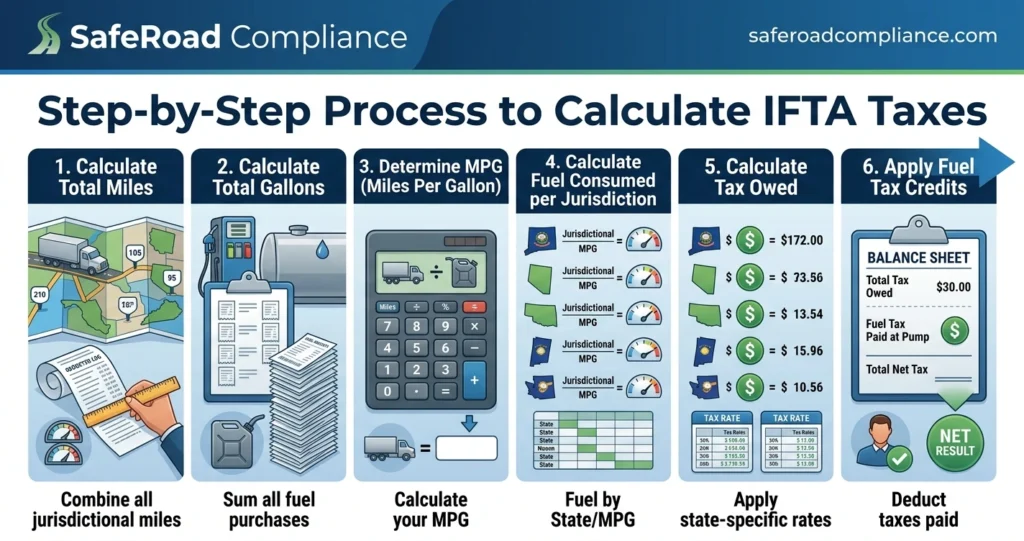
To calculate IFTA taxes accurately, follow this structured process:
Step 1: Calculate Total Miles
Add all miles driven during the reporting period across all jurisdictions.
Step 2: Calculate Total Gallons
Sum all fuel purchased during the quarter.
Step 3: Determine MPG (Miles Per Gallon)
Divide total miles by total gallons.
MPG = Total Miles ÷ Total Gallons
Step 4: Calculate Fuel Consumed per Jurisdiction
Divide miles driven in each state by your MPG.
Step 5: Calculate Tax Owed
Multiply fuel consumed in each state by that state’s tax rate.
Step 6: Apply Fuel Tax Credits
Subtract taxes already paid at the pump from total tax owed.
This step-by-step approach ensures consistency and accuracy in your calculations.
Sample IFTA Tax Calculation (Real-World Example)
Let’s break this down with a simple example:
- Total miles driven: 10,000 miles
- Total fuel purchased: 2,000 gallons
- MPG: 5 miles per gallon
Now, suppose:
- 4,000 miles driven in Texas
- 6,000 miles driven in Oklahoma
Step 1: Calculate Fuel Used
- Texas: 4,000 ÷ 5 = 800 gallons
- Oklahoma: 6,000 ÷ 5 = 1,200 gallons
Step 2: Apply Tax Rates
Assume:
- Texas tax rate: $0.20 per gallon
- Oklahoma tax rate: $0.19 per gallon
Tax owed:
- Texas: 800 × 0.20 = $160
- Oklahoma: 1,200 × 0.19 = $228
Step 3: Apply Fuel Tax Credit
If you purchased:
- 900 gallons in Texas
- 1,100 gallons in Oklahoma
You already paid fuel taxes at purchase.
Final calculation determines whether you owe additional tax or receive a credit.
Understanding Fuel Tax Credits in IFTA Reporting
Fuel tax credit is one of the most overlooked benefits of IFTA reporting. It allows carriers to recover taxes paid in jurisdictions where fuel was purchased but not fully used.
Here’s how it works:
- If you buy more fuel in a state than you use, you earn a credit
- If you use more fuel than you purchased, you owe tax
For example:
- Purchased 1,000 gallons in State A
- Used only 800 gallons in that state
You receive a credit for the excess 200 gallons.
Fuel tax credits help balance your tax liability across jurisdictions and can significantly reduce overall costs when calculated correctly.
Common Mistakes in IFTA Tax Calculations
Even experienced carriers make mistakes when calculating IFTA taxes. These errors can lead to penalties or missed credits.
Common mistakes include:
- Incorrect mileage tracking
- Missing fuel receipts
- Using estimated MPG instead of actual data
- Misallocating miles to wrong jurisdictions
- Ignoring updated tax rates
- Failing to calculate fuel tax credits properly
Insight:
Most errors occur due to poor recordkeeping, not calculation complexity. Carriers that rely on manual logs are at higher risk of inaccuracies.
Implementing structured tracking systems can eliminate most of these issues.
Pro Tips to Improve Accuracy and Maximize Credits
Improving IFTA accuracy is not about working harder, it is about working smarter with the right systems.
Best practices include:
- Use ELD systems for automatic mileage tracking
- Maintain digital fuel receipts
- Reconcile fuel data weekly instead of quarterly
- Monitor MPG trends regularly
- Verify tax rates before filing
Pro Tip:
Review your IFTA data before submission, not after. Early detection of discrepancies prevents costly corrections later.
Accurate tracking ensures you capture every eligible fuel tax credit while staying compliant.
Key Takeaways
- Accurate IFTA calculations depend on reliable mileage and fuel data
- MPG is the foundation of all IFTA tax calculations
- Fuel tax credits can significantly reduce tax liability
- Most errors come from poor recordkeeping, not math
- Using automated tools improves accuracy and compliance
Wrap up
Calculating IFTA taxes does not have to be complicated, but it does require accuracy, consistency, and proper systems. Carriers that take shortcuts often pay the price through penalties, audits, or lost fuel tax credits.
By following a structured calculation process and maintaining accurate records, you can ensure compliance while optimizing your tax position.
If you want expert assistance and eliminate the risk of costly errors, schedule a consultation today!
Apply with our help and ensure your IFTA reporting is accurate, compliant, and optimized for maximum savings.
FAQs
Calculate total miles, determine MPG, allocate fuel usage per state, apply tax rates, and subtract fuel tax credits.
MPG is miles per gallon, calculated by dividing total miles by total fuel consumed.
It is a refund or offset for fuel taxes paid in jurisdictions where fuel was not fully used.
Yes, fuel receipts are required to claim tax credits and prove purchases.
You may face penalties, audits, or overpay taxes.
No, estimates increase audit risk and can lead to violations.
IFTA returns are filed quarterly in the United States.