Disclosure: Informational only. We are not FMCSA or USDOT. Always verify your status directly through official FMCSA systems.
What to Do After an FMCSA Audit Identifies Compliance Violations
Receiving an unfavorable result after a DOT audit can feel overwhelming, but it doesn’t always mean your business is out of options. In many cases, the next step is developing a DOT corrective action plan (CAP) that demonstrates to the Federal Motor Carrier Safety Administration (FMCSA) how your company will address identified compliance deficiencies and prevent them from happening again.
A well-prepared corrective action plan is more than a written response. It is a structured roadmap that explains the root cause of each violation, the corrective measures your company has already implemented, the policies being updated, the employees responsible for maintaining compliance, and the documentation supporting those improvements.
Whether your company receives a Notice of Violation (NOV), a Notice of Claim (NOC), a less-than-satisfactory safety rating, or is asked to provide evidence of corrective actions following a compliance review, responding promptly and thoroughly can significantly influence the outcome.
This guide explains when a corrective action plan is required, what FMCSA typically expects to see, how to build a strong CAP, common mistakes that lead to rejection, and practical steps to strengthen your DOT compliance program after an audit.
What Is a DOT Corrective Action Plan?
A DOT Corrective Action Plan (CAP) is a formal written document prepared by a motor carrier after an FMCSA audit, compliance review, or enforcement action identifies compliance deficiencies. The plan explains the violations found, the corrective actions taken, the long-term improvements implemented to prevent recurrence, and the supporting documentation that demonstrates those improvements.
The purpose of a CAP is not to dispute the audit findings. Instead, it shows FMCSA that your company understands the root causes of the violations, has taken meaningful corrective action, and has established stronger safety management controls to maintain ongoing compliance.
An effective CAP should clearly answer five questions:
- What compliance issue was identified?
- Why did the violation occur?
- What corrective actions have already been completed?
- What long-term changes have been implemented to prevent recurrence?
- How will compliance be monitored going forward?
Think of your corrective action plan as evidence that your company has improved its compliance program, not simply corrected individual mistakes. FMCSA reviewers want to see sustainable processes that reduce the likelihood of future violations.
Why Corrective Action Plans Matter
FMCSA’s primary objective is improving highway safety, not simply issuing penalties.
A well-documented corrective action plan helps demonstrate that your company has:
- Identified compliance weaknesses
- Addressed root causes
- Updated policies and procedures
- Improved employee training
- Strengthened recordkeeping practices
- Implemented systems to reduce future violations
An effective CAP shows regulators that compliance improvements are sustainable rather than temporary.
When Does FMCSA Require a Corrective Action Plan?
Not every roadside inspection or minor violation requires a formal corrective action plan.
However, FMCSA may expect a CAP following more significant enforcement actions or compliance reviews where systemic deficiencies are identified.
Situations that commonly lead to corrective action requests include:
- Compliance reviews identifying multiple violations
- Unsatisfactory or Conditional safety ratings
- Serious recordkeeping deficiencies
- Driver Qualification File (DQF) violations
- Hours of Service (HOS) compliance failures
- Drug and Alcohol Program deficiencies
- Vehicle maintenance record violations
- Repeated violations showing ineffective safety management controls
The exact response expected depends on the type of enforcement action and the severity of the findings.
Understanding FMCSA Audit Outcomes
Not every FMCSA audit leads to the same outcome. Depending on the severity of the violations and the effectiveness of your safety management controls, FMCSA may issue a Warning Letter, Notice of Violation (NOV), Notice of Claim (NOC), or a safety rating such as Conditional or Unsatisfactory. Understanding these outcomes helps determine whether a DOT corrective action plan is expected and how quickly your company should respond.
Although every enforcement action should be taken seriously, a Notice of Violation, Conditional Safety Rating, or Unsatisfactory Safety Rating generally requires a more detailed remediation effort. Always follow the instructions in your FMCSA correspondence, as submission requirements and deadlines may vary depending on the enforcement action.
Why Acting Quickly Matters
Many carriers make the mistake of treating a corrective action request as ordinary paperwork.
In reality, delayed or incomplete responses can prolong enforcement actions, increase regulatory scrutiny, and delay improvements to your safety management program.
The most successful carriers begin corrective actions immediately by:
- Reviewing every audit finding carefully
- Assigning responsibility for each deficiency
- Gathering supporting documentation
- Updating policies and procedures
- Training affected employees
- Monitoring implementation progress
A proactive response demonstrates a stronger commitment to compliance than waiting until submission deadlines approach.
If you’re preparing for future compliance reviews or strengthening your audit readiness, these resources provide additional guidance:
Together with a well-developed corrective action plan, these resources can help build a stronger long-term compliance program.
What Triggers a DOT Corrective Action Plan?
A DOT corrective action plan is generally requested when FMCSA determines that a carrier’s compliance deficiencies are more than isolated mistakes. Instead, the agency is looking for evidence that the carrier’s safety management controls need improvement.
A CAP is designed to answer one key question:
The more serious or repetitive the deficiencies, the more detailed your corrective action plan should be.
Common Situations That May Trigger a CAP
FMCSA may request or expect a corrective action plan following:
- An on-site or off-site compliance review
- A New Entrant Safety Audit with identified deficiencies
- A Conditional or Unsatisfactory Safety Rating
- A Notice of Violation (NOV)
- Repeated roadside inspection violations
- High CSA BASIC performance indicating systemic issues
- Significant Hours of Service (HOS) violations
- Driver Qualification File (DQF) deficiencies
- Drug and Alcohol Clearinghouse non-compliance
- Vehicle maintenance and inspection record deficiencies
- Accident investigation findings that reveal poor safety management controls
While not every enforcement action requires a formal CAP, carriers that proactively document corrective actions often demonstrate a stronger commitment to compliance.
Common FMCSA Violations That Require Corrective Action
Some compliance issues are isolated administrative errors, while others indicate weaknesses throughout a company’s compliance program.
The following violations commonly require comprehensive remediation.
The goal is not simply correcting one missing document. FMCSA wants evidence that your company has improved the entire compliance process.
Before You Start Writing Your CAP
Many corrective action plans fail because carriers begin writing before fully understanding the audit findings.
Before drafting your response:
Step 1: Read Every Audit Finding Carefully
Review:
- Every cited regulation
- Inspector comments
- Supporting evidence
- Violation severity
- Safety management deficiencies
Avoid responding with generic statements such as:
“We will make sure this doesn’t happen again.”
Instead, identify exactly what failed within your compliance program.
Step 2: Determine the Root Cause
FMCSA expects carriers to explain why violations occurred.
Examples include:
- Lack of written procedures
- Inadequate driver training
- Poor document management
- No compliance calendar
- Failure to monitor expiration dates
- Insufficient management oversight
- Weak dispatch planning
- Inconsistent internal audits
Root cause analysis demonstrates that your company understands the underlying problem, not just its symptoms.
Step 3: Implement Improvements Before Submitting
Whenever possible, complete corrective actions before submitting your CAP.
Examples include:
- Updating company policies
- Completing driver retraining
- Correcting missing records
- Purchasing compliant ELD equipment
- Assigning compliance responsibilities
- Implementing recurring audits
Supporting documentation carries much more weight when improvements have already been completed.
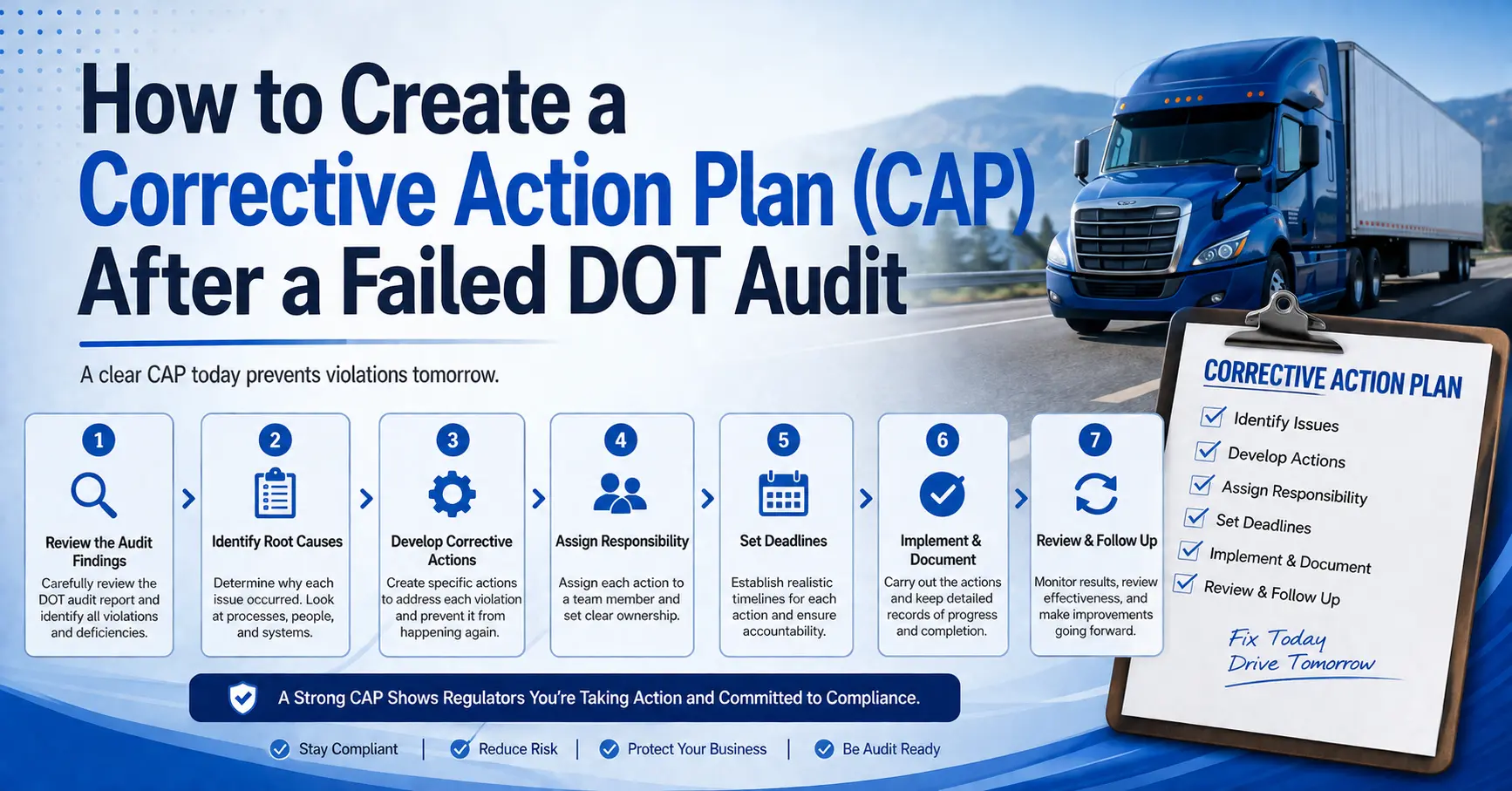
How to Create a DOT Corrective Action Plan (Step by Step)
An effective CAP follows a logical structure that addresses each audit finding individually.
Rather than submitting one general explanation, respond to every violation with specific corrective actions and supporting evidence.
Step 1: List Every Audit Finding
Start by identifying every violation exactly as it appears in the FMCSA report.
Include:
- Regulation number
- Description of the finding
- Date of the audit
- Department affected
Never combine multiple findings into one response.
Each issue should be addressed separately.
Step 2: Explain the Root Cause
For every violation, explain why it occurred.
Example:
Audit Finding
Driver Qualification Files contained expired medical examiner certificates.
Root Cause
The company had no centralized system for tracking document expiration dates, resulting in missed renewal reminders.
Be honest.
FMCSA generally values accurate explanations over attempts to minimize responsibility.
Step 3: Describe Immediate Corrective Actions
Next, explain what has already been completed.
Examples include:
- Renewed expired medical certificates
- Updated Driver Qualification Files
- Corrected ELD records
- Repaired vehicle maintenance deficiencies
- Completed supervisor training
- Conducted internal compliance reviews
Focus on completed actions, not future intentions.
Step 4: Explain Long-Term Preventive Measures
This is often the most important section.
FMCSA wants assurance that similar violations will not recur.
Examples include:
- Monthly compliance audits
- Automated document expiration tracking
- Annual policy reviews
- Quarterly driver safety meetings
- Written compliance procedures
- Scheduled management reviews
- Internal recordkeeping audits
Preventive controls demonstrate ongoing compliance rather than one-time corrections.
Step 5: Assign Responsibility
Every corrective action should have an owner.
Example:
Clear accountability shows FMCSA that compliance responsibilities are defined within your organization.
Step 6: Establish Completion Dates
Include realistic implementation timelines.
Example:
Avoid unrealistic promises.
Only commit to deadlines your organization can consistently meet.
Recommended Structure for a DOT Corrective Action Plan
Most successful corrective action plans follow a consistent format.
1. Executive Summary
Briefly acknowledge the audit findings and your commitment to correcting deficiencies.
2. Audit Findings
List every cited violation separately.
3. Root Cause Analysis
Explain why each issue occurred.
4. Immediate Corrective Actions
Describe actions already completed.
5. Preventive Measures
Explain long-term improvements.
6. Responsible Personnel
Identify who will maintain compliance moving forward.
7. Supporting Documentation
Reference all attached evidence.
8. Follow-Up Monitoring
Explain how compliance will be reviewed going forward.
What Evidence Does FMCSA Expect?
A corrective action plan is only as strong as the documentation supporting it.
Whenever possible, attach evidence showing that corrective actions have already been implemented.
Common supporting documents include:
- Updated Driver Qualification Files
- Driver training attendance records
- Written company safety policies
- ELD audit reports
- Internal compliance audit results
- Vehicle maintenance schedules
- Preventive maintenance records
- Drug and Alcohol Program documentation
- Accident register updates
- Compliance calendars
- Organizational charts showing assigned compliance responsibilities
- Copies of revised company procedures
The stronger your documentation, the easier it is for FMCSA to verify that meaningful corrective action has occurred.
Corrective Action Plan Framework Example:
The following framework illustrates how one audit finding can be addressed.
This structured approach makes it easier for FMCSA reviewers to understand the issue, verify the corrective actions, and evaluate the effectiveness of your compliance improvements.
For guidance on creating measurable and effective corrective actions, review the U.S. Department of Transportation’s How to Write SMART Corrective Action Plans resource.
DOT Corrective Action Plan Submission Timeline
Submitting a corrective action plan isn’t just about writing a thorough response, it also requires responding within the timeframe specified by FMCSA. Missing deadlines or submitting incomplete documentation can delay resolution and may lead to additional enforcement actions.
Always review the correspondence you receive from FMCSA carefully, as submission instructions and due dates vary depending on the type of enforcement action.
Generally, carriers should:
- Review the audit findings immediately.
- Begin corrective actions as soon as deficiencies are identified.
- Gather supporting documentation.
- Prepare the CAP.
- Submit the response within the timeframe outlined by FMCSA.
- Retain copies of everything submitted for future reference.
The sooner corrective actions begin, the easier it becomes to demonstrate a genuine commitment to compliance.
Sample DOT Corrective Action Timeline
Remember that implementing improvements after submission is just as important as describing them in your CAP.
What Happens After You Submit Your CAP?
After receiving your corrective action plan, FMCSA reviews both your written response and the supporting documentation.
Reviewers generally look for evidence that your company has:
- Corrected every cited violation
- Addressed the root cause of each deficiency
- Implemented sustainable compliance procedures
- Assigned accountability within the organization
- Established ongoing monitoring processes
- Provided sufficient documentation to support every corrective action
Depending on the findings, FMCSA may:
- Accept the corrective action plan.
- Request additional information or clarification.
- Conduct a follow-up review or investigation.
- Continue enforcement proceedings if deficiencies remain unresolved.
Submitting a CAP does not automatically resolve every enforcement matter. The quality of your response and supporting evidence plays a significant role in the review process.
Common Reasons FMCSA Rejects Corrective Action Plans
Many corrective action plans are delayed or rejected because they describe good intentions rather than documented improvements.
Below are some of the most common issues.
A successful CAP focuses on measurable actions rather than broad commitments.
Mistakes That Delay Audit Recovery
Even carriers with good intentions can unintentionally slow the remediation process.
Avoid these common mistakes:
Waiting Until the Deadline
Starting your CAP a few days before it’s due often results in incomplete documentation and rushed responses.
Blaming Drivers Without Addressing Management Controls
FMCSA evaluates the effectiveness of a carrier’s safety management controls, not just individual driver performance.
If multiple drivers made similar mistakes, regulators may conclude that company policies, training, or oversight need improvement.
Submitting Policies That Aren’t Being Followed
Written procedures are valuable only when employees understand and consistently follow them.
Training records, audit reports, and monitoring activities help demonstrate implementation.
Ignoring Similar Compliance Risks
Corrective actions should address the broader compliance process, not just one isolated violation.
For example, if one expired medical certificate was discovered, consider improving your document tracking system for all driver qualification records.
Sample DOT Audit Remediation Workflow
A structured workflow helps carriers organize corrective actions from the day the audit findings are received until compliance improvements are fully implemented.
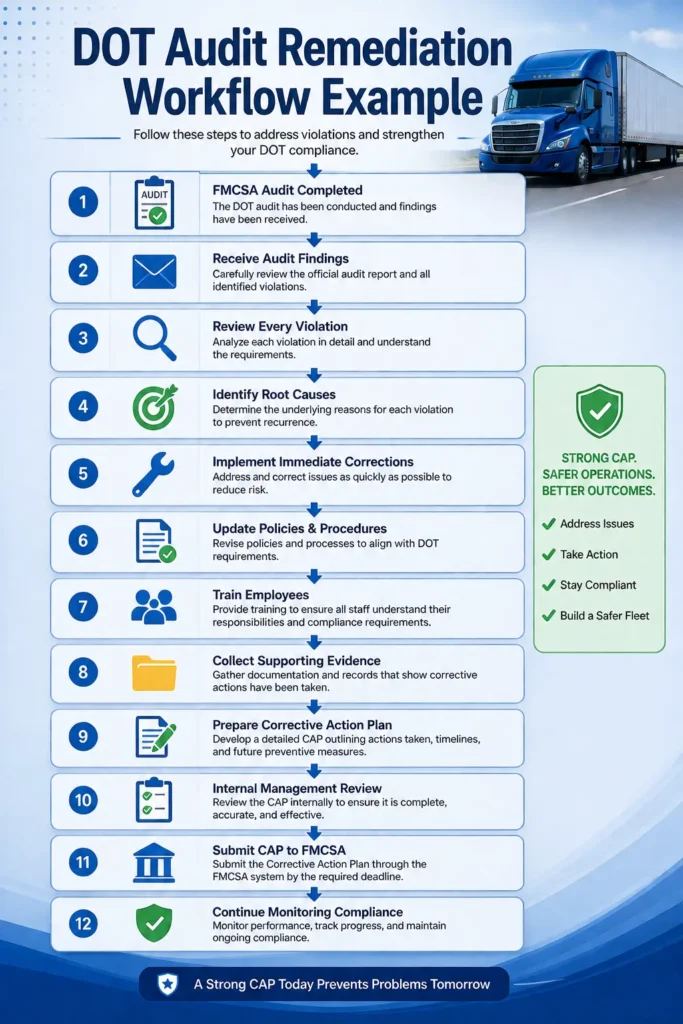
This workflow encourages continuous improvement rather than treating compliance as a one-time project.
Real-World Example
Scenario
A regional trucking company undergoes an FMCSA compliance review.
Inspectors identify:
- Incomplete Driver Qualification Files
- Multiple Hours of Service violations
- Missing annual vehicle inspection reports
- Inconsistent maintenance documentation
Rather than responding with a short explanation, the carrier develops a structured corrective action plan.
Corrective Actions
The company:
- Updates every Driver Qualification File.
- Conducts HOS refresher training for all drivers.
- Introduces monthly ELD log reviews.
- Implements a preventive maintenance schedule.
- Creates a compliance calendar for document expiration dates.
- Assigns a Safety Manager to oversee ongoing compliance.
Supporting Evidence
The CAP includes:
- Updated DQF records
- Training attendance logs
- Revised safety policies
- Maintenance schedules
- Internal audit checklists
- Compliance calendar screenshots
Instead of simply stating that improvements will be made, the carrier demonstrates that the improvements have already begun.
Decision Tree: Do You Need a Corrective Action Plan?
Use this simplified framework to determine your next steps after an FMCSA audit.
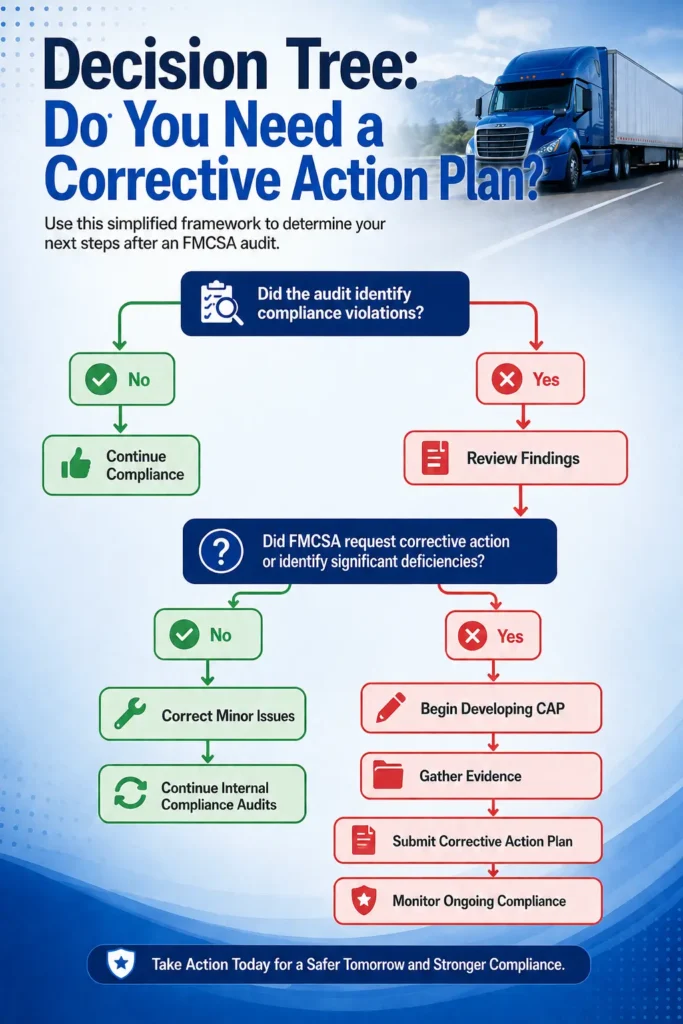
This decision tree is not a substitute for reviewing FMCSA correspondence, but it provides a practical overview of the typical remediation process.
Strengthening Your Compliance Program After a Failed Audit
A corrective action plan should be viewed as the beginning of stronger compliance, not the end of an audit.
Many successful carriers use audit findings to improve their overall safety management system by:
- Conducting quarterly internal compliance audits
- Reviewing Driver Qualification Files regularly
- Monitoring ELD logs every day
- Maintaining preventive maintenance schedules
- Tracking document expiration dates
- Updating written safety policies annually
- Providing recurring driver and supervisor training
- Reviewing CSA performance trends
These ongoing practices reduce the likelihood of repeated violations and help carriers remain prepared for future compliance reviews.
Continue Building Your Audit Readiness
If you’re strengthening your compliance program after an audit, these related resources can help:
- How to Prepare for a DOT Audit – Learn how to reduce compliance risks before your next FMCSA review.
- DOT Audit Preparation Document Checklist – Understand which records inspectors commonly request and how to organize them efficiently.
These resources complement a corrective action plan by helping carriers establish stronger compliance systems before the next audit.
Best Practices for Creating an Effective DOT Corrective Action Plan
A successful corrective action plan does more than respond to audit findings, it demonstrates that your company has established a stronger compliance program capable of preventing future violations.
The following best practices can improve the quality of your CAP and increase the likelihood of FMCSA accepting your response.
1. Address Every Audit Finding Individually
Avoid combining multiple violations into one explanation.
Instead:
- Reference each cited regulation separately.
- Explain the root cause.
- Describe the corrective action taken.
- Include supporting documentation.
- Explain how future compliance will be maintained.
A detailed response is easier for FMCSA reviewers to evaluate.
2. Focus on Root Causes, Not Symptoms
Simply replacing missing paperwork rarely resolves the underlying compliance issue.
Instead, identify why the violation occurred.
Examples include:
- No written compliance procedures
- Inadequate management oversight
- Poor driver onboarding
- Lack of recurring internal audits
- Inconsistent recordkeeping practices
Correcting the process, not just the paperwork, creates long-term compliance improvements.
3. Support Every Claim With Documentation
Your CAP should be evidence-based.
Examples of supporting documentation include:
- Updated Driver Qualification Files
- Driver training records
- Revised safety policies
- Internal audit reports
- ELD log review reports
- Vehicle maintenance records
- Drug and Alcohol Program documentation
- Compliance calendars
- Management review meeting notes
Documentation demonstrates that corrective actions have already been implemented rather than simply planned.
4. Assign Clear Accountability
FMCSA expects carriers to identify who is responsible for maintaining compliance.
Common responsibilities include:
Clear ownership reduces the risk of recurring deficiencies.
5. Monitor Compliance Continuously
Corrective action should become part of your ongoing safety management system.
Successful carriers often implement:
- Monthly compliance reviews
- Quarterly internal audits
- Annual policy updates
- Driver refresher training
- Management compliance meetings
- Document expiration tracking
- CSA performance monitoring
Continuous improvement is one of the strongest indicators of an effective compliance program.
DOT Corrective Action Plan Compliance Checklist
Use this checklist before submitting your CAP.
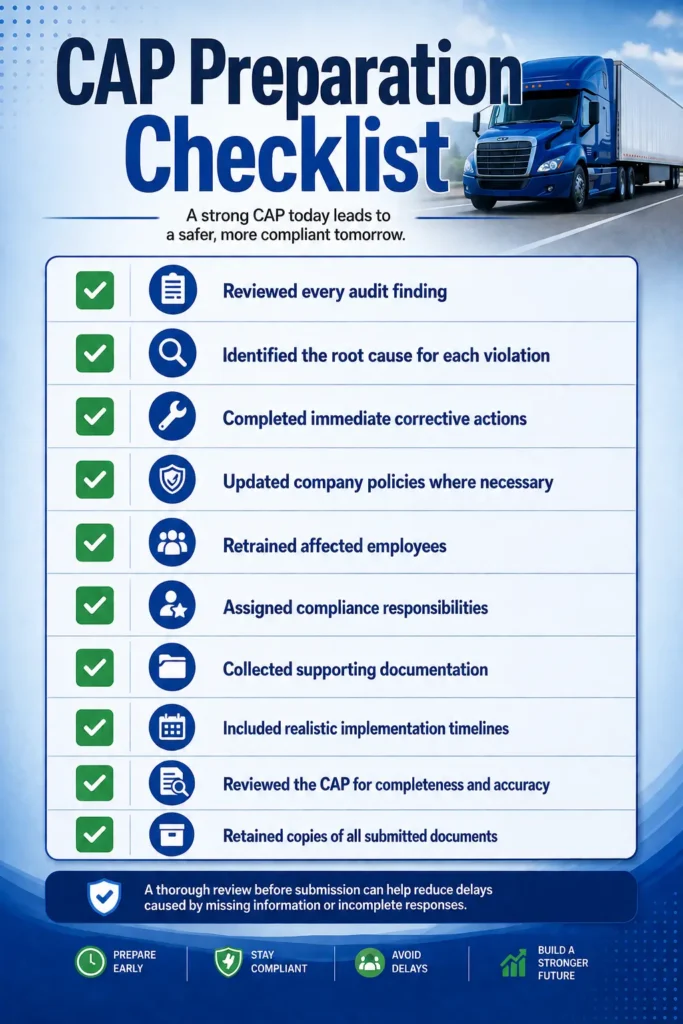
A thorough review before submission can help reduce delays caused by missing information or incomplete responses.
Expert Tips
Don’t Copy Generic CAP Templates
Every FMCSA audit is different. A generic template rarely addresses the specific violations identified during your compliance review. Tailor your corrective action plan to your company’s findings, operations, and safety management practices.
Show Progress, Not Perfection
FMCSA understands that meaningful compliance improvements take time.
What reviewers typically want to see is evidence that:
- Problems have been identified.
- Corrective actions have begun.
- Responsibilities are assigned.
- Monitoring systems are in place.
Demonstrating measurable progress is more valuable than making unrealistic promises.
Strengthen Your Internal Controls
Many violations stem from weak management systems rather than isolated employee mistakes.
Consider implementing:
- Compliance calendars
- Automated document reminders
- Standard operating procedures
- Internal audit schedules
- Management review meetings
These controls help prevent future violations before they occur.
Prepare for Future Audits, Not Just This One
A corrective action plan shouldn’t end once it’s submitted.
Continue:
- Reviewing compliance records regularly.
- Updating safety policies.
- Monitoring CSA performance.
- Training drivers and supervisors.
- Conducting periodic internal audits.
This proactive approach makes future FMCSA audits much easier to manage.
Key Takeaways
- A DOT Corrective Action Plan (CAP) explains how a carrier has corrected audit findings and implemented long-term compliance improvements.
- FMCSA expects corrective actions to address the root cause of each violation, not just the immediate deficiency.
- Strong CAPs include detailed explanations, supporting documentation, assigned responsibilities, and ongoing monitoring procedures.
- Common reasons CAPs are rejected include generic responses, insufficient evidence, incomplete corrective actions, and failure to address every audit finding.
- Implementing stronger safety management controls after an audit helps reduce future compliance risks and supports long-term operational success.
- Internal audits, driver training, document management, and proactive oversight are essential components of an effective remediation strategy.
Frequently Asked Questions
A DOT Corrective Action Plan (CAP) is a written response that explains how a motor carrier has corrected violations identified during an FMCSA audit or compliance review and what steps have been taken to prevent similar issues in the future.
FMCSA may request or expect a corrective action plan following significant compliance reviews, Notices of Violation (NOVs), Conditional or Unsatisfactory safety ratings, or other enforcement actions involving systemic compliance deficiencies.
A comprehensive CAP should include:
• Audit findings
• Root cause analysis
• Immediate corrective actions
• Long-term preventive measures
• Assigned responsibilities
• Supporting documentation
• Implementation timelines
• Ongoing monitoring procedures
Supporting documentation may include:
• Updated Driver Qualification Files
• Driver training records
• Revised safety policies
• ELD reports
• Maintenance records
• Internal audit results
• Drug and Alcohol Program documentation
• Compliance tracking records
Common reasons include:
• Incomplete responses
• Generic explanations
• Missing documentation
• Failure to identify root causes
• No long-term preventive measures
• Failure to address every cited violation
No. A corrective action plan demonstrates how violations have been addressed, but it does not automatically remove audit findings or enforcement actions. FMCSA evaluates the adequacy of the corrective actions before determining the next steps.
Carriers should:
• Respond promptly
• Address every finding individually
• Provide clear supporting evidence
• Assign accountability
• Implement sustainable compliance procedures
• Continue monitoring compliance after submission
The best approach is to treat the CAP as part of a continuous compliance program by conducting regular internal audits, reviewing safety records, maintaining accurate documentation, and training employees on FMCSA requirements.
Conclusion
A failed DOT audit doesn’t have to define the future of your business. In many cases, it serves as an opportunity to strengthen your safety management controls, improve operational procedures, and build a more resilient compliance program.
An effective DOT corrective action plan goes beyond correcting individual violations. It demonstrates that your company understands the underlying causes of compliance issues, has implemented meaningful improvements, and is committed to maintaining FMCSA standards over the long term.
Whether you’re responding to a Notice of Violation, addressing a Conditional safety rating, or preparing documentation after a compliance review, a well-structured CAP supported by clear evidence can help move the remediation process forward with confidence.
If you need guidance developing a corrective action plan, organizing supporting documentation, or responding to an FMCSA compliance review, SafeRoad Compliance provides professional DOT audit assistance to help carriers navigate the audit remediation process and strengthen their compliance programs.
Additional Resource:
For additional guidance, review the FMCSA’s Corrective Action Plan (CAP) Submission Guidance, which outlines what reviewers expect, how to organize your response, and the types of supporting documentation that strengthen a CAP submission.