Disclosure: Informational only. We are not FMCSA or USDOT. Always verify your status directly through official FMCSA systems.
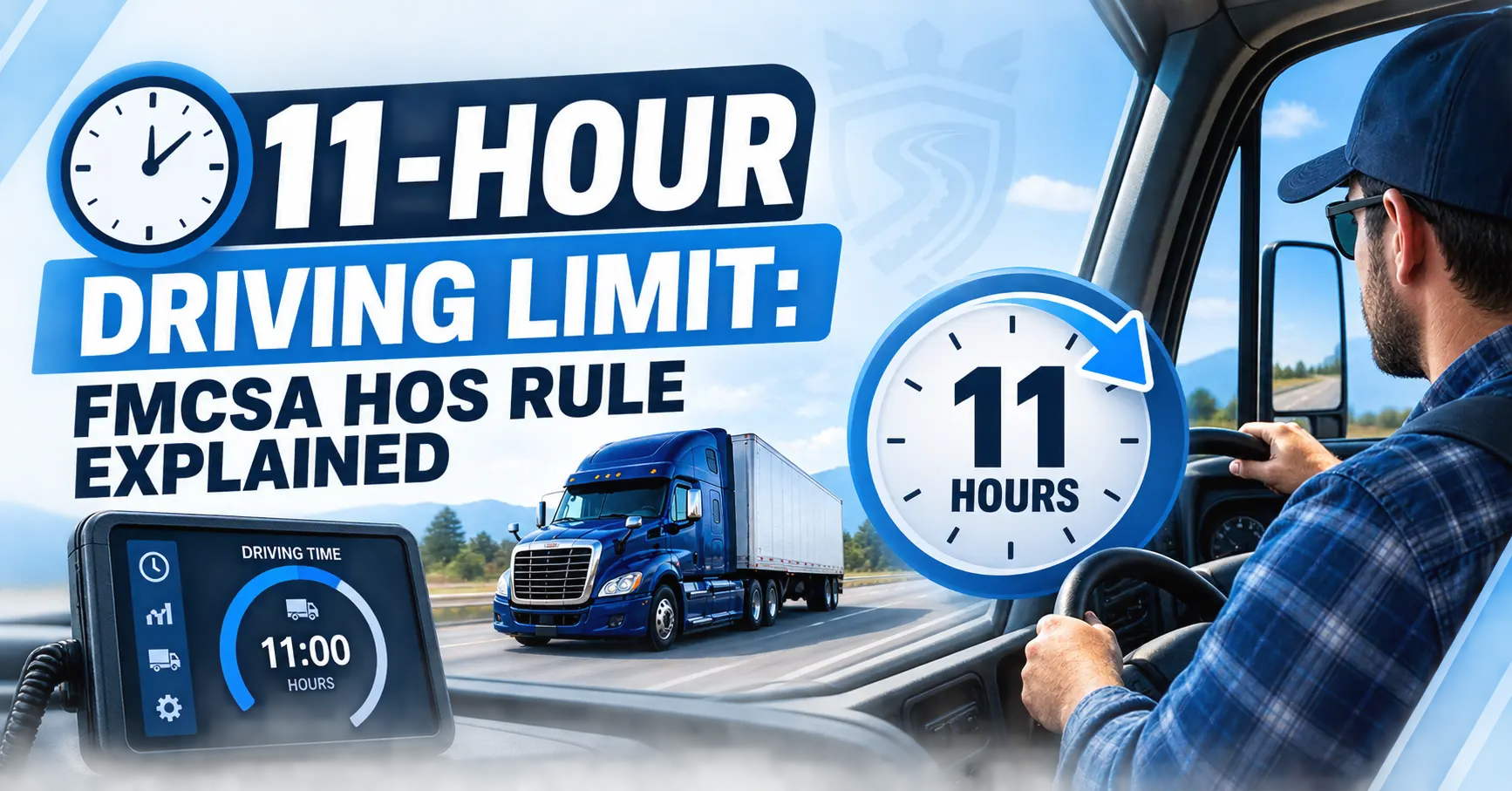
The 11-hour driving limit is one of the most important Hours of Service (HOS) rules for property-carrying commercial motor vehicle drivers.
Under 49 CFR §395.3(a)(3), a driver generally may not drive more than 11 hours following 10 consecutive hours off duty. The rule limits actual driving time; it does not mean a driver has 11 hours of total on-duty time.
Understanding this distinction is critical because a driver can still have available on-duty time under the 14-hour rule while having no remaining driving time under the 11-hour limit.
Quick Answer: A property-carrying driver generally may drive a maximum of 11 hours after obtaining at least 10 consecutive hours off duty. Once the driver reaches 11 hours of driving, the driver must stop driving until the applicable HOS requirements allow additional driving.
This guide explains how the 11-hour rule works, how it interacts with the 14-hour window, common scenarios that cause violations, and practical ways carriers can prevent them.
Important: The 11-hour rule is only one part of the FMCSA HOS framework. For the broader requirements, see the HOS & ELD Compliance Guide.
What Is the 11-Hour Driving Limit?
The FMCSA 11-hour driving limit restricts how long a property-carrying CMV driver can actually drive after receiving the required off-duty period.
The basic rule is:
10 consecutive hours off duty → up to 11 hours of driving
The 11-hour limit is based on driving time, not simply the amount of time a driver has been awake or on duty.
For example, a driver could spend several hours loading, unloading, fueling, inspecting equipment, or waiting at a facility without using driving hours. Those activities can affect the driver’s available on-duty time but do not automatically count as driving time.
The Basic HOS Relationship
Think of the rule this way:
| HOS Limit | What It Controls |
|---|---|
| 11-hour limit | Maximum driving time |
| 14-hour window | Maximum window in which driving may occur |
| 30-minute break | Required break after 8 cumulative hours of driving |
| 60/70-hour limit | Cumulative on-duty limit |
These limits operate together.
A driver must comply with all applicable limits rather than simply staying below 11 hours of driving.
How the 11-Hour Rule Works
A driver generally needs 10 consecutive hours off duty before beginning a new driving period under the standard property-carrying HOS rules.
After that rest period, the driver can accumulate up to 11 hours of driving.
For example:
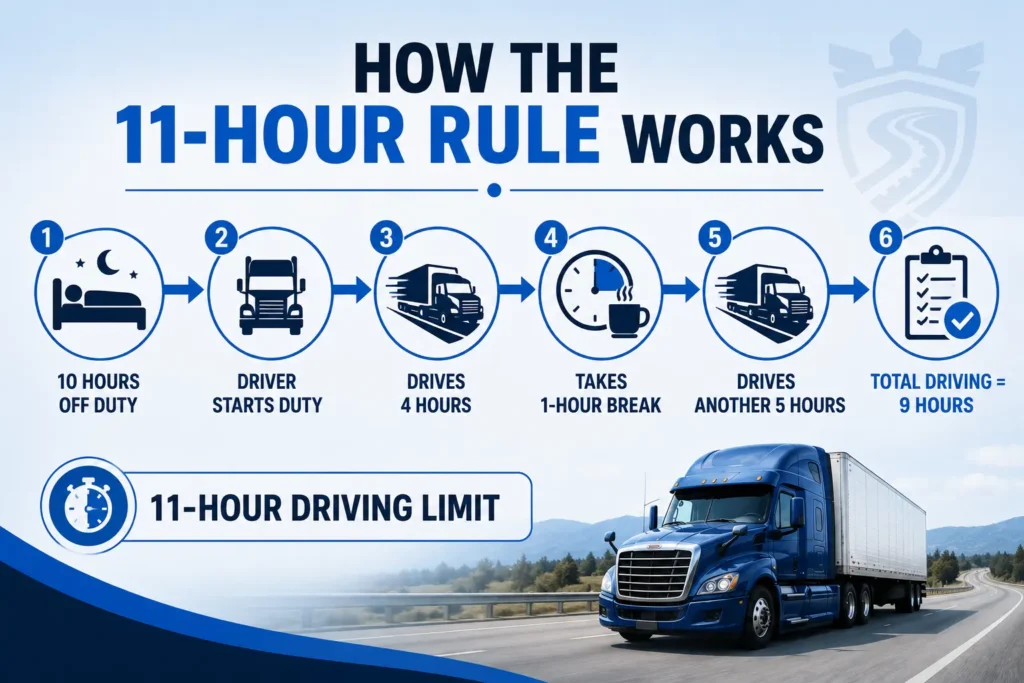
The driver still has 2 hours of available driving time under the 11-hour limit, assuming no other applicable HOS restriction prevents driving.
However, the driver must also remain within the applicable 14-hour window.
This is where many HOS mistakes occur.
11-Hour Driving Limit vs. 14-Hour Rule
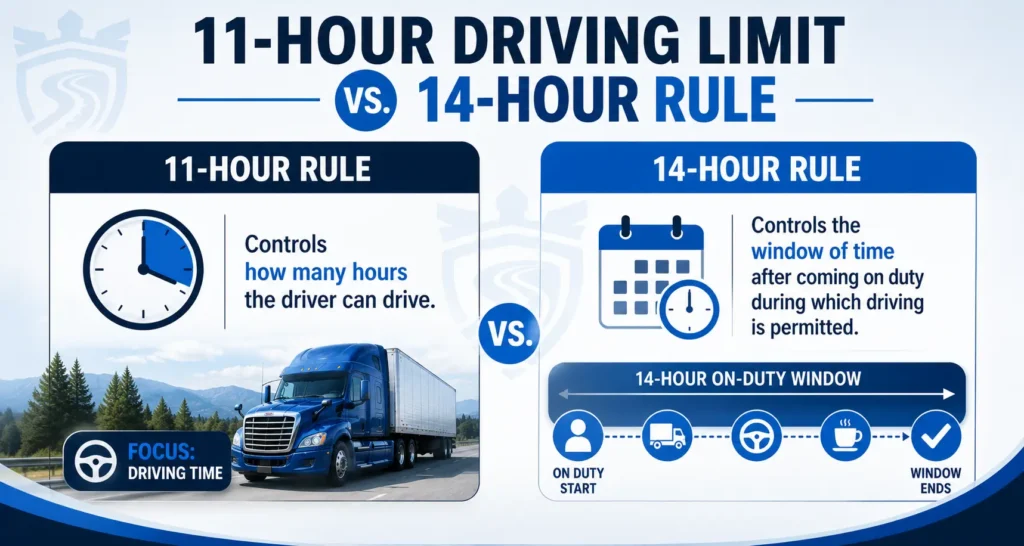
The 11-hour and 14-hour rules are related, but they are not interchangeable.
11-Hour Rule
Controls how many hours the driver can drive.
14-Hour Rule
Controls the window of time after coming on duty during which driving is permitted.
Consider this example:
A driver begins work at 6:00 a.m. after obtaining the required 10 consecutive hours off duty.
The driver’s 14-hour window generally ends at 8:00 p.m.
Suppose the driver has only accumulated 9 hours of driving by 8:00 p.m.
The driver cannot simply drive another 2 hours because the 14-hour window has expired.
The driver must comply with both limits.
| Scenario | Driving Available? | Why |
|---|---|---|
| 10 hours driving, 13-hour window | Yes, assuming other rules are satisfied | Both limits remain available |
| 11 hours driving, 12-hour window | No | 11-hour driving limit reached |
| 9 hours driving, 14-hour window expired | No | 14-hour window reached |
| 7 hours driving, 10-hour window remaining | Potentially | Both limits may still be available |
This distinction is essential for dispatchers and drivers.
Examples of the 11-Hour Rule
Example 1: Driver Reaches 11 Hours
A driver begins after 10 consecutive hours off duty and accumulates 11 hours of driving during the applicable period.
The driver has reached the maximum driving limit.
Even if the driver’s 14-hour window has not yet expired, the driver cannot continue driving under the standard rule.
Example 2: Driver Has Only 9 Hours of Driving
A driver has driven 9 hours but has reached the end of the applicable 14-hour window.
The driver cannot use the remaining 2 hours of driving time simply because the 11-hour limit has not been reached.
The 14-hour limitation controls.
Example 3: Loading Delay
A driver starts at 7:00 a.m. and spends several hours waiting at a shipper.
The driver may still have substantial driving time remaining, but the waiting period can consume the driver’s 14-hour window.
This is why detention and loading delays should be considered when planning routes.
When Does the Driving Clock Reset?
The standard property-carrying HOS rules require the driver to obtain the applicable 10 consecutive hours off duty before starting a new driving period.
The important point is that the driver cannot simply stop for a short break and assume the 11-hour clock has been restored.
A brief off-duty period does not automatically provide another 11 hours of driving.
The driver must satisfy the applicable HOS requirements before beginning a new driving period.
What About Sleeper Berth Splits?
The sleeper berth provision can allow qualifying drivers to split required off-duty periods into two qualifying periods under the applicable HOS rules.
However, drivers must correctly understand how the sleeper berth exception interacts with their driving and on-duty calculations.
It should not be treated as a simple way to “reset” the 11-hour clock whenever a driver needs additional hours.
What Counts as Driving Time?
For purposes of the 11-hour limit, the critical issue is whether the driver is actually operating the CMV.
Examples of driving-related time can include:
- Operating the commercial motor vehicle on a public road
- Moving the vehicle during normal operations
- Driving between facilities
- Operating the vehicle while making deliveries
Other work activities generally fall into different duty-status categories.
Examples include:
- Loading or unloading
- Fueling
- Vehicle inspections
- Completing paperwork
- Waiting at a shipper
- Performing other on-duty non-driving work
These activities may not consume the driver’s 11 hours of driving, but they can affect the driver’s overall HOS availability, particularly the 14-hour window and cumulative limits.
Common 11-Hour HOS Violations
Drivers and carriers commonly encounter problems when schedules are built around the assumption that all available hours can be used.
Exceeding 11 Hours of Driving
The most direct violation occurs when a driver continues operating after reaching the applicable 11-hour driving limit.
Confusing Driving Time With On-Duty Time
A driver may believe that 11 hours of on-duty time is the maximum.
That is incorrect.
The 11-hour rule specifically addresses driving time, while other HOS rules address the broader on-duty period.
Ignoring the 14-Hour Window
Having unused driving hours does not mean a driver can continue after the applicable 14-hour window expires.
Poor Dispatch Planning
Tight delivery schedules can encourage drivers to continue driving even when their available HOS time is nearly exhausted.
Incorrect ELD Entries
Incorrect duty-status changes or unaddressed unidentified driving time can create discrepancies between actual operations and recorded HOS data.
Misunderstanding Sleeper Berth Rules
Incorrectly applying the sleeper berth provision can lead to incorrect calculations of available driving and on-duty time.
What Happens When a Driver Exceeds 11 Hours?
An 11-hour driving violation can be identified through an ELD record during a roadside inspection or compliance review.
Inspectors may review:
- ELD records
- Driver duty-status history
- Supporting documents
- Shipping records
- Fuel records
- Other available operational evidence
The exact enforcement consequences depend on the circumstances and applicable enforcement policies.
For carriers, repeated HOS violations can also affect their broader safety profile and compliance standing.
Rather than waiting for an inspection to identify a problem, carriers should review HOS records proactively.
How ELDs Help Monitor the 11-Hour Limit
Electronic Logging Devices have made it easier for carriers and enforcement personnel to monitor driving time.
An ELD can automatically record driving activity and help identify when a driver is approaching available HOS limits.
However, an ELD is not a substitute for compliance management.
Drivers and carriers still need to:
- Review logs
- Correct legitimate errors properly
- Address unidentified driving
- Monitor available hours
- Understand exemptions
- Follow malfunction procedures
- Train drivers on HOS requirements
A driver who misunderstands the HOS rules can still create a violation even when using a compliant ELD.
Common Mistakes
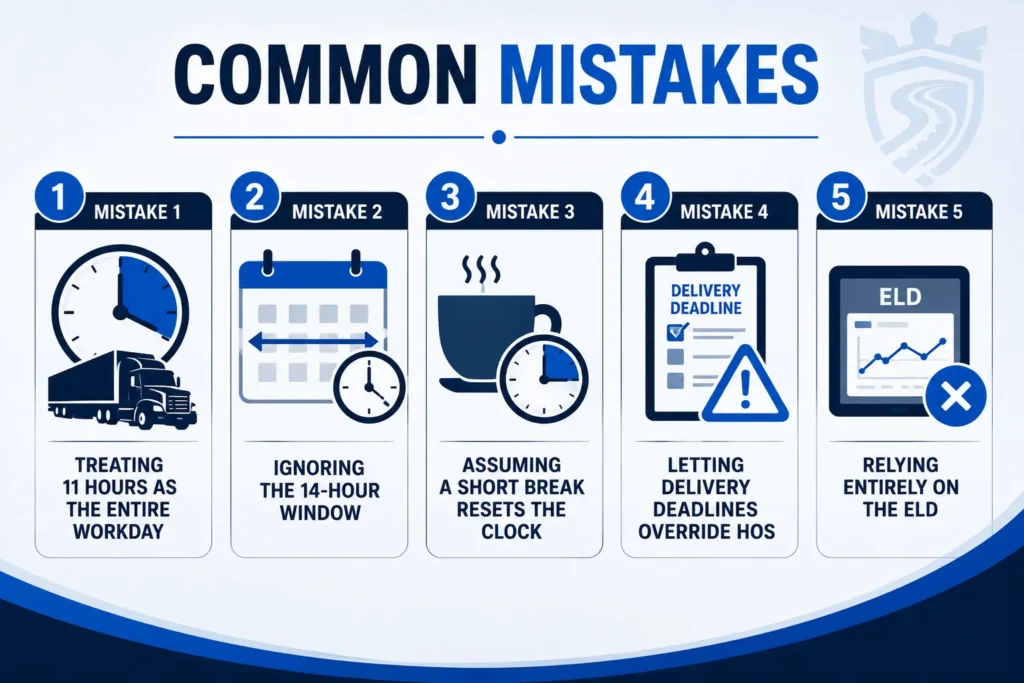
Mistake 1: Treating 11 Hours as the Entire Workday
The 11-hour limit applies to driving. It does not mean a driver has 11 total hours available for all work.
Mistake 2: Ignoring the 14-Hour Window
The driver must comply with both the driving limit and the applicable on-duty window.
Mistake 3: Assuming a Short Break Resets the Clock
A brief break does not automatically provide another 11 hours of driving.
Mistake 4: Letting Delivery Deadlines Override HOS
A late load or urgent delivery does not eliminate applicable HOS requirements.
Mistake 5: Relying Entirely on the ELD
Technology can help identify available hours, but drivers and management still need to understand the rules.
Best Practices for Staying Within the 11-Hour Limit
Carriers can reduce violations by building HOS compliance into daily operations.
Before Dispatch
- Review the driver’s available driving hours.
- Check the applicable 14-hour window.
- Consider expected traffic and facility delays.
- Avoid unrealistic delivery commitments.
During the Trip
- Monitor remaining driving time.
- Track the 14-hour window separately.
- Review ELD warnings.
- Communicate delays to dispatch before the driver’s available time becomes critical.
After the Trip
- Review the driver’s logs.
- Investigate discrepancies.
- Correct legitimate errors properly.
- Document recurring HOS problems.
- Use repeated violations as training opportunities.
11-Hour Driving Limit Compliance Checklist
Before dispatching a driver, confirm:
- ☐ Driver has completed the required off-duty period.
- ☐ Available driving hours have been reviewed.
- ☐ Available 14-hour window has been checked.
- ☐ Route and expected delays have been considered.
- ☐ ELD is functioning correctly.
- ☐ Driver understands available HOS time.
- ☐ Required breaks have been planned.
- ☐ Dispatch instructions do not encourage HOS violations.
- ☐ Logs are reviewed when discrepancies appear.
For a broader review of HOS requirements, use the Hours of Service Violations Guide.
Expert Tips from SafeRoad Compliance
1. Track the 11-hour and 14-hour limits separately.
A driver can have driving hours remaining but still be unable to drive because the 14-hour window has expired.
2. Plan for delays.
A route that works under perfect conditions may create an HOS problem when loading, traffic, weather, or detention adds several hours.
3. Review HOS before dispatch, not after a violation.
Preventive monitoring is more effective than trying to explain a violation after an inspection.
4. Train dispatchers too.
HOS compliance is not only a driver’s responsibility. Dispatch practices can contribute to preventable violations.
5. Use ELD data proactively.
The most valuable use of ELD information is identifying potential problems before the driver reaches the limit.
Conclusion
The FMCSA 11-hour driving limit is straightforward in principle: a property-carrying driver generally cannot drive more than 11 hours after obtaining the required 10 consecutive hours off duty.
The challenge comes from understanding how that limit interacts with the 14-hour window, required breaks, sleeper berth provisions, ELD records, and real-world operational delays.
For carriers, the best approach is to monitor available driving time before dispatch, plan realistic routes, train drivers and dispatch personnel, and review ELD records consistently.
For the complete HOS framework, continue to the HOS & ELD Compliance Guide.
Frequently Asked Questions
The standard property-carrying HOS rule generally prohibits a driver from driving more than 11 hours following 10 consecutive hours off duty.
No. The 11-hour limit applies to driving time. Other HOS provisions control on-duty time and the driver’s overall duty window.
Only if the driver remains within all other applicable HOS limits, including the 14-hour window and other requirements.
No. The required 30-minute break is a separate HOS requirement and does not provide a new 11-hour driving period
The driver must stop driving because the 11-hour driving limit has been reached.
The driver generally cannot continue driving simply because driving hours remain. The applicable 14-hour limitation must also be satisfied.
An ELD can help monitor driving time and provide warnings, but it cannot replace proper HOS knowledge, planning, and oversight.
The standard property-carrying 11-hour driving limit is addressed in 49 CFR §395.3(a)(3).