Disclosure: Informational only. We are not FMCSA or USDOT. Always verify your status directly through official FMCSA systems.
The 14-hour rule is one of the most misunderstood parts of the Federal Motor Carrier Safety Administration (FMCSA) Hours of Service (HOS) regulations.
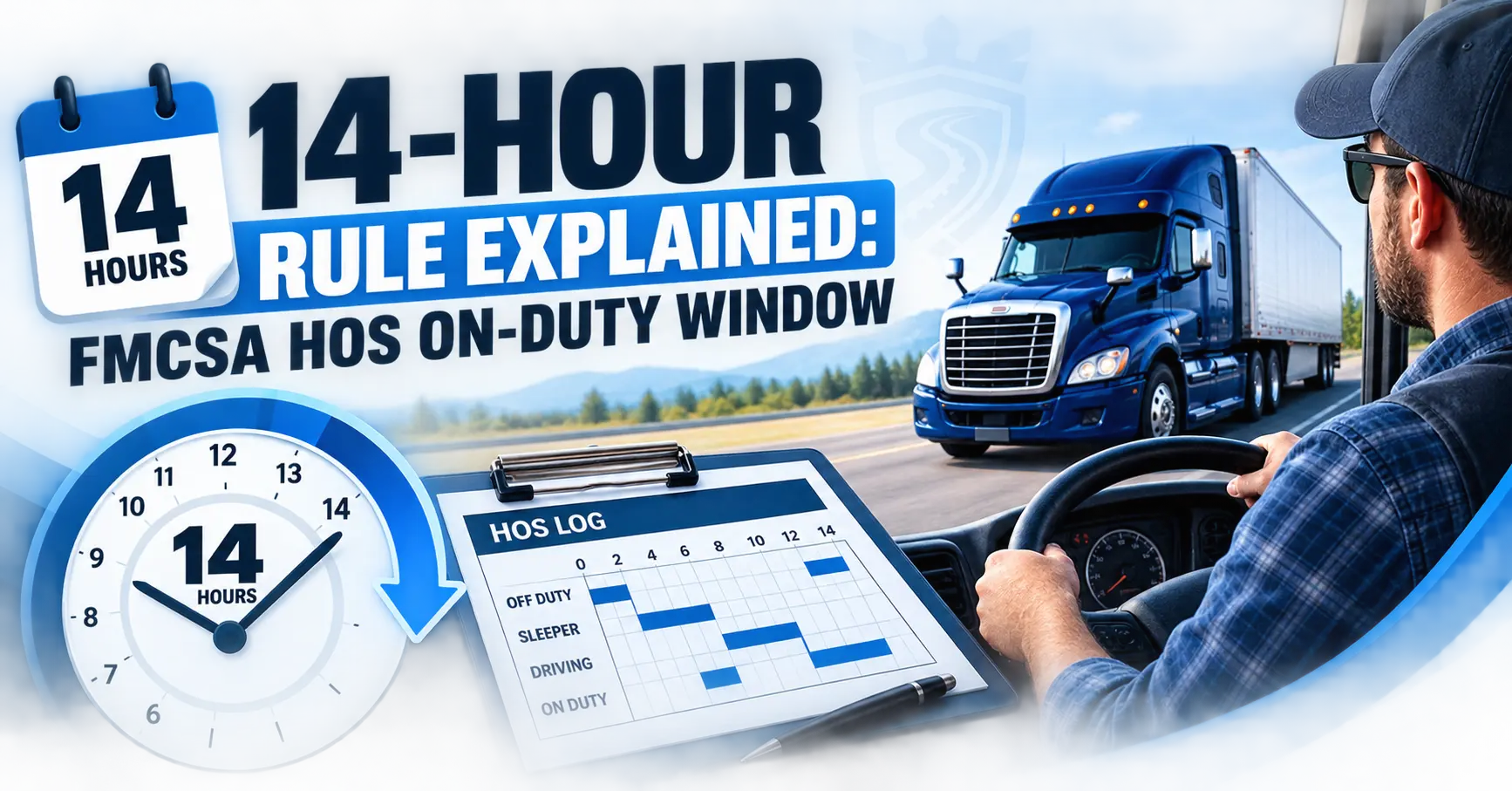
The rule limits how long a property-carrying commercial motor vehicle driver can remain on duty after coming on duty following at least 10 consecutive hours off duty. The driver may drive for up to 11 hours during that period, but the entire 14-hour on-duty window cannot be extended simply because the driver takes breaks during the day.
Under 49 CFR §395.3(a)(2), a property-carrying driver may not drive after being on duty for 14 consecutive hours following 10 consecutive hours off duty.
Understanding the difference between the 14-hour window and the 11-hour driving limit is essential for accurate HOS compliance.
GOVINFO Doc: DOT § 395.3
What Is the FMCSA 14-Hour Rule?
The 14-hour rule establishes the maximum length of a driver’s on-duty window after the driver has completed the required 10 consecutive hours off duty.
A property-carrying driver generally must:
- Have at least 10 consecutive hours off duty before beginning a new driving window.
- Complete the workday within a 14-consecutive-hour period.
- Limit actual driving to 11 hours within that window.
- Stop driving once the 14-hour window expires, even if the driver has unused driving hours remaining.
The key point is that the 14-hour period is a fixed window. Taking additional off-duty time during the window does not normally restart or extend it.
How the 14-Hour On-Duty Window Works
The simplest way to understand the rule is to think of the 14 hours as a clock that starts when the driver begins a new on-duty period after the required 10 consecutive hours off duty.
For example:
10:00 p.m. – 8:00 a.m.
Driver receives 10 consecutive hours off duty.
8:00 a.m.
The driver’s new 14-hour window begins.
8:00 a.m. – 10:00 p.m.
The driver is within the 14-hour window.
The driver may have periods recorded as driving, on duty not driving, or qualifying off-duty time during this period. However, the standard 14-hour window continues to run.
At 10:00 p.m., the 14-hour period has ended.
The driver cannot simply take a two-hour break and then continue driving until midnight under the standard rule.
14-Hour Rule vs. 11-Hour Driving Limit
The 14-hour rule and 11-hour driving limit work together, but they are not the same requirement.
A driver could have 2 hours of driving time remaining under the 11-hour limit but still be prohibited from driving because the 14-hour window has expired.
Example
A driver starts at 6:00 a.m.
By 4:00 p.m., the driver has:
- Driven 9 hours
- Spent 3 hours on duty but not driving
- Taken a 1-hour meal break
The driver has not yet used 11 driving hours.
However, the 14-hour window runs from 6:00 a.m. to 8:00 p.m.
After 8:00 p.m., the driver cannot continue driving under the standard property-carrier HOS rules simply because driving hours remain.
The 14-hour window can become the limiting factor before the 11-hour driving limit does.
When Does the 14-Hour Clock Start?
For a standard property-carrying driver, the 14-hour window begins after the driver has completed the required 10 consecutive hours off duty and starts a new on-duty period.
This is why dispatchers and drivers should look at the driver’s complete HOS status rather than only asking:
“How many driving hours do you have left?”
A driver may have available driving time but not enough remaining time in the 14-hour window to legally complete the trip.
Simple Decision Framework
Has the driver completed 10 consecutive hours off duty?
→ Yes: A new standard driving/on-duty window can begin.
→ No: The driver may not begin a new standard driving window yet.
Has the 14-hour window expired?
→ Yes: The driver cannot continue driving under the standard rule.
→ No: Continue checking remaining driving hours and other HOS requirements.
Can Off-Duty Time Stop the 14-Hour Clock?
This is one of the most important concepts to understand.
Under the standard 14-hour rule, off-duty periods do not simply pause the 14-hour window.
For example, suppose a driver begins the workday at 7:00 a.m. and takes a two-hour off-duty period from 1:00 p.m. to 3:00 p.m.
The 14-hour window still generally runs from:
7:00 a.m. → 9:00 p.m.
The two-hour break does not turn the window into:
7:00 a.m. → 11:00 p.m.
This distinction prevents a common HOS mistake: treating every off-duty period as if it stops the 14-hour clock.
Important Exception
Certain qualifying sleeper-berth combinations can affect how a driver’s available time is calculated under the applicable HOS provisions.
These situations require careful application of the sleeper-berth rules rather than simply assuming that any off-duty period extends the 14-hour window.
For complex schedules, carriers should review the applicable FMCSA rules and the driver’s ELD records before determining whether an exception applies.
14-Hour Rule Timeline Example
Consider a driver who begins the day after completing the required 10 consecutive hours off duty.
Example Schedule
The driver has accumulated 9 hours of driving in this example.
That does not mean the driver can drive another two hours after 8:00 p.m.
The driver’s 14-hour window has ended.
What Happens When the 14 Hours Expire?
Once the standard 14-hour window expires, the driver generally cannot continue driving until the requirements for a new driving window have been satisfied.
For property-carrying operations, this normally means obtaining the required 10 consecutive hours off duty before beginning a new standard driving period.
This is why trip planning should account for more than mileage and estimated arrival time.
Dispatchers should consider:
- Driver’s available driving hours
- Remaining 14-hour window
- Required breaks
- Off-duty periods
- Sleeper-berth provisions, if applicable
- Traffic and loading delays
- Appointment schedules
- ELD-recorded duty status
A route that appears achievable based solely on the 11-hour driving limit may still create an HOS problem if loading, unloading, fueling, traffic, or other on-duty activities consume too much of the 14-hour window.
Common 14-Hour Rule Misconceptions
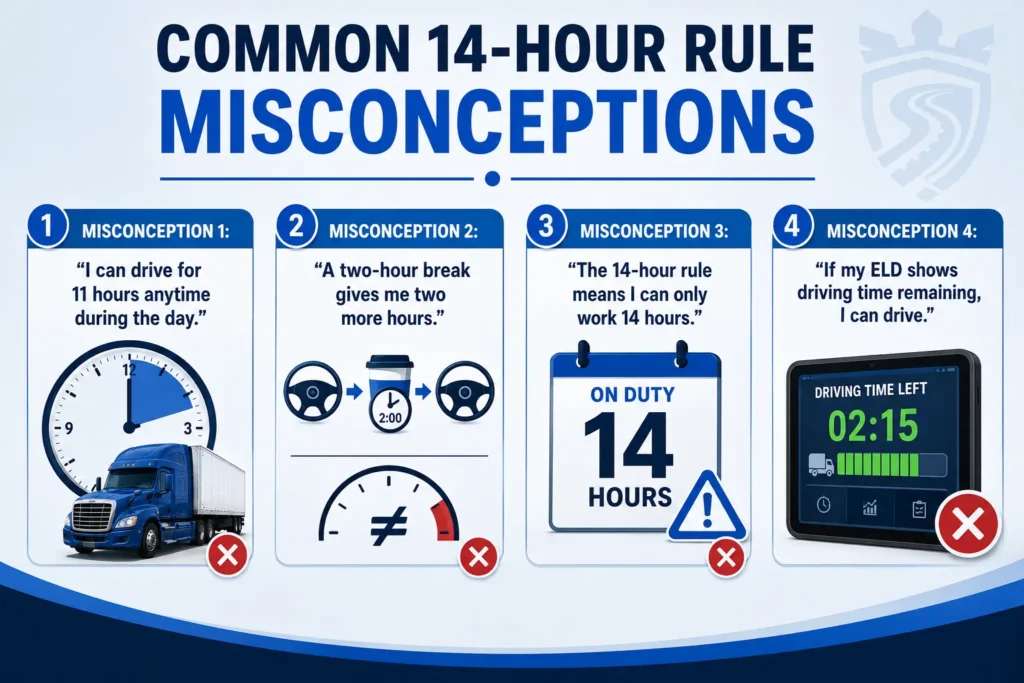
Misconception 1: “I can drive for 11 hours anytime during the day.”
Not necessarily.
The 11-hour driving limit operates within the applicable 14-hour window. Once the 14-hour window expires, unused driving time does not allow the driver to continue operating.
Misconception 2: “A two-hour break gives me two more hours.”
Under the standard rule, no.
A normal off-duty period does not simply add time to the end of the 14-hour window.
Misconception 3: “The 14-hour rule means I can only work 14 hours.”
Not exactly.
The rule establishes the length of the driver’s standard on-duty window. It should not be interpreted as a simple statement that a driver can perform exactly 14 hours of on-duty work.
The 11-hour driving limit and other HOS requirements still apply.
Misconception 4: “If my ELD shows driving time remaining, I can drive.”
Not necessarily.
The driver must consider all applicable HOS limits. Remaining driving time does not override an expired 14-hour window.
Exceptions to the Standard 14-Hour Rule
The standard 14-hour rule applies to property-carrying drivers, but certain HOS provisions can change how available driving or on-duty time is calculated.
Carriers should not treat every unusual schedule as an exception. The specific regulatory conditions must be satisfied and properly documented.
Sleeper Berth Provision
The sleeper-berth provisions allow qualifying drivers to split their required off-duty time into two periods under specific conditions.
This can affect how the driver’s available hours are calculated.
Because sleeper-berth schedules can become complicated, dispatchers should verify the driver’s actual duty-status records rather than manually adding or subtracting hours.
Adverse Driving Conditions
FMCSA rules provide limited additional driving time when a driver encounters qualifying adverse driving conditions that were not reasonably foreseeable when the trip began.
This is not a general permission to extend every driver’s workday.
The carrier and driver should ensure the conditions meet the regulatory definition and that the use of the exception is properly recorded.
Short-Haul Operations
Certain short-haul operations may qualify for an exception from maintaining a standard driver’s record of duty status when all applicable conditions are satisfied.
However, short-haul treatment does not mean that every short-distance driver is automatically exempt from HOS requirements.
Carriers should determine which specific exception applies before relying on it.
Common 14-Hour Rule Violation Scenarios
Understanding realistic scenarios makes the rule easier to apply.
Scenario 1: Driver Has Driving Time Left
A driver begins at 6:00 a.m. and reaches 8:00 p.m. with only 9 hours of driving recorded.
The driver may believe there are two hours remaining because the 11-hour driving limit has not been reached.
However, the 14-hour window has expired.
Result: The driver cannot continue driving under the standard rule simply because driving hours remain.
Scenario 2: Two-Hour Lunch Break
A driver starts at 7:00 a.m. and takes two hours off duty during the afternoon.
The driver assumes the break moves the end of the workday from 9:00 p.m. to 11:00 p.m.
Result: A normal off-duty period does not automatically extend the standard 14-hour window.
Scenario 3: Loading Delay
A driver arrives at a shipper at 4:00 p.m. and spends three hours waiting to load.
The driver then wants to drive several more hours because only part of the 11-hour driving limit has been used.
Result: Loading and waiting time can consume the 14-hour window even though it does not count as driving time.
This is why appointment delays can create HOS problems even when a driver has substantial driving hours remaining.
Scenario 4: Dispatch Adds a Late Delivery
A driver is approaching the end of the 14-hour window when dispatch assigns another delivery.
The driver cannot legally extend the workday merely because the customer needs the shipment delivered that evening.
Compliance principle: Operational deadlines do not override applicable HOS limits.
14-Hour Rule and ELD Records
An Electronic Logging Device (ELD) helps carriers monitor HOS compliance, but the ELD does not replace proper planning.
Drivers and safety managers should review the driver’s:
- Current duty status
- Remaining driving time
- Remaining on-duty window
- Previous off-duty periods
- Required breaks
- Sleeper-berth periods, when applicable
- HOS violations or edits
Why ELD Review Matters
A driver may see several hours remaining in one HOS category while having little or no time remaining in another.
For example:
Driving time remaining: 2 hours
14-hour window remaining: 20 minutes
The driver cannot simply use the two remaining driving hours.
The shorter applicable limitation controls.
How Dispatchers Should Manage the 14-Hour Window
HOS compliance is not only a driver’s responsibility.
Dispatch planning can either help prevent violations or create unnecessary pressure to exceed available hours.
Before assigning a trip, dispatch should consider:
- When did the driver’s current 14-hour window begin?
- How much driving time remains?
- How much time remains in the 14-hour window?
- Are loading or unloading delays expected?
- Will traffic affect the schedule?
- Are additional stops required?
- Does the trip involve a qualifying HOS exception?
- Can the driver legally complete the assignment?
A good dispatch plan should allow enough time for operational delays instead of planning around the driver’s maximum theoretical driving time.
14-Hour Rule Decision Framework
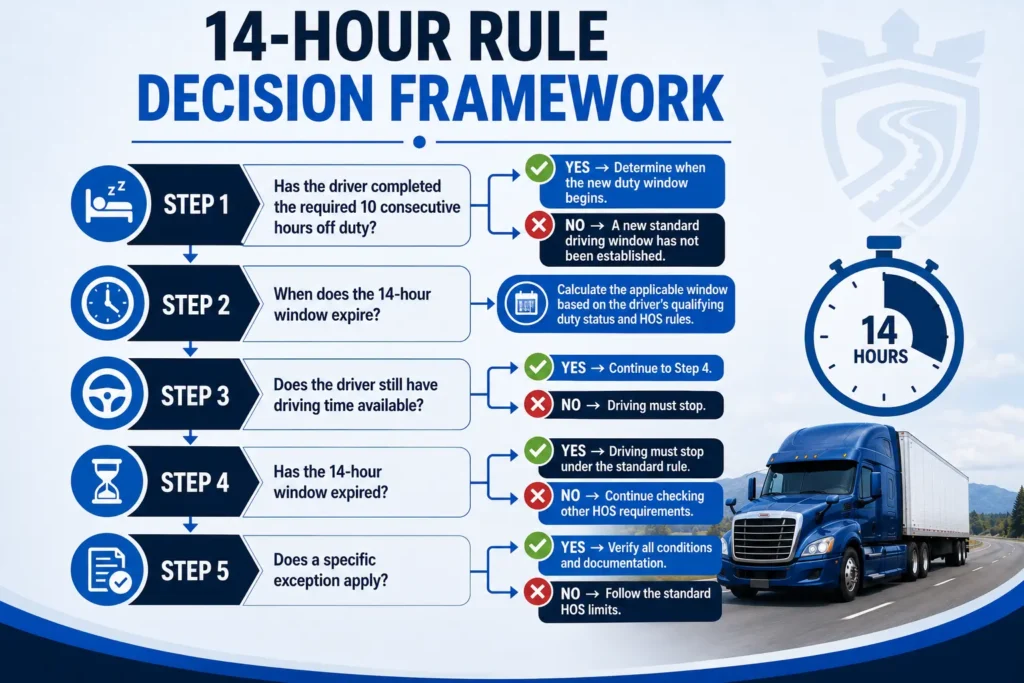
Use this simple framework when evaluating a driver’s available time.
Step 1: Has the driver completed the required 10 consecutive hours off duty?
- Yes → Determine when the new duty window begins.
- No → A new standard driving window has not been established.
Step 2: When does the 14-hour window expire?
Calculate the applicable window based on the driver’s qualifying duty status and HOS rules.
Step 3: Does the driver still have driving time available?
- Yes → Continue to Step 4.
- No → Driving must stop.
Step 4: Has the 14-hour window expired?
- Yes → Driving must stop under the standard rule.
- No → Continue checking other HOS requirements.
Step 5: Does a specific exception apply?
- Yes → Verify all conditions and documentation.
- No → Follow the standard HOS limits.
14-Hour Rule Compliance Checklist
Before dispatching or extending a trip, review:
- Driver completed the required off-duty period.
- Start of the applicable 14-hour window is identified.
- Remaining driving time has been checked.
- Remaining 14-hour window has been checked.
- Required 30-minute break requirements have been considered.
- Sleeper-berth provisions are properly applied when relevant.
- Potential adverse driving conditions are evaluated correctly.
- ELD records are accurate.
- Dispatch schedule allows for loading and unloading delays.
- Driver is not being pressured to exceed HOS limits.
Best Practices for 14-Hour HOS Compliance
1. Track Both Clocks
Never monitor only the 11-hour driving limit.
Drivers and dispatchers should monitor the driving limit and the 14-hour window together.
2. Plan for Delays
A schedule that works with no delays may fail when a driver spends two hours at a shipper.
Build reasonable operational time into trip planning.
3. Review ELD Data Regularly
Safety managers should review HOS records for recurring patterns rather than waiting until a roadside inspection or compliance review identifies a problem.
4. Train Dispatch Personnel
Dispatchers should understand that delivery deadlines do not change federal HOS requirements.
Training should include practical examples involving loading delays, traffic, customer appointments, and remaining available hours.
5. Investigate Repeated Violations
One HOS error may indicate a training problem.
Repeated violations can point to deeper issues involving dispatch practices, scheduling, supervision, or internal compliance controls.
Common Mistakes Carriers Should Avoid
Mistake 1: Tracking only driving hours
The 11-hour limit is only one part of HOS compliance.
Mistake 2: Treating off-duty time as a reset
A normal break does not automatically restart the 14-hour window.
Mistake 3: Ignoring non-driving work
Loading, unloading, inspections, fueling, and other on-duty activities can consume valuable time within the window.
Mistake 4: Planning trips to the absolute limit
A trip that leaves no room for delays creates unnecessary compliance risk.
Mistake 5: Relying entirely on the ELD
An ELD records duty status, but drivers and carriers still need to understand the rules governing those records.
Expert Tips
From a compliance-management perspective, the best approach is to treat the 14-hour rule as a planning constraint, not something to calculate after the driver is already running out of time.
A practical carrier process should:
- Review HOS availability before dispatch.
- Monitor both driving and on-duty windows.
- Identify recurring HOS problem routes.
- Review ELD violations regularly.
- Train drivers and dispatchers together.
- Document corrective actions when violations occur.
- Include HOS reviews in broader DOT compliance monitoring.
For a broader explanation of HOS requirements, review SafeRoad Compliance’s HOS & ELD compliance guide and Hours of Service violations guide.
14-Hour Rule Compliance Example for a Small Carrier
Consider a small carrier that schedules a driver for a morning pickup followed by an evening delivery.
The driver begins the day at 6:00 a.m. The pickup takes longer than expected, and traffic adds another two hours to the route.
By late afternoon, the driver still has driving hours available but has much less time remaining in the 14-hour window.
Instead of asking the driver to continue because “you still have driving hours left,” the safety manager should evaluate the complete HOS picture.
If the delivery cannot be completed legally within the available window, the carrier should consider alternatives such as:
- Rescheduling the delivery.
- Using another qualified driver.
- Adjusting the route.
- Reviewing whether a legitimate HOS exception applies.
The correct solution is to manage the operation around the applicable HOS limits rather than treating the limits as optional.
Conclusion
The 14-hour rule is easier to manage when carriers stop viewing it as a simple countdown and instead treat it as one part of the driver’s complete HOS compliance picture.
Drivers need to understand when their window begins and ends. Dispatchers need to plan realistic schedules, and safety managers should regularly review ELD records for patterns that could lead to violations.
For a broader understanding of federal HOS requirements, use the SafeRoad Compliance HOS & ELD compliance guide as the main resource for related rules and requirements.
If your company needs help managing broader federal requirements, SafeRoad Compliance can also support your fleet through DOT compliance management and ongoing compliance services.
Frequently Asked Questions
The FMCSA 14-hour rule limits the standard on-duty window for property-carrying drivers to 14 consecutive hours after the required 10 consecutive hours off duty. A driver generally cannot drive after that window expires.
Generally, no. A normal off-duty break does not simply pause the standard 14-hour window.
No. The 11-hour rule limits driving time, while the 14-hour rule limits the driver’s standard on-duty window. Both restrictions apply independently.
Generally, no. Remaining driving time does not override an expired 14-hour window under the standard property-carrier HOS rules.
Yes. On-duty activities such as loading or unloading can consume time within the 14-hour window even though they are not driving time.
Qualifying sleeper-berth provisions can affect how available time is calculated. The specific regulatory conditions must be satisfied, so carriers should not assume that any sleeper period automatically extends the driver’s available time.
Under the standard rule, the driver must stop driving and obtain the required off-duty period before beginning a new standard driving window.
Carriers can reduce violations by monitoring both the 11-hour driving limit and 14-hour window, planning for operational delays, reviewing ELD records, and training drivers and dispatchers on HOS requirements.