Disclosure: Informational only. We are not FMCSA or USDOT. Always verify your status directly through official FMCSA systems.
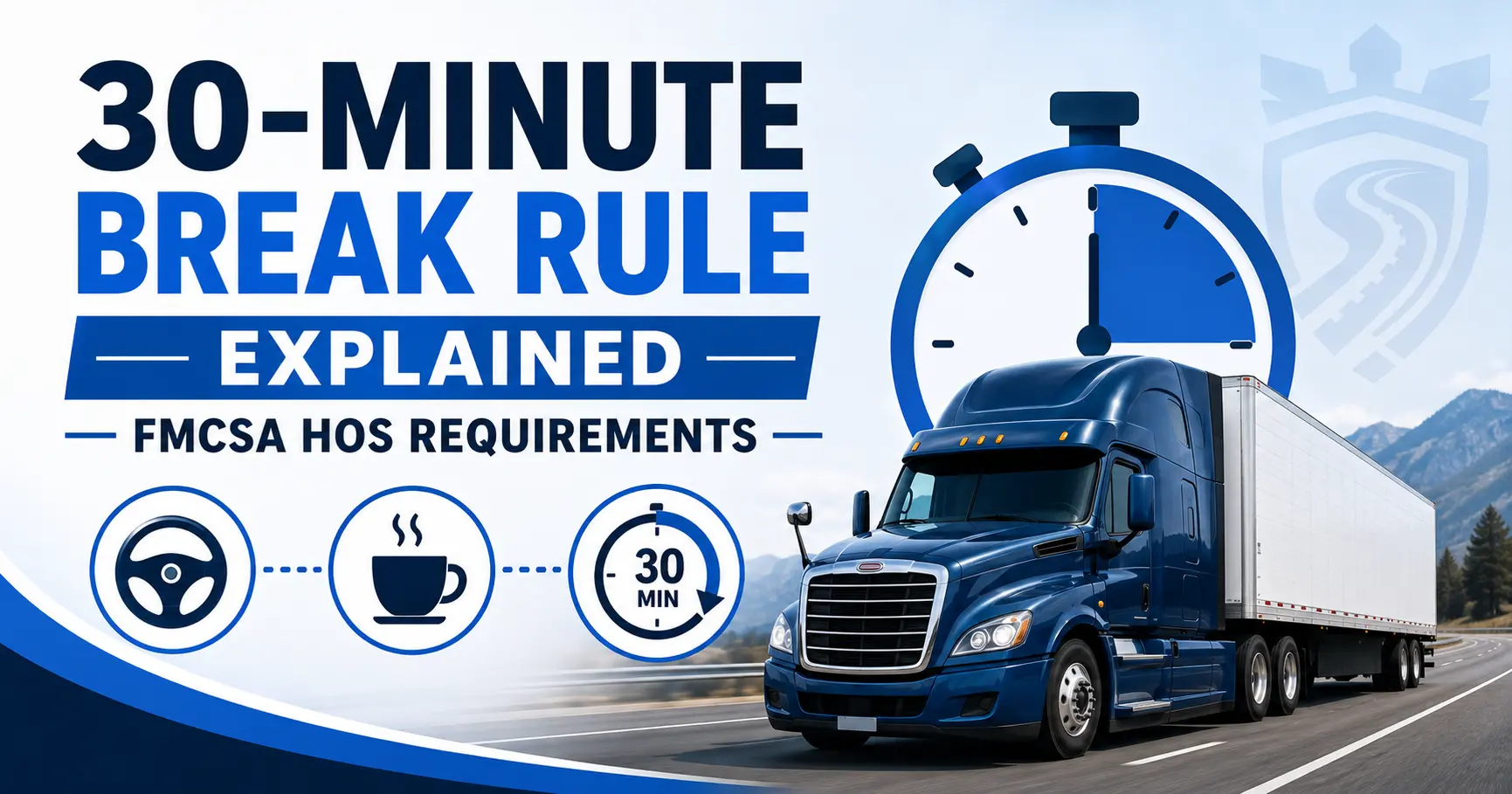
The 30-minute break rule requires certain commercial motor vehicle drivers to take a qualifying 30-minute interruption of driving after accumulating 8 hours of driving without at least a 30-minute interruption.
The rule is part of the Federal Motor Carrier Safety Administration’s (FMCSA) Hours of Service (HOS) regulations under 49 CFR §395.3(a)(3)(ii). Understanding when the break is required, what counts as a break, and how it interacts with other HOS rules can help drivers and carriers avoid violations.
This guide explains the rule in practical terms, including qualifying duty statuses, timing examples, exceptions, and common misconceptions.
Under the federal HOS rule, a property-carrying driver generally may not drive beyond 8 cumulative hours without at least a 30-minute interruption in driving. The interruption can be satisfied by a qualifying non-driving duty status, including off-duty, sleeper berth, or certain other qualifying statuses.
What Is the FMCSA 30-Minute Break Rule?
The federal 30-minute break rule is an HOS requirement designed to interrupt extended periods of driving.
Under 49 CFR §395.3(a)(3)(ii), a property-carrying driver must take at least a 30-minute interruption of driving when the driver has accumulated 8 hours of driving time since the last qualifying 30-minute interruption.
Importantly, the rule focuses on driving time, not simply the number of hours a driver has been on duty.
That distinction is one of the most common sources of confusion.
The Basic Rule
A driver generally must:
- Accumulate no more than 8 hours of driving without a qualifying 30-minute interruption.
- Take the required interruption before continuing beyond the applicable 8-hour driving period.
- Record the qualifying activity accurately.
- Continue complying with all other applicable HOS requirements.
The 30-minute break does not give the driver an additional 30 minutes of driving time.
Instead, it interrupts the period during which the driver is accumulating driving time.
When Is the 30-Minute Break Required?
The requirement is based on 8 cumulative hours of driving.
This means the driver does not necessarily need to take the break exactly 8 hours after starting the workday.
For example, suppose a driver:
- Drives for 3 hours.
- Stops for 1 hour to load.
- Drives for another 5 hours.
The driver has accumulated 8 hours of driving.
A qualifying 30-minute interruption is therefore required before the driver continues driving.
The clock is based on cumulative driving time, rather than simply elapsed time since the driver’s shift began.
Important Distinction
The 30-minute rule is separate from the:
- 11-hour driving limit
- 14-hour on-duty window
- 60/70-hour limit
- Sleeper berth provisions
- Other applicable HOS requirements
A driver must comply with all applicable limits simultaneously.
What Counts as a 30-Minute Break?
A qualifying interruption must last at least 30 consecutive minutes.
Depending on the circumstances, the interruption may be recorded using qualifying duty statuses such as:
- Off duty
- Sleeper berth
- On-duty not driving
- A combination of qualifying statuses
The key point is that the driver must have a qualifying interruption from driving.
For example, a driver could spend 30 minutes:
- Waiting at a customer location while properly recorded as on-duty not driving.
- Taking an off-duty break.
- Resting in the sleeper berth.
The activity and duty status should accurately reflect what the driver is actually doing.
What Does Not Qualify as a Break?
A common mistake is assuming that any 30-minute period without moving the truck automatically satisfies the rule.
That is not necessarily true.
For example, a driver who remains stopped while performing loading or unloading work may still be on duty. Although on-duty not driving can qualify as an interruption under the current federal rule, the driver’s records must accurately reflect the actual activity.
Drivers should never change their duty status simply to manufacture a break that did not occur.
Do Not Confuse These Concepts
Not driving and being off duty are not always the same thing.
A driver can be stopped but still performing work-related duties.
The correct duty status depends on what the driver is actually doing.
How the 8-Hour Driving Period Works
The easiest way to understand the rule is to think of driving time as accumulating until a qualifying interruption occurs.
Consider this example:
| Activity | Driving Time Accumulated |
|---|---|
| Drive | 2 hours |
| Loading | 1 hour |
| Drive | 3 hours |
| Fueling | 30 minutes |
| Drive | 3 hours |
| Total driving | 8 hours |
The driver has accumulated 8 hours of driving.
Before continuing to drive, the driver needs a qualifying 30-minute interruption.
What Happens After the Break?
Once the driver takes the qualifying interruption, the driver can continue accumulating driving time.
The break does not reset the driver’s 11-hour driving limit or 14-hour window.
Those HOS limits continue to apply independently.
Example: Break Taken Too Early
Consider a driver who starts driving at 6:00 a.m.
At 10:00 a.m., the driver has accumulated only 3 hours of actual driving because of stops and other non-driving activities.
The driver takes a 30-minute break at that point.
That break can satisfy the interruption requirement, but it does not mean the driver now has another 11 hours available to drive.
The driver remains subject to the other HOS limits.
Example: Split Driving Periods
A driver may have several periods of driving separated by stops.
For example:
- 2 hours driving
- 45 minutes loading
- 2 hours driving
- 30 minutes fueling
- 4 hours driving
Total driving = 8 hours.
Even though more than 8 hours have passed since the beginning of the workday, the important calculation is the driver’s cumulative driving time.
The driver should take a qualifying 30-minute interruption before continuing to drive.
30-Minute Break Rule vs. 11-Hour Driving Limit
These rules are related but serve different purposes.
| HOS Requirement | Basic Purpose |
|---|---|
| 30-minute break rule | Interrupt extended driving after 8 cumulative hours |
| 11-hour limit | Limits total driving during the 14-hour window |
| 14-hour rule | Limits the driver’s on-duty window |
| 60/70-hour limit | Limits cumulative on-duty time over the applicable period |
A driver can satisfy the 30-minute break requirement and still violate another HOS rule.
For example, taking a 30-minute break does not extend the 14-hour window.
It also does not create an additional 11 hours of driving availability.
Does Sleeper Berth Time Count as the 30-Minute Break?
A sleeper berth period can qualify as the required interruption if it satisfies the applicable requirements.
For example, a driver who spends at least 30 consecutive minutes in the sleeper berth is not driving during that period.
However, carriers should ensure the driver’s ELD records accurately reflect the actual duty status.
Longer sleeper berth periods also interact with the separate sleeper berth provisions under the HOS regulations.
Do not treat the 30-minute requirement as a substitute for understanding the complete sleeper berth rules.
Short-Haul Drivers and the 30-Minute Break Rule
Short-haul operations require particular attention because certain drivers may qualify for an HOS exception.
The short-haul exception under 49 CFR §395.1(e) can allow eligible drivers to use a time record instead of a standard record of duty status under specific conditions.
However, the existence of a short-haul operation does not mean every driver is automatically exempt from every HOS requirement.
The exact exception and its conditions matter.
For carriers using short-haul operations, determine whether the driver and operation actually satisfy the applicable regulatory requirements before assuming the 30-minute requirement does not apply.
For a broader explanation of short-haul HOS provisions, see SafeRoad Compliance’s DOT short-haul exemption guide.
Common Misconceptions About the 30-Minute Rule
Misconception 1: The Break Must Be Off Duty
Not necessarily.
The federal rule focuses on an interruption in driving, and qualifying duty statuses can satisfy the requirement when properly recorded.
Misconception 2: The Break Restarts the 14-Hour Clock
It does not.
A 30-minute interruption does not extend the driver’s 14-hour driving window.
Misconception 3: The Driver Must Take the Break at Exactly 8 Hours
The rule is based on cumulative driving.
A driver can take a qualifying interruption before reaching 8 hours of driving.
Misconception 4: Any 30-Minute Stop Counts
The activity and duty status matter.
Drivers should accurately record what they are actually doing rather than labeling every stop as a qualifying break.
Misconception 5: The Rule Gives Drivers More Driving Time
It does not.
The break interrupts the driving period but does not increase the driver’s maximum driving allowance.
Common 30-Minute Break Violations
Carriers and drivers should watch for several recurring problems.
1. Continuing to Drive After 8 Hours
A driver reaches 8 cumulative hours of driving but continues operating without a qualifying interruption.
2. Incorrect ELD Duty Status
The driver’s actual activity does not match the recorded duty status.
3. Misunderstanding the 14-Hour Rule
A driver assumes that taking a break extends the 14-hour window.
4. Poor Trip Planning
A driver waits until reaching the 8-hour threshold before looking for a safe location to stop.
5. Assuming Short-Haul Status Automatically Eliminates HOS Requirements
The carrier does not verify whether the operation meets all conditions of the applicable exception.
Best Practices for Drivers and Carriers
Good HOS compliance starts before the truck moves.
For Drivers
- Monitor cumulative driving time.
- Plan breaks before reaching the 8-hour threshold.
- Use the correct ELD duty status.
- Review your log before ending the shift.
- Never falsify or manipulate duty-status records.
- Remember that the 30-minute break does not extend the 14-hour window.
For Fleet Managers
- Train drivers on cumulative driving time.
- Review ELD records for recurring break violations.
- Identify patterns rather than treating every violation as an isolated event.
- Address inaccurate duty-status records through coaching and training.
- Incorporate HOS reviews into your broader compliance program.
30-Minute Break Compliance Checklist
Before operating, carriers should make sure drivers understand:
- When the 8-hour driving threshold applies
- What activities can satisfy the interruption requirement
- How to record the correct ELD duty status
- How the break interacts with the 11-hour limit
- How the break interacts with the 14-hour window
- Whether a short-haul exception applies
- How to identify potential HOS violations
- Where to safely take the required interruption
Expert Tips
Do not manage the 30-minute break rule in isolation.
A driver can have a compliant break and still exceed the 11-hour driving limit, 14-hour window, or applicable cumulative on-duty limit.
The strongest HOS programs review the driver’s entire duty record and look at how the rules interact.
For a broader overview of HOS requirements, see our HOS and ELD Compliance Guide.
Conclusion
The 30-minute break rule is designed to interrupt extended periods of driving after a property-carrying driver accumulates 8 hours of driving without a qualifying interruption.
The most important point is that the rule is based on cumulative driving time, not simply the number of hours since the driver’s workday began.
Carriers should also remember that satisfying the break requirement does not reset the 11-hour driving limit or 14-hour on-duty window.
Accurate ELD records, proper driver training, and practical trip planning can help prevent avoidable HOS violations.
For carriers that need broader assistance reviewing HOS records, driver documentation, or DOT compliance procedures, SafeRoad Compliance can help strengthen the compliance process.
Schedule an Appointment Today
Get expert guidance for your DOT compliance needs.
Frequently Asked Questions
The federal rule generally requires a property-carrying driver to take at least a 30-minute interruption in driving after accumulating 8 hours of driving without a qualifying interruption.
No. The federal rule focuses on an interruption from driving. Certain qualifying duty statuses may satisfy the requirement when accurately recorded.
No. The 30-minute interruption does not extend or restart the driver’s 14-hour on-duty window.
No. The interruption does not provide additional driving hours beyond the driver’s other applicable HOS limits.
Yes, a qualifying sleeper berth period can satisfy the interruption requirement when it meets the applicable requirements and is properly recorded.
It depends on whether the driver and operation qualify for an applicable short-haul exception. Carriers should verify the specific regulatory conditions rather than assuming all short-haul drivers are exempt.
The federal requirement is found in 49 CFR §395.3(a)(3)(ii).
No. Drivers must continue complying with the 11-hour driving limit, 14-hour window, applicable cumulative on-duty limits, and other HOS requirements.