Disclosure: Informational only. We are not FMCSA or USDOT. Always verify your status directly through official FMCSA systems.
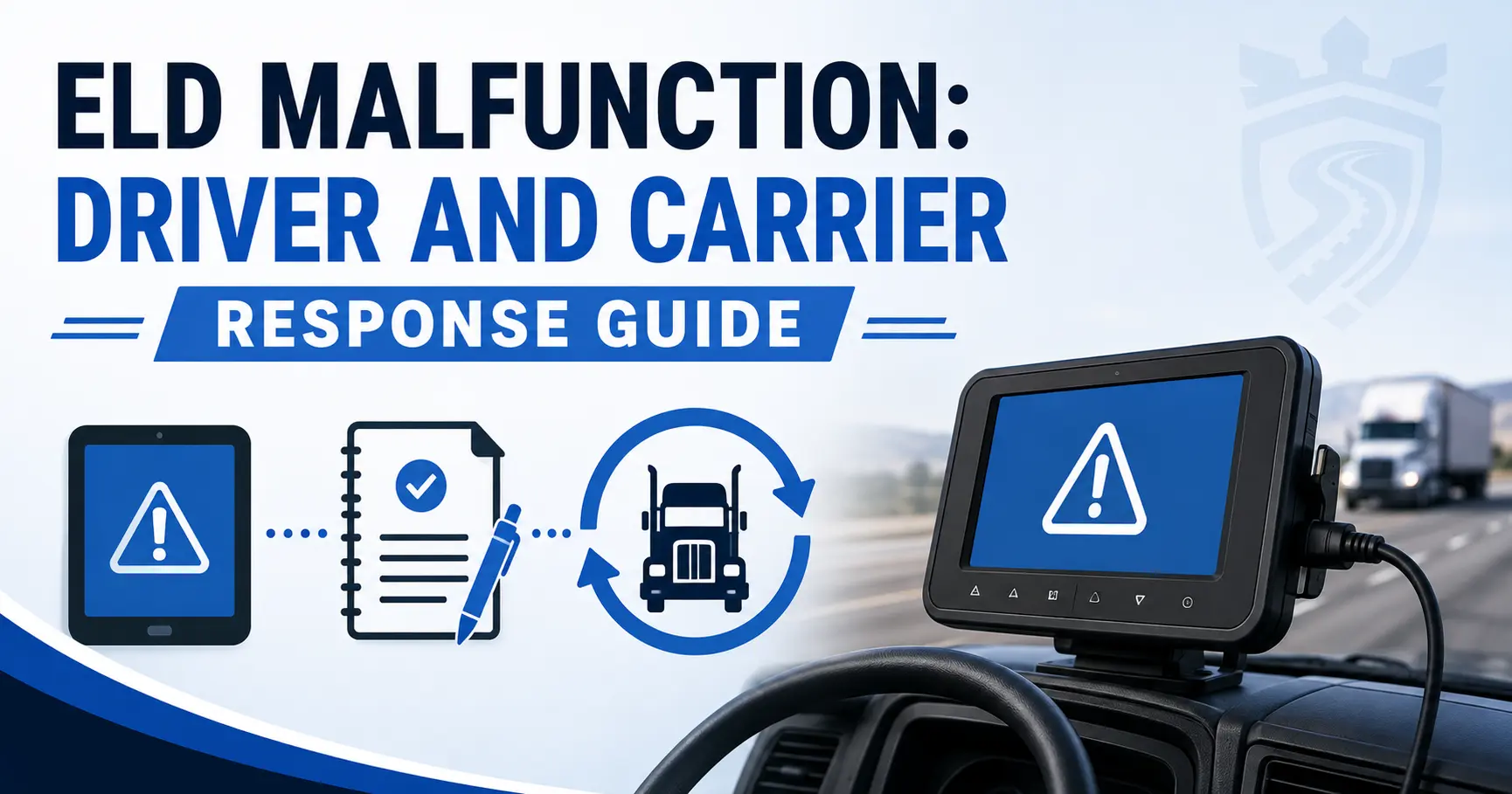
An ELD malfunction can create an immediate compliance problem for a commercial motor carrier and driver.
When an electronic logging device stops working correctly, the driver still has to maintain an accurate record of duty status and comply with the applicable Hours of Service (HOS) rules.
The Federal Motor Carrier Safety Administration (FMCSA) has specific requirements for handling ELD failures, including notifying the carrier, creating paper records when required, reconstructing duty-status information, and making sure the malfunction is addressed within the required timeframe.
This guide explains what drivers and carriers should do when an ELD fails, from the first notification through repair and record reconciliation.
If an ELD malfunctions, the driver should notify the motor carrier as required, document the malfunction, reconstruct the driver’s record of duty status using the required method, and maintain supporting records until the ELD is repaired or replaced. The carrier must take appropriate action to ensure the device is repaired within the applicable FMCSA timeframe.
What Is an ELD Malfunction?
An ELD malfunction occurs when an electronic logging device fails to properly perform one or more of the functions required under the federal ELD regulations.
ELDs are used to record a driver’s duty-status information and help carriers maintain accurate HOS records.
Not every technical inconvenience is necessarily an FMCSA-defined ELD malfunction.
For example, a device may have a temporary connectivity issue while still retaining the required records. The specific problem should be evaluated against the applicable ELD malfunction requirements.
The federal requirements for ELDs are primarily found in 49 CFR Part 395, Subpart B.
Important Link: ELD Factsheet
What Causes an ELD Failure?
An ELD problem can occur for several reasons.
Common examples include:
- Hardware failure
- Software problems
- Loss of required functionality
- Damaged equipment
- Communication problems
- Power-related issues
- Device malfunction affecting required records
- Failure of the ELD to properly record or display required information
The important issue is not simply whether the screen turns on.
The question is whether the device continues to meet the applicable federal ELD requirements.
Driver Responsibilities After an ELD Malfunction
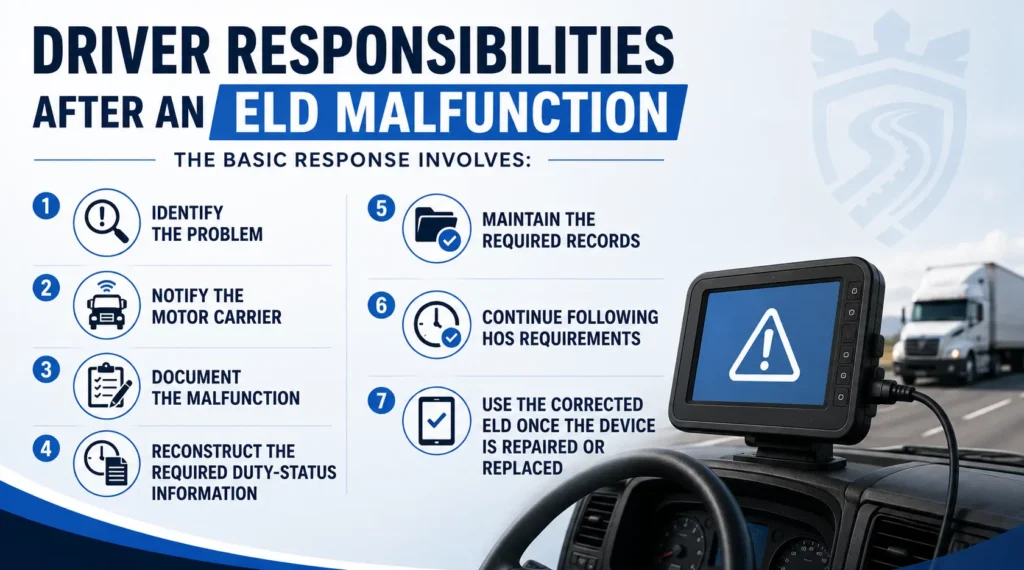
When a driver becomes aware of an ELD malfunction, the driver should take action promptly.
The basic response involves:
- Identify the problem.
- Notify the motor carrier.
- Document the malfunction.
- Reconstruct the required duty-status information.
- Maintain the required records.
- Continue following HOS requirements.
- Use the corrected ELD once the device is repaired or replaced.
Drivers should not continue operating as though nothing happened if the ELD is no longer capable of accurately recording the required information.
Step 1: Identify the ELD Problem
The driver should determine what is wrong with the device.
The ELD may display a malfunction or diagnostic code, depending on the nature of the problem.
Drivers should record:
- Date and time the issue was discovered
- Nature of the malfunction
- Relevant ELD message or code
- Current duty status
- Location, when appropriate
- Information needed by the carrier to troubleshoot the problem
If the driver is unsure whether an issue qualifies as an FMCSA-defined malfunction, the carrier should evaluate it using the applicable ELD requirements.
Step 2: Notify the Motor Carrier
Under the federal ELD rules, the driver must notify the carrier of the malfunction within the applicable timeframe.
The driver should follow the company’s established ELD malfunction reporting procedure.
A good internal procedure should identify:
- Who the driver contacts
- How the malfunction is reported
- What information must be provided
- Where supporting documentation is stored
- Who coordinates repair or replacement
This reduces confusion when the failure occurs during an active trip.
Step 3: Use Paper Records When Required
When an ELD malfunction prevents the device from accurately recording the driver’s duty status, the driver may need to use paper records of duty status as required by the regulations.
The paper record should accurately reflect the driver’s activities.
Drivers should not simply estimate their day after the fact if reliable information is available.
The goal is to preserve an accurate record that can demonstrate compliance during an inspection or review.
What Should the Driver Record?
Depending on the applicable requirements, the record should include the information required for a compliant record of duty status, such as:
- Driver identification
- Date
- Duty-status changes
- Total hours
- Vehicle information
- Required location information
- Appropriate remarks or supporting information
The driver should follow the applicable federal recordkeeping requirements and the carrier’s written malfunction procedure.
How Long Can a Driver Use Paper Logs?
Paper records are not intended to become a permanent replacement for an operational ELD.
Federal regulations establish specific requirements concerning the period during which a driver may use paper records following an ELD malfunction.
The carrier should act quickly to have the malfunctioning ELD repaired or replaced rather than allowing the problem to continue unnecessarily.
For the exact regulatory requirements, carriers should review 49 CFR §395.34 and the current FMCSA guidance applicable to ELD malfunctions.
What Must the Carrier Do?
The carrier has responsibilities beyond simply telling the driver to use paper logs.
Once notified of an ELD malfunction, the motor carrier should:
- Document the notification.
- Determine the nature of the malfunction.
- Arrange for timely repair or replacement.
- Provide instructions to the driver.
- Ensure accurate duty-status records are maintained.
- Preserve supporting documentation.
- Reconcile records when the ELD is restored.
- Verify continued HOS compliance.
The carrier should also have a written process that drivers can follow without having to figure out the response themselves.
ELD Malfunction Response Workflow
A practical workflow looks like this:
ELD Malfunction Response Workflow
This workflow should be incorporated into the carrier’s written safety and compliance procedures.
How to Reconstruct HOS Records During an ELD Failure
One of the most important responsibilities during an ELD malfunction is maintaining an accurate record of duty status.
The driver should reconstruct the day based on actual activities.
For example:
| Time | Activity | Duty Status |
|---|---|---|
| 6:00–6:30 a.m. | Pre-trip work | On duty, not driving |
| 6:30–10:30 a.m. | Driving | Driving |
| 10:30–11:00 a.m. | Break | Appropriate qualifying status |
| 11:00 a.m.–2:00 p.m. | Driving | Driving |
| 2:00–3:00 p.m. | Loading | On duty, not driving |
| 3:00–5:00 p.m. | Driving | Driving |
The exact record should reflect what actually occurred.
The purpose of reconstruction is not to create a convenient log.
It is to preserve an accurate record of the driver’s activities while the electronic system is unavailable.
Do Not Guess or Backdate Records
A malfunction does not give a driver permission to recreate a log based on what would have been convenient.
Records should be based on the driver’s actual activities.
If supporting information is available from dispatch records, fuel receipts, bills of lading, gate records, or other legitimate sources, carriers can use that information to help verify the timeline.
However, supporting records should complement—not replace—the driver’s required record of duty status.
How Long Does a Carrier Have to Repair an ELD?
FMCSA regulations establish a specific repair timeframe for an ELD malfunction.
Under 49 CFR §395.34, a motor carrier must take steps to correct the malfunction within the applicable regulatory period.
The carrier should not wait until the final permissible day to arrange service if the problem can be resolved sooner.
A proactive repair process reduces the risk of:
- Extended paper-log use
- Missing documentation
- Driver confusion
- HOS record discrepancies
- Roadside inspection problems
- Repeated malfunction issues
Carriers should maintain a list of approved repair or replacement options so drivers can receive assistance quickly when an ELD fails on the road.
What Records Should Be Maintained?
An ELD malfunction should create a documentation trail.
Carriers should consider retaining:
- Driver’s malfunction notification
- Date and time of notification
- Description of the malfunction
- Paper records, when required
- Repair documentation
- Service invoices
- Replacement documentation
- Communications with the ELD provider
- Relevant supporting records
- Reconciled HOS information
A clear documentation trail can help demonstrate that the carrier responded appropriately.
Common ELD Malfunction Mistakes
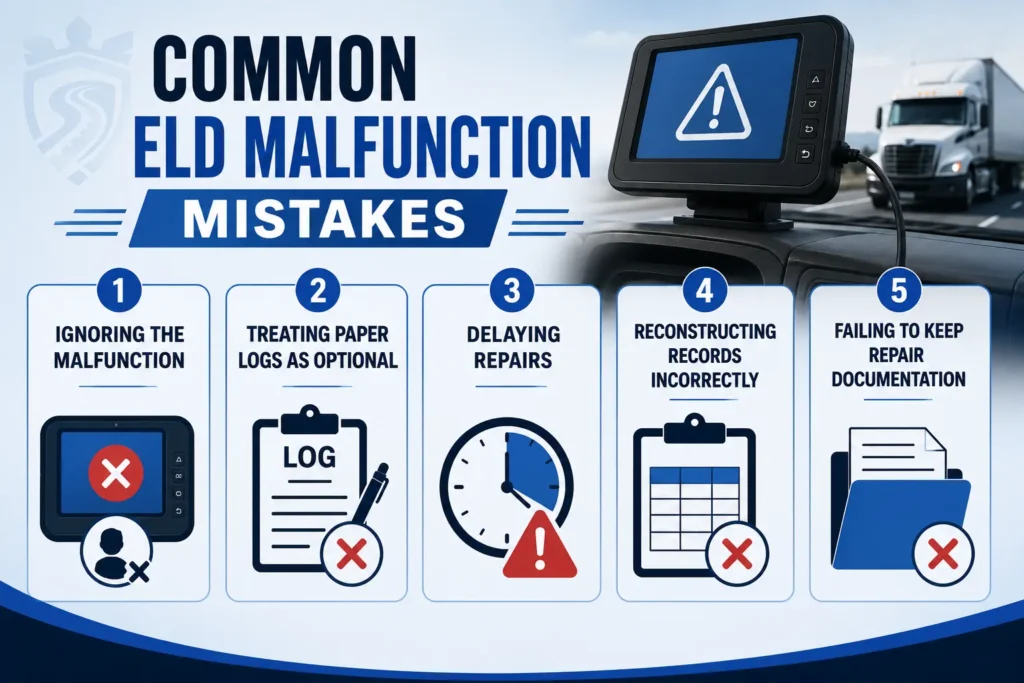
1. Ignoring the Malfunction
A driver notices a problem but continues operating without reporting it.
Better approach: Report the issue promptly and follow the company’s written malfunction procedure.
2. Treating Paper Logs as Optional
A driver continues driving even though the ELD cannot accurately record duty status.
Better approach: Follow the applicable paper-record requirements immediately.
3. Delaying Repairs
The carrier knows about the malfunction but does not arrange timely repair or replacement.
Better approach: Start the repair process as soon as the problem is confirmed.
4. Reconstructing Records Incorrectly
The driver creates records from memory without checking available information.
Better approach: Reconstruct the actual duty-status timeline using reliable information.
5. Failing to Keep Repair Documentation
The carrier repairs the device but cannot demonstrate what happened.
Better approach: Maintain service records and related communications.
Best Practices for Drivers
Drivers should keep a simple malfunction response process available in the cab.
Driver Checklist
- Know how to identify an ELD malfunction.
- Know who to contact at the carrier.
- Report the issue promptly.
- Record the malfunction details.
- Maintain required records.
- Continue following HOS limits.
- Keep supporting documents available.
- Follow carrier instructions for repair.
- Review records after the ELD is restored.
Drivers should never assume that an ELD problem temporarily suspends HOS requirements.
It does not.
Best Practices for Carriers
A carrier’s ELD malfunction procedure should be part of its broader HOS compliance program.
Recommended Carrier Controls
Written procedure: Give every driver clear instructions for reporting ELD problems.
Emergency contact: Maintain a contact who can respond outside normal office hours.
Repair network: Establish access to qualified repair or replacement resources.
Documentation: Keep records of malfunction notifications and corrective actions.
Training: Train drivers on both ELD operation and malfunction procedures.
Periodic review: Examine malfunction events to identify recurring device or training problems.
ELD Malfunction Compliance Checklist
Before considering a malfunction resolved, verify:
- Driver identified the ELD issue.
- Driver notified the carrier.
- Malfunction information was documented.
- Required paper records were created when necessary.
- HOS compliance continued during the failure.
- Carrier arranged repair or replacement.
- Repair documentation was retained.
- Duty-status information was reconciled.
- ELD functionality was verified after repair.
- Driver returned to normal electronic recordkeeping.
Expert Tips From SafeRoad Compliance
Treat an ELD malfunction as a compliance event, not simply a technology problem.
The strongest response combines three things:
- Accurate records
- Prompt communication
- Documented corrective action
Carriers should also periodically review their ELD malfunction history.
If the same device repeatedly fails, the issue may require more than another temporary repair.
For broader HOS and ELD requirements, review SafeRoad Compliance’s HOS & ELD Compliance Guide.
Conclusion
An ELD malfunction does not eliminate a driver’s HOS responsibilities.
When an ELD fails, the driver and carrier need a documented process for identifying the problem, communicating the failure, maintaining accurate records, arranging timely repair or replacement, and reconciling records afterward.
The best approach is to prepare before a malfunction occurs.
Drivers should know exactly who to contact and how to maintain records, while carriers should have written procedures, repair resources, and documentation controls in place.
For carriers looking to strengthen their broader DOT compliance program, SafeRoad Compliance can provide professional compliance support.
Frequently Asked Questions
The driver should identify and document the problem, notify the motor carrier, maintain the required records, and follow the carrier’s ELD malfunction procedure while continuing to comply with HOS requirements.
Yes, when an ELD malfunction prevents the device from properly recording the driver’s duty status, federal regulations provide for paper records or other required documentation during the malfunction period.
No. A malfunction does not allow a driver to exceed applicable HOS limits.
Federal regulations establish specific requirements for correcting ELD malfunctions. Carriers should arrange repair or replacement promptly and comply with the applicable requirements in 49 CFR §395.34.
Yes. Maintaining documentation of the malfunction, driver notification, corrective action, and repair or replacement helps demonstrate that the carrier responded appropriately.
Required records should be created and maintained according to the applicable regulations during the malfunction. The information must accurately reflect the driver’s actual duty status.
No. The driver remains subject to all applicable HOS limits, including the 11-hour driving limit, 14-hour window, and cumulative on-duty limits.
A carrier procedure should explain how drivers report malfunctions, maintain required records, communicate with dispatch or safety personnel, obtain repair or replacement, and document the resolution.