Disclosure: Informational only. We are not FMCSA or USDOT. Always verify your status directly through official FMCSA systems.
This content is provided for informational purposes only. SafeRoad Compliance is an independent compliance service provider and is not affiliated with the FMCSA or USDOT. Always verify your operating authority, registration status, and compliance information through official FMCSA systems before making business or regulatory decisions.
Starting or expanding a trucking business involves more than purchasing equipment and finding customers. Before transporting freight across state lines or arranging transportation for compensation, businesses must obtain the correct operating authority from the Federal Motor Carrier Safety Administration (FMCSA).
Choosing the wrong authority, or failing to secure one when required, can delay operations, lead to costly compliance violations, or even prevent a company from legally conducting business.
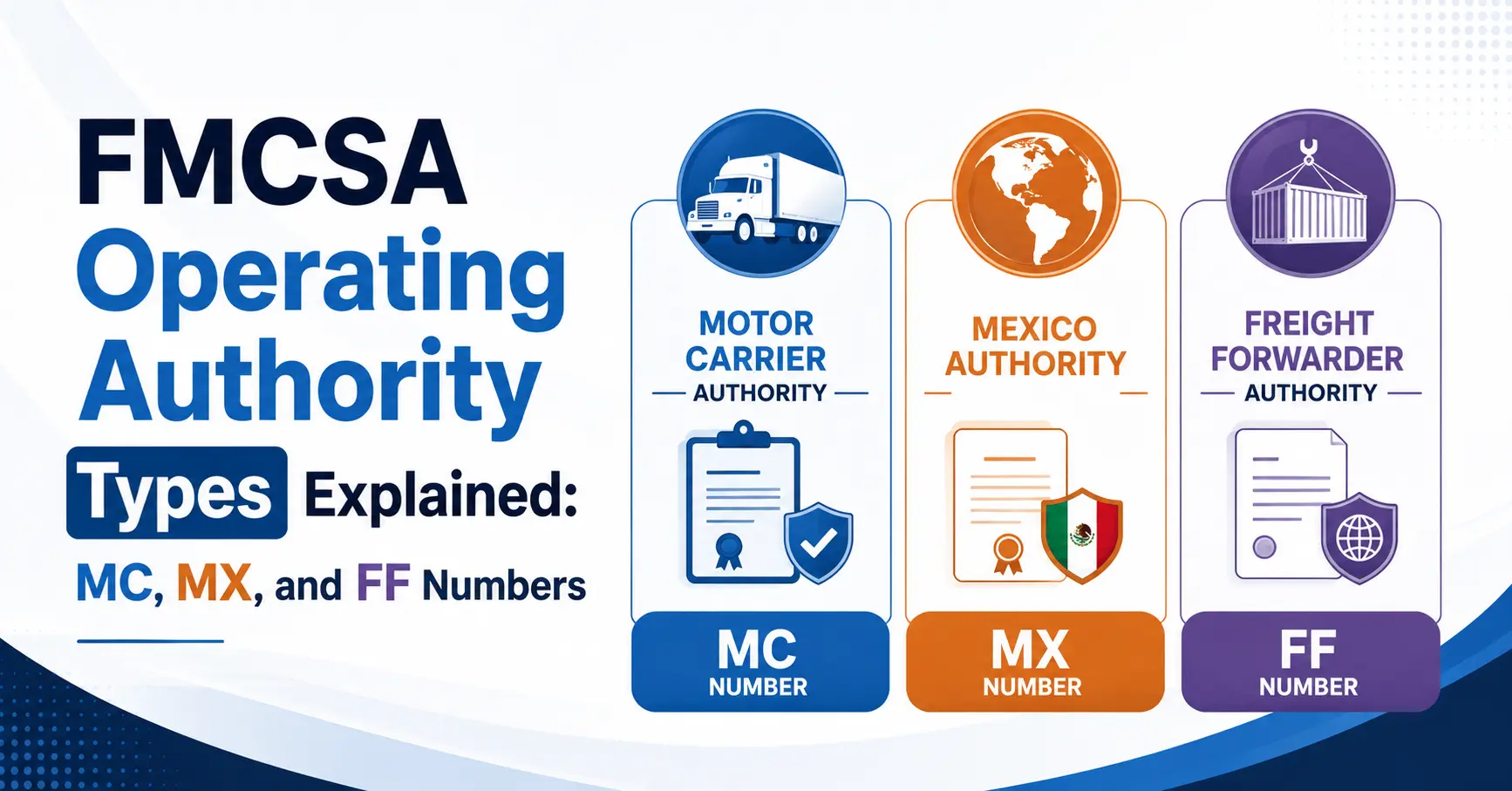
Whether you’re an owner-operator, motor carrier, freight broker, freight forwarder, or cross-border transportation company, understanding the differences between MC, MX, and FF operating authorities is essential for long-term compliance.
This guide explains each FMCSA operating authority type, who needs it, how it differs from a USDOT Number, the insurance and financial responsibility requirements involved, and how to determine which authority best matches your business model. You’ll also find practical examples, comparison tables, and compliance guidance to help you make informed decisions
FMCSA Operating Authority is the federal authorization required for businesses that transport regulated freight or arrange transportation for compensation in interstate commerce. The type of authority you need depends on your business activities.
- MC Number – Required for most for-hire motor carriers and property brokers.
- FF Authority – Required for freight forwarders.
- MX Number – Required for Mexico-domiciled carriers operating beyond U.S. commercial zones.
The right authority depends on the transportation services your company provides.
Note: The Federal Motor Carrier Safety Administration (FMCSA) regulates this authority under Title 49 of the Code of Federal Regulations (CFR).
What Is FMCSA Operating Authority?
FMCSA operating authority is the legal permission issued by the Federal Motor Carrier Safety Administration (FMCSA) that allows certain businesses to transport regulated goods or arrange transportation for compensation in interstate commerce.
Unlike a USDOT Number, which identifies a company for safety monitoring and compliance tracking, operating authority determines what type of transportation services a business is legally permitted to perform.
Depending on your business activities, the FMCSA may issue different authority types, including:
- Motor Carrier (MC)
- Freight Broker (MC)
- Freight Forwarder (FF)
- Mexico-Domiciled Carrier (MX)
Each authority comes with its own insurance requirements, filing obligations, and ongoing compliance responsibilities.
FMCSA Operating Authority
FMCSA Operating Authority is a federal authorization that permits a company to transport regulated freight or arrange transportation for compensation in interstate commerce. It establishes the legal operating rights of carriers, brokers, and freight forwarders.
FMCSA Operating Authority vs. USDOT Number
One of the most common misconceptions among new trucking businesses is assuming that a USDOT Number and an MC Number are the same thing.
Although they often work together, they serve different purposes.
| Feature | USDOT Number | FMCSA Operating Authority (MC / FF / MX) |
|---|---|---|
| Primary Purpose | Safety identification | Legal operating authority |
| Required for Safety Monitoring | ✔ | ✔ |
| Allows For-Hire Interstate Operations | ❌ | ✔ |
| Used During Audits | ✔ | ✔ |
| Insurance Filings Required | Usually No | Yes (depending on authority) |
| Issued By | FMCSA | FMCSA |
In Simple Terms
Think of a USDOT Number as your company’s identification record and your operating authority as your legal license to perform specific transportation services.
Many businesses require both.
Why Operating Authority Is Important
Operating authority is more than a registration requirement, it forms the legal foundation of your interstate transportation business.
Having the correct authority helps your company:
- Operate legally across state lines
- Obtain shipper and broker contracts
- Meet insurance filing requirements
- Pass compliance reviews
- Avoid enforcement actions
- Build credibility with customers
Operating without the proper authority may result in:
- Civil penalties
- Out-of-service orders
- Delayed authority activation
- Insurance complications
- Loss of business opportunities
Obtaining the correct authority from the beginning can prevent costly administrative corrections later.
Types of FMCSA Operating Authority
The FMCSA offers several operating authority classifications based on the services a company performs. Understanding these distinctions helps ensure your application aligns with your business model.
Below are the major types of FMCSA operating authority under the OP-series forms and the Unified Registration System (URS).
1. Motor Carrier Authority (MC Number)
Motor Carrier Authority is the most common operating authority for trucking companies that transport regulated freight for compensation.
A motor carrier owns or operates commercial motor vehicles and is responsible for moving cargo from one location to another.
Typical Businesses
- Owner-operators
- Trucking companies
- Flatbed carriers
- Refrigerated carriers
- Dry van fleets
- Specialized freight carriers
A trucking company hauling construction materials from Texas to Oklahoma for paying customers would typically require Motor Carrier (MC) Operating Authority because it is transporting regulated freight for compensation across state lines.
Key Compliance Requirements
- Active USDOT Number
- Public liability insurance
- BOC-3 Process Agent filing
- Unified Registration System (URS) application
- Ongoing safety compliance
Motor Carrier of Property (Except Household Goods)
This authority applies to carriers transporting general commodities that are not classified as household goods.
Includes:
- Steel
- Lumber
- Machinery
- Building materials
- Food products
- Industrial equipment
A flatbed carrier transporting construction materials across state lines for compensation would typically need Motor Carrier (MC) Operating Authority before beginning interstate operations.
Key Requirements:
- Proof of Public Liability (BI & PD) insurance filed with FMCSA.
- Compliance with 49 CFR Part 387 (Minimum Levels of Financial Responsibility).
- Registration through the Unified Registration System (URS).
Motor Carrier of Household Goods (HHG)
Household goods carriers transport personal property used in homes.
This authority is subject to additional consumer protection requirements because carriers handle individuals’ personal belongings.
Examples include:
- Residential moving companies
- Interstate movers
- Relocation service providers
Additional responsibilities include:
- Cargo insurance
- Public liability insurance
- Arbitration program participation for loss or damage disputes under 49 U.S.C. 14708.
- Consumer protection compliance
- Written estimates and documentation requirements
A moving company transporting a family’s household belongings from Wyoming to Colorado for compensation would typically require Household Goods (HHG) Operating Authority before conducting interstate moves.
Because of these additional obligations, HHG carriers face more extensive regulatory oversight than general freight carriers.
2. Broker Authority (MC Number)
A freight broker does not transport cargo. Instead, brokers connect shippers with authorized motor carriers while coordinating freight movement. Brokers never take possession of the freight and do not assume carrier responsibilities during transportation.
A logistics company receives a shipment request from a manufacturer and hires an authorized trucking company to complete the delivery. The broker coordinates the shipment and manages the transaction but does not own or operate the trucks transporting the freight.
Broker Requirements
To operate legally, brokers must obtain:
- Broker Operating Authority (MC)
- $75,000 Surety Bond (BMC-84) or Trust Fund (BMC-85)
- BOC-3 filing
- Active FMCSA registration
Because brokers handle financial transactions between shippers and carriers, federal regulations require financial security through a surety bond or trust fund.
Useful Link: FMCSA Insurance Filing Requirements
Freight Forwarder Authority (FF Number)
A Freight Forwarder (FF) combines the functions of a carrier and a broker. They arrange transportation but also take responsibility for the shipment, often consolidating freight, issuing bills of lading, and assuming liability for cargo.
Freight forwarders must have both operating authority and insurance coverage similar to carriers, including cargo and liability insurance.
A logistics provider collects several small shipments from different businesses, consolidates them into a single truckload, and manages the transportation under its own shipping documentation. This is a typical example of a freight forwarder providing transportation services.
Key Requirements:
- Freight Forwarder Authority (FF Number)
- Cargo insurance
- Public liability insurance
- Recordkeeping requirements
- Compliance with applicable FMCSA regulations
Businesses considering freight forwarding should carefully evaluate whether their operations extend beyond traditional brokerage services, as assuming responsibility for freight can significantly change regulatory obligations.
Quick Comparison: MC vs. Broker vs. FF Authority
| Authority | Transports Freight | Arranges Freight | Takes Responsibility for Cargo | Typical User |
|---|---|---|---|---|
| Motor Carrier (MC) | ✔ | Sometimes | ✔ | Trucking companies |
| Broker (MC) | ❌ | ✔ | ❌ | Freight brokers |
| Freight Forwarder (FF) | Sometimes | ✔ | ✔ | Logistics providers |
Decision Tree: Which Authority Might You Need?
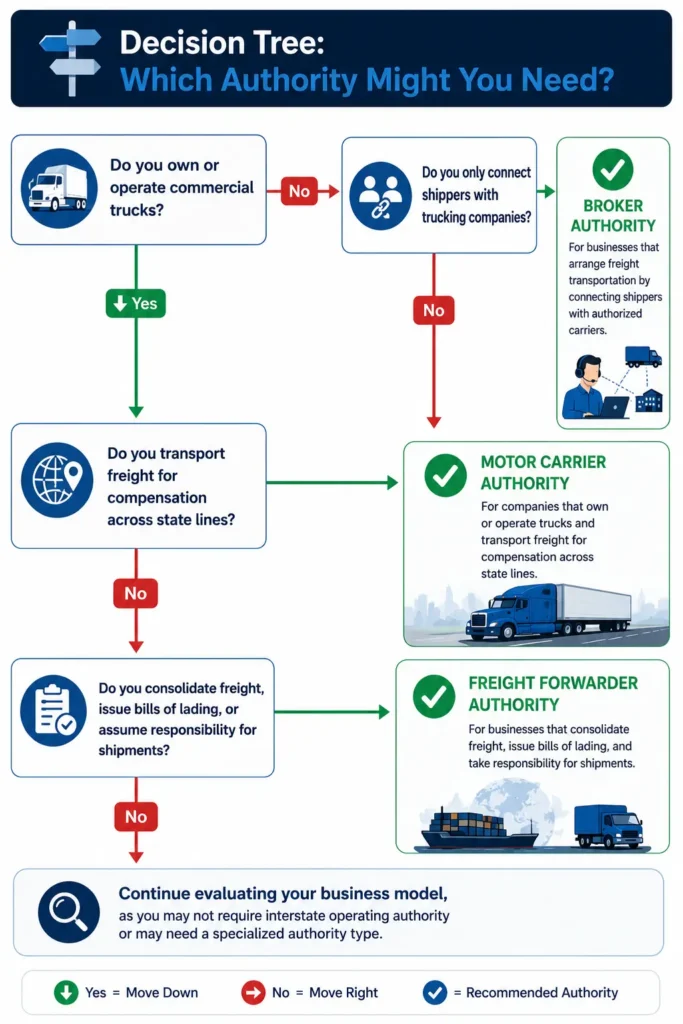
Continue evaluating your business model, as you may not require interstate operating authority or may need a specialized authority type.
Expert Insight
Many new transportation companies mistakenly apply for broker authority when they actually intend to operate trucks, or vice versa. Reviewing your business model before submitting an FMCSA application can help avoid processing delays, additional filing fees, and compliance complications.
If you’re unsure which authority aligns with your operations, working with experienced compliance professionals, such as the team at SafeRoad Compliance, can help ensure your registration is completed accurately from the start.
Mexico-Domiciled Carrier Authority (MX Number)
An MX Number is issued to Mexico-domiciled motor carriers that transport property or passengers beyond the commercial zones along the U.S.-Mexico border. This authority allows qualified carriers to operate in the United States while complying with FMCSA safety standards and applicable federal regulations.
Unlike standard MC authority, MX authority is specifically designed for cross-border transportation and requires carriers to meet additional safety and documentation requirements before operating in the United States.
A trucking company based in Monterrey, Mexico transports commercial goods to warehouses in Dallas, Texas. Because the carrier operates beyond the designated U.S. commercial zone, it must obtain FMCSA MX Operating Authority before conducting interstate commercial transportation in the United States.
Key Requirements
- MX operating authority application
- Active insurance meeting U.S. minimum requirements
- BOC-3 Process Agent designation
- Successful FMCSA safety review
- Compliance with driver qualification and vehicle inspection standards
- Ongoing adherence to U.S. Hours of Service and applicable FMCSA regulations
Note: Mexico-domiciled carriers operating beyond U.S. commercial zones must apply for an MX Number using Form OP-1(MX).
Other Specialized FMCSA Operating Authorities
Although most businesses only need Motor Carrier, Broker, Freight Forwarder, or MX authority, FMCSA also recognizes several specialized operating authority classifications.
These include:
United States–Based Enterprise Carrier of International Cargo (Except HHG)
This type of authority applies to U.S.-based companies owned or controlled (over 55%) by a Mexican citizen or resident alien that transports international cargo, excluding household goods.
A U.S.-based freight carrier owned by a Mexican company transports cross-border shipments from Mexico to destinations throughout the United States. Depending on its operating structure and the transportation services it provides, the carrier may be required to obtain FMCSA MX Operating Authority to legally conduct cross-border commercial operations.
Key Requirements:
- Proof of international cargo movement.
- Compliance with cross-border FMCSA and CBP regulations.
- Must maintain active insurance coverage applicable to international operations.
United States–Based Enterprise Carrier of International Household Goods
This authority covers the transportation of household goods internationally by U.S.-based companies controlled by Mexican nationals.
A moving company transports families’ household belongings between the United States and Mexico. Because the company provides cross-border household goods transportation, it may be required to obtain the appropriate FMCSA Household Goods (HHG) Operating Authority and meet all applicable cross-border operating requirements.
Key Requirements:
- Same insurance and arbitration requirements as HHG carriers.
- Proof of international household goods transport.
- Compliance with FMCSA and CBP regulations.
How to Choose the Right Operating Authority
Selecting the correct authority depends entirely on how your business operates, not simply on the type of freight you move.
Consider the following factors:
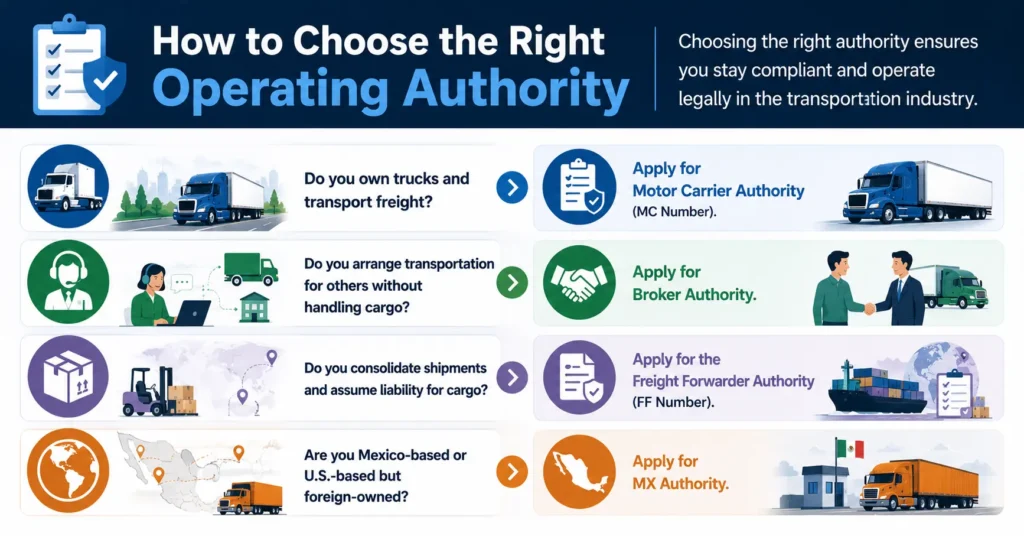
Questions to Ask Yourself
Before submitting an application, consider:
Answering these questions early helps prevent application errors and unnecessary filing costs.
How to Apply for FMCSA Operating Authority
Although each authority type has unique requirements, the overall registration process follows a similar path.
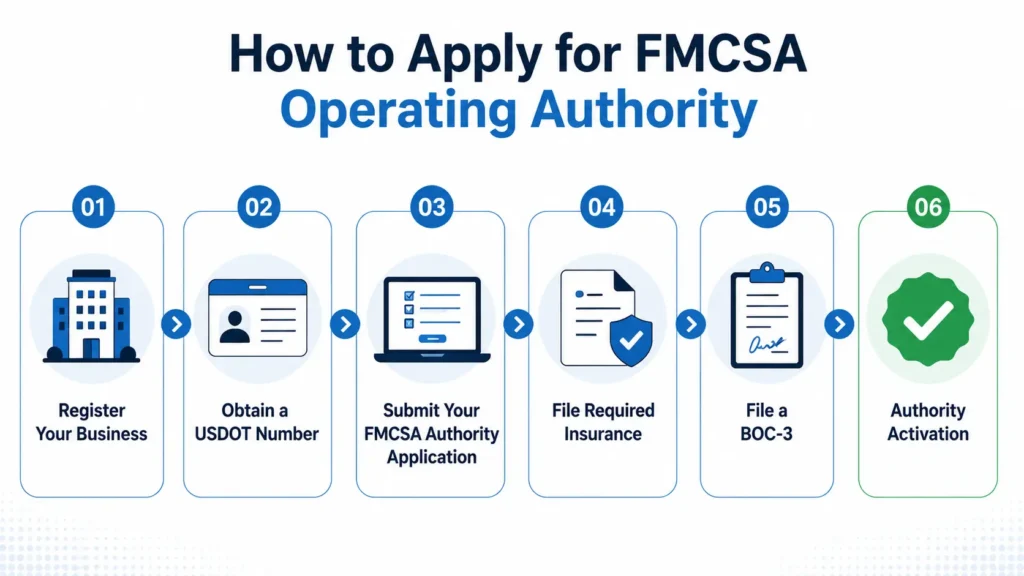
Step 1: Register Your Business
Form your legal business entity and obtain an Employer Identification Number (EIN) if applicable.
Step 2: Obtain a USDOT Number
Most interstate carriers must first obtain a USDOT Number, which identifies the company for safety monitoring and compliance purposes.
Step 3: Submit Your FMCSA Authority Application
Complete your application through FMCSA’s Unified Registration System (URS), selecting the authority that matches your business activities.
Be sure to review every section carefully, as mistakes may delay processing.
Step 4: File Required Insurance
Depending on the authority type, FMCSA requires proof of insurance before activating operating authority.
Examples include:
- Public Liability Insurance
- Cargo Insurance (when applicable)
- Surety Bond (BMC-84)
- Trust Fund (BMC-85)
Insurance must be filed electronically by your insurance provider.
Step 5: File a BOC-3
A BOC-3 (Designation of Process Agents) appoints legal representatives in every state who can accept legal documents on behalf of your business.
Without an approved BOC-3 filing, FMCSA cannot activate operating authority.
Step 6: Wait for Authority Activation
After all required filings have been received and the protest period has expired, FMCSA activates the operating authority.
Processing times vary depending on filing accuracy and insurance submission.
Insurance Requirements by Authority Type
Insurance requirements differ depending on the services your business provides.
| Authority | Liability Insurance | Cargo Insurance | Surety Bond |
|---|---|---|---|
| Motor Carrier | ✔ Required | Sometimes Required | ❌ |
| Household Goods Carrier | ✔ Required | ✔ Required | ❌ |
| Broker | ❌ | ❌ | $75,000 |
| Freight Forwarder | ✔ Required | ✔ Required | Depends on operations |
| MX Carrier | ✔ Required | May Apply | ❌ |
Always confirm current insurance requirements before filing, as specific coverage limits depend on the commodities transported.
Maintaining Compliance After Receiving Authority
Receiving operating authority is only the beginning. Businesses must continue meeting FMCSA compliance obligations to remain in good standing.
Ongoing responsibilities typically include:
- Keeping insurance active
- Renewing Unified Carrier Registration (UCR)
- Updating the MCS-150 Biennial Update
- Maintaining Driver Qualification Files (DQFs)
- Conducting vehicle inspections and maintenance
- Following Hours of Service regulations
- Maintaining drug and alcohol testing compliance (when applicable)
- Keeping accurate safety records
Failure to maintain compliance may result in suspension or revocation of operating authority.
Common Mistakes New Applicants Make
Many registration delays stem from avoidable errors.
Common mistakes include:
- Applying for the wrong authority type
- Confusing a USDOT Number with operating authority
- Waiting too long to obtain insurance
- Forgetting to submit a BOC-3 filing
- Entering inconsistent business information
- Failing to update the MCS-150 every two years
- Assuming cargo insurance is always optional
- Beginning operations before authority becomes active
Avoiding these mistakes can save both time and money.
Best Practices
To build a compliant and efficient transportation business:
- Review your business model before applying.
- Keep copies of all FMCSA filings and confirmations.
- Monitor insurance expiration dates.
- Perform regular compliance audits.
- Train employees on recordkeeping requirements.
- Use compliance management software to track deadlines.
- Stay informed about FMCSA regulatory updates.
- Maintain organized documentation for safety reviews and audits.
FMCSA Operating Authority Compliance Checklist
Completing these steps helps reduce delays and supports ongoing compliance.
Expert Tips
- Don’t choose an authority based solely on what another carrier has—base it on your own business activities.
- Review your insurance requirements before submitting your FMCSA application.
- Keep digital copies of all compliance documents for quick access during audits.
- Schedule periodic internal compliance reviews rather than waiting for an FMCSA investigation.
- If your services expand over time, review whether additional operating authority is required.
Conclusion
Selecting the correct FMCSA operating authority is one of the most important decisions a transportation business makes. Whether you operate as a motor carrier, broker, freight forwarder, or Mexico-domiciled carrier, choosing the proper authority helps ensure legal operations, smoother registration, and long-term regulatory compliance.
Understanding the differences between MC, MX, and FF authorities, along with their insurance, filing, and operational requirements, can prevent unnecessary delays and compliance issues as your business grows.
If you’re unsure which authority best fits your business model or need assistance completing FMCSA registrations, SafeRoad Compliance can help simplify the process. Learn more about our FMCSA Operating Authority Registration Services and get expert guidance to complete your filings accurately and stay compliant from day one.
Key Takeaways
- An FMCSA operating authority determines what transportation services your business can legally perform.
- A USDOT Number identifies your company for safety monitoring, while an operating authority grants legal permission to operate for hire.
- Motor carriers, brokers, freight forwarders, and Mexico-domiciled carriers each require different authority types.
- Insurance, BOC-3 filings, and other compliance requirements vary by authority classification.
- Maintaining insurance, updating registrations, and keeping accurate compliance records are essential after authority approval.
- Choosing the correct authority before applying can help avoid costly delays and administrative corrections.
Frequently Asked Questions
In most cases, FMCSA operating authority becomes active within 20–25 business days after the application is submitted, provided all required insurance filings and the BOC-3 designation are received on time and there are no protests or application errors. Missing documents or incorrect information can delay activation.
Yes. A company can hold multiple FMCSA operating authorities if it performs more than one regulated activity. For example, a trucking company may transport freight using its own trucks while also brokering loads to other authorized carriers. Each authority has separate compliance and financial responsibility requirements.
Not always. Many intrastate carriers only need a USDOT Number if required by federal or state regulations. However, if you transport regulated freight for hire across state lines or participate in interstate commerce, you will generally need the appropriate FMCSA operating authority in addition to your USDOT Number.
An MC Number is issued to U.S.-based for-hire motor carriers, brokers, and freight forwarders operating in interstate commerce. An MX Number is specifically issued to Mexico-domiciled carriers that operate beyond the commercial zones along the U.S.–Mexico border and must meet additional cross-border safety requirements.
No. Federal regulations do not require every motor carrier to maintain cargo insurance. However, household goods carriers must carry cargo insurance, and many shippers or freight brokers require cargo coverage through contractual agreements even when it is not federally mandated.
A BOC-3 (Designation of Process Agents) authorizes legal representatives in each state to receive court papers and legal notices on behalf of your business. FMCSA requires an approved BOC-3 filing before activating operating authority.
Yes. As your business grows, you can apply for additional operating authorities if your services expand. For example, a motor carrier can later obtain broker authority, or a broker may apply for freight forwarder authority if business operations change.
You can verify your authority status through the FMCSA Licensing & Insurance (L&I) system. The portal displays your operating authority, insurance filings, BOC-3 status, and current operating status, making it the official source for confirming whether your authority is active.
Need Help Choosing the Right FMCSA Operating Authority?
UApplying for FMCSA operating authority is more than completing an application, it requires selecting the correct authority type, meeting insurance requirements, submitting the proper filings, and maintaining ongoing compliance.
Whether you’re launching a new trucking company, becoming a freight broker, expanding into freight forwarding, or operating across the U.S.-Mexico border, choosing the correct authority from the beginning can help prevent delays and unnecessary expenses.
If you need guidance, SafeRoad Compliance’s FMCSA Operating Authority Registration Services can help you determine the right authority, prepare the required filings, and support your business through the registration process so you can start operating with confidence.