Disclosure: Informational only. We are not FMCSA or USDOT. Always verify your status directly through official FMCSA systems.
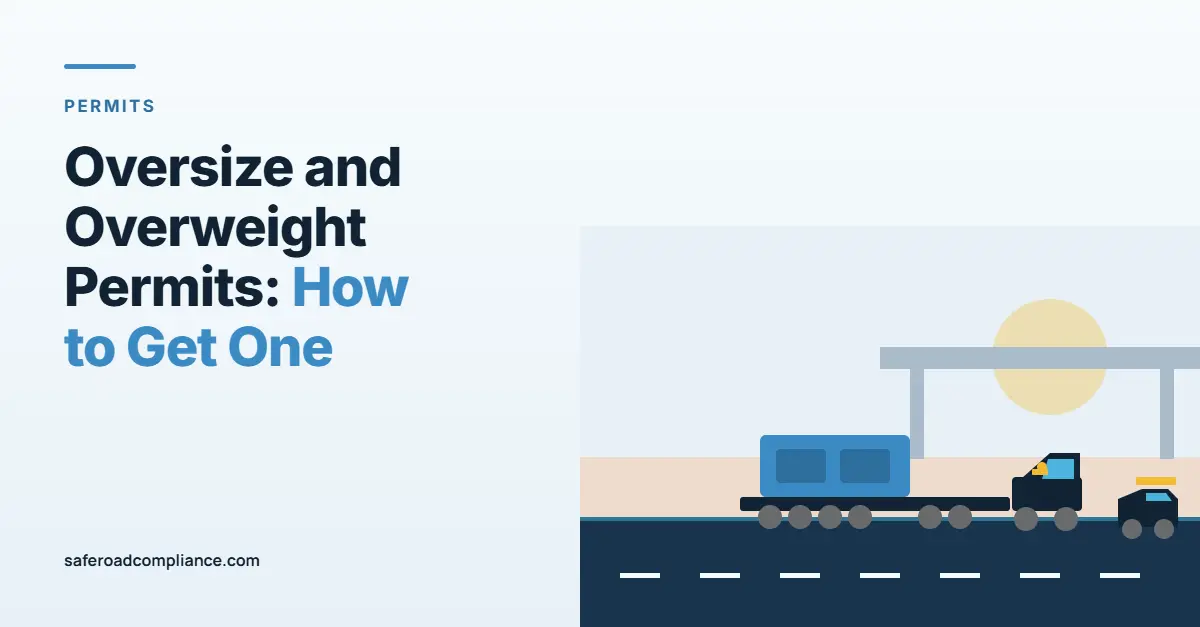
A load that goes past legal size or weight limits cannot move until the state issues a permit. The federal government does not issue these permits. The states do.
When a load needs a permit
A load needs an oversize or overweight permit when it goes past the legal limits on the road it travels. The main triggers are width, height, length, and weight. Each state sets its own limits, so the same load can need a permit in one state and not in the next. Height is the one most drivers miss. The federal government sets no height limit. States set their own, and most fall between 13 feet 6 inches and 14 feet.
The federal baseline
Federal rules set the limits on the National Network and the Interstate System. A load that stays within these numbers needs no federal permit. States can set stricter limits on their own roads.
- Width: 102 inches on the National Network. Wider cargo needs an overwidth permit.
- Gross weight: 80,000 pounds on the Interstate System, unless the bridge formula gives a lower number.
- Single axle: 20,000 pounds.
- Tandem axle: 34,000 pounds.
- Bridge formula: applies to groups of consecutive axles. A truck can pass the axle limits and still fail this formula.
States may permit a nondivisible load over these limits. A load is nondivisible when separating it would destroy its value or take more than 8 work hours to dismantle. The applicant must prove the dismantling time. Federal size and weight questions and answers lists the full figures.
Who issues permits and what they cover
Each state issues its own oversize and overweight permits. A permit is time-limited and tied to a specific vehicle or load. Most permits fall into three types:
- Nondivisible load permits: allow a load to exceed the axle, gross, or bridge limits when the load cannot be split.
- Divisible load permits: allowed only where a state has grandfather rights or a congressional authorization for a commodity or route.
- Overwidth permits: cover cargo wider than 102 inches on the National Network.
Federal rules also limit what states can require. A state may not require a permit as a condition for reasonable access.
Route check before you apply
A permit can be approved and the trip can still fail. Check the route before you apply, and check it again before you roll.
- Height and clearances: bridges, overpasses, signals, and wires along the route. Measure the load with its tie-downs and equipment on.
- Route restrictions: states can close specific roads or bridges to permitted loads, even when the load itself is legal for the state.
- Axle spacing: the bridge formula depends on how far apart the axles sit. Changing the trailer or the spacing can change the weight the route allows.
- County and city roads: local jurisdictions can set their own conditions on roads they control. Read each route line on the permit, not only the state highway names.
- Escort and pilot car requirements: these are set in the permit. Follow them exactly, including the equipment and the number of vehicles.
Apply directly or through a service
You can apply to each state yourself or use a permit service. A trip through several states means several applications, each with its own forms and route rules.
Direct Filing vs. Permit Service
Compare the responsibilities, effort, and support involved in obtaining permits.
| Factor | Apply Directly | Use a Permit Service |
|---|---|---|
| Who files | You, state by state | The service, under your account |
| Route knowledge | You check each state’s rules | The service checks routes and forms |
| Time you spend | Higher, especially on multi-state trips | Lower |
| Responsibility | You own every filing and error | You still own the load and the route |
Some states allow self-issued permits for certain loads. Check the state’s rules before you assume you can issue your own.
Cost and timing
Fees and processing times depend on the state and the permit type. Read each state’s current fee schedule before you budget a trip. Do not rely on a fee quoted in an older article.
Allow more time for loads that need an engineering review, a route survey, or escorts. Those steps add days, and a state may not issue a permit until each one clears.
Frequently asked questions
The state does. The federal government does not issue these permits.
No. Each state sets its own limits, so the answer depends on the state and the load.
Some states allow it for certain loads. Check the state’s rules first.
Permits are time-limited. Check the dates and every route condition on your permit before you move.
Don’t Let Compliance
Slow Your Business Down.
Stay organized, keep required records current, and stay ahead of important DOT compliance requirements with professional support.