Introduction to the FMCSA Pre-Employment Screening Program (PSP)
In the trucking and transportation industry, hiring qualified and safety-conscious drivers is essential. The Federal Motor Carrier Safety Administration (FMCSA) recognized this need and introduced the Pre-Employment Screening Program (PSP) to help carriers make better hiring decisions. The PSP provides access to a commercial driver’s crash and roadside inspection history, giving employers an accurate picture of a driver’s past safety performance before making a hiring decision.
Launched in 2010 as part of the FMCSA’s Compliance, Safety, Accountability (CSA) initiative, PSP was designed to improve highway safety and reduce crash rates by giving carriers insight into a driver’s historical data. According to FMCSA studies, carriers using PSP have seen an 8% reduction in crash rates and a 17% reduction in driver out-of-service (OOS) rates.
This article explores how the PSP works, what information it provides, how both carriers and drivers can use it, and why it is a valuable tool for compliance and operational safety.
What Is the Pre-Employment Screening Program (PSP)?
The Pre-Employment Screening Program is an online service managed by FMCSA that provides motor carriers, individual drivers, and third-party administrators access to safety performance data stored in the Motor Carrier Management Information System (MCMIS).
A PSP report contains a driver’s five years of crash data and three years of roadside inspection data. This information is sourced from FMCSA’s MCMIS database, which compiles data from every state in the U.S., ensuring accuracy and transparency.
The goal of PSP is not to penalize drivers but to help carriers make informed hiring decisions. It ensures that commercial drivers with a strong safety record are rewarded with better job opportunities while encouraging continuous safety improvement among all drivers.
For example, while a Motor Vehicle Record (MVR) only lists traffic convictions, a PSP report goes deeper by including all roadside inspection results, even those that did not lead to a citation. This gives employers a much more complete understanding of a driver’s safety history.
For carriers who want to build safe, compliant fleets, the PSP is an indispensable tool that complements other compliance requirements such as Driver Qualification (DQ) files, drug and alcohol testing, and DOT physical exams.
Related reading: Driver Qualification and Vetting Process
Why Was the PSP Created?
The PSP was established under the Safe, Accountable, Flexible, Efficient Transportation Equity Act: A Legacy for Users (SAFETEA-LU), a 2005 federal law aimed at improving transportation safety and efficiency. Congress directed FMCSA to create information systems that enhance the exchange of safety data and help carriers make data-driven hiring choices.
Before PSP, employers had limited access to safety data. They relied mainly on MVRs or internal records, which did not provide a complete safety performance picture. The PSP filled this gap by making national safety and violation data accessible to both employers and drivers.
By implementing the PSP, FMCSA aimed to:
- Reduce crashes involving commercial motor vehicles
- Improve the quality of carrier hiring decisions
- Encourage drivers to maintain clean safety records
- Increase accountability and data transparency
This initiative complements other FMCSA compliance programs like CSA scores, Drug and Alcohol Clearinghouse, and Driver Qualification Files, all of which contribute to a safer trucking industry.
Learn more about FMCSA’s role in safety: Understanding the Role of FMCSA in DOT Compliance
What Information Does a PSP Report Contain?
A PSP report provides comprehensive insight into a driver’s safety history. Each report includes:
- Crash Records:
Covers five years of DOT-recordable crashes, including the date, location, and motor carrier involved. - Roadside Inspections:
Includes three years of inspection data, listing all violations, whether or not they led to citations. - Out-of-Service Violations:
Notes instances where the driver or vehicle was placed out of service for safety violations. - Carrier Information:
Lists the company name under which the driver operated during each recorded incident. - Inspection Outcomes:
Details the results of each inspection, including violation codes and severity weights.
This level of detail provides employers with a more accurate measure of driver reliability and helps them evaluate safety risks. It also benefits drivers by promoting transparency, allowing them to monitor and improve their safety records over time.
How Do Carriers Use PSP in the Hiring Process?
Using PSP is voluntary, but many safety-conscious carriers consider it an essential part of their driver onboarding process. Once enrolled, a carrier can access a driver’s PSP report only with the driver’s written authorization. This consent ensures privacy and compliance with FMCSA regulations.
Carriers typically use PSP data to:
- Verify a driver’s safety performance before hiring
- Assess risk levels associated with prior crashes or violations
- Establish minimum qualification standards for driver applicants
- Supplement other pre-employment screening processes like MVR and background checks
For example, a carrier might set a policy that disqualifies applicants with multiple out-of-service violations or preventable crashes within the past two years. By using PSP data, the company can make those determinations with confidence.
See also: How to Maintain Driver Qualification Files
How Do Drivers Access and Use Their PSP Records?
Commercial drivers can access their own PSP records directly through the FMCSA PSP portal. By creating an account, they can view their crash and inspection history, ensuring that the data is accurate and up to date.
Drivers can also enroll in PSP Monitoring, a feature that notifies them whenever new data is added or changes occur in their record. Since FMCSA updates MCMIS data monthly, this monitoring helps drivers stay proactive about their safety performance.
If a driver finds incorrect information in their PSP report, they can file a Request for Data Review (RDR) through the FMCSA DataQs system. This allows them to challenge errors or request updates after a violation is dismissed or found non-preventable.
Monitoring PSP data helps drivers maintain a clean record and positions them for better employment opportunities.
How Much Does It Cost to Access PSP Reports?
The PSP operates on a simple and affordable pricing model:
- Individual Reports: $10 per report for single requests
- Bulk Requests: Discounts for carriers requesting multiple reports at once
- Subscription Plans: Monthly access for carriers based on fleet size
- Carriers with fewer than 99 power units: $25/month
- Carriers with 100 or more power units: $100/month
Payments can be made via ACH, credit card, or check, and carriers receive invoices for each billing cycle.
This flexible pricing structure makes it easy for both small and large carriers to incorporate PSP into their hiring processes without adding significant costs.
Benefits of the PSP for Carriers and Drivers
For Carriers:
- Improves hiring accuracy and reduces risk
- Enhances compliance with DOT and FMCSA standards
- Lowers crash rates and OOS violations
- Helps build a safety-first company culture
For Drivers:
- Provides transparency about their performance history
- Encourages responsible driving behavior
- Enables monitoring and correction of data errors
- Strengthens job prospects with reputable carriers
By integrating PSP into safety and compliance programs, carriers can align with broader FMCSA objectives and demonstrate commitment to highway safety.
Difference Between PSP and MVR Reports
While both PSP and Motor Vehicle Reports (MVRs) provide driver information, they serve different purposes:
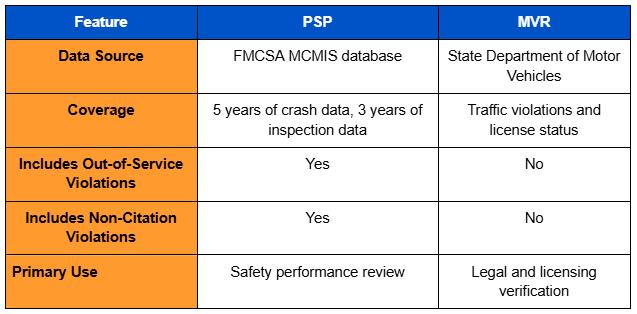
Using both reports together gives carriers the most complete picture of a driver’s record, ensuring safer hiring and better compliance outcomes.
How to Enroll in the PSP Program
Carriers can enroll online through the FMCSA PSP website. The process involves:
- Completing a company registration form
- Agreeing to FMCSA’s terms of use
- Providing company credentials (USDOT number, contact information)
- Setting up payment options for reports
After approval, the carrier receives login credentials to the PSP online system and can immediately begin ordering driver reports.
Key Takeaways
- The FMCSA Pre-Employment Screening Program (PSP) provides valuable data to carriers and drivers about crash and inspection histories.
- PSP reports include five years of crash data and three years of roadside inspection data.
- Carriers can use PSP to make safer hiring decisions and reduce crash risk.
- Drivers can review their own PSP data and correct inaccuracies through FMCSA DataQs.
- Studies show that carriers using PSP have 8% fewer crashes and 17% fewer out-of-service incidents.
Explore related topics: DOT Recordkeeping Requirements for Trucking Companies, CSA Scores Explained, DOT Compliance Mistakes to Avoid.
FAQs
No, participation in the Pre-Employment Screening Program (PSP) is voluntary, but many carriers use it to improve hiring accuracy and safety performance.
FMCSA updates PSP data monthly using the latest information from the MCMIS database.
Yes, through the FMCSA DataQs system, drivers can file a Request for Data Review (RDR) to challenge or correct inaccurate information.
The PSP includes federal crash and inspection data, while MVRs contain state-level traffic violations and licensing details.
Yes, FMCSA studies show that carriers using PSP experience fewer crashes and out-of-service violations.