Disclosure: Informational only. We are not FMCSAor USDOT. Always verify your status directly through official FMCSA systems.
Introduction
If you’re running trucks across multiple states, registration is not as simple as getting a single plate and hitting the road. Many carriers unknowingly operate with incorrect registration, which can lead to fines, penalties, and even operational delays during inspections. One of the most misunderstood requirements in interstate trucking is IRP registration.
So, what is IRP, and why does it matter for your fleet?
The International Registration Plan, commonly referred to as IRP, is a registration agreement that allows commercial vehicles to travel across multiple jurisdictions with a single apportioned plate. Instead of registering separately in each state, carriers pay registration fees based on the distance traveled in each jurisdiction.
Understanding IRP is critical for compliance, cost management, and smooth interstate operations. In this guide, we break down how IRP works, who needs it, how fees are calculated, and how you can stay compliant without unnecessary complications.
What Is IRP in Trucking?
The International Registration Plan, or IRP, is a cooperative agreement between the United States and Canadian provinces that simplifies vehicle registration for interstate carriers. It allows trucking companies to operate legally across multiple jurisdictions using a single registration system.
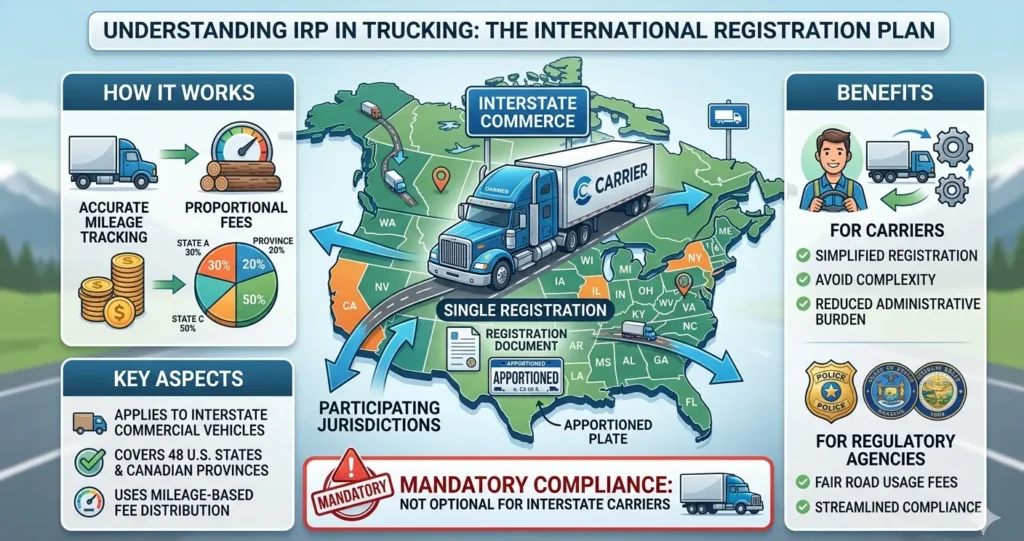
Under IRP, carriers receive apportioned plates, which grant them permission to travel in all participating jurisdictions. Instead of paying full registration fees in every state, carriers pay a proportional fee based on mileage driven in each location.
This system benefits both carriers and regulatory agencies. Carriers avoid the complexity of multiple registrations, while states receive their fair share of registration fees based on road usage.
Key aspects of IRP include:
- Applies to interstate commercial vehicles
- Covers all 48 contiguous U.S. states and most Canadian provinces
- Requires accurate mileage tracking
- Uses proportional fee distribution
For carriers operating beyond state lines, IRP is not optional. It is a mandatory compliance requirement that ensures your fleet is legally registered wherever it operates.
How IRP Registration Works for Carriers
IRP registration is based on the concept of proportional fees, meaning carriers pay according to how much they operate in each jurisdiction. The process begins with selecting a base jurisdiction, which is typically the state where your business is established.
Once registered, the carrier reports total miles traveled in each state during a reporting period. These miles are used to calculate the percentage of travel in each jurisdiction.
Here is how the process works:
- Choose a base state for registration
- Submit fleet details and operational records
- Report mileage across all jurisdictions
- Pay apportioned registration fees
- Receive apportioned plates and cab card
The cab card is a critical document that lists all jurisdictions where the vehicle is authorized to operate. Drivers must carry it at all times during operations.
Accurate mileage reporting is essential. Any discrepancies can lead to audits, penalties, or incorrect fee calculations. This is why many carriers invest in fleet tracking systems to automate mileage reporting and maintain compliance.
What Are Apportioned Plates?
Apportioned plates are the physical license plates issued under IRP registration. These plates allow a commercial vehicle to legally operate across multiple states without needing separate registrations.
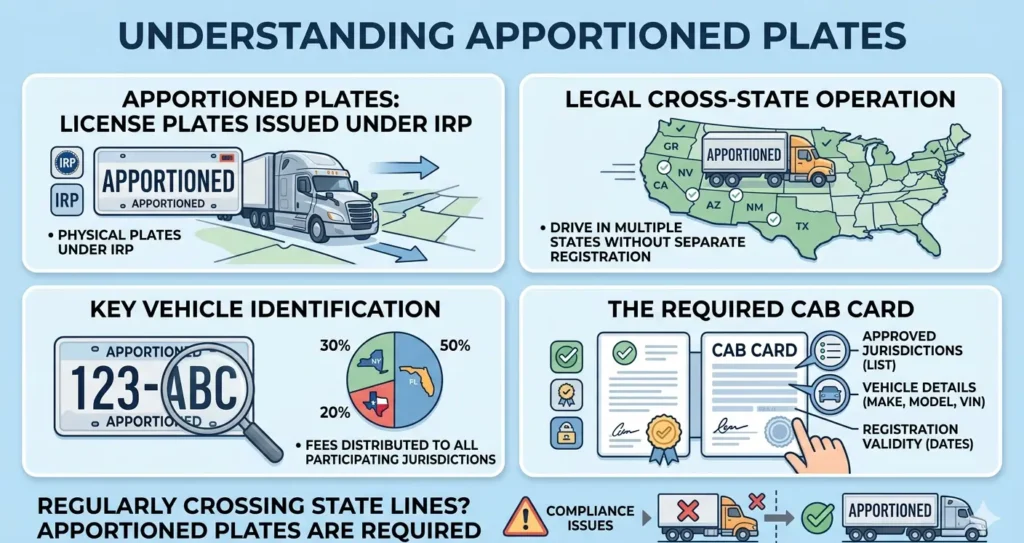
Unlike standard plates, apportioned plates indicate that the vehicle is registered under IRP and that fees have been distributed among participating jurisdictions.
When a carrier receives apportioned plates, they also receive a cab card. This document specifies:
- Approved jurisdictions
- Vehicle details
- Registration validity
Apportioned plates are essential for interstate operations. Without them, a carrier may be restricted to operating within a single state or face penalties for unauthorized travel.
Many new carriers confuse apportioned plates with standard registration, which can lead to compliance issues. If your vehicle crosses state lines regularly and meets weight requirements, apportioned plates are required.
Who Needs IRP Registration?
Not every commercial vehicle requires IRP registration. However, most interstate carriers fall under IRP requirements based on vehicle weight and operational scope.
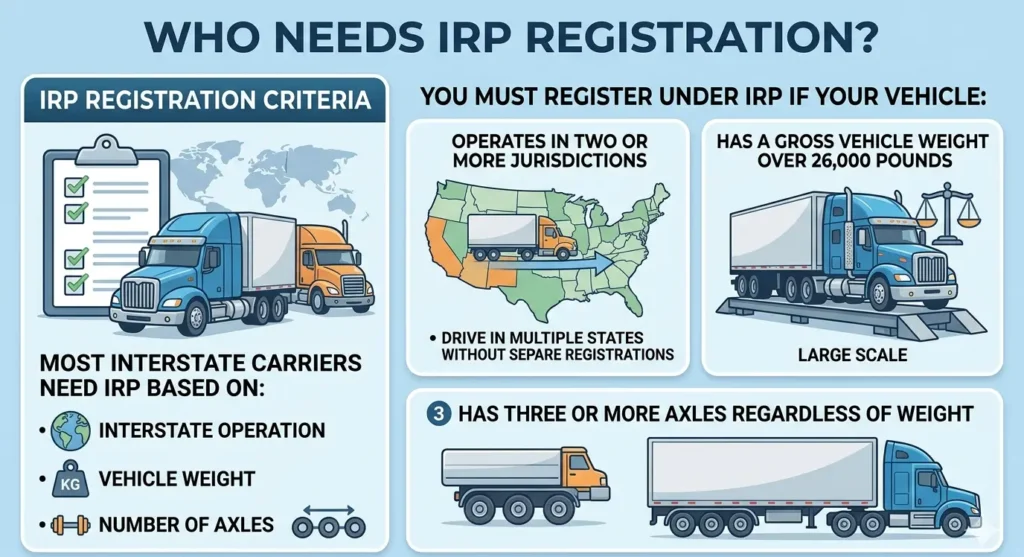
You must register under IRP if your vehicle:
- Operates in two or more jurisdictions
- Has a gross vehicle weight over 26,000 pounds
- Has three or more axles regardless of weight
- Is used for interstate commerce
Examples include:
- Long-haul trucking companies
- Owner-operators running multi-state routes
- Logistics and freight carriers
Vehicles that operate only within a single state do not need IRP registration. However, once you cross state lines, IRP becomes mandatory.
Failing to register under IRP when required can result in fines, vehicle impoundment, or denied entry into certain jurisdictions.
How IRP Fees Are Calculated
IRP fees are calculated based on the percentage of miles traveled in each jurisdiction. This ensures that each state receives a fair share of registration fees based on road usage.
The calculation involves:
- Total fleet mileage
- Mileage per jurisdiction
- Registration fee rates for each state
For example:
If your fleet travels:
- 50% in Texas
- 30% in California
- 20% in Arizona
Your registration fees will be distributed accordingly.
Factors that influence IRP fees include:
- Vehicle weight
- Distance traveled
- State-specific fee structures
Accurate recordkeeping is critical here. Even small errors in mileage reporting can result in overpaying or underpaying fees, both of which can trigger audits.
Common IRP Mistakes Carriers Make
Many carriers struggle with IRP compliance due to misunderstandings or poor recordkeeping. These mistakes can lead to audits, penalties, and operational disruptions.
Common mistakes include:
- Incorrect mileage tracking
- Choosing the wrong base jurisdiction
- Missing renewal deadlines
- Failing to update fleet changes
- Incomplete documentation
Pro Tip:
Use automated tracking systems to record mileage in real time. This reduces manual errors and ensures accurate reporting.
Another major mistake is confusing IRP with fuel tax requirements. While IRP handles registration, fuel taxes are managed separately under IFTA. If you want a detailed breakdown, read this guide:
Avoiding these mistakes is key to maintaining compliance and avoiding unnecessary costs.
IRP vs Other DOT Compliance Requirements
IRP is just one part of the broader DOT compliance landscape. Carriers must also manage fuel taxes, safety regulations, driver qualifications, and more.
IRP specifically deals with:
- Vehicle registration
- Interstate operation authorization
It does not cover:
- Fuel tax reporting
- Driver compliance
- Safety audits
This is where many carriers get confused. They assume IRP covers all compliance needs, which is not true.
For example:
- IRP handles registration fees
- IFTA handles fuel tax reporting
- FMCSA regulations cover safety and operations
Understanding how these systems work together is essential for running a compliant and efficient fleet.
Pro Tips to Stay Compliant with IRP
Maintaining IRP compliance requires consistent effort and proper systems. Here are practical tips to stay ahead:
- Track mileage daily using GPS or ELD systems
- Maintain organized records for audits
- Renew registration before deadlines
- Verify cab cards for accuracy
- Update fleet changes immediately
Insight:
Carriers with digital fleet management systems experience significantly fewer IRP-related violations compared to those using manual logs.
Additionally, training drivers on documentation requirements ensures they are prepared during roadside inspections.
Key Takeaways
- IRP is a registration system for interstate commercial vehicles
- Apportioned plates allow operation across multiple jurisdictions
- Fees are based on mileage distribution
- Accurate recordkeeping is essential for compliance
- IRP is separate from fuel tax and safety regulations
- Non-compliance can result in fines and operational delays
Conclusion
Understanding what IRP is and how it works is essential for any interstate carrier. From apportioned plates to mileage-based fee calculations, IRP plays a critical role in keeping your operations legal and efficient.
However, IRP is just one part of the larger compliance picture. Managing registration, fuel taxes, and safety regulations together requires a structured approach and expert guidance.
If you want to simplify compliance and avoid costly mistakes, explore professional DOT Compliance Services to keep your fleet fully compliant and audit-ready.
FAQs
The International Registration Plan (IRP) is a system that allows commercial vehicles to operate across multiple U.S. states and Canadian provinces with one registration. Instead of paying full registration fees in each state, carriers pay apportioned fees based on the miles driven in each jurisdiction.
You need IRP registration if your vehicle operates in two or more states and meets any of the following criteria:
• Gross vehicle weight exceeds 26,000 pounds
• Vehicle has three or more axles
• Used for interstate commercial transportation
Carriers that operate only within one state typically do not need IRP.
Apportioned plates are special license plates issued under IRP that allow a commercial vehicle to legally travel across multiple jurisdictions. These plates work alongside a cab card, which lists all approved states where the vehicle can operate.
IRP fees are calculated based on the percentage of miles your fleet travels in each state. The total registration fee is divided proportionally according to mileage, vehicle weight, and each state’s fee structure.
If your vehicle qualifies for IRP but is not registered, you may face:
• Fines and penalties
• Out-of-service orders
• Denied entry into states
• Delays during roadside inspections
Operating without IRP can also negatively impact your compliance record.
No, IRP and IFTA serve different purposes. IRP covers vehicle registration for interstate travel, while IFTA handles fuel tax reporting across states. Both are required for most interstate carriers but must be managed separately.
IRP registration is typically valid for one year and must be renewed annually through your base jurisdiction. Renewal requires updated mileage records and payment of apportioned fees.
Yes, owner-operators can apply for IRP registration if they operate across state lines and meet the weight or axle requirements. They must maintain proper mileage records and comply with all IRP reporting rules.
Common documents required for IRP include:
• Proof of business location
• Vehicle title or lease agreement
• USDOT number
• Mileage records
• Proof of insurance
Requirements may vary slightly by state.
To stay compliant with IRP:
• Track mileage accurately
• Maintain organized records
• Renew registration on time
• Keep cab cards updated
• Use fleet management or compliance software
Proper systems help prevent audits and penalties.