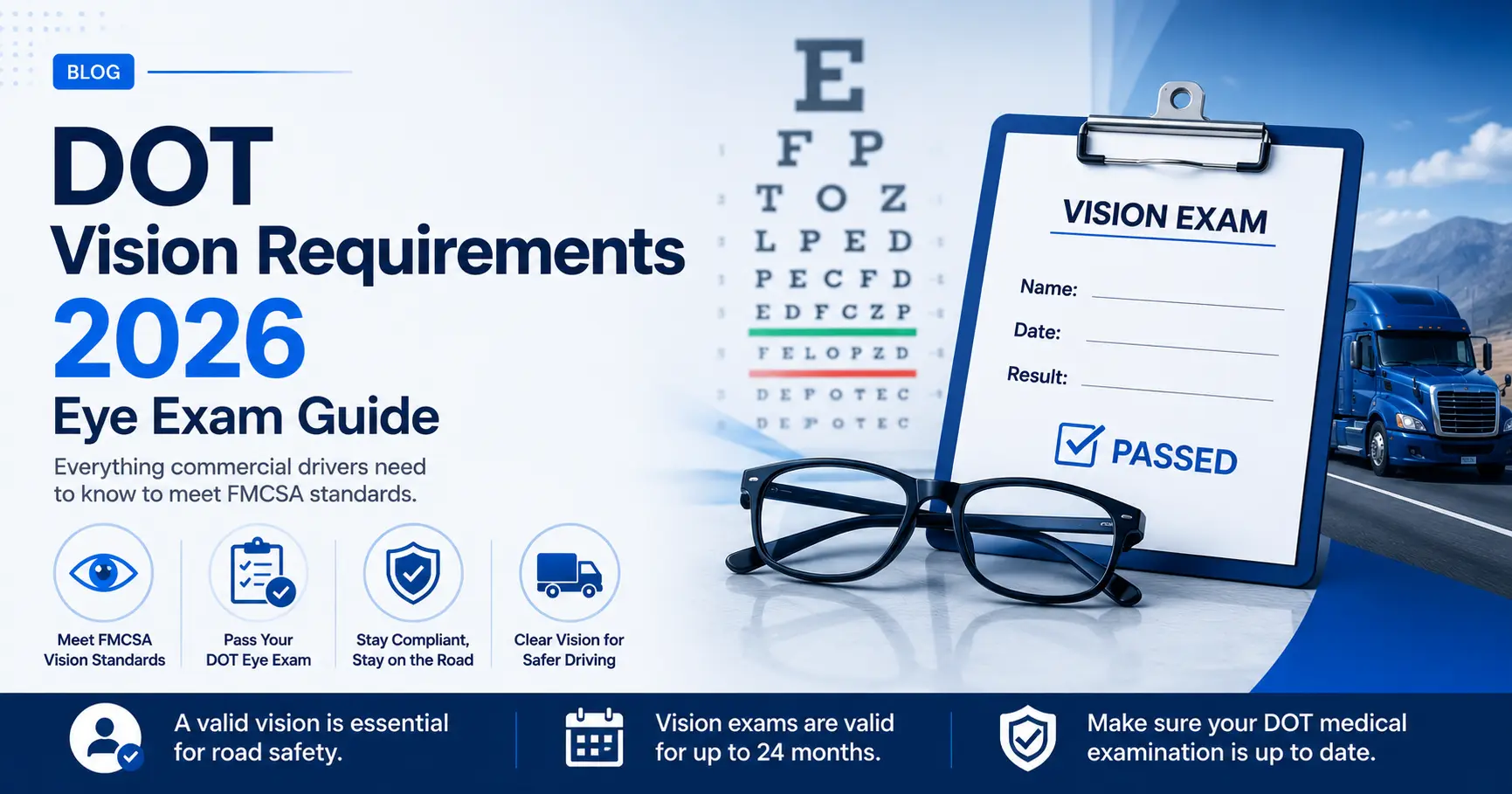
Vision plays a critical role in commercial driving safety, which is why the DOT Physical includes a strict eye examination process. For CDL drivers, meeting vision standards is not just about passing a test, it is about ensuring road safety, hazard awareness, and compliance with federal regulations.
The Federal Motor Carrier Safety Administration sets clear vision requirements under 49 CFR Part 391, ensuring that drivers can safely operate commercial motor vehicles under all conditions. These standards are designed to evaluate distance vision, peripheral awareness, and the ability to distinguish traffic signal colors.
If you are preparing for your DOT physical, check this complete DOT physical exam guide for full details.
What Is the DOT Vision Test and Why It Matters
The DOT vision test is a mandatory part of the medical certification process for commercial drivers. Its purpose is to ensure that every driver on the road has the visual ability to react quickly, identify hazards, and operate safely in high-risk environments.
Commercial driving requires constant awareness of surroundings, including reading road signs, monitoring blind spots, and reacting to sudden changes in traffic. Poor vision increases the likelihood of delayed reactions and accidents, making it a major safety concern.
The vision test focuses on three key capabilities:
- Distance vision for reading road signs and spotting hazards
- Peripheral vision for detecting vehicles and pedestrians
- Color recognition for identifying traffic signals
Failing to meet these requirements can result in disqualification or temporary delays in certification. This is why proactive vision care and preparation are essential for every CDL driver.
DOT Vision Requirements Under FMCSA Regulations
The FMCSA outlines strict vision standards under 49 CFR 391.41(b)(10). Drivers must meet all criteria to be considered medically qualified.
To pass the DOT vision exam, drivers must have:
- At least 20/40 vision in each eye, either without corrective lenses or corrected to 20/40 or better with lenses
- At least 20/40 vision with both eyes together (with or without corrective lenses)
- A minimum 70-degree field of vision in each eye
- The ability to distinguish red, green, and amber colors
These requirements ensure that drivers can safely recognize traffic signals, brake lights, and road hazards.
If corrective lenses are required to meet these standards, the medical examiner will note this on the medical certificate, and drivers must wear them at all times while operating a commercial vehicle.
What Eye Chart Is Used in the DOT Physical
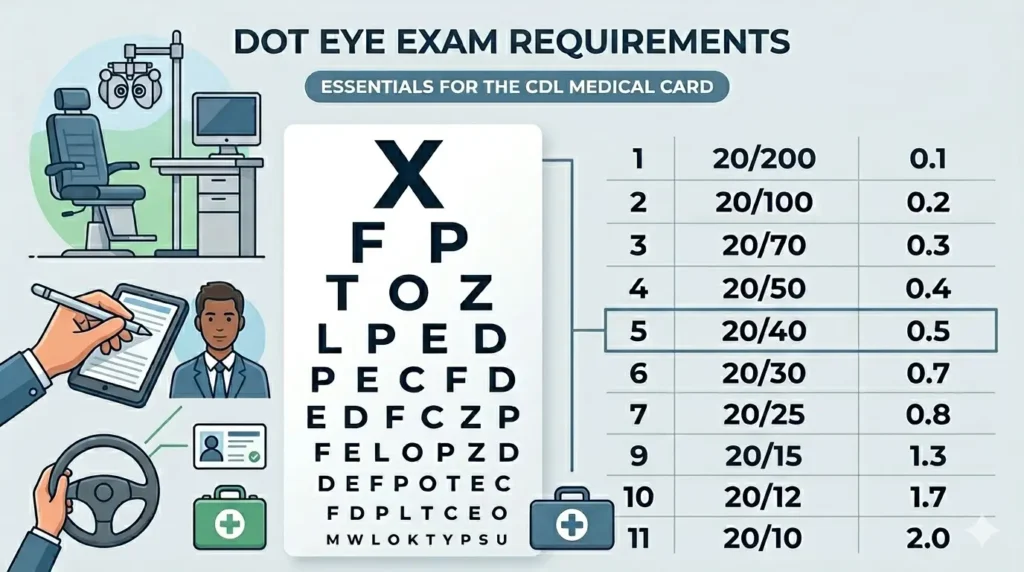
Most DOT physical exams use the Snellen eye chart, the standard chart with rows of letters decreasing in size. This test measures how clearly a driver can see at a distance.
In some cases, medical examiners may use specialized vision testing devices that assess:
- Depth perception
- Peripheral vision
- Reaction capability
The process is simple but important. Drivers are asked to read letters from a specific distance, usually 20 feet. Each eye is tested separately, followed by both eyes together.
The results help determine whether the driver meets the required visual acuity standards. Even minor vision issues can affect performance, so accuracy during testing is critical.
Understanding Peripheral Vision and Field of View
Peripheral vision is just as important as distance vision for commercial drivers. It allows drivers to detect movement and hazards outside their direct line of sight.
FMCSA requires drivers to have at least a 70-degree field of vision in each eye. This ensures that drivers can:
- Monitor adjacent lanes
- Detect vehicles approaching from the sides
- Respond to pedestrians or obstacles
During the exam, the medical examiner may perform a simple confrontation test or use specialized equipment to measure visual field range.
Drivers with reduced peripheral vision may still qualify under certain conditions, but they must demonstrate sufficient awareness and adaptation.
Color Vision Requirements for CDL Drivers
Recognizing traffic signal colors is a fundamental requirement for safe driving. The DOT vision test includes a color recognition assessment to ensure drivers can identify:
- Red for stop signals
- Green for go signals
- Amber for caution signals
This test may involve identifying colored lights or symbols. Drivers who cannot distinguish these colors accurately may face disqualification.
Color blindness does not automatically disqualify a driver, but the ability to correctly identify traffic signals is mandatory. Medical examiners evaluate this carefully during the certification process.
Safe driving depends on a combination of visual acuity, field of vision, and the ability to process visual information effectively. For a deeper understanding of how these standards are evaluated, refer to the FMCSA vision standard and waiver program analysis.
For more detailed medical guidance, refer to the official FMCSA visual disorders guidelines for commercial drivers.
Can You Pass the DOT Eye Exam with Glasses or Contacts
Yes, many drivers pass the DOT vision test using corrective lenses. In fact, it is very common for drivers to rely on glasses or contact lenses to meet the required standards.
If you use corrective lenses:
- Wear them during your exam
- Inform the medical examiner
- Ensure your prescription is up to date
If you meet the vision requirements with correction, you will still be certified. However, your medical certificate will include a restriction requiring you to wear corrective lenses while driving.
Drivers who fail to wear required lenses while operating a CMV may face penalties and compliance violations.
Monocular Vision and the Alternative Vision Standard
FMCSA introduced an alternative vision standard that allows drivers with vision in only one eye to qualify under specific conditions.
To qualify under this rule, drivers must:
- Have at least 20/40 vision in the better eye
- Maintain a 70-degree field of vision
- Demonstrate stable vision over time
- Complete a Vision Evaluation Report
This change has opened opportunities for many drivers who were previously disqualified. However, the process requires additional medical review and ongoing monitoring.
Drivers must renew their certification regularly and provide updated documentation to remain compliant.
What Happens If You Fail the DOT Vision Test
Failing the DOT vision test does not necessarily mean the end of your driving career. In many cases, the issue can be corrected with proper medical attention.
Common solutions include:
- Updating glasses or contact lens prescriptions
- Undergoing corrective procedures like LASIK
- Providing additional documentation from an eye specialist
Medical examiners may delay certification until the issue is resolved. Once corrected, drivers can retake the exam and obtain certification.
For drivers managing other health conditions, it is also important to review related requirements such as DOT physical blood pressure requirements.
How to Prepare for the DOT Eye Exam
Preparation can significantly improve your chances of passing the DOT vision test on the first attempt. Drivers who take proactive steps often avoid unnecessary delays and complications.
Here are key preparation tips:
- Schedule an eye exam before your DOT physical
- Update your prescription if needed
- Bring your glasses or contact lenses
- Avoid eye strain before the test
- Get proper rest to reduce fatigue
Drivers who experience headaches, blurred vision, or difficulty seeing at night should address these issues early. Preventive care ensures compliance and long-term driving safety.
How SafeRoad Compliance Helps Drivers Stay Qualified
Managing DOT medical requirements can be complex, especially for fleets with multiple drivers. SafeRoad Compliance simplifies this process with structured systems and expert support.
Our solutions include:
- Medical certificate tracking and alerts
- Digital record management for audits
- Compliance monitoring for FMCSA regulations
- Driver support and consultation
By automating compliance processes, we help carriers avoid missed deadlines, expired medical cards, and costly violations.
With SafeRoad Compliance, drivers and fleet managers can stay focused on operations while maintaining full regulatory compliance.
Key Takeaways
- DOT vision requirements ensure driver safety and compliance
- Drivers must meet 20/40 vision and 70-degree field standards
- Corrective lenses are allowed but must be worn if required
- Peripheral vision and color recognition are critical components
- Alternative vision standards allow qualification in certain cases
- Preparation and regular eye exams improve success rates
- SafeRoad Compliance helps streamline medical compliance management
FAQs
Drivers must have at least 20/40 vision in each eye and a 70-degree field of vision.
Yes, corrective lenses are allowed and commonly used during testing.
You may need corrective lenses or further evaluation before certification.
Yes, drivers must meet minimum field of vision requirements.
Yes, under the alternative vision standard with additional documentation.