Disclosure: Informational only. We are not FMCSA or USDOT. Always verify your status directly through official FMCSA systems.
Introduction
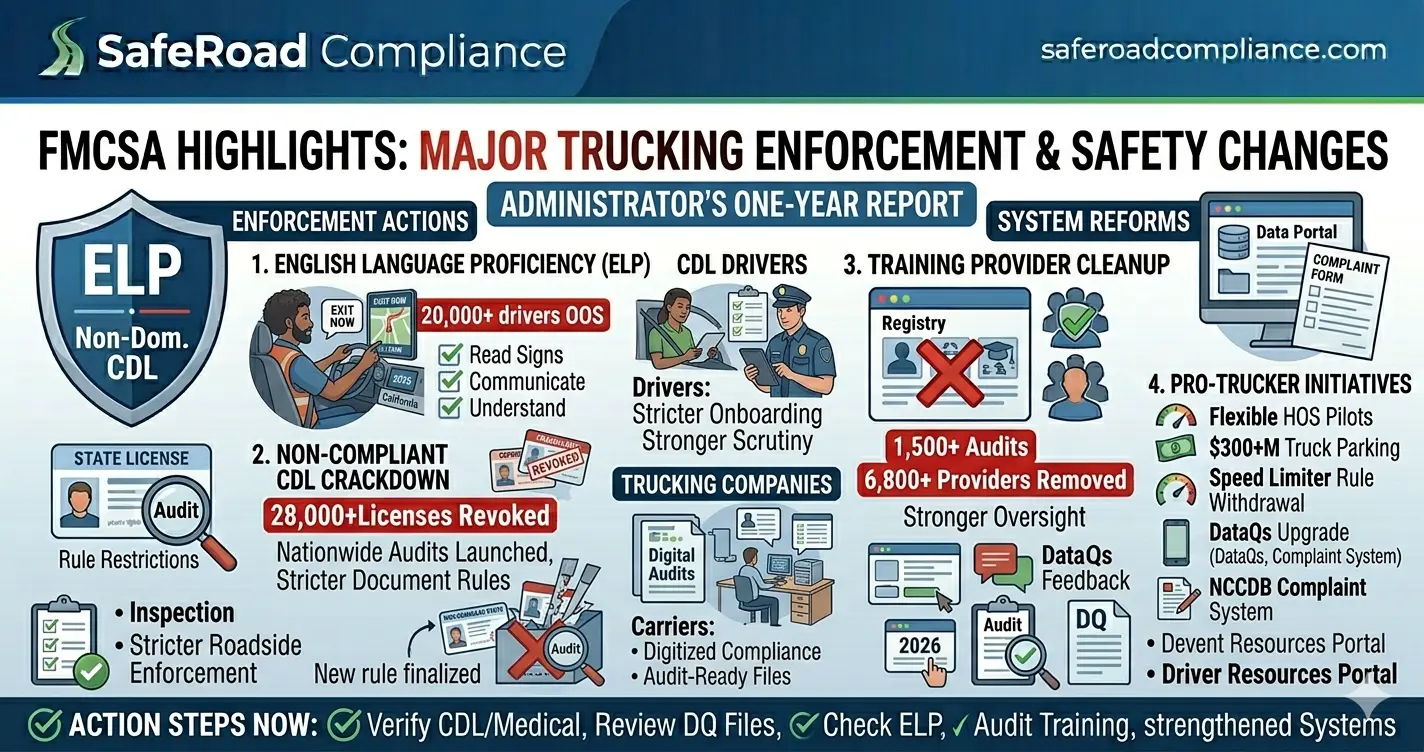
The Federal Motor Carrier Safety Administration and United States Department of Transportation have released a major update highlighting one year of trucking industry reforms under Sean P. Duffy.
The announcement outlines sweeping enforcement actions, CDL policy changes, English Language Proficiency (ELP) enforcement, training provider crackdowns, and multiple new initiatives impacting trucking companies and CDL drivers nationwide.
Key Update Summary
According to FMCSA, the administration has taken major actions focused on:
- Enforcing English Language Proficiency (ELP) rules
- Cracking down on non-compliant foreign CDL issuance
- Removing fraudulent training providers
- Expanding truck parking investments
- Updating DataQs and complaint systems
- Launching flexible Hours-of-Service pilot programs
- Reducing regulatory burdens for trucking companies
The agency describes these efforts as part of a broader push to restore “safety, security, and integrity” to the trucking industry.
Major Changes & Enforcement Actions
🇺🇸 English Language Proficiency (ELP) Enforcement
FMCSA reinstated stricter ELP enforcement standards in 2025.
Key Developments:
- English-only testing implementation underway
- 20,000+ drivers reportedly placed out-of-service since June 2025
- Funding withheld from states failing to enforce standards
- California resumed ELP enforcement in January 2026
Drivers must now demonstrate the ability to:
- Read road signs
- Communicate with law enforcement
- Understand official instructions
Crackdown on Non-Compliant CDL Issuance
FMCSA also intensified enforcement against states issuing non-compliant non-domiciled CDLs.
Reported Actions:
- Nationwide audits launched across states
- 28,000+ allegedly illegal licenses revoked
- Enforcement actions issued to multiple states
- New rules finalized to restrict unqualified foreign drivers from obtaining CDLs
This signals increased scrutiny around:
- CDL documentation
- Licensing procedures
- Driver verification systems
Training Provider Enforcement
FMCSA deployed investigators nationwide to review training providers.
Reported Outcomes:
- 1,500 training providers audited
- 6,800+ unqualified providers removed from FMCSA registry
Expect stronger oversight in:
- Entry-level driver training (ELDT)
- CDL school compliance
- Training documentation standards
Pro-Trucker Initiatives
The administration also announced several trucking support measures:
- $300+ million invested in truck parking grants
- Withdrawal of proposed speed limiter rulemaking
- Continued ELD exemption for pre-2000 trucks
- Pilot programs for flexible sleeper berth and split-duty periods
- Mobile-friendly upgrades to:
What This Means for Drivers & Companies
For CDL Drivers
Drivers should expect:
- Stricter roadside enforcement
- Increased document verification
- Stronger ELP screening
- More scrutiny during inspections
Compliance standards are clearly becoming tighter nationwide.
For Trucking Companies
Carriers must prepare for:
- Increased audits
- Higher driver qualification standards
- More aggressive enforcement actions
- Stronger compliance documentation requirements
FMCSA is shifting toward a more enforcement-driven compliance environment.
Action Steps (What You Should Do Now)
✔ Review driver qualification files immediately
✔ Verify CDL and medical documentation accuracy
✔ Ensure drivers meet ELP requirements
✔ Audit training provider records and ELDT compliance
✔ Strengthen internal compliance monitoring systems
✔ Prepare for increased roadside inspections and audits
SafeRoad’s Expert Analysis & Take
This announcement is much bigger than a political update.
From a compliance perspective, this is a clear roadmap of FMCSA’s future enforcement direction.
What FMCSA highlighted in this release tells trucking companies exactly where federal oversight is heading over the next several years. The agency is no longer focusing only on traditional paperwork audits or isolated roadside violations. Instead, the industry is moving toward a far more aggressive, data-driven, and qualification-focused compliance environment.
The Bigger Shift Happening Behind the Scenes
If you analyze all the actions mentioned in this announcement together, a very clear pattern emerges:
FMCSA is targeting three major areas simultaneously:
1. Driver Qualification Integrity
The agency is heavily focusing on:
- English Language Proficiency (ELP)
- CDL authenticity
- Medical qualifications
- Training legitimacy
- Driver eligibility verification
This means regulators are becoming increasingly concerned about whether drivers are truly qualified to operate commercial vehicles safely—not just whether documents exist on file.
In the past, many carriers treated qualification checks as basic onboarding paperwork. Going forward, FMCSA appears to be treating driver qualification as a core safety enforcement priority.
2. State & Carrier Accountability
Another major shift is that FMCSA is no longer placing responsibility only on drivers.
Now:
- States issuing non-compliant CDLs
- Training schools
- Medical exam systems
- Motor carriers themselves
…are all being held directly accountable.
The withholding of federal funds from states and nationwide audits sends a strong signal:
FMCSA is willing to apply financial and operational pressure at every level of the trucking ecosystem.
This creates a ripple effect where carriers may face:
- More investigations
- Stricter verification expectations
- Increased audit frequency
- Greater liability exposure
3. Digital & Real-Time Enforcement
Several updates mentioned in the release point toward a future of digital compliance monitoring:
- Upgraded DataQs systems
- Enhanced complaint tracking
- Electronic verification systems
- Increased database integration
- Expanded audit technology
Compliance is becoming increasingly real-time.
Historically, many compliance problems were discovered months later during audits. But FMCSA is clearly building systems designed to identify issues much faster.
That means:
- Invalid records
- Incorrect CDL data
- Medical certification problems
- HOS inconsistencies
- Training documentation gaps
…may become easier for regulators to detect immediately.
What Smart Trucking Companies Should Notice
FMCSA is no longer focused only on:
- Basic compliance paperwork
The agency is now aggressively targeting:
- Driver qualification integrity
- Licensing loopholes
- Fraudulent training systems
- Digital compliance oversight
- State-level enforcement failures
The Real Industry Shift Happening
This marks a transition toward:
“High-enforcement compliance era”
Where FMCSA is prioritizing:
- Real-time verification
- Data-based enforcement
- Aggressive auditing
- Qualification authenticity
Hidden Risk Many Carriers Ignore
Many companies still operate with:
- Incomplete DQ files
- Weak onboarding procedures
- Poor documentation systems
Under this enforcement environment, those weaknesses become major liabilities.
SafeRoad’s Pro Recommendation
The carriers that succeed over the next few years will be the ones that:
✔ Build audit-ready systems NOW
✔ Digitize compliance tracking
✔ Strengthen hiring verification procedures
✔ Monitor driver eligibility continuously
✔ Treat compliance as an operational strategy—not just paperwork
Strategic Insight
FMCSA’s recent actions show one thing clearly:
Enforcement is becoming faster, stricter, and more data-driven.
Companies waiting until audits happen will already be behind.
Source: Official FMCSA Announcement
Stay Compliant with SafeRoad Compliance
The trucking industry is entering a new era of compliance enforcement.
At SafeRoad Compliance, we help carriers:
- Stay audit-ready
- Maintain compliant driver qualification systems
- Manage FMCSA regulations proactively
- Reduce risk before violations occur
Protect your fleet with smarter compliance systems built for modern FMCSA enforcement.
Schedule an Appointment Today
Book your 30-minute compliance consultation with our DOT experts.