Disclosure: Informational only. We are not FMCSA or USDOT. Always verify your status directly through official FMCSA systems.
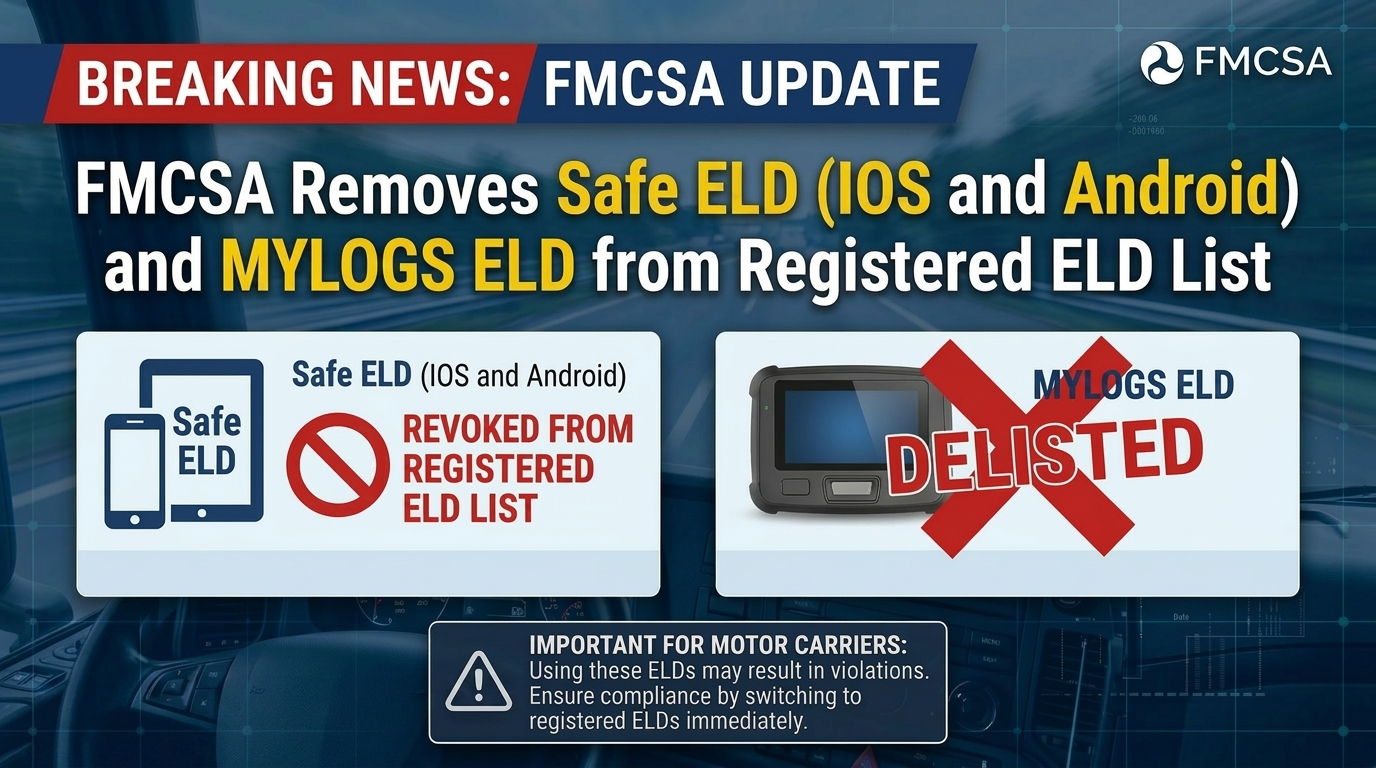
This latest ELD removal announcement on Thursday, May 7, 2026 is another strong indicator that FMCSA is aggressively tightening control over the electronic logging ecosystem.
At first glance, many carriers may see this as:
“Just another ELD revocation.”
But from a compliance and enforcement perspective, this update actually reveals something much bigger happening across the industry.
FMCSA Is Actively Cleaning the ELD Market
The most important statement in this bulletin is not the device names.
It’s this:
FMCSA has now removed 67 noncompliant ELD devices since January 2025
That number is extremely significant.
It shows that FMCSA is no longer simply approving devices and relying on providers to self-manage compliance. The agency is now:
- Monitoring ELD providers more aggressively
- Auditing technical compliance standards
- Removing unreliable systems faster
- Increasing enforcement pressure on technology vendors
This marks a major shift toward:
Active ELD ecosystem enforcement
Why This Matters More Than Most Carriers Realize
Many trucking companies assume:
“If the device was once approved, it must still be safe to use.”
That assumption is now dangerous.
The reality is:
- ELD approval is no longer “set it and forget it”
- Providers can lose compliance status unexpectedly
- Carriers become responsible the moment revocation occurs
This creates operational risk that many fleets are not prepared for.
The Hidden Compliance Risk: Emergency ELD Transitions
One of the biggest problems we see during ELD revocations is not the removal itself.
It’s the rushed transition afterward.
When carriers suddenly switch:
- Drivers become confused
- Log continuity gets disrupted
- HOS records become inconsistent
- Paper log backups are poorly maintained
- Compliance teams panic near the deadline
This creates the perfect environment for:
- Audit findings
- Roadside violations
- Missing records
- Out-of-service risks
FMCSA’s Enforcement Philosophy Is Changing
Historically, FMCSA focused heavily on:
- Driver behavior
- HOS violations
- Roadside inspections
Now the agency is increasingly focused on:
The technology infrastructure behind compliance itself
That includes:
- ELD reliability
- Data integrity
- Record authenticity
- System performance
- Digital compliance accuracy
This is important because modern FMCSA enforcement is becoming:
Technology-driven enforcement
What Smart Carriers Should Learn From This
The biggest lesson here is:
Choosing an ELD provider is no longer just an operational decision.
It’s now a compliance-risk decision.
Many smaller carriers choose ELDs based on:
- Cheapest price
- Simple interface
- Quick installation
But low-cost providers often:
- Lack technical support
- Fail certification standards
- Struggle with FMCSA compliance requirements
- Become revocation risks
The short-term savings can quickly become:
- Downtime
- Compliance violations
- Lost revenue
- Driver frustration
- Audit exposure
Another Hidden Risk: Paper Log Transition Errors
FMCSA allows temporary paper logs during the transition period, but many fleets underestimate how risky that period can become.
When fleets move from digital logs back to temporary manual systems:
- Drivers often forget proper documentation procedures
- Supporting documents become inconsistent
- Duty status changes are recorded incorrectly
- Dispatch coordination becomes weaker
Even though citations may be temporarily reduced before the deadline, the compliance exposure still exists.
And if records are later reviewed during an audit, inconsistencies can still create serious problems.
SafeRoad’s Strategic Recommendation
Carriers should treat every ELD revocation as:
“A fleet-wide compliance event”
Not just a software replacement.
Here’s what smart fleets should do immediately:
Audit Your Current ELD Provider
Don’t assume your provider is safe long term.
Review:
- FMCSA registration status
- Provider support quality
- Update frequency
- Technical reliability
- Compliance history
Create an ELD Emergency Response Plan
Most fleets have no backup process if an ELD suddenly gets revoked.
Build procedures for:
- Temporary paper logging
- Driver retraining
- Data backup
- Transition documentation
- Fleet-wide communication
Train Drivers Before Problems Happen
Many compliance issues occur because drivers:
- Don’t understand paper logs
- Forget HOS backup procedures
- Mismanage transition periods
Driver education is critical during these events.
Monitor FMCSA ELD Updates Regularly
The pace of revocations is increasing.
Companies that fail to monitor updates risk:
- Missing deadlines
- Continuing use of revoked systems
- Operating unknowingly in violation
Concluding Industry Analysis
This announcement confirms something very important:
FMCSA is transforming ELD compliance from a passive registration system into an actively enforced digital compliance framework.
The industry is moving toward:
- Stronger technology oversight
- Faster enforcement actions
- Real-time compliance validation
- Increased digital accountability
The carriers that will thrive in this environment are the ones that:
- ✔ Build stable compliance systems
- ✔ Choose reliable technology partners
- ✔ Prepare for enforcement changes early
- ✔ Treat compliance technology as business-critical infrastructure
The carriers that continue relying on weak systems, outdated processes, or low-cost shortcuts will face increasing operational and regulatory pressure moving forward.
Sources
Official FMCSA Bulletin:
FMCSA Removes Safe ELD and MYLOGS ELD from Registered Devices List
FMCSA Registered ELD Devices List:
FMCSA Registered ELD List
Commercial Vehicle Safety Alliance OOS Criteria:
CVSA ELD Out-of-Service Enforcement Criteria
FMCSA ELD Information Portal:
FMCSA ELD Website
Stay Compliant & Avoid FMCSA Penalties
Don’t risk your business by missing critical updates from the Federal Motor Carrier Safety Administration.
SafeRoad Compliance offers expert DOT Compliance Services designed to keep your trucking operations safe, legal, and audit-ready.
👉 Get in touch today and let our experts handle your compliance needs.
Schedule an Appointment Today
Book your 30-minute compliance consultation with our DOT experts.