Disclosure: Informational only. We are not FMCSA or USDOT. Always verify your status directly through official FMCSA systems.
Introduction
Most motor carriers think about their BOC-3 filing only when applying for FMCSA operating authority. Once the filing is accepted, it often becomes a “set it and forget it” compliance requirement. However, your designated process agent may resign, stop providing services, or become unreachable, creating an unexpected compliance issue that should be addressed promptly.
A process agent serves an important legal function by accepting service of process and certain legal documents on behalf of your company. If that representative is no longer available and your BOC-3 information is outdated, important legal notices may not reach your business when they should. This can complicate legal proceedings and create unnecessary operational risk.
Fortunately, replacing a process agent is a straightforward process when handled correctly. This guide explains what happens if your process agent resigns, when you should update your BOC-3 filing, how to select a qualified replacement, and the steps carriers can take to maintain uninterrupted FMCSA compliance.
What Is a Process Agent?
A process agent is an individual or company authorized to receive service of process and certain legal documents on behalf of a motor carrier, freight broker, or freight forwarder.
Because interstate carriers may become involved in legal proceedings in states where they do not maintain a physical office, FMCSA requires companies operating under federal authority to designate representatives who can legally accept documents in each state where service may occur.
Rather than appointing individual agents across the country, most carriers work with an FMCSA-approved blanket process company that provides nationwide coverage and electronically files the required BOC-3 form.
Process Agent Responsibilities
A designated process agent may receive documents such as:
- Civil lawsuits
- Court summons
- Legal complaints
- Regulatory notices
- Certain administrative documents requiring legal service
It is important to understand that a process agent does not:
- Manage DOT compliance programs
- Represent carriers in court
- Provide legal advice
- Handle safety audits
- Respond to FMCSA investigations on your behalf
Their primary responsibility is to ensure legal documents can be properly received and forwarded to your company.
Why Every FMCSA-Authorized Carrier Needs a Process Agent
The FMCSA requires a valid BOC-3 filing before operating authority can generally become active for carriers, brokers, and freight forwarders subject to the requirement.
The process agent requirement helps establish a consistent legal framework by ensuring that companies operating across state lines remain accessible for service of process regardless of where legal proceedings arise.
Without this system, individuals or organizations attempting to serve legal documents could face significant challenges locating interstate transportation companies operating in multiple jurisdictions.
For carriers, maintaining accurate process agent information helps support:
- Compliance with FMCSA operating authority requirements
- Reliable receipt of legal documents
- Accurate business records
- Efficient handling of legal matters
- Reduced risk of missed notifications
What Happens If Your Process Agent Resigns?
A process agent may resign for several reasons, including business closure, organizational restructuring, discontinued services, or changes to its client relationships.
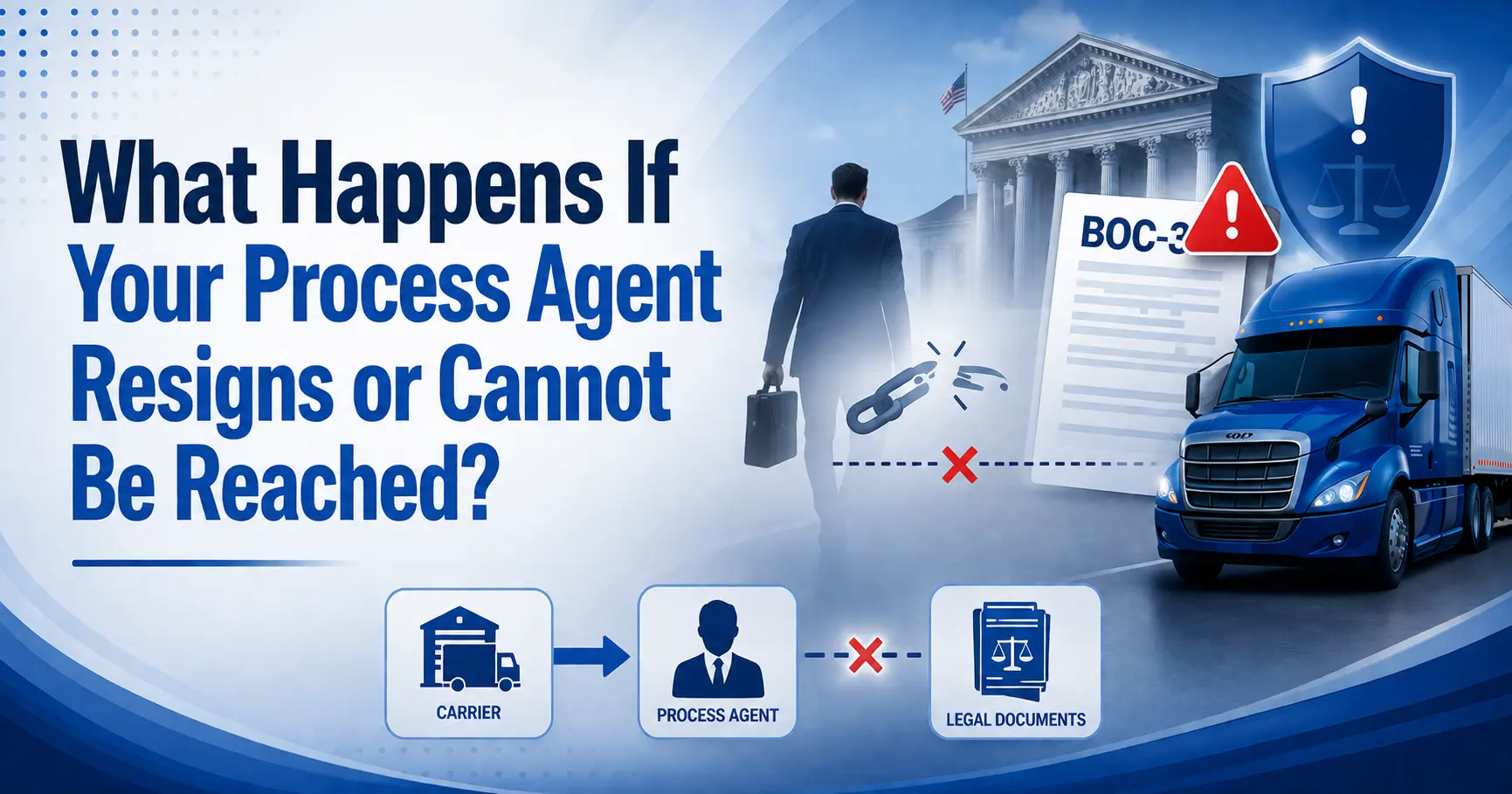
If this occurs, your company should not assume the original BOC-3 filing remains adequate indefinitely. An unavailable process agent may no longer be able to receive or forward legal documents intended for your business.
Although a resignation does not automatically cancel your operating authority, leaving outdated process agent information on file can expose your company to avoidable legal and administrative complications.
For this reason, carriers should arrange for a replacement FMCSA-approved blanket process company and have a new BOC-3 filed as soon as practical after learning that their designated agent is no longer available.
Common Reasons a Process Agent Becomes Unavailable
Several situations may require a carrier to update its BOC-3 filing.
Common examples include:
- The blanket process company permanently closes.
- The provider discontinues process agent services.
- The company resigns as your designated agent.
- Your provider merges with another organization.
- The business can no longer be contacted.
- Repeated communication attempts go unanswered.
- You choose to move to another approved provider offering better support.
Regardless of the reason, carriers should verify that their designated process agent remains active and capable of accepting legal documents.
Risks of an Outdated BOC-3 Filing
Many carriers assume that once a BOC-3 has been filed, no further action is required. In reality, the filing should remain accurate throughout the life of your operating authority.
If your designated process agent resigns or becomes unavailable and your records are not updated, your business could face unnecessary legal and administrative risks.
Potential issues include:
- Legal documents not reaching your company promptly
- Delays in responding to lawsuits or legal notices
- Increased administrative complications
- Outdated FMCSA records
- Missed communications involving service of process
- Additional time spent resolving avoidable compliance issues
Although an outdated BOC-3 does not automatically suspend your authority, maintaining current information is an important part of good compliance management.
Why Prompt Replacement Matters
Replacing a process agent isn’t simply about updating paperwork.
Your designated representative serves as the official contact for receiving legal service on behalf of your business. If that representative can no longer perform this function, important documents may not reach the appropriate people within your company.
Promptly filing an updated BOC-3 helps:
- Maintain accurate FMCSA records
- Preserve uninterrupted service of process
- Reduce the risk of missed legal notifications
- Support ongoing regulatory compliance
- Give carriers confidence that official documents can be delivered correctly
For growing fleets, keeping compliance records current is just as important as maintaining driver qualification files, insurance filings, and vehicle documentation.
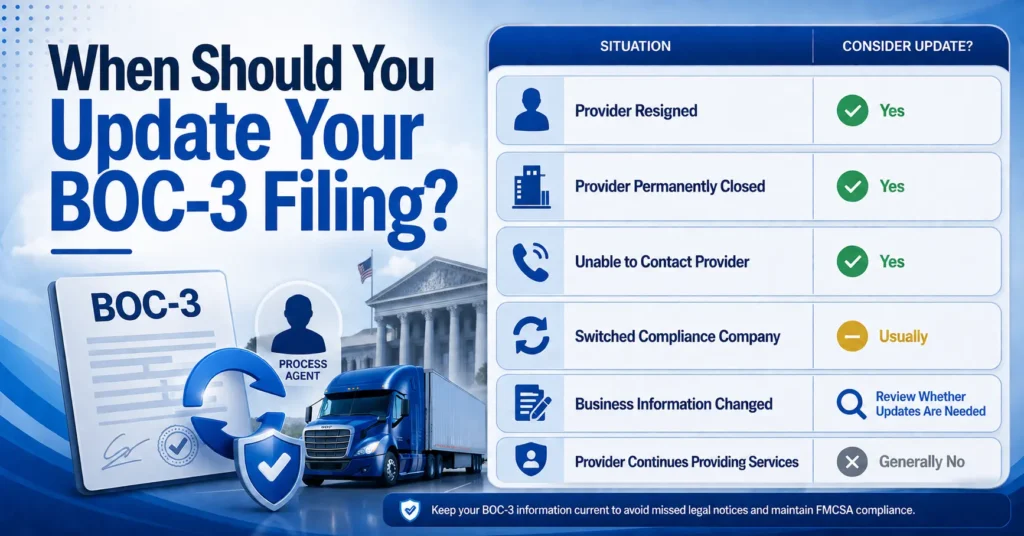
When Should You Update Your BOC-3?
Carriers should not wait until a legal issue arises before reviewing their process agent information.
A new BOC-3 filing is generally appropriate whenever the designated blanket process company changes or is no longer able to represent your business.
Common situations include:
Your Process Agent Resigns
If your provider officially resigns as your designated process agent, arrange for a replacement promptly.
Your Provider Closes Its Business
Business closures can leave carriers without active representation for service of process.
Selecting a new FMCSA-approved blanket process company should be a priority.
You Switch Providers
Some carriers choose to move to another provider for improved customer support, faster service, or broader compliance assistance.
Changing providers requires an updated BOC-3 filing through the new blanket process company.
Contact Information Is No Longer Valid
If you cannot reach your provider after repeated attempts, verify whether your process agent is still actively serving your account.
If not, replacing the provider may be the best course of action.
Signs It May Be Time to Replace Your Process Agent
Use this checklist to evaluate your current provider.
How to Replace a Blanket Process Company
Replacing a blanket process company is usually a straightforward process.
The new provider handles most of the filing responsibilities after confirming your business information.
Step 1: Select a New FMCSA-Approved Blanket Process Company
Verify that the provider is authorized to file BOC-3 forms electronically with FMCSA.
Choose a company that offers reliable customer support and nationwide process agent coverage.
Step 2: Provide Company Information
The new provider will typically request information such as:
- Legal business name
- USDOT Number
- MC Number (if applicable)
- Business address
- Contact information
Accurate information helps avoid unnecessary filing delays.
Step 3: Provider Files the Updated BOC-3
The replacement blanket process company electronically submits a new BOC-3 filing to FMCSA.
This filing replaces the previous process agent designation.
Step 4: Retain Your Records
Although the filing is submitted electronically, keep confirmation documents with your DOT compliance records.
Maintaining organized compliance files can simplify future audits and internal record reviews.
Decision Tree: Do You Need to Replace Your Process Agent?
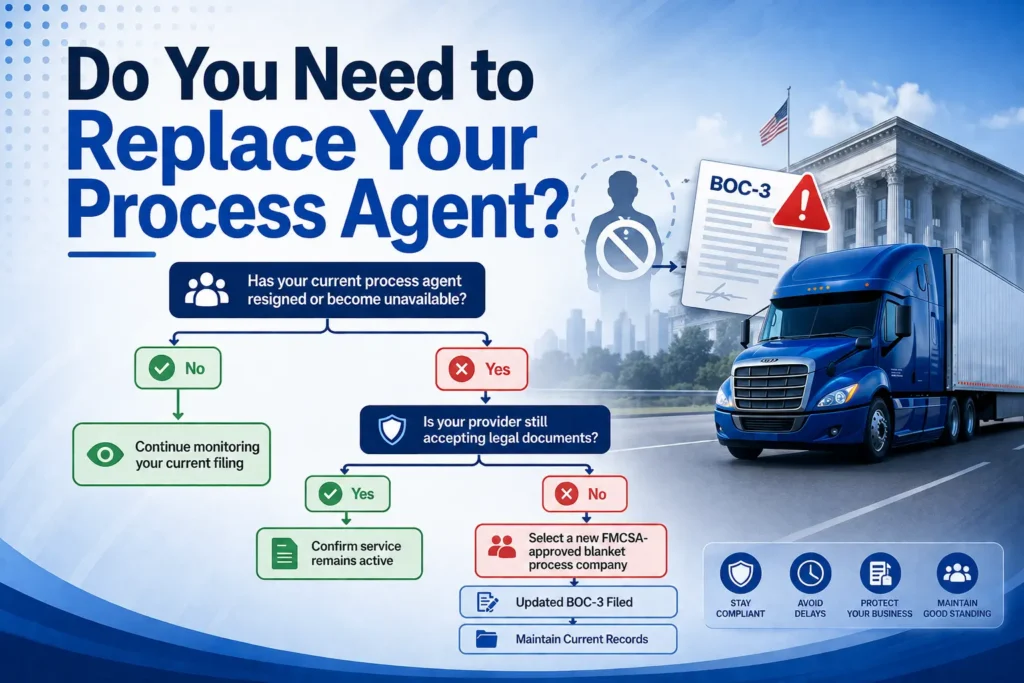
How to Choose the Right Replacement Provider
Not all BOC-3 providers offer the same level of service.
While cost is often considered, reliability and responsiveness are equally important because your provider plays an ongoing legal role after your operating authority becomes active.
Look for a provider that offers:
- FMCSA-approved blanket process company services
- Nationwide process agent coverage
- Electronic BOC-3 filing
- Responsive customer support
- Clear communication
- Transparent pricing
- Experience serving motor carriers, brokers, and freight forwarders
Many carriers also prefer providers that offer additional DOT compliance services, allowing multiple regulatory requirements to be managed through one trusted partner.
Questions to Ask Before Switching Providers
Before selecting a replacement process agent, consider asking:
- Are you an FMCSA-approved blanket process company?
- How quickly can you submit a replacement BOC-3?
- Will you notify me after the filing is complete?
- What support is available if my business information changes?
- Do you provide additional DOT compliance services?
Choosing the right provider can reduce administrative work while helping your business maintain accurate compliance records.
Common Mistakes Carriers Make After a Process Agent Resigns
Many BOC-3 compliance issues arise not because carriers ignore the rules, but because they assume their original filing remains valid indefinitely.
Avoid these common mistakes to reduce unnecessary compliance risks.
Waiting Too Long to Replace the Process Agent
Some carriers postpone updating their BOC-3 because they believe the change is not urgent.
While a resignation does not automatically affect operating authority, delaying the appointment of a new process agent can leave your business without a reliable representative for service of process.
Assuming the Old Provider Is Still Active
A provider may stop offering services, merge with another company, or close altogether.
If you have not communicated with your process agent in a long time, it’s a good idea to confirm they are still actively serving your account.
Choosing an Unapproved Provider
Only an FMCSA-approved blanket process company can electronically submit a BOC-3 filing on behalf of most carriers, brokers, and freight forwarders.
Working with an unqualified provider may delay the filing process and require additional corrective steps.
Failing to Keep Compliance Records
After your replacement BOC-3 is filed, retain confirmation documents along with your other DOT compliance records.
Organized documentation makes future audits, internal reviews, and administrative updates much easier.
Treating BOC-3 as a One-Time Requirement
Although many carriers only think about the BOC-3 when applying for operating authority, the filing should remain accurate throughout the life of your business.
Reviewing your compliance records periodically helps identify outdated information before it becomes a larger issue.
Best Practices for Maintaining BOC-3 Compliance
Keeping your BOC-3 current doesn’t require significant effort, but it does require periodic attention.
Following these best practices can help your business remain organized and prepared.
- Verify your process agent information annually.
- Confirm your provider is still actively serving your account.
- Update your BOC-3 promptly if your provider changes.
- Maintain copies of all filing confirmations.
- Keep business contact information current.
- Store compliance records in one organized location.
- Review FMCSA filings whenever major business changes occur.
Many carriers include a BOC-3 review as part of their annual compliance audit to ensure all federal filings remain accurate.
BOC-3 Compliance Checklist
Use this checklist to help keep your filing current.
✅ Confirm your process agent is still active.
✅ Verify the provider is an FMCSA-approved blanket process company.
✅ Review your business information for accuracy.
✅ Replace unavailable or resigned process agents promptly.
✅ Save copies of updated BOC-3 filings.
✅ Organize filing confirmations with DOT compliance records.
✅ Review BOC-3 information during annual compliance reviews.
Expert Tips from SafeRoad Compliance
Maintaining an accurate BOC-3 filing is often viewed as a simple administrative task, but it plays an important role in your overall compliance program.
Our recommendations include:
- Don’t wait for a legal issue before reviewing your process agent information.
- Work with an experienced blanket process company familiar with FMCSA filing requirements.
- Keep all federal compliance filings organized in one secure location.
- Review your BOC-3 whenever your company experiences significant operational changes.
- Combine BOC-3 reviews with other recurring compliance tasks such as insurance, UCR, MCS-150 updates, and driver qualification file reviews.
A proactive approach reduces administrative surprises and helps maintain uninterrupted compliance.
Conclusion
Your BOC-3 filing doesn’t end once your FMCSA operating authority becomes active. If your designated process agent resigns, closes its business, or can no longer receive legal documents, updating your filing should become a priority.
Replacing a process agent is typically a straightforward process when handled through an FMCSA-approved blanket process company. Keeping your BOC-3 current helps ensure legal documents can be received properly, supports accurate FMCSA records, and reduces unnecessary compliance risks.
If you need to replace your process agent or file a new BOC-3, SafeRoad Compliance provides professional BOC-3 Filing services to help carriers, brokers, and freight forwarders complete the process accurately and efficiently while supporting their broader DOT compliance needs.
Key Takeaways
- A process agent receives legal service of process on behalf of your company.
- Carriers should replace a resigned or unavailable process agent promptly.
- An outdated BOC-3 can create unnecessary legal and administrative complications.
- Most carriers must use an FMCSA-approved blanket process company to file an updated BOC-3.
- Keep copies of all filing confirmations with your DOT compliance records.
- Review your BOC-3 information regularly as part of your overall compliance program.
- Choosing a responsive and experienced provider helps simplify long-term compliance management.
Frequently Asked Questions
If your designated process agent resigns or is no longer available, you should arrange for an FMCSA-approved blanket process company to file an updated BOC-3 so your company continues to have a valid representative for service of process.
No. A resignation does not automatically revoke your FMCSA operating authority. However, carriers should update their BOC-3 promptly to maintain accurate compliance records and ensure legal documents can be properly received.
Choose a new FMCSA-approved blanket process company, provide your business information, and have the provider electronically submit a replacement BOC-3 filing on your behalf.
In most cases, no. Motor carriers typically must use an FMCSA-approved blanket process company to submit the filing electronically.
There is no specific FMCSA deadline tied to a resignation, but carriers should update the filing as soon as reasonably possible to avoid unnecessary legal or administrative complications.
Look for an FMCSA-approved provider with nationwide coverage, responsive customer support, transparent pricing, and experience serving interstate motor carriers.
It’s a good practice to review your BOC-3 annually and whenever your business, compliance provider, or process agent changes.
Yes. SafeRoad Compliance assists carriers with BOC-3 Filing services, including updating filings when a process agent changes, helping ensure your FMCSA records remain accurate and up to date.