Disclosure: Informational only. We are not FMCSA or USDOT. Always verify your status directly through official FMCSA systems.
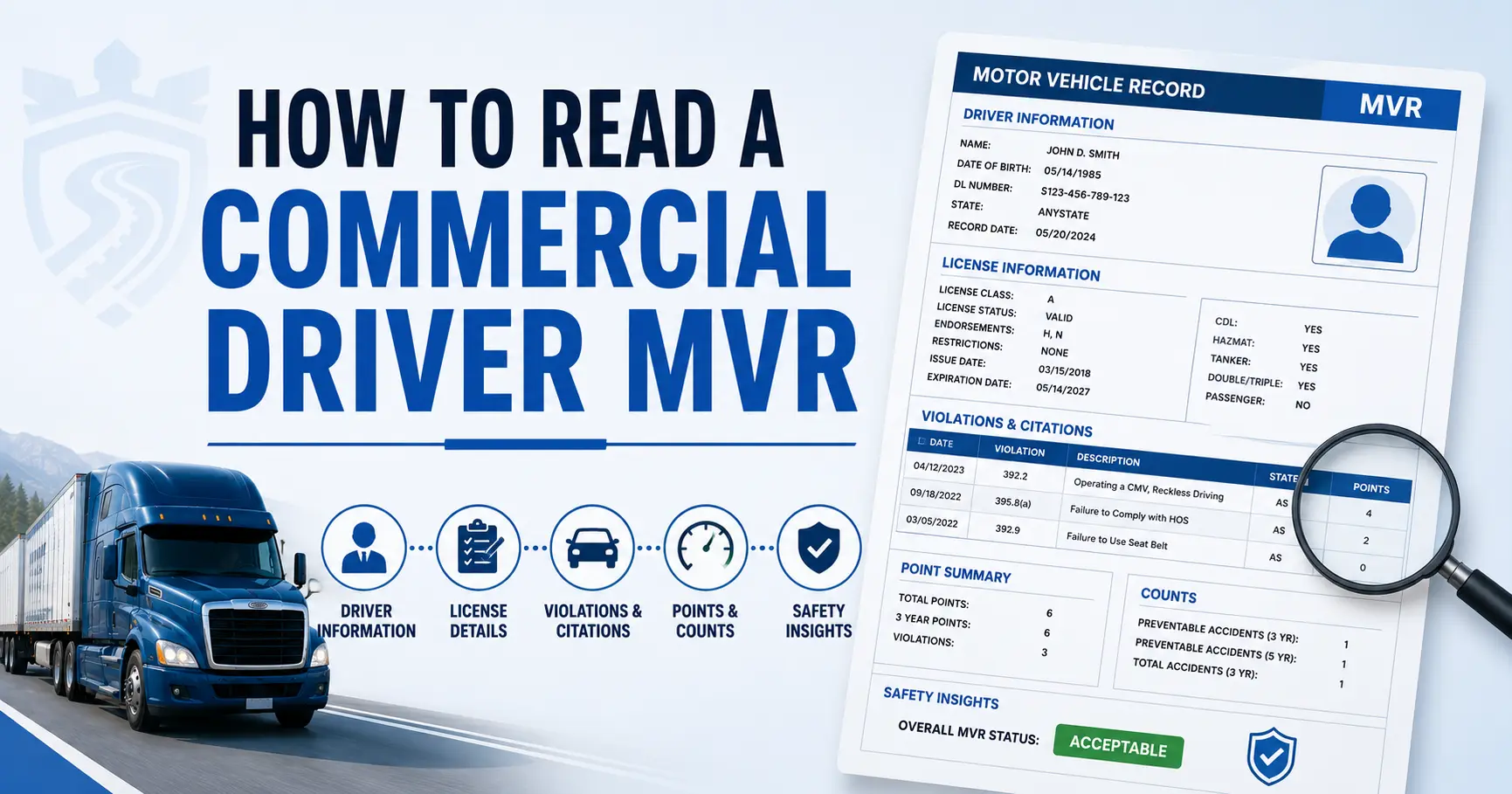
A commercial driver MVR can contain much more information than a simple list of traffic tickets. For motor carriers, the report can help identify licensing problems, moving violations, crashes, restrictions, suspensions, and other information that may affect a driver’s qualification or require further review.
The challenge is knowing what to look for, what each entry means, and which findings require action.
Under 49 CFR §391.25, motor carriers must make an annual inquiry and review of each driver’s driving record. FMCSA guidance also states that the review should consider as much reasonably available information about the driver’s experience as possible, including known violations, crashes, and other information indicating a lack of due regard for public safety.
This guide explains how to read a commercial driver MVR from an employer and compliance perspective.
What Is a Commercial Driver MVR?
A commercial driver MVR, or motor vehicle record, is a driving-history report obtained from a state driver licensing authority or through an authorized record provider.
Depending on the jurisdiction and report format, an MVR may contain information such as:
- Driver identification information
- License or CDL status
- License class
- Endorsements
- Restrictions
- License expiration information
- Traffic convictions
- Moving violations
- Crashes or accidents
- Suspensions or revocations
- Administrative actions
- Other reportable driving events
The exact format and terminology vary by state. Therefore, employers should avoid assuming that every MVR uses the same codes, categories, or reporting periods.
For compliance purposes, the goal is not simply to find a particular ticket. The goal is to determine whether the driver’s record raises a qualification, safety, licensing, or review issue that requires attention.
How to Read an MVR: Start With the Driver’s Identity
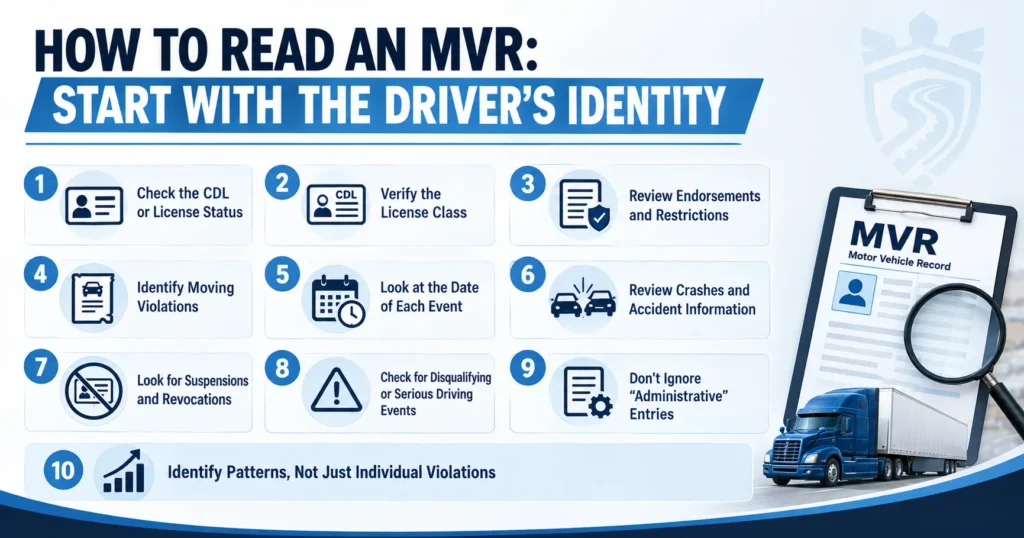
Before reviewing violations, confirm that the MVR belongs to the correct driver.
Check the identifying information against the driver’s qualification records, such as:
- Full legal name
- Date of birth
- Driver’s license number
- State of issuance
- CDL information
- Other identifying information shown on the report
This step matters because an incorrect identity match can result in an employer attributing another person’s driving history to the wrong driver.
If information does not match, do not automatically treat the discrepancy as a compliance violation. First determine whether the difference is caused by a name change, data-entry issue, state reporting format, or another explanation.
1. Check the CDL or License Status
The license-status section should be one of the first areas an employer reviews.
Look for language indicating whether the driver’s license or CDL is:
- Valid
- Expired
- Suspended
- Revoked
- Cancelled
- Disqualified
- Restricted
- Otherwise subject to an administrative action
A driver may have a clean-looking violation history but still present a serious qualification issue if the license or CDL status is not valid for the operation.
Why License Status Matters
A motor carrier should not treat the MVR as merely a list of tickets.
The basic question is:
Is the driver currently properly licensed and legally eligible for the type of commercial driving being performed?
If the report shows a suspension, revocation, disqualification, or other adverse licensing action, the employer should stop and investigate the status before treating the driver as qualified.
2. Verify the License Class
Next, review the license class or CDL classification.
The class should be consistent with the type of commercial motor vehicle the driver operates.
For example, an employer should verify that the driver’s license credentials are appropriate for the vehicle and operation rather than assuming that possession of a CDL automatically establishes qualification for every vehicle or assignment.
Also review any endorsements or restrictions shown on the record.
3. Review Endorsements and Restrictions
Endorsements and restrictions can affect what a driver is authorized or permitted to operate.
Depending on the driver’s job, review information such as:
- Required endorsements
- License restrictions
- Corrective-lens restrictions
- Vehicle-type restrictions
- Other limitations shown by the issuing state
A restriction is not automatically a violation. It becomes important when it conflicts with the driver’s assigned equipment or operating responsibilities.
Example
Suppose a driver has a restriction that requires corrective lenses.
That entry alone does not necessarily indicate that the driver is unqualified.
The employer should instead determine whether the restriction applies to the driver’s operation and whether the driver is complying with it.
4. Identify Moving Violations
Moving violations are among the most important entries to evaluate.
Depending on the state and report format, an MVR may identify violations involving matters such as:
- Speeding
- Reckless driving
- Following too closely
- Improper lane changes
- Failure to obey traffic controls
- Unsafe driving
- Other moving violations
Do not evaluate every violation solely by counting the number of entries.
Consider:
- What happened?
- When did it happen?
- Was there a conviction or other final disposition?
- Is the event related to commercial driving?
- Does it indicate a pattern?
- Does it suggest a potential safety concern?
- Does additional information need to be reviewed?
FMCSA guidance states that the annual review should consider known violations and other information relevant to whether the driver has demonstrated due regard for public safety.
5. Look at the Date of Each Event
Dates provide important context.
When reviewing an MVR, distinguish between:
- Violation date
- Conviction or disposition date
- License action date
- Crash date
- Report date
The date shown can affect how the employer interprets the event.
A recent violation may require more immediate attention than an older event, while multiple events occurring within a relatively short period may indicate a developing pattern.
Avoid treating every old entry as equally significant without considering its context.
6. Review Crashes and Accident Information
An MVR may contain crash-related information, although the level of detail varies.
A crash entry should not automatically be treated as proof that the driver caused the accident.
Instead, determine what the record actually establishes.
Questions to ask include:
- Is the event identified as a crash or accident?
- Is a violation associated with it?
- Does the record identify a conviction?
- Is there additional documentation available?
- Does the event require further investigation?
FMCSA’s annual-review guidance specifically states that a driver’s involvement in motor vehicle accidents should be considered as part of the overall driving-record review.
The important distinction is:
A crash record and a proven traffic violation are not necessarily the same thing.
7. Look for Suspensions and Revocations
Suspensions and revocations deserve immediate attention.
Review:
- Reason for the action
- Effective date
- Duration
- Current status
- Whether reinstatement occurred
- Any restrictions associated with reinstatement
A report showing a previous suspension does not necessarily mean the driver is currently disqualified.
The employer should determine the current license status and understand the underlying event before making a qualification decision.
8. Check for Disqualifying or Serious Driving Events
Some entries may require more than a routine MVR review.
Depending on the circumstances, pay particular attention to events involving:
- Operating while suspended or revoked
- Serious traffic offenses
- Alcohol- or drug-related driving offenses
- Leaving the scene
- Reckless or dangerous driving
- Other events that may affect qualification
Do not make a final compliance decision from an unfamiliar code alone.
If the MVR uses an abbreviation or state-specific code that is unclear, verify its meaning through the issuing jurisdiction or another reliable source.
9. Don’t Ignore “Administrative” Entries
Not every important MVR entry looks like a traditional traffic ticket.
Administrative actions can include licensing-status changes, suspensions, restrictions, or other state actions.
These entries may provide important information even when the report contains few or no conventional moving violations.
This is why an MVR should be reviewed as a driving and licensing record, not simply as a ticket report.
10. Identify Patterns, Not Just Individual Violations
One of the biggest mistakes in MVR review is looking at each violation independently.
For example:
Driver A
- One minor speeding violation several years ago
Driver B
- Several speeding violations
- A following-too-closely violation
- A recent crash
- A recent license action
The number of individual events is not the only issue.
Driver B’s record may indicate a pattern that deserves significantly more attention.
When reviewing an MVR, look for:
- Frequency
- Recency
- Severity
- Similar repeated violations
- Escalating behavior
- Multiple types of safety-related events
- License-status problems
A pattern can be more informative than any single entry.
MVR Review vs. Annual Driving Record Review
These terms are related, but they should not be treated as identical.
An MVR is the record or report obtained from a driver licensing authority or authorized source.
The annual review is the employer’s compliance activity of examining the driver’s driving record and documenting the required review.
FMCSA guidance indicates that the annual review should consider as much reasonably available information about the driver’s experience as possible, including known violations and crashes.
Therefore, simply downloading an MVR does not by itself demonstrate that the employer properly evaluated the record.
The compliance process should show that the carrier:
- Obtained the applicable driving record.
- Reviewed the information.
- Considered relevant safety-related events.
- Determined whether further action was necessary.
- Documented the annual review appropriately.
What Should Employers Do When an MVR Has a Violation?
An MVR violation does not automatically mean the driver must be removed from service or terminated.
Instead, classify the finding and determine what it means.
Step 1: Verify the Event
Confirm what the entry actually represents.
Do not rely on an unexplained abbreviation or code.
Step 2: Check the Date
Determine whether the event is recent, historical, or part of a repeated pattern.
Step 3: Determine the Disposition
Look for information showing whether the event resulted in a conviction, dismissal, suspension, or another outcome.
Step 4: Evaluate the Safety Significance
Ask whether the event indicates a potential safety concern or licensing problem.
Step 5: Check for Additional Information
If the MVR alone does not provide enough context, determine whether additional documentation is needed.
Step 6: Document the Review
Keep the required documentation in the driver’s qualification file and record the employer’s annual review as required.
Example: How an Employer Might Read an MVR
Consider an MVR showing:
- Valid CDL
- Correct license class
- One speeding conviction 30 months ago
- One recent following-too-closely violation
- No current suspension
- No revocation
- No other recent violations
A basic review should not stop at:
“Two violations – driver failed.”
Instead, the employer should evaluate the nature, timing, and pattern of the events.
The older speeding conviction may carry different significance from the recent following-too-closely violation. The employer should consider the overall record and determine whether additional review or corrective action is appropriate under its qualification and safety policies.
The point is to make a documented, evidence-based review rather than relying on a simple violation count.
Common MVR Review Mistakes
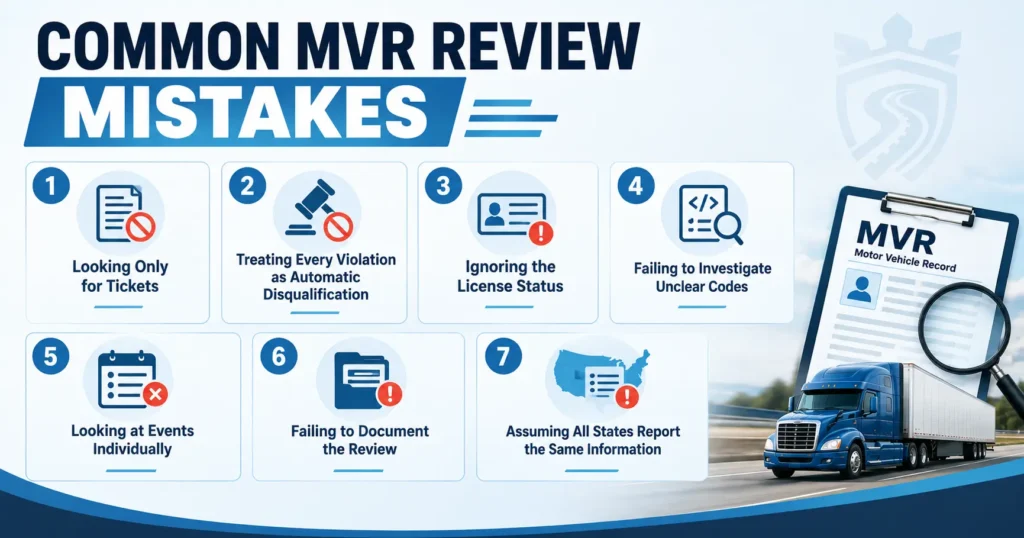
1. Looking Only for Tickets
An MVR can contain licensing information, restrictions, suspensions, and other events that may matter even when there are few tickets.
2. Treating Every Violation as Automatic Disqualification
A violation should be evaluated in context rather than automatically treated as a disqualifying event.
3. Ignoring the License Status
A driver may have few violations but still have a serious licensing issue.
4. Failing to Investigate Unclear Codes
State MVR terminology varies. An unfamiliar abbreviation should be verified rather than guessed.
5. Looking at Events Individually
Repeated violations can reveal a pattern that is not obvious when each entry is reviewed separately.
6. Failing to Document the Review
Obtaining the MVR is not the same as documenting the required annual review.
7. Assuming All States Report the Same Information
MVR formats and reporting practices vary by jurisdiction. Avoid applying one state’s terminology or assumptions to another state’s report.
MVR Review Checklist for Employers
Use this checklist when reviewing a commercial driver MVR:
- Confirm driver identity
- Verify license/CDL status
- Check license class
- Review endorsements
- Review restrictions
- Identify moving violations
- Check violation dates
- Review crash information
- Check suspensions or revocations
- Investigate unfamiliar codes
- Look for repeated violations
- Evaluate the overall safety pattern
- Determine whether additional information is needed
- Complete the required annual review
- Document the review in the DQ file
How Continuous MVR Monitoring Fits Into the Process
An annual MVR review provides a scheduled compliance checkpoint, but it does not necessarily provide real-time awareness of changes occurring between annual reviews.
Continuous MVR monitoring can help employers identify reportable changes such as licensing actions or new driving events sooner, depending on the monitoring service and jurisdiction.
That makes continuous monitoring complementary to, not simply a replacement for, the carrier’s required qualification and annual-review processes.
For a broader comparison of these approaches, see Continuous MVR Monitoring vs. Annual MVR Checks.
Best Practices for Reading Commercial Driver MVRs
A reliable MVR review process should be:
Consistent
Use the same core review process for every applicable driver.
Evidence-Based
Base decisions on what the record actually shows rather than assumptions about unfamiliar codes.
Timely
Review records within the required compliance timeframe and address significant findings promptly.
Documented
Keep evidence that the required review was completed.
Contextual
Consider the driver’s overall record rather than automatically treating one isolated entry as the entire picture.
Connected to the DQ File
MVR documentation should fit into the driver’s broader qualification records rather than being maintained as an isolated document.
Expert Tip: Read the MVR in Layers
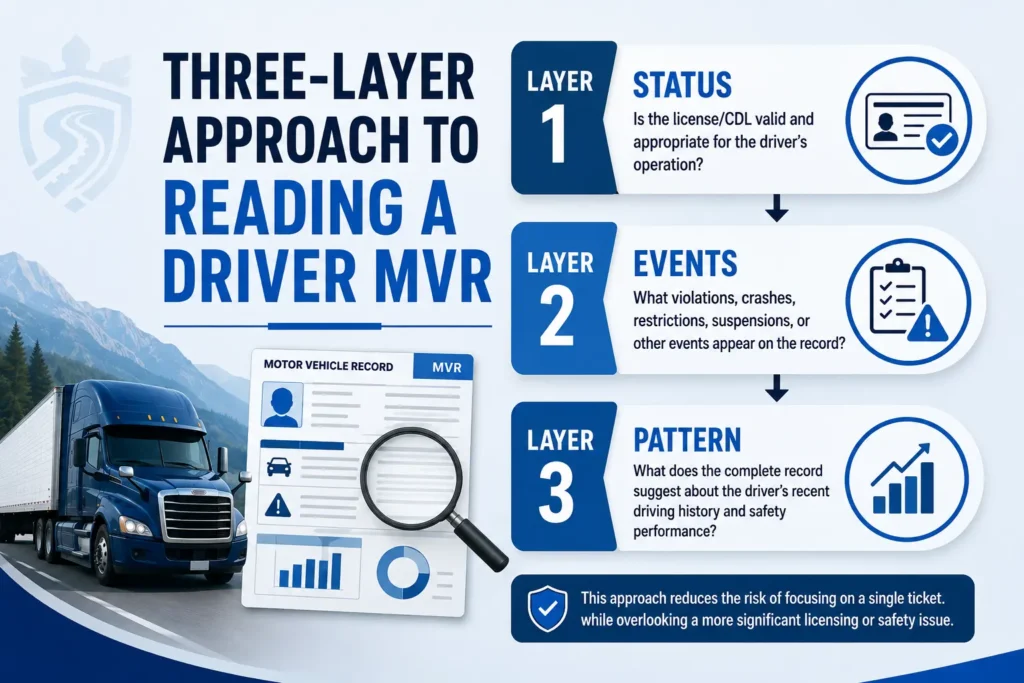
A practical way to review an MVR is to use a three-layer approach:
Layer 1 Status:
Is the license/CDL valid and appropriate for the driver’s operation?
Layer 2 Events:
What violations, crashes, restrictions, suspensions, or other events appear on the record?
Layer 3 Pattern:
What does the complete record suggest about the driver’s recent driving history and safety performance?
This approach reduces the risk of focusing on a single ticket while overlooking a more significant licensing or safety issue.
Conclusion
Reading a commercial driver MVR correctly helps employers identify licensing issues, violations, and safety patterns before they become larger compliance concerns. A consistent MVR review process also supports better hiring decisions and ongoing driver qualification.
If you need accurate MVR checks for your drivers, SafeRoad Compliance can help you obtain and review motor vehicle records as part of your DOT compliance process. Check Your MVR with SafeRoad Compliance.
FAQs
Start with driver identity, CDL or license status, license class, endorsements, restrictions, violations, crashes, suspensions, revocations, and other adverse licensing actions. Then evaluate the overall pattern rather than looking at each entry in isolation.
Not necessarily. The significance of a violation depends on the event, applicable regulations, license status, timing, circumstances, and the driver’s overall record. Employers should evaluate the record rather than relying on a simple violation count.
Motor carriers subject to 49 CFR §391.25 must make an inquiry and review of each driver’s driving record at least annually.
No. The MVR is the driving record obtained for review. The annual review is the employer’s required process of examining the record and documenting the review.
Do not guess what the code means. Verify the terminology with the applicable state driver licensing authority or another reliable source before making a compliance decision.
Yes. FMCSA guidance states that a driver’s involvement in motor vehicle accidents should be considered as part of the overall annual driving-record review.
Treat the finding as requiring immediate investigation. Determine the reason, effective dates, current status, and whether the driver’s license has been properly reinstated before determining qualification.
FMCSA guidance permits certain third-party arrangements for obtaining driving records and recognizes computerized employer notification systems for annual reviews. The carrier remains responsible for meeting its applicable compliance obligations.
Required MVR documentation should be maintained as part of the driver’s qualification records in accordance with applicable FMCSA recordkeeping requirements.
An annual check is a scheduled review of the driver’s record. Continuous monitoring is designed to identify certain changes between scheduled reviews. The two approaches can work together as part of a broader driver-monitoring program.