Disclosure: Informational only. We are not FMCSA or USDOT. Always verify your status directly through official FMCSA systems.
A failed DOT drug test can immediately affect a driver’s ability to perform safety-sensitive duties. For employers and drivers, the most important question is usually: What happens next?
When a DOT drug test produces a verified positive result, the process does not simply end with the test result. Specific DOT and FMCSA requirements can apply, including removal from safety-sensitive functions, referral to a qualified Substance Abuse Professional (SAP), the return-to-duty process, and follow-up testing.
The employer must also handle the situation according to applicable 49 CFR Part 40, 49 CFR Part 382, and FMCSA Drug & Alcohol Clearinghouse requirements.
Quick Answer: After a verified positive DOT drug test, the driver must be removed from DOT safety-sensitive functions and cannot simply return to driving. The driver must complete the applicable SAP and return-to-duty process before becoming eligible to resume covered duties.
This article explains the overall lifecycle after a failed DOT drug test. For the detailed step-by-step return-to-duty procedure, see SafeRoad Compliance’s Return-to-Duty Process After a DOT Violation.
What Does a Failed DOT Drug Test Mean?
In DOT compliance, the phrase “failed drug test” is commonly used to describe a drug test that results in a verified positive result.
However, employers should use the precise terminology found in DOT regulations and testing records. A laboratory result goes through the required testing and Medical Review Officer (MRO) process before the result is treated as a verified positive.
The distinction matters because not every initial laboratory finding automatically becomes a verified positive DOT result.
A verified positive result can have significant employment and compliance consequences for a driver subject to FMCSA drug and alcohol testing requirements.
Common DOT Drug Testing Results and Issues
A driver’s testing history can involve several different situations, including:
- Verified positive drug test
- Drug test refusal
- Alcohol violation
- Dilute specimen
- Invalid or rejected specimen
- Other testing or collection issues
Each situation can have different regulatory consequences.
For this reason, carriers should not treat every unusual test result as a “failed drug test.” The employer should follow the specific instructions and requirements applicable to the actual result.
What Happens Immediately After a Positive DOT Drug Test?
Once a DOT drug test is verified positive, the employer’s first priority is preventing the driver from performing covered safety-sensitive functions.
This is not simply a disciplinary decision. It is a DOT compliance requirement.
The employer should follow its drug and alcohol program procedures and the applicable federal requirements to ensure the driver is removed from covered duties.
The Basic Lifecycle
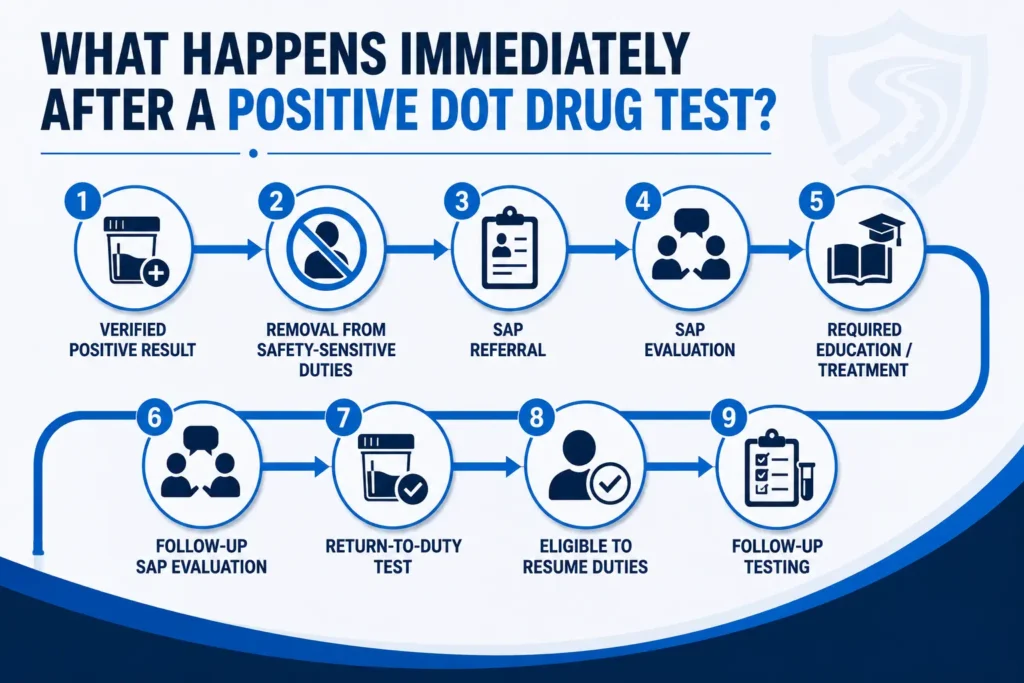
The process can generally be understood as:
Verified positive result → Removal from safety-sensitive duties → SAP referral → SAP evaluation → Required education/treatment → Follow-up SAP evaluation → Return-to-duty test → Eligible to resume duties → Follow-up testing
The exact requirements can vary depending on the circumstances.
This is why carriers should avoid creating their own informal “second chance” procedure without following the DOT return-to-duty framework.
When Must the Driver Stop Performing Safety-Sensitive Work?
A driver who has a verified positive DOT drug test generally cannot continue performing DOT-regulated safety-sensitive functions.
For an FMCSA-regulated driver, safety-sensitive work can include operating a commercial motor vehicle subject to the applicable regulations.
The employer should have a clear internal procedure for immediately identifying the driver’s status and preventing unauthorized dispatch.
What the Employer Should Do
After receiving the applicable verified result, the employer should:
- Confirm the official result and required documentation.
- Remove the driver from applicable safety-sensitive functions.
- Provide the required information regarding the SAP process.
- Follow applicable Clearinghouse reporting requirements.
- Document the actions taken.
- Ensure the driver does not return to covered duties prematurely.
A carrier should not allow a driver to continue operating simply because the driver has not yet completed the SAP process.
What Is the SAP Process?
A Substance Abuse Professional (SAP) is a qualified professional responsible for evaluating employees who have violated DOT drug and alcohol regulations and recommending appropriate education, treatment, follow-up services, and return-to-duty steps.
The SAP is not the same as the employer’s HR department, drug testing provider, or regular physician.
The SAP process is designed to determine what education or treatment is appropriate based on the driver’s circumstances.
The General SAP Lifecycle
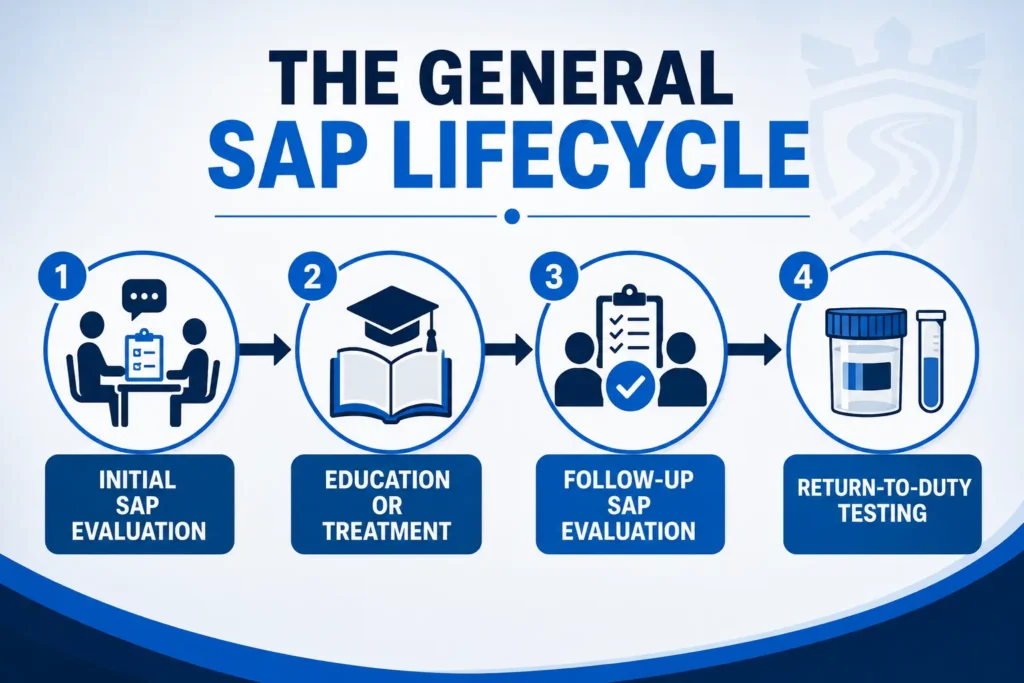
The process generally involves:
1. Initial SAP evaluation
The driver meets with a qualified SAP for an evaluation.
2. Education or treatment
The SAP determines whether education, treatment, or other services are appropriate.
3. Follow-up SAP evaluation
After completing the SAP’s recommendations, the driver returns for the required evaluation.
4. Return-to-duty testing
The driver must satisfy the applicable return-to-duty testing requirement before resuming covered safety-sensitive work.
The SAP does not simply “clear” a driver because enough time has passed.
For detailed information about each stage, use the Return-to-Duty Process After a DOT Violation guide.
How the Clearinghouse Fits Into the Process
The FMCSA Drug & Alcohol Clearinghouse is an important part of the process for CDL drivers subject to its requirements.
Certain drug and alcohol program violations must be reported to the Clearinghouse. A driver’s Clearinghouse record can affect whether the driver is permitted to perform safety-sensitive functions.
This creates an important distinction:
The DOT drug test identifies a testing event or result. The Clearinghouse provides a centralized record of certain FMCSA drug and alcohol program violations and related return-to-duty information.
Employers must therefore manage both the testing requirements and applicable Clearinghouse obligations.
Why Clearinghouse Status Matters
A driver with a violation that requires the return-to-duty process may have a status that prevents an employer from allowing the driver to perform applicable safety-sensitive functions.
Employers should verify the driver’s Clearinghouse status as required rather than relying solely on verbal statements from the driver.
For broader background on FMCSA drug and alcohol compliance, see SafeRoad Compliance’s Drug & Alcohol Testing and Clearinghouse Guide.
What Happens Before the Driver Can Return to Work?
Completing a SAP evaluation alone does not automatically make the driver eligible to return to safety-sensitive work.
The driver must complete the applicable steps established under the DOT return-to-duty process.
A simplified decision framework is:
| Question | If Yes | If No |
|---|---|---|
| Was a DOT violation established? | Continue the applicable process | Follow the appropriate testing procedure |
| Was the driver removed from safety-sensitive work? | Continue | Correct the employer’s process |
| Has the driver completed the SAP process? | Continue | Driver remains ineligible for covered duties |
| Has the required return-to-duty test been completed with the required result? | Continue | Driver cannot return yet |
| Are applicable Clearinghouse requirements satisfied? | Return may be permitted if all other requirements are met | Continue required remediation |
The carrier should document each stage rather than relying on informal confirmation.
Return-to-Duty Testing
A driver who has violated applicable DOT drug and alcohol testing requirements generally must complete the required return-to-duty testing process before resuming covered safety-sensitive functions.
The return-to-duty test is different from an ordinary pre-employment test.
Its purpose is to satisfy the applicable requirements after a DOT drug and alcohol violation.
The driver should not be dispatched until the employer has verified that the applicable requirements have been satisfied. For a complete explanation of the return-to-duty process, see our guide on Return-to-Duty Process After a DOT Violation.
Follow-Up Testing After Return to Duty
Returning to work does not necessarily mean the compliance process is finished.
After the return-to-duty process is completed, the driver may be subject to a follow-up testing plan established through the SAP process.
Follow-up testing is separate from the employer’s routine random testing program.
This distinction is important because carriers should track the applicable follow-up testing requirements independently and ensure required tests are completed according to the established plan.
Employers should maintain appropriate documentation showing that follow-up requirements are being managed.
Employer Responsibilities After a Failed DOT Drug Test
The employer has responsibilities throughout the process.
A carrier should have procedures covering:
- Immediate removal from applicable safety-sensitive functions
- Required employee notification
- SAP referral information
- Clearinghouse reporting where required
- Return-to-duty verification
- Follow-up testing administration
- Recordkeeping
- Driver status tracking
- Prevention of premature return to safety-sensitive duties
A good compliance system should make it difficult for a driver with an unresolved DOT violation to be accidentally dispatched.
Common Mistakes
Allowing the Driver to Keep Driving
One of the most serious mistakes is allowing a driver to continue performing covered safety-sensitive work after a qualifying violation.
Treating the SAP Evaluation as the Final Step
A SAP evaluation is part of the return-to-duty process. It does not automatically authorize the driver to return to work.
Confusing DOT and Non-DOT Testing
A company may have its own testing program in addition to DOT testing. Employers should clearly distinguish DOT-regulated testing from non-DOT testing.
Ignoring the Clearinghouse
For covered CDL drivers, Clearinghouse requirements are an important part of the compliance process.
Failing to Track Follow-Up Testing
A driver may have ongoing follow-up testing requirements after returning to safety-sensitive work.
Relying on Verbal Confirmation
Employers should maintain appropriate documentation rather than relying on a driver saying that they have completed the required process.
Best Practices for Carriers
A strong drug and alcohol compliance program should have a written procedure for handling a positive DOT drug test.
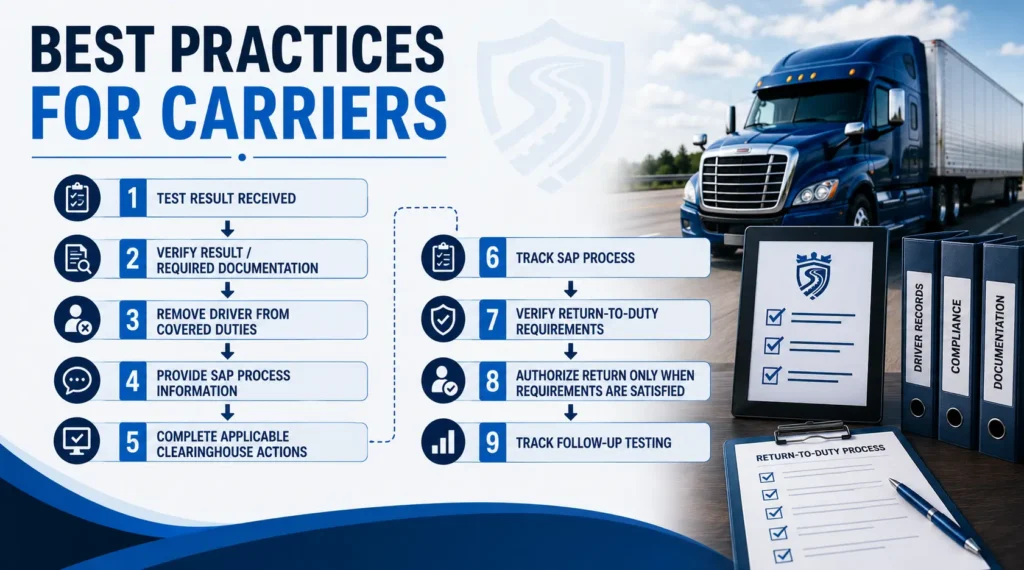
This workflow creates clear ownership and reduces the chance of a compliance step being missed.
Failed DOT Drug Test Compliance Checklist
Use this checklist when managing a qualifying DOT drug test violation:
- ☐ Official test result reviewed
- ☐ Driver removed from applicable safety-sensitive functions
- ☐ Required employee information provided
- ☐ SAP process initiated
- ☐ Applicable Clearinghouse requirements addressed
- ☐ SAP recommendations completed
- ☐ Required follow-up SAP evaluation completed
- ☐ Return-to-duty testing completed as required
- ☐ Driver’s eligibility verified before dispatch
- ☐ Follow-up testing requirements documented
- ☐ Required records maintained
This checklist should be integrated into the carrier’s broader drug and alcohol compliance program rather than maintained as a standalone document.
Expert Tips
1. Separate the stages.
Do not combine “positive test,” “SAP completed,” and “eligible to drive” into one status. They are different compliance stages.
2. Control dispatch access.
If your system allows drivers with unresolved compliance issues to be dispatched, the risk is operational as well as regulatory.
3. Document dates carefully.
Record when the result was received, when the driver was removed, and when each required step was completed.
4. Treat Clearinghouse records as part of the workflow.
For covered CDL drivers, drug and alcohol compliance should be connected to Clearinghouse management.
5. Do not rush the process.
A staffing shortage or urgent load does not eliminate federal compliance requirements.
Conclusion
A failed DOT drug test does not simply mean that a driver cannot work. It begins a defined compliance process that can involve removal from safety-sensitive duties, SAP evaluation, education or treatment, return-to-duty testing, Clearinghouse requirements, and follow-up testing.
For carriers, the key is maintaining control over the driver’s status at every stage. A documented workflow helps prevent premature dispatch and ensures that required actions are completed before the driver returns to covered safety-sensitive functions.
If your company needs help managing DOT drug and alcohol compliance, SafeRoad Compliance can support your broader compliance program and help organize the documentation and processes carriers need to maintain.
Frequently Asked Questions
After a verified positive DOT drug test, the driver must be removed from applicable safety-sensitive duties and follow the required DOT return-to-duty process, which can include SAP evaluation, education or treatment, return-to-duty testing, and follow-up testing.
Generally, no. A driver who has a qualifying DOT drug and alcohol violation must not perform applicable safety-sensitive functions until the requirements for returning to duty have been satisfied.
Certain FMCSA drug and alcohol program violations are reported to the Clearinghouse under applicable requirements. Employers should follow the specific reporting and status requirements applicable to the violation.
When the DOT return-to-duty process is triggered by a qualifying violation, the driver must complete the applicable SAP process before returning to covered safety-sensitive work.
Not automatically. The driver must satisfy the applicable return-to-duty requirements, including the required testing and other conditions, before resuming covered safety-sensitive functions.
A driver who completes the return-to-duty process may be subject to a SAP-directed follow-up testing plan. This is separate from the employer’s normal random testing program.
There is no single timeline that applies to every case. The duration depends on the SAP’s evaluation and recommendations, completion of required education or treatment, return-to-duty requirements, and other applicable compliance steps.
Yes. SafeRoad Compliance supports carriers with broader DOT compliance needs, including drug and alcohol compliance management, documentation, and related regulatory requirements.