Disclosure: Informational only. We are not FMCSA or USDOT. Always verify your status directly through official FMCSA systems.
Every motor carrier that employs CDL drivers has an ongoing responsibility to monitor the FMCSA Drug and Alcohol Clearinghouse. One of the most important requirements is conducting a query for each currently employed CDL driver at least once within the required 12-month period.
An annual Clearinghouse query is not the same as the pre-employment query performed before hiring a driver. Employers generally use a limited query for the annual check, although a full query can also satisfy the annual requirement.
The challenge for many carriers is not understanding that an annual query is required. The bigger challenge is maintaining a reliable system for tracking due dates, obtaining the correct Clearinghouse consent, retaining evidence, and responding appropriately when a limited query indicates that information exists in a driver’s record.
Quick Answer: Employers of CDL drivers must conduct a Clearinghouse query for each current CDL driver at least once every 365 days. A limited query can satisfy the annual requirement when the employer has obtained the driver’s required general consent. If the limited query returns a record, the employer must obtain the driver’s specific electronic consent and conduct a full query to access the details.
This guide focuses specifically on the ongoing annual query process, documentation, audit readiness, consent management, and common mistakes. It is designed to complement, not duplicate, the broader pre-employment Clearinghouse requirements covered in our Clearinghouse Query Requirements guide.
What Is an Annual Clearinghouse Query?
An annual Clearinghouse query is a required check of a currently employed CDL driver’s Clearinghouse record.
The purpose is to determine whether the driver has information in the Clearinghouse that could indicate a drug and alcohol program violation affecting the driver’s eligibility to perform safety-sensitive functions.
Under 49 CFR §382.701, employers must conduct a query at least once during the required 12-month period for each CDL driver they employ. FMCSA describes this requirement as a rolling 12-month or 365-day obligation.
The annual query is therefore an ongoing employer responsibility.
It does not end after the driver passes the pre-employment Clearinghouse check.
Who Must Conduct Annual Clearinghouse Queries?
Employers subject to the FMCSA Clearinghouse requirements must query the records of their current CDL drivers.
This includes motor carriers employing drivers who perform safety-sensitive functions covered by the applicable DOT drug and alcohol testing requirements.
An employer can conduct the queries itself or designate a consortium/third-party administrator (C/TPA) to perform them on the employer’s behalf.
Owner-operators should pay particular attention to this requirement because an owner-operator may have responsibilities as both an employer and an employee.
FMCSA specifically states that owner-operators must query CDL drivers they employ, including themselves, and may use a designated C/TPA to conduct queries on their behalf.
How the 365-Day Annual Query Requirement Works
One of the most common misconceptions is that all annual queries must be completed by a fixed calendar date.
That is not how the requirement works.
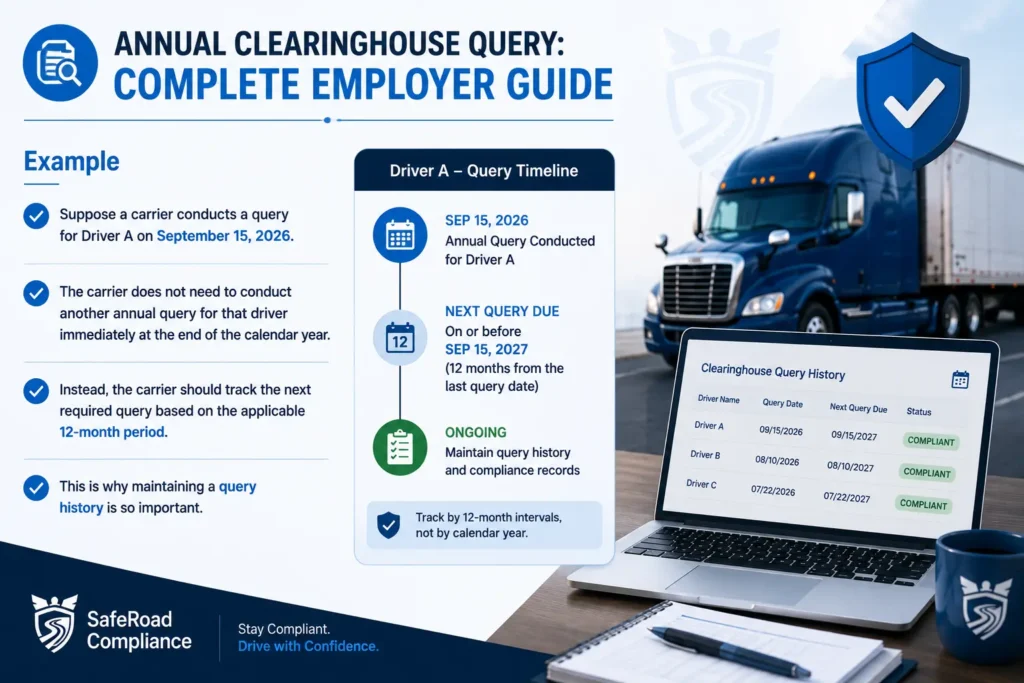
The annual query requirement is generally tracked on a rolling 365-day basis. The next annual query is due based on the applicable previous query date.
Example
Important Exception: A Follow-Up Query
If an employer receives notification that information has changed in a driver’s Clearinghouse record and conducts the required follow-on query, that completed follow-on query can satisfy the annual query requirement and reset the rolling period based on the date of the follow-on query.
That makes automated monitoring and notification management an important part of a carrier’s compliance process.
Limited Query vs. Full Query for Annual Compliance
The distinction between limited and full queries is especially important when managing annual compliance.
| Feature | Limited Query | Full Query |
|---|---|---|
| Typical annual use | Yes | Can also satisfy annual requirement |
| Driver consent | General consent | Specific electronic consent |
| Consent location | Outside Clearinghouse | Inside Clearinghouse |
| Shows whether a record exists | Yes | Yes |
| Provides detailed violation information | No | Yes |
| If record is found | Full query may be required | Details can be reviewed |
| Common purpose | Annual monitoring | Pre-employment or detailed review |
FMCSA confirms that a limited query satisfies the annual requirement. A full query can also satisfy the annual requirement, but it requires the driver’s specific electronic consent.
For many carriers, the limited query is the practical method for routine annual monitoring.
What Is a Limited Query?
A limited query allows an employer to determine whether a driver’s Clearinghouse record contains information about resolved or unresolved drug and alcohol program violations.
It does not provide the specific details of the violation.
For a limited query, the employer must first obtain the driver’s general consent outside the Clearinghouse. FMCSA allows this consent to be maintained for multiple years, provided the consent document specifies the applicable timeframe.
This creates an important compliance distinction:
Annual query ≠ annual consent form
The annual query must be conducted within the required period, but a properly structured general consent for limited queries does not necessarily have to be re-signed every year.
What Happens If the Limited Query Finds a Record?
A limited query may indicate that information exists in the driver’s Clearinghouse record.
That does not mean the employer automatically has access to the details.
The employer must obtain the driver’s specific electronic consent through the Clearinghouse before conducting the full query needed to obtain the detailed information.
The process can be summarized as:
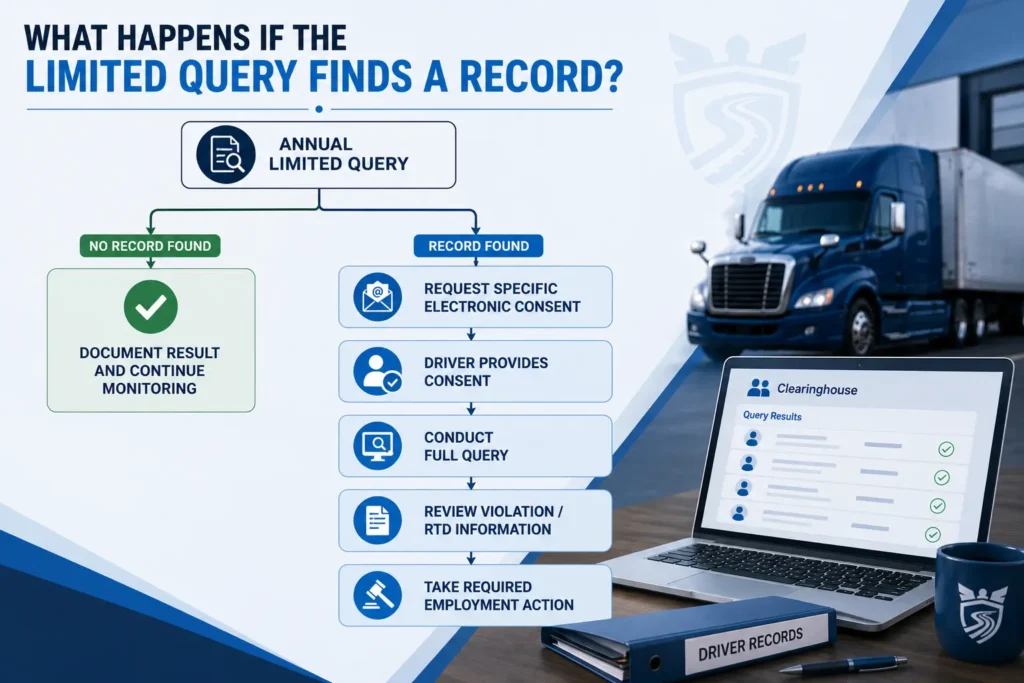
If a driver refuses the required consent, the employer cannot access the record through the query process. FMCSA states that a driver who refuses consent cannot perform safety-sensitive functions for that employer because the employer cannot verify the driver’s Clearinghouse status.
Clearinghouse Consent Requirements
Consent is one of the most important pieces of an audit-ready Clearinghouse program.
All employer queries require driver consent, but the type of consent depends on the query.
Limited Query Consent
For a limited query:
- Obtain general consent outside the Clearinghouse.
- The consent may be written or electronic.
- The consent should identify the applicable timeframe.
- Maintain evidence of the driver’s consent.
- Use that consent when conducting permitted limited queries.
FMCSA states that employers must retain records of limited-query consent for three years. The consent record does not necessarily have to be stored in the Driver Qualification File, but the employer must be able to provide evidence when requested.
Full Query Consent
A full query requires specific electronic consent from the driver through the Clearinghouse before the employer can access detailed violation information.
This is different from the general consent used for limited queries.
What Documentation Should Employers Keep?
A carrier should be able to demonstrate more than simply saying, “We completed our annual queries.”
A strong compliance file should allow the company to reconstruct the process.
Consider maintaining:
- Driver name
- Driver identification information
- Date of query
- Query type
- Query result
- General limited-query consent
- Evidence of full-query consent when applicable
- Follow-up documentation
- C/TPA records, if applicable
- Corrective or employment actions when required
- Query history
FMCSA maintains query history within the Clearinghouse, including query activity and relevant consent information for full queries. Employers must separately retain evidence of limited consent for three years.
Annual Clearinghouse Query Audit Proof
If an FMCSA investigator asks how your company manages annual queries, the carrier should be able to demonstrate a consistent process.
A practical audit trail should answer five questions:
| Audit Question | Evidence |
|---|---|
| Was the driver subject to the requirement? | Driver/employment records |
| Was the annual query completed on time? | Clearinghouse query history |
| Was proper consent obtained? | Limited or full consent documentation |
| What did the query show? | Query result/history |
| What happened if a record was identified? | Follow-up query and required action documentation |
The goal is not to create unnecessary paperwork.
The goal is to make compliance verifiable.
Annual Clearinghouse Query Compliance Workflow
Use this process for each current CDL driver.
Step 1: Maintain Your Current Driver List
Start with an accurate list of all current CDL drivers subject to the Clearinghouse query requirement.
Do not rely on an outdated spreadsheet.
Step 2: Check the Last Query Date
Review the driver’s Clearinghouse query history and determine when the previous applicable query was completed.
Step 3: Verify Consent
Before a limited query, confirm that valid general consent exists for the applicable period.
Step 4: Conduct the Query
Complete the annual query through the Clearinghouse or through an authorized C/TPA acting on the employer’s behalf.
Step 5: Document the Result
Record the date, query type, result, and supporting documentation.
Step 6: Respond to a Record Notification
If the limited query indicates that information exists, obtain the driver’s specific electronic consent and conduct the required full query.
Step 7: Complete Follow-Up Actions
If the full query reveals a violation or prohibited status, follow the applicable FMCSA requirements before allowing the driver to perform safety-sensitive functions.
Step 8: Schedule the Next Review
Maintain an internal tracking system so the next annual query is not missed.
Common Annual Query Mistakes
Mistake 1: Treating the Annual Query as a One-Time Requirement
The Clearinghouse requirement continues throughout the driver’s employment.
Better practice: Track each driver individually on a rolling schedule.
Mistake 2: Assuming the Pre-Employment Query Is Enough
The pre-employment query satisfies the annual requirement for the applicable period, but the employer must continue querying the driver annually while employed.
Better practice: Record the pre-employment query date and use it to establish the driver’s ongoing tracking schedule.
Mistake 3: Using the Wrong Consent
General consent applies to limited queries. Full queries require specific electronic consent.
Better practice: Keep separate procedures for the two query types.
Mistake 4: Failing to Keep Limited-Query Consent
A completed query without supporting consent documentation can create an audit problem.
Better practice: Retain limited-query consent evidence for the required three-year period.
Mistake 5: Stopping After a Limited Query Shows a Record
A limited query does not provide the detailed violation information.
Better practice: Obtain the driver’s specific electronic consent and complete the full query when required.
Mistake 6: Letting C/TPA Responsibilities Become Unclear
Using a C/TPA does not mean the employer should stop monitoring its own compliance obligations.
Better practice: Clearly define who conducts queries, who tracks deadlines, and who maintains supporting records.
Annual Clearinghouse Query Compliance Checklist
Before considering your annual process complete, verify:
- Current CDL driver list is accurate.
- Last query date is documented for each driver.
- Annual deadline is tracked on a rolling basis.
- Valid limited-query consent is available.
- Limited query was completed when due.
- Query result was documented.
- Full query was initiated when a record was identified.
- Specific electronic consent was obtained for the full query.
- Required follow-up actions were documented.
- Limited consent records are retained for three years.
- C/TPA responsibilities are clearly assigned.
- Query history can be produced during an audit.
- Next annual query date is tracked.
Best Practices for Employers
A reliable Clearinghouse program should be built around tracking, documentation, and follow-through.
Use a Driver Compliance Calendar
Track annual query dates separately for each driver.
Avoid Calendar-Year Thinking
The requirement is based on a rolling period, so a January-to-December spreadsheet can create unnecessary confusion.
Centralize Consent Records
Store limited-query consent in a secure, organized location where it can be retrieved quickly.
Reconcile Your Driver List
Compare your active driver roster against your Clearinghouse compliance records regularly.
Review C/TPA Activity
If a C/TPA handles queries, periodically confirm that queries are being completed and records are available.
Document Exceptions
If a query is delayed because of a driver consent issue, system issue, or other circumstance, document what happened and what corrective action was taken.
Expert Tips From SafeRoad Compliance
1. Track the date, not just the status.
A spreadsheet saying “Clearinghouse compliant” is less useful than recording the actual query date and next due date.
2. Separate limited and full query procedures.
The consent requirements and information available from each query type are different.
3. Build an audit trail before you need one.
If an investigator asks for proof, you should not have to reconstruct years of query activity from memory.
4. Treat notifications seriously.
An annual query is only one part of ongoing Clearinghouse monitoring. When the system generates a notification requiring follow-up, review it promptly.
5. Make C/TPA responsibilities explicit.
If a third party performs your queries, your internal compliance process should still identify who verifies completion and maintains records.
Conclusion
Annual Clearinghouse queries are an ongoing responsibility for employers of CDL drivers. The requirement is based on a rolling 365-day period, and carriers must have the correct consent, query process, and documentation in place to demonstrate compliance.
For many employers, a limited query is the practical method for satisfying the annual requirement. But a limited query does not reveal detailed violation information, so carriers need a clear process for obtaining specific electronic consent and conducting a full query when the limited query indicates that a record exists.
The strongest approach is to manage Clearinghouse compliance as a recurring operational process rather than a once-a-year administrative task.
For carriers that want help managing drug and alcohol compliance, including Clearinghouse responsibilities, SafeRoad Compliance can provide structured support through its DOT drug and alcohol consortium services.
FAQs
Employers subject to the Clearinghouse requirements must conduct an annual query for each CDL driver they employ. The requirement is tracked on a rolling 365-day basis.
Yes. FMCSA states that a limited query satisfies the annual query requirement. A full query can also satisfy the requirement.
Not necessarily. General consent for limited queries may be valid for multiple years, but the consent document must specify the applicable timeframe. The annual query itself must still be completed within the required period.
Employers must retain records of drivers’ limited consent for three years and must be able to provide evidence upon request.
A limited query only indicates that information exists. The employer must obtain the driver’s specific electronic consent and conduct a full query to access detailed violation information.
Yes. A pre-employment query can satisfy the annual requirement for that driver for the applicable 12-month period. The employer must continue conducting annual queries thereafter while the driver remains employed.
Yes. Employers can designate a consortium/third-party administrator to conduct Clearinghouse queries on their behalf.
Maintain evidence of limited-query consent, query history, relevant query results, full-query consent when applicable, and documentation of any required follow-up actions. FMCSA specifically requires limited-consent records to be retained for three years.