Disclosure: Informational only. We are not FMCSA or USDOT. Always verify your status directly through official FMCSA systems.
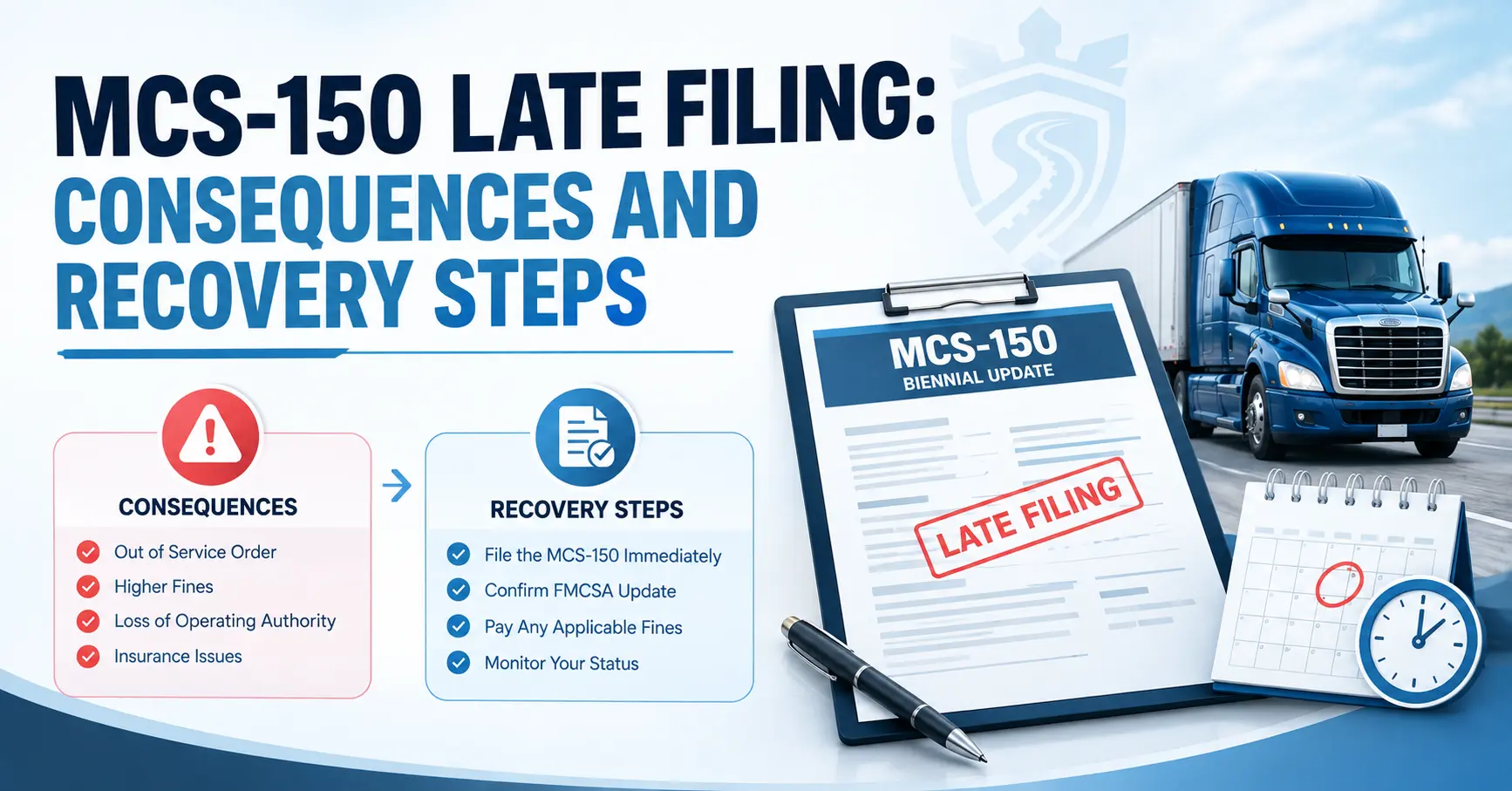
Missing an MCS-150 biennial update can create problems for a motor carrier’s USDOT registration record. Depending on the carrier’s circumstances and the status of FMCSA’s registration system, a late or missed update can lead to an outdated registration record, potential enforcement consequences, or a need to reactivate an inactive USDOT Number.
The good news is that a missed MCS-150 update does not mean you should apply for a new USDOT Number.
The appropriate recovery step depends on the current status of your existing USDOT record.
What Is an MCS-150 Late Filing?
An MCS-150 late filing occurs when a motor carrier does not complete its required biennial update by the applicable FMCSA deadline.
The MCS-150, or Motor Carrier Identification Report, is used to update an existing USDOT Number record. FMCSA requires entities subject to the requirement to update their information every two years according to the prescribed filing schedule.
The update is required even when the company’s information has not changed.
A carrier should therefore not assume that an unchanged address, fleet, ownership structure, or operation eliminates the filing requirement.
Why Is the MCS-150 Biennial Update Important?
The MCS-150 keeps FMCSA’s company registration information current.
Depending on the carrier, the record can contain information such as:
- Legal business information
- Business address
- Contact information
- Operation classification
- Power units
- Vehicle information
- Driver information
- Annual vehicle miles traveled
- Cargo classifications
- Other registration information
Keeping this information current also matters because FMCSA safety systems use registration information in their broader data environment.
FMCSA specifically notes that carriers should update MCS-150 information whenever relevant information changes rather than waiting for the next biennial deadline.
When Is the MCS-150 Biennial Update Due?
The filing schedule is determined by the USDOT Number.
The next-to-last digit determines whether the update is due in an odd- or even-numbered year, while the last digit determines the month.
For example, under the standard schedule:
- USDOT ending in 1 → January
- USDOT ending in 2 → February
- USDOT ending in 3 → March
- USDOT ending in 4 → April
- USDOT ending in 5 → May
- USDOT ending in 6 → June
- USDOT ending in 7 → July
- USDOT ending in 8 → August
- USDOT ending in 9 → September
- USDOT ending in 0 → October
The applicable odd/even year is determined by the next-to-last digit of the USDOT Number.
What Happens If You Miss the MCS-150 Deadline?
The consequences depend on the carrier’s situation and the current FMCSA registration status.
Historically, FMCSA stated that failure to complete a required biennial update could result in deactivation of the USDOT Number and could lead to civil penalties of up to $1,000 per day, not to exceed $10,000.
However, FMCSA currently has a temporary suspension in place during the 2026 transition to Motus.
FMCSA states that entities whose biennial updates were due on or after June 1, 2026 will receive additional time and will not have their USDOT Number inactivated for failing to complete the update during this temporary suspension.
This means carriers should distinguish between:
A missed deadline
and
an actually inactive USDOT Number.
They are not necessarily the same situation.
Need Help With DOT Compliance?
Get reliable guidance and support to keep your DOT compliance on track.
What Should You Do If Your MCS-150 Is Late?
Do not immediately apply for a new USDOT Number.
First, determine the status of the existing USDOT record.
A practical recovery process is:
Check → Update → Verify → Reactivate if necessary → Confirm
Step 1: Check Your USDOT Record
Start by checking the carrier’s current FMCSA registration information.
Review:
- USDOT Number
- Company legal name
- Address
- Operating classification
- Number of power units
- Driver information
- Vehicle information
- Current registration status
- Last update information
The purpose is to determine whether the problem is simply an overdue update or whether the USDOT Number has actually become inactive.
Step 2: Determine Whether an Update Is Required
If the USDOT Number remains active and the carrier’s biennial update is overdue, the appropriate action is generally to complete the required update rather than create a new registration.
FMCSA’s current MCS-150 instructions specifically identify “Biennial Update or Changes” as a reason for filing the form.
Step 3: Correct Outdated Company Information
Do not treat the filing as a checkbox exercise.
Review the information being reported and correct outdated data.
Check items such as:
- Legal business name
- Address
- Contact information
- Operation type
- Power units
- Drivers
- Vehicle information
- Mileage information
- Cargo classification
A late filing is an opportunity to bring the USDOT record back into alignment with the carrier’s actual operation.
Step 4: Submit the Update Through the Current FMCSA System
FMCSA’s registration environment transitioned to Motus, the USDOT Registration System, in 2026.
Motus supports biennial updates and other registration lifecycle actions, including updating business information and reactivating an inactive USDOT Number.
Registrants access the new system through Login.gov and identity verification rather than relying on the legacy USDOT PIN process for electronic registration actions.
Step 5: Save Evidence of the Filing
After submitting the update, retain evidence showing that the filing was completed.
Useful documentation can include:
- Submission confirmation
- Filing date
- Confirmation or reference information
- Submitted information
- Supporting documentation
- Updated registration record
This creates an audit trail showing when the carrier corrected its registration information.
Step 6: Verify the Updated Record
Do not assume that submission automatically means the public registration record is immediately updated everywhere.
FMCSA notes that some downstream safety data systems update on a separate schedule. For example, MCS-150 changes may not appear immediately in SMS and may appear with the following monthly data update.
The carrier should therefore verify the registration record after the filing has been processed.
What If the USDOT Number Is Already Inactive?
An inactive USDOT Number requires a different recovery path.
Do not create a second USDOT Number simply because the existing number is inactive.
FMCSA’s current MCS-150 instructions include a specific REACTIVATE filing reason for an inactive USDOT Number.
The current FMCSA registration framework also allows registrants to reactivate USDOT Numbers through Motus.
Basic USDOT Recovery Sequence
Should You Apply for a New USDOT Number?
Usually, a previously assigned USDOT Number should not simply be replaced with a new one because an update was missed.
FMCSA’s MCS-150 instructions specifically state that if a company currently has or previously had a USDOT Number, it should not submit the MCS-150 as a new application merely to obtain another number.
The appropriate filing reason may instead be:
- Biennial Update or Changes
- Reactivation
- Reapplication after applicable revocation
- Another appropriate registration action
The correct option depends on the status and circumstances of the existing record.
Late MCS-150 Filing vs. Inactive USDOT Number
These situations should be separated.
| Situation | What It Means | General Next Step |
|---|---|---|
| Update is due | Biennial requirement has reached its deadline | Submit the required update |
| Update is late but USDOT remains active | Filing requirement was missed or delayed | Complete the update and verify the record |
| USDOT Number is inactive | Existing USDOT registration is not currently active | Follow the applicable reactivation process |
| Registration was revoked | Different regulatory status | Follow the applicable reapplication process |
| Company information changed | Registration record needs correction | Submit the appropriate update |
The current 2026 temporary suspension makes it especially important to verify the actual status instead of assuming that every missed deadline caused automatic inactivation.
Common Reasons an MCS-150 Update Gets Delayed
A missed filing can happen for simple administrative reasons.
The Carrier Forgot the Due Date
The biennial schedule is based on the USDOT Number, so carriers should not rely on memory alone.
The Company Information Has Not Changed
Some carriers assume that no changes means no filing is necessary.
FMCSA still requires the biennial update even when company information has not changed.
Company Information Changed but Was Never Updated
A carrier may have changed its address, fleet size, operation classification, or other information without updating FMCSA.
Registration Responsibilities Were Transferred
When ownership or administrative responsibility changes, the new person may not know when the next update is due.
The Carrier Relied on an Outdated Filing Process
The 2026 transition to Motus changed the registration environment and how registrants access and manage registration actions.
Carriers should use the current FMCSA registration system and instructions rather than relying on older screenshots or legacy workflows.
What Information Should You Review Before Filing?
Before submitting a late update, review the entire registration profile.
Company Information
Confirm:
- Legal name
- DBA, if applicable
- Principal address
- Mailing address
- Contact information
Operation Information
Confirm:
- Carrier operation type
- Interstate/intrastate status
- Applicable operation classifications
- Cargo classifications
Fleet Information
Confirm:
- Power units
- Trailers or applicable equipment
- Vehicle information
- Mileage information
Driver Information
Confirm that reported driver information accurately reflects the company’s current operation.
Registration Access
Confirm that the person responsible for registration has the necessary access to the current FMCSA system.
MCS-150 Late Filing Recovery Checklist
Use this checklist when a carrier discovers a missed biennial update:
- Identify the USDOT Number
- Determine the scheduled filing year and month
- Check the current USDOT registration status
- Confirm whether the update is actually overdue
- Review company information
- Review operation classification
- Review power-unit and driver information
- Review mileage and cargo information
- Complete the appropriate MCS-150 filing
- Use the current FMCSA registration system
- Save the submission confirmation
- Verify the updated registration record
- Determine whether reactivation is required
- Do not create a duplicate USDOT Number simply because the update was missed
2026 Motus: What Carriers Need to Know
The transition to Motus is particularly important for carriers dealing with MCS-150 issues in 2026.
FMCSA launched Motus as its new USDOT Registration System in May 2026. The system supports registration lifecycle activities including biennial updates, company-information changes, and USDOT Number reactivation.
FMCSA has also temporarily suspended enforcement of biennial-update failures and USDOT inactivation for entities whose updates were due on or after June 1, 2026. The agency says additional guidance will be provided as Motus recovery and stabilization efforts continue.
Because this is a temporary policy during a system transition, carriers should verify the current FMCSA instructions before relying on older MCS-150 recovery procedures.
What If Your MCS-150 Information Is Incorrect?
A late update is not the only problem.
A carrier can technically file on time while still maintaining inaccurate information.
For example, a company may have:
- Increased its fleet size
- Changed its address
- Changed operation type
- Added or removed drivers
- Changed cargo classifications
- Changed other registration information
FMCSA encourages carriers to update MCS-150 information whenever relevant data changes rather than waiting for the next biennial deadline.
The objective should therefore be accurate registration information, not merely a timely submission.
How to Prevent Another Late MCS-150 Filing
The easiest late-filing problem to fix is the one that never occurs.
Carriers can establish a simple registration-control process:
Track the Due Date
Record the biennial deadline based on the USDOT Number.
Set Internal Reminders
Create reminders well before the actual deadline.
Review Information Before Filing
Do not wait until filing day to discover that the company record is outdated.
Assign One Responsible Person
Make one person accountable for monitoring the registration requirement.
Keep Filing Evidence
Store confirmation and related documentation with the company’s compliance records.
Verify After Submission
Confirm that the filing has been processed and the registration information reflects the intended update.
When Should You Get Help With a Late MCS-150?
Professional assistance may be useful when the situation involves more than a routine update.
Consider getting help if:
- The USDOT Number shows inactive status
- The carrier cannot access the registration account
- Company information has changed significantly
- The carrier is unsure which filing reason applies
- A previous filing was rejected
- The carrier has registration or authority issues connected to the record
- The company is dealing with a Motus transition issue
- The carrier is concerned about potential penalties or enforcement
The important first step is to identify the current status of the existing USDOT record.
Need Help With DOT Compliance?
Get reliable guidance and support to keep your DOT compliance on track.
Frequently Asked Questions
The consequences depend on the circumstances and current FMCSA policy. Historically, failure to complete a required biennial update could result in USDOT Number deactivation and potential civil penalties. For certain 2026 deadlines, FMCSA has temporarily suspended enforcement and inactivation during the Motus transition.
A missed deadline does not mean the update can no longer be completed. The carrier should check its current FMCSA registration status and submit the appropriate update through the current registration system.
No. A missed update generally does not mean you should obtain a new USDOT Number. FMCSA specifically instructs companies that already have or previously had a USDOT Number not to submit a new application simply to obtain another number.
If the existing USDOT Number is inactive, use the applicable reactivation process rather than applying for an unrelated new number. FMCSA’s current registration system supports USDOT Number reactivation.
Yes. FMCSA requires entities subject to the requirement to file the biennial update even if their information has not changed.
The due date is determined by the digits of the USDOT Number. The next-to-last digit determines the odd/even filing year, and the last digit determines the filing month.
FMCSA identifies the biennial update as having no processing fee.
Not necessarily. FMCSA notes that MCS-150 changes do not appear immediately in SMS and may appear with the following monthly data update.
Yes. FMCSA states that an MCS-150 or MCS-150C update completed during the 12 months immediately preceding the biennial due date can satisfy the biennial update requirement under its stated conditions.
Yes. Motus is the current FMCSA USDOT Registration System and supports submitting biennial updates and other registration actions. The underlying requirement to keep the USDOT registration information current remains important.