Disclosure: Informational only. We are not FMCSA or USDOT. Always verify your status directly through official FMCSA systems.
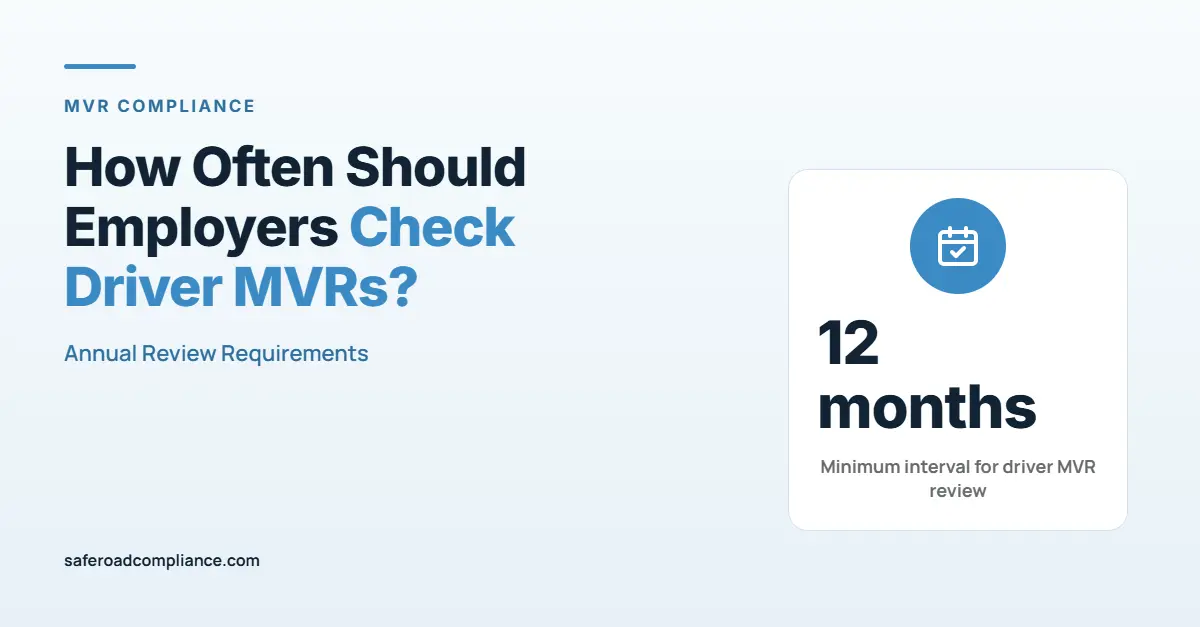
Federal rules require two motor vehicle record (MVR) checks: one at hiring, from every state where the driver held a license in the past 3 years, and one at least every 12 months after that, with a documented review. That is the minimum. Some fleets add more frequent checks by policy, and some use continuous monitoring, which FMCSA has said can satisfy the annual review when it gives a complete, automatically updated record.
The right frequency depends on which of three levels you’re aiming for: the federal minimum, your company policy, or continuous monitoring. For what an MVR shows, see what an MVR is.
The Federal Minimum: Two Required MVR Checks
FMCSA’s driver qualification rules set two checkpoints. Both apply to drivers of CMVs in interstate commerce, including owner-operators who drive for their own authority.
Pre-Employment vs. Annual MVR Checks
Understand when carriers must obtain motor vehicle records, which records to review, and what documentation belongs in the driver qualification file.
| Check | Rule | What’s Required |
|---|---|---|
| Pre-employment Before qualification | 49 CFR § 391.23 | Obtain an MVR from each state where the driver held a motor vehicle operator’s license or permit during the preceding three years, as required by the rule. The MVR must be placed in the driver qualification file within 30 days of the driver’s employment. If a state does not respond, document the required good-faith effort and follow the regulation’s procedures. |
| Annual review At least every 12 months | 49 CFR § 391.25 | At least once every 12 months, obtain an updated MVR from each state that issued a motor vehicle operator’s license or permit the driver held during the preceding year. Review the record to determine whether the driver meets the applicable safe-driving requirements and is not disqualified under § 391.15. Document the review with the reviewer’s name and date, and retain the required record in the driver qualification file. |
Compliance tip: Obtaining an MVR is only one part of driver qualification. Maintain the required investigation and review documentation, and verify the current rule text for applicable exceptions and recordkeeping details. See the official 49 CFR Part 391.
The review is the easy part to miss. Pulling the record without documenting who reviewed it and what they decided does not meet 391.25. FMCSA’s Safety Planner and its Annual Review of Driving Record form show what the documentation looks like.
For CDL holders, FMCSA’s Safety Planner says the MVR to obtain is the CDLIS record from the current licensing state.
Three Levels of MVR Check Frequency
The question “how often” has three answers, depending on the standard you hold yourself to.
How Often Should You Check a Driver’s MVR?
Compare the annual federal review requirement with more frequent company checks and continuous driver-record monitoring.
| Level | Frequency | Who Sets It | What It Catches |
|---|---|---|---|
| Federal minimum 49 CFR 391.23 / 391.25 | At hire and at least every 12 months, as applicable to the driver qualification requirements. | FMCSA regulations establish the applicable investigation and annual review requirements. | Shows information available in the motor vehicle record when it is obtained. It may not reflect later events that have not yet been recorded. |
| Company policy Additional checks | At an interval selected by the company, such as quarterly or after a safety-related incident. | Your written safety policy, risk-management practices, or insurer requirements. | Can identify record changes between annual reviews, depending on when the check is performed and when state records are updated. |
| Continuous monitoring Ongoing alerts | Alerts when covered driver-record changes are reported by a monitoring service. | Your company, a state Employer Notification Service, or an eligible third-party monitoring provider. | May flag new convictions, license suspensions, or expirations soon after they are reported to the service. Timing and coverage vary by state and provider. |
Compliance tip: Continuous monitoring can supplement—but does not automatically replace—required driver qualification investigations and annual MVR reviews. Follow applicable recordkeeping, driver-notification, and state privacy requirements. Review 49 CFR Part 391 for the governing requirements.
Why the minimum leaves a gap. FMCSA’s Employer Notification Service guidance points out that with only an annual check and driver self-reporting, a conviction can go unnoticed for up to 364 days. The same document cites FMCSA research finding that drivers with suspended licenses had a crash rate 14 times higher than other drivers.
Continuous monitoring can replace the annual pull. FMCSA guidance says a third-party system that provides a complete, automatically updated state driving record satisfies 391.25(a), as long as a manager reviews the record and the system logs who reviewed it (FMCSA). FMCSA also says a state Employer Notification Service used to check the record at least annually satisfies the requirement.
For a side-by-side look at cost, setup, and coverage, see continuous MVR monitoring vs annual MVR checks.
Events That Should Trigger an Extra MVR Check
Outside the scheduled checks, a few events are good reasons to pull a record right away. Only the first is a federal driver duty; the rest are recommended practice.
- A driver reports a conviction. CDL holders must notify their employer in writing within 30 days of a conviction for any state or local traffic law violation other than parking (FMCSA Safety Planner). Pull the MVR to confirm what was recorded.
- A crash or roadside citation. Check whether the event has posted and whether it creates a disqualification.
- A serious traffic violation. Speeding 15 mph or more over the limit, reckless driving, and hand-held phone use count toward CDL disqualification. Two in three years means 60 days off the road.
- License or medical certificate renewal. Confirm the new dates and status are on the record.
- Before a high-risk assignment. Hazmat, passenger, or new-lane work can justify a fresh look.
Whatever your schedule, put it in writing and apply it to every driver.
Set Up MVR Checks You Can Defend
SafeRoad Compliance runs pre-employment and annual MVR checks, documents the annual review in each driver qualification file, and offers ongoing MVR monitoring, as part of our DOT compliance services. To set up a schedule for your drivers, contact SafeRoad Compliance.
FAQs
At hire and at least once every 12 months, under 49 CFR 391.23 and 391.25.
It meets the federal minimum. It can leave months between a conviction and when you learn about it, which is why some carriers check more often or use continuous monitoring.
It can. FMCSA guidance says a complete, automatically updated record satisfies the annual review, as long as a manager reviews it and the system logs who reviewed it.
Yes. An owner-operator running under its own authority is the motor carrier and must do the annual review on itself.
An updated MVR from each state where the driver holds a license, a decision on whether the driver meets minimum safe driving requirements or is disqualified, and a note with the reviewer’s name and date.
CDL drivers must notify their employer in writing within 30 days of a conviction for any non-parking traffic violation.
Don’t Let Compliance
Slow Your Business Down.
Stay organized, keep required records current, and stay ahead of important DOT compliance requirements with professional support.