Disclosure: Informational only. We are not FMCSA or USDOT. Always verify your status directly through official FMCSA systems.
A driver’s Motor Vehicle Record (MVR) can change long after the initial hiring decision. A speeding conviction, license suspension, serious traffic violation, or other driving-related event can affect a driver’s qualification and create compliance concerns for a motor carrier.
That raises an important question for fleet managers: Is an annual MVR review enough, or should carriers use continuous MVR monitoring throughout the year?
Under 49 CFR §391.25, motor carriers generally must make an inquiry into each employed driver’s driving record at least once every 12 months and review that record to determine whether the driver continues to meet applicable safe-driving requirements. FMCSA also recognizes certain state Employer Notification Services (ENS) as a way to receive ongoing driving-record notifications.
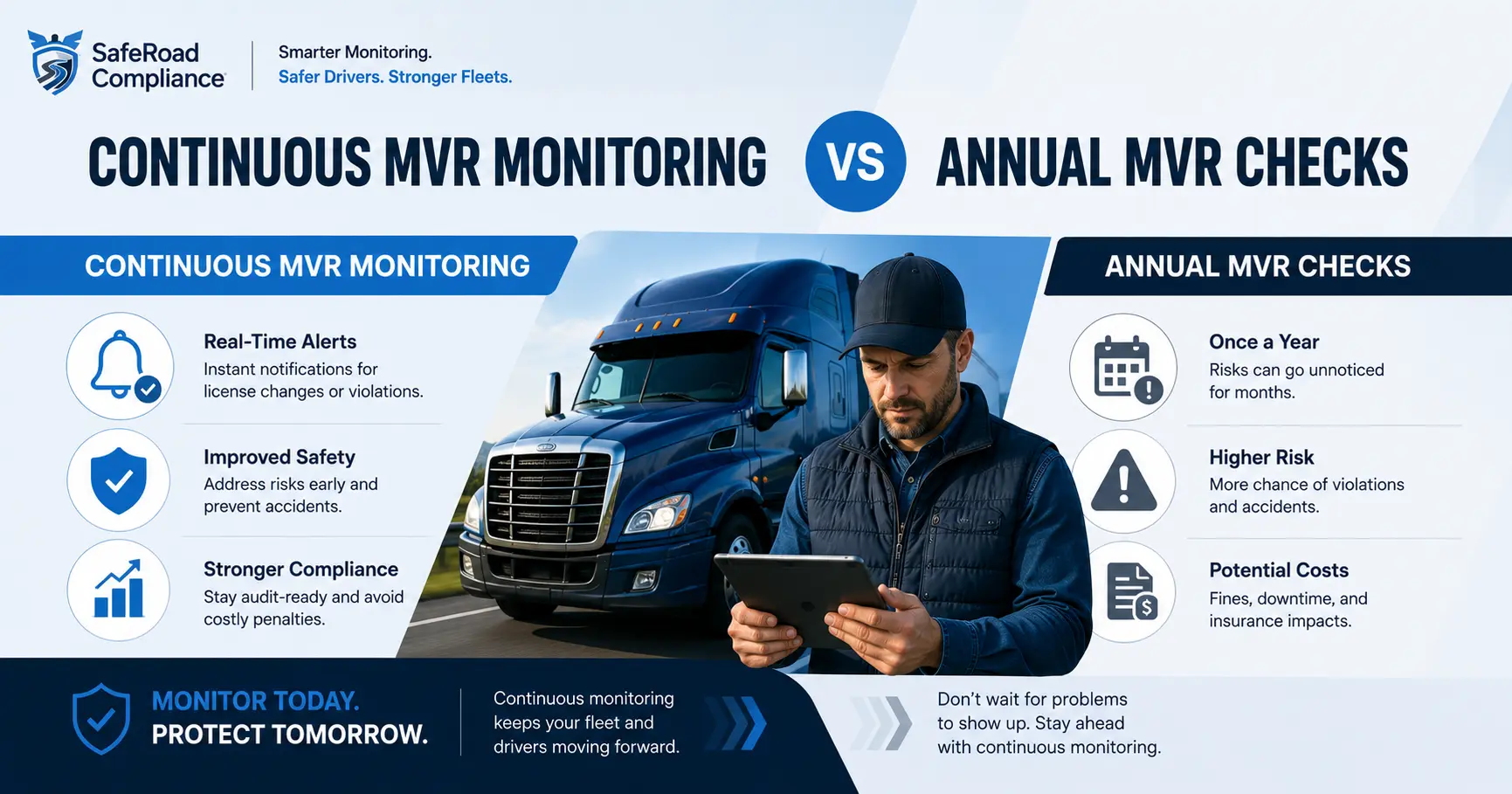
However, an annual MVR review and continuous MVR monitoring serve different purposes. Annual review helps satisfy a recurring regulatory requirement, while continuous monitoring can provide earlier visibility into changes between scheduled reviews.
Quick Answer: Annual MVR review is a recurring FMCSA compliance requirement under §391.25 for most covered drivers. Continuous MVR monitoring is an additional risk-management approach that can alert a carrier to qualifying driving-record changes sooner rather than waiting for the next annual review.
What Is an MVR Review?
A Motor Vehicle Record (MVR) is a driving record maintained by a state licensing authority. For commercial carriers, it can provide important information about a driver’s license status, traffic violations, convictions, and other driving history relevant to qualification and safety.
MVR information is an important component of a carrier’s Driver Qualification File (DQF) and ongoing driver management process.
An MVR review should not be treated as simply downloading a report and placing it in a file. The carrier must evaluate the available information and determine whether the driver continues to meet the applicable requirements.
FMCSA guidance states that the carrier must consider information reasonably available about the driver’s driving experience, including known violations, accidents, and other information indicating a lack of due regard for public safety.
This makes the review process just as important as obtaining the record.
What Does FMCSA Require for Annual MVR Checks?
For most drivers subject to the federal driver qualification rules, 49 CFR §391.25 requires an annual inquiry and review of the driving record.
The carrier generally must:
- Make an inquiry to obtain the driver’s MVR at least once every 12 months.
- Obtain the record from the appropriate state licensing authority or authorities.
- Review the record to determine whether the driver continues to meet minimum safe-driving requirements.
- Consider relevant violations and accident information.
- Maintain the required documentation in the driver’s qualification file.
FMCSA’s current Driver Qualification File checklist also identifies the annual state-agency inquiry and annual review as required DQF components.
What Must Be Documented?
The annual process should leave an audit-ready paper trail.
FMCSA guidance identifies two important records:
- A copy of the MVR obtained through the annual inquiry
- A note documenting the annual review, including the name of the person who performed the review and the date of the review.
A carrier should therefore avoid treating an annual MVR check as a simple administrative task.
The goal is to demonstrate that the company actually reviewed the record and made an appropriate qualification decision.
What Is Continuous MVR Monitoring?
Continuous MVR monitoring is a driver-safety process that checks for qualifying changes to a driver’s driving record throughout the year rather than relying exclusively on a scheduled annual review.
Depending on the state and monitoring provider, these systems may use state Employer Notification Services (ENS) or other authorized third-party processes to provide notifications when relevant driving-record information changes.
FMCSA recognizes that state-operated notification systems can provide ongoing information about license status, crashes, and convictions. The agency has also stated that certain ENS arrangements can satisfy the annual inquiry requirement when used appropriately.
The important distinction is this:
Continuous monitoring does not eliminate the carrier’s responsibility to conduct and document the required annual review.
Instead, it can supplement the annual process by giving safety managers earlier visibility into changes.
Continuous MVR Monitoring vs. Annual MVR Review
| Factor | Annual MVR Review | Continuous MVR Monitoring |
|---|---|---|
| Frequency | At least once every 12 months | Ongoing, depending on monitoring system |
| Primary Purpose | Meet annual review requirements | Identify changes sooner |
| Driver Risk Visibility | Periodic | More frequent |
| Compliance Documentation | Required | Should also be documented |
| Response to New Violations | May wait until next review unless otherwise reported | Potentially faster |
| Best Use | Baseline compliance process | Ongoing risk management |
| Replaces Annual Review? | N/A | Not automatically |
| Suitable for Larger Fleets | Requires recurring manual coordination | Can improve scalability |
The strongest approach for many carriers is not necessarily annual versus continuous.
It is annual compliance review plus appropriate ongoing monitoring.
Why Annual Checks Alone May Create Operational Gaps
Imagine a carrier completes an MVR review for a driver in January.
The driver appears qualified, and the documentation is properly placed in the DQF.
In May, however, the driver’s license status changes or a significant driving event appears on the state record.
If the carrier relies exclusively on its next annual review, that information may not be identified through the normal MVR review process until much later.
That creates a potential visibility gap.
The carrier may still have responsibilities under its safety-management policies, insurance requirements, state requirements, or other applicable rules depending on the specific circumstances.
Continuous monitoring can help reduce that gap by creating an earlier notification mechanism.
Important: Continuous monitoring should be viewed as a risk-management tool, not as a substitute for understanding the specific FMCSA requirements applicable to your operation.
How Continuous Monitoring Can Reduce Driver Risk
A driver’s qualification status is not necessarily static.
Even an experienced CDL driver with a clean hiring record can later develop issues that require management attention.
Continuous monitoring can help fleets identify events such as:
- License status changes
- Suspensions or revocations
- Reportable traffic convictions
- Certain serious driving violations
- New accident-related information
- Other state-record changes supported by the monitoring system
The carrier can then investigate the notification and determine what action is appropriate.
That might include requesting an updated MVR, reviewing the driver’s DQF, contacting the driver, consulting applicable regulations, or temporarily restricting driving duties when required.
The key benefit is earlier awareness.
Annual MVR Review Is Still the Compliance Foundation
It is important not to confuse monitoring with the annual review requirement.
A fleet might receive continuous notifications throughout the year, but it still needs a controlled process for completing and documenting its required annual inquiry and review.
FMCSA specifically states that the annual review requires the carrier to consider the driver’s available driving information and determine whether the driver continues to meet the applicable safe-driving requirements.
For compliance managers, the ideal workflow looks like this:
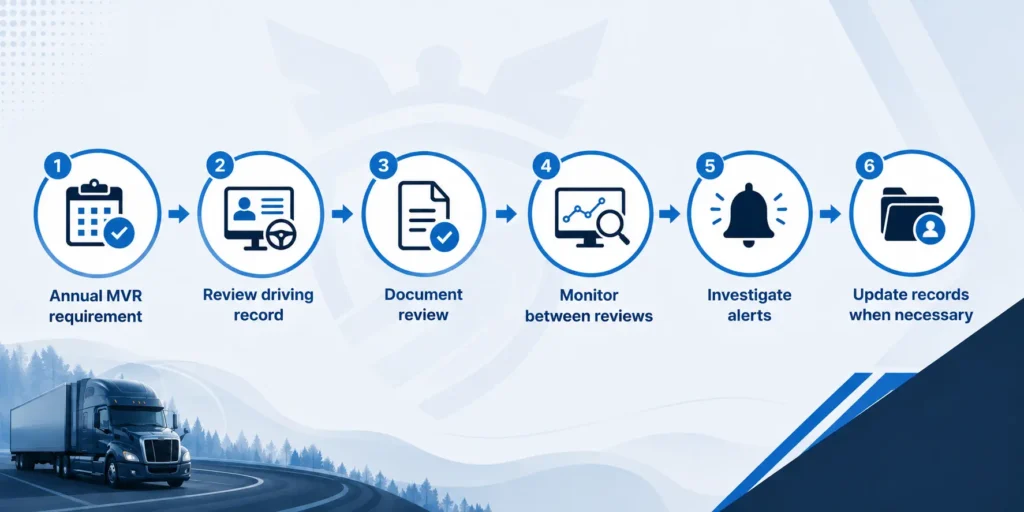
This creates both a regulatory baseline and an ongoing safety-management process.
Who Should Consider Continuous MVR Monitoring?
Continuous monitoring can be particularly useful for carriers with:
- Large driver populations
- High driver turnover
- Multiple operating locations
- Frequent hiring
- Safety-sensitive operations
- Limited internal compliance staff
- Drivers operating across multiple jurisdictions
- Existing driver-risk monitoring programs
Smaller carriers can also benefit, particularly when the owner or safety manager handles several compliance responsibilities at once.
The decision should be based on the carrier’s operational risk, driver population, monitoring capabilities, and compliance-management resources.
Building a Continuous MVR Monitoring Program
How to Build an Effective MVR Monitoring Program
A continuous MVR monitoring program should do more than generate alerts. Your fleet needs a defined process for receiving, reviewing, documenting, and acting on driving-record changes.
A practical workflow can be organized into six steps:
- Identify drivers who require monitoring
- Enroll drivers through an appropriate monitoring service
- Establish responsibility for reviewing alerts
- Investigate each notification
- Document the decision and supporting records
- Complete the required annual MVR review
This creates a repeatable process that can be managed across a growing fleet.
Step 1: Identify Drivers for Monitoring
Start with an accurate driver roster.
Your list should include active drivers subject to your company’s qualification and safety-management requirements. Compare the roster against your Driver Qualification Files to identify missing or outdated information.
For each driver, verify:
- Legal name
- Driver’s license number
- State of issuance
- Current employment status
- DQF status
- Existing MVR documentation
- Monitoring enrollment status
Keeping this information accurate matters because an incorrect license number or state can interfere with record matching.
Step 2: Choose an Appropriate Monitoring Method
There is no single MVR monitoring method that works for every carrier.
Some fleets use state Employer Notification Services (ENS), while others use commercial MVR monitoring providers or broader driver-risk management platforms.
Before selecting a provider, evaluate:
| Factor | What to Check |
|---|---|
| State Coverage | Can it monitor the states where your drivers are licensed? |
| Notification Method | How are alerts delivered? |
| Data Accuracy | How is driver information matched? |
| Review Process | Can your safety team document actions? |
| Record Retention | Can supporting records be retained for compliance purposes? |
| Fleet Size | Does the system support your number of drivers? |
| Integration | Can it work with your existing compliance workflow? |
The goal is not simply to purchase a monitoring product.
The goal is to establish a reliable compliance process around the information the system provides.
What Should Happen When an MVR Alert Appears?
An MVR alert should never automatically result in termination or immediate removal from service.
The notification is a trigger for review.
For example, suppose a fleet receives an alert indicating that one driver’s license status has changed.
A safety manager should:
- Confirm the alert belongs to the correct driver.
- Obtain or review the underlying MVR information.
- Determine what changed.
- Compare the information against applicable FMCSA requirements.
- Review the driver’s DQF and company safety policies.
- Determine whether additional documentation is needed.
- Document the review and resulting action.
This distinction is important because a monitoring alert is not necessarily the same thing as a regulatory violation.
What If a Driver Receives a Serious Traffic Violation?
Consider a hypothetical carrier with 25 CDL drivers.
A driver who had a clean MVR during the annual review receives a serious traffic conviction several months later. The carrier’s monitoring system generates an alert.
Instead of waiting until the next annual review, the safety manager investigates the event immediately.
The carrier can then determine whether the event affects:
- Driver qualification
- Company safety policy
- Insurance requirements
- Assignment eligibility
- Driver training requirements
- Internal disciplinary procedures
The carrier should document the decision and retain relevant records according to its compliance procedures.
This is one of the primary operational advantages of fleet MVR monitoring: the safety team has an opportunity to investigate potentially important information sooner.
Does Continuous MVR Monitoring Replace Annual MVR Checks?
Not automatically.
This is one of the most important distinctions fleet managers should understand.
Under 49 CFR §391.25, carriers generally must make an inquiry into the driver’s driving record at least once every 12 months and review that record.
Certain state Employer Notification Services may satisfy the annual inquiry requirement when the applicable conditions are met, but carriers should verify that their specific process meets FMCSA requirements rather than assuming that any monitoring service automatically replaces the annual review.
A carrier should maintain a documented annual compliance process even when it uses continuous monitoring.
Recommended Approach
Continuous monitoring + annual documented review = stronger driver-risk management
Monitoring provides ongoing visibility.
The annual review provides a structured compliance checkpoint.
MVR Monitoring and Insurance Risk
MVR information can also play an important role in fleet risk management.
Insurance underwriters commonly evaluate driver history when assessing commercial trucking risk. Serious violations, license issues, accidents, and patterns of unsafe driving can affect how an insurer views a fleet.
However, carriers should avoid assuming that continuous monitoring will automatically reduce premiums.
There is no universal guarantee that using an MVR monitoring service will produce a specific insurance discount.
The more defensible benefit is that monitoring can help a carrier identify and manage driver risk earlier.
That can support a broader safety program that includes:
- Driver qualification
- Preventive training
- Accident review
- MVR checks
- Roadside inspection management
- CSA monitoring
- Written safety policies
Common MVR Monitoring Mistakes
Even carriers using an MVR monitoring system can have compliance weaknesses.
1. Treating Monitoring as a Replacement for Compliance Review
Receiving automated alerts does not mean the safety department can stop reviewing driver records.
The carrier still needs a documented process for meeting applicable annual requirements.
2. Failing to Investigate Alerts
An alert sitting unread in an email inbox does not demonstrate effective monitoring.
Assign a responsible person or team to review notifications within a defined timeframe.
3. Not Documenting the Decision
If a safety manager reviews an alert and determines that no action is required, that decision should still be documented according to company procedures.
A future auditor should be able to understand what happened and how the carrier responded.
4. Monitoring the Wrong Driver Information
Incorrect license numbers, names, or states can cause record-matching problems.
Driver information should be verified when employees are onboarded and updated when necessary.
5. Assuming Every Violation Disqualifies a Driver
Not every traffic event automatically means a driver is no longer qualified.
The appropriate response depends on the specific violation, applicable regulations, driver history, company policies, and circumstances.
6. Ignoring State Requirements
Driver-record systems and notification programs can vary by state.
Carriers should confirm that their monitoring process works for the jurisdictions where their drivers are licensed.
Best Practices for Fleet MVR Monitoring
A strong MVR program should be consistent, documented, and actionable.
Best Practice 1: Assign Ownership
Someone should be responsible for reviewing MVR notifications.
For larger fleets, this might be a safety manager or compliance department. Smaller carriers may assign the responsibility to an owner or designated compliance administrator.
Best Practice 2: Set an Internal Response Time
Do not allow alerts to remain unresolved indefinitely.
Create an internal policy specifying when notifications should be reviewed and escalated.
Best Practice 3: Connect MVR Monitoring to the DQF
When a driver’s record changes, determine whether the Driver Qualification File needs additional documentation.
This helps connect ongoing driver monitoring with the carrier’s broader qualification process.
Best Practice 4: Use Written Escalation Procedures
Your safety team should know what to do when an alert involves:
- License suspension
- License revocation
- Serious traffic violations
- Multiple violations
- Accident information
- Potential qualification concerns
Written procedures reduce inconsistent decisions.
Best Practice 5: Review Your Entire Driver Population
Do not create a monitoring program for only a handful of drivers while leaving the rest outside the process without a documented reason.
The monitoring strategy should align with your fleet’s compliance requirements and risk-management objectives.
MVR Compliance Workflow for Fleet Managers
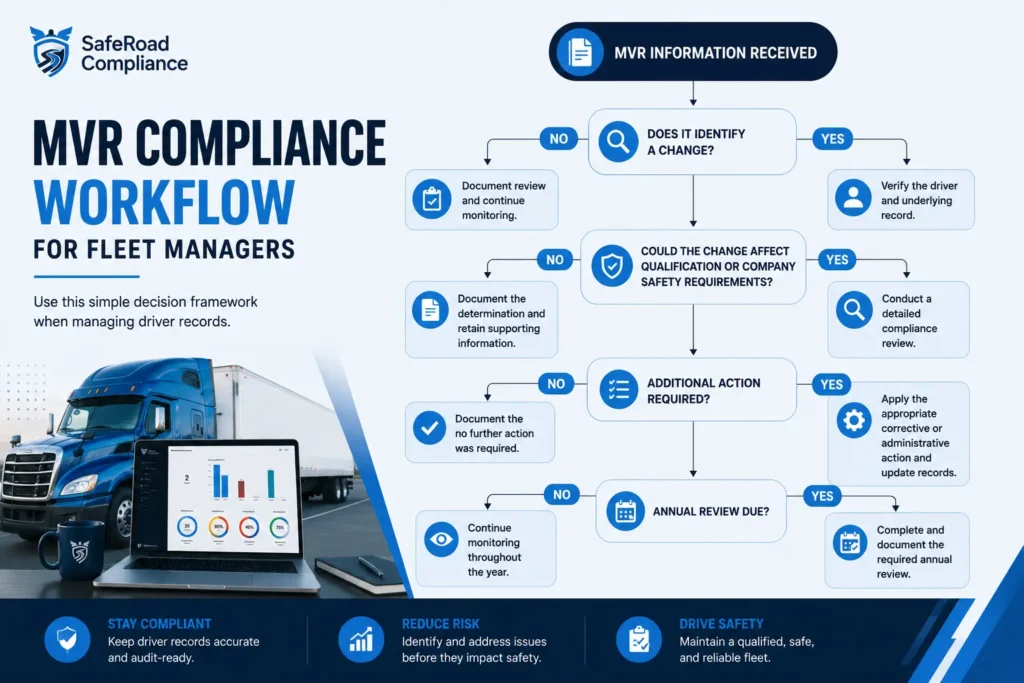
This workflow prevents an MVR alert from becoming an isolated piece of information that never reaches the carrier’s compliance process.
MVR Compliance Checklist
Before considering your MVR program complete, verify the following:
- Current driver roster is maintained
- Driver license information is accurate
- Required MVR inquiries are completed
- Annual MVR reviews are documented
- Continuous monitoring is configured where appropriate
- MVR alerts have an assigned reviewer
- Alerts are investigated promptly
- Driver qualification implications are evaluated
- Supporting documentation is retained
- DQF records are updated when necessary
- Written escalation procedures exist
- State-specific requirements are considered
- Compliance responsibilities are clearly assigned
Expert Tips From SafeRoad Compliance
Tip 1: Don’t wait for the annual deadline to discover a problem.
Annual MVR reviews are important, but they only provide a periodic snapshot. Continuous monitoring can provide additional visibility between reviews.
Tip 2: Treat every alert as information that requires evaluation—not an automatic violation.
Verify the underlying record before making a driver-management decision.
Tip 3: Connect MVR monitoring to your DQF workflow.
Driver qualification should be managed as an ongoing process rather than a file created only when someone is hired.
Tip 4: Document decisions, not just violations.
A strong compliance record shows what information was reviewed, who reviewed it, when it was reviewed, and what action was taken.
Tip 5: Don’t let technology replace judgment.
Automated monitoring can identify changes, but qualified personnel still need to determine what those changes mean for the carrier.
Continuous MVR Monitoring: Is It Worth It?
For many fleets, the answer depends on the size of the operation, driver risk profile, internal resources, and existing compliance controls.
A small carrier with a handful of drivers may be able to manage annual MVR reviews effectively with a well-organized compliance calendar.
A larger fleet with dozens or hundreds of drivers may benefit more from continuous monitoring because manually identifying changes between annual reviews becomes increasingly difficult.
The key question is not simply “Do we need continuous monitoring?”
Ask instead:
“How quickly would we know if one of our drivers’ driving records changed?”
If the answer is “not until the next annual MVR review,” there may be an opportunity to strengthen the fleet’s driver-risk management process.
Key Takeaways
- Annual MVR review remains an important FMCSA driver qualification requirement under 49 CFR §391.25.
- Continuous MVR monitoring provides additional visibility into driving-record changes between annual reviews.
- Continuous monitoring does not automatically replace the required annual review.
- MVR alerts should be investigated rather than automatically treated as driver disqualifications.
- MVR monitoring should connect with the carrier’s Driver Qualification File (DQF) process.
- Documentation is critical for demonstrating that the carrier actively manages driver qualification.
- Larger fleets may benefit significantly from automated monitoring and centralized review workflows.
- A strong MVR program combines regulatory compliance, ongoing monitoring, documented decisions, and clear escalation procedures.
Need Help Managing Driver MVR Compliance?
Keeping up with annual MVR requirements, driver qualification records, and ongoing driver-risk monitoring can become difficult as your fleet grows.
SafeRoad Compliance can help carriers organize their MVR checks and driver qualification processes so important compliance tasks are easier to track and manage.
For carriers that want a more structured approach to driver qualification and MVR management, professional compliance support can help reduce administrative gaps while keeping the focus on safe, qualified drivers.
FAQs
Continuous MVR monitoring is not universally required simply because a carrier employs CDL drivers. FMCSA generally requires carriers subject to §391.25 to conduct and document an annual inquiry and review of the driver’s driving record. Some state notification programs may satisfy the annual inquiry requirement when applicable conditions are met.
For drivers covered by the federal requirements in 49 CFR §391.25, the carrier generally must make an inquiry into the driver’s driving record at least once every 12 months and review the record.
Not automatically. A carrier should not assume that enrollment in a commercial monitoring service eliminates its annual review obligations. The carrier should verify that its specific process satisfies applicable FMCSA requirements.
The carrier should verify the driver and underlying record, determine what changed, evaluate whether the event affects qualification or company safety requirements, take appropriate action, and document the review.
Not necessarily. The impact depends on the specific violation, applicable FMCSA requirements, the driver’s circumstances, and the carrier’s policies. A safety manager should evaluate the actual record rather than relying solely on an automated alert.
Records relating to driver qualification should be maintained according to applicable FMCSA requirements and the carrier’s recordkeeping procedures. When an MVR event affects driver qualification, relevant supporting documentation should be incorporated into the carrier’s compliance workflow.
Large fleets have more drivers and more opportunities for driving-record changes between annual reviews. Automated monitoring can help safety teams identify potential issues sooner and create a more consistent review process.
An MVR check is a specific review of a driver’s motor vehicle record, often performed for hiring or annual compliance purposes. MVR monitoring is an ongoing process designed to identify qualifying changes to a driver’s record between scheduled reviews.