Disclosure: Informational only. We are not FMCSA or USDOT. Always verify your status directly through official FMCSA systems.
Hiring a CDL driver involves much more than reviewing a résumé and scheduling orientation. Before a new driver gets behind the wheel of a commercial motor vehicle (CMV), motor carriers must complete several FMCSA-required qualification steps to verify that the driver is legally and medically qualified to operate safely.
A standardized onboarding process helps carriers stay compliant while reducing hiring delays and administrative errors. It also ensures every new hire is evaluated using the same documented procedures, which becomes especially important during DOT audits or compliance reviews.
Whether you’re hiring your first owner-operator or onboarding dozens of drivers each month, using a structured CDL driver onboarding checklist can save time, improve recordkeeping, and reduce the risk of missing critical compliance requirements.
In this guide, you’ll learn:
- The FMCSA requirements before hiring a CDL driver
- A practical 30-minute onboarding workflow
- Required qualification documents
- PSP, Clearinghouse, and MVR verification steps
- How to create a compliant Driver Qualification File (DQF)
- Training and orientation best practices
- How digital document management can simplify onboarding
Why Driver Onboarding Matters
A well-defined onboarding process protects both the carrier and the driver. Missing a required qualification step can lead to compliance violations, increased liability, and problems during FMCSA audits.
Beyond regulatory compliance, effective onboarding also helps carriers:
- Hire qualified drivers more efficiently
- Reduce paperwork errors
- Improve safety performance
- Standardize hiring procedures
- Maintain complete compliance records
- Prepare for DOT audits with confidence
For growing fleets, a documented onboarding workflow also makes it easier to train hiring managers and maintain consistency across every new hire.
Before You Make the Job Offer: Pre-Offer Hiring Checks
Before collecting onboarding documents, carriers should complete several preliminary evaluations to determine whether the applicant meets the company’s hiring standards.
Typical pre-offer checks include:
- Confirming the applicant meets minimum age requirements
- Verifying CDL class and endorsements
- Reviewing employment history
- Confirming commercial driving experience
- Screening for required endorsements (Hazmat, Tanker, Doubles/Triples, etc.)
- Reviewing accident and violation history disclosed by the applicant
- Confirming the applicant can meet company insurance requirements
These initial checks help avoid spending time on applicants who do not meet minimum operational or compliance standards.
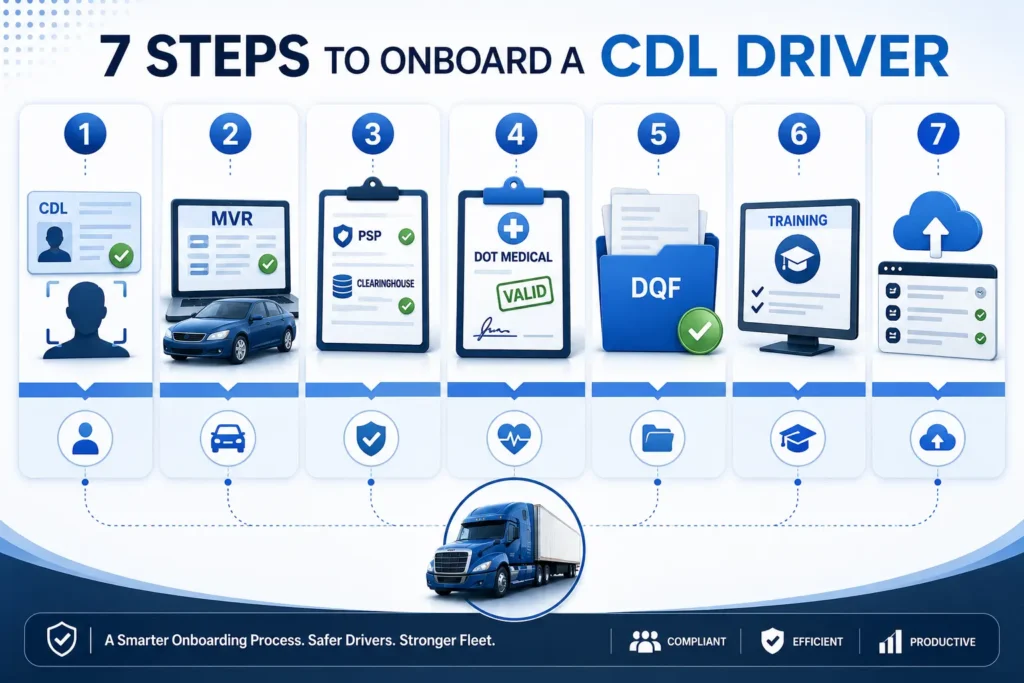
Step 1: Verify the Driver’s CDL and Identity
Once the applicant accepts the position, begin by confirming their identity and license information.
Review and verify:
- Commercial Driver’s License (CDL)
- License class
- License expiration date
- Required endorsements
- Restrictions
- State of issuance
- Government-issued photo identification
The information provided should match employment records and all onboarding documents. Any inconsistencies should be resolved before the hiring process continues.
Step 2: Review the Motor Vehicle Record (MVR)
A Motor Vehicle Record (MVR) review is one of the most important steps in the hiring process because it provides insight into the driver’s recent driving history.
An MVR review may reveal:
- License suspensions
- Serious traffic violations
- Speeding convictions
- Accident history
- License status
- CDL restrictions
- Disqualifying offenses
Hiring managers should compare the MVR with the driver’s employment application to ensure all violations have been accurately disclosed.
A clean MVR does not automatically guarantee a qualified driver, but it provides an important snapshot of driving behavior and licensing status.
Step 3: Conduct PSP and Clearinghouse Checks
FMCSA requires employers to perform specific background reviews before allowing many CDL drivers to operate.
Pre-Employment Screening Program (PSP)
The PSP report summarizes the driver’s five-year crash history and three-year roadside inspection history reported to FMCSA.
Reviewing the PSP can help carriers identify:
- Inspection trends
- Out-of-service violations
- Crash involvement
- Recurring compliance issues
- Safety performance patterns
Although participation is voluntary, many carriers use PSP reports as a key hiring tool because they provide additional insight beyond the MVR.
FMCSA Drug and Alcohol Clearinghouse Query
For CDL drivers operating under the Clearinghouse regulations, employers must complete the required pre-employment Clearinghouse query before permitting the driver to perform safety-sensitive functions.
The query helps determine whether the applicant has unresolved drug or alcohol program violations that prohibit them from operating a commercial motor vehicle.
Both the PSP review and Clearinghouse query should be documented as part of the driver’s qualification process.
Step 4: Validate the DOT Medical Examiner’s Certificate
Before a CDL driver performs safety-sensitive duties, verify that they have a valid Medical Examiner’s Certificate (MEC) issued by a certified medical examiner listed on the National Registry of Certified Medical Examiners (NRCME).
During this review, confirm:
- Medical certificate expiration date
- Driver identity matches the certificate
- Any medical restrictions or limitations
- Applicable CDL medical certification status
- State driver’s licensing agency records are current, when applicable
If a medical certificate has expired or contains discrepancies, the driver may not be medically qualified to operate a commercial motor vehicle until the issue is resolved.
Best Practice: Set automated reminders 60–90 days before a medical certificate expires to avoid last-minute compliance issues.
Step 5: Create the Driver Qualification File (DQF)
Every regulated motor carrier must maintain a Driver Qualification File (DQF) for each required driver under FMCSA regulations.
Creating the DQF during onboarding helps ensure all required documents are collected before the driver begins operating.
A typical Driver Qualification File includes:
- Driver employment application
- Copy of CDL
- Medical Examiner’s Certificate
- Motor Vehicle Record (MVR)
- Annual MVR review documentation
- Previous employer safety performance history (when required)
- Road test certificate or equivalent qualification documentation
- Driver certification forms
- Drug and alcohol testing documentation, when applicable
Maintaining a complete DQF not only supports FMCSA compliance but also makes future audits significantly easier.
Learn more about building compliant driver files with our Driver Qualification & Vetting resources.
Step 6: Assign Required Training
Document collection is only one part of onboarding. New hires should also complete company-specific orientation before receiving dispatch assignments.
Training topics commonly include:
- Hours of Service (HOS) procedures
- Electronic Logging Device (ELD) usage
- Vehicle inspection requirements
- Accident reporting procedures
- Company safety policies
- Cargo securement practices
- Defensive driving expectations
- Drug and alcohol policy awareness
- DOT roadside inspection procedures
Each completed training session should be documented and retained with the driver’s onboarding records whenever appropriate.
A standardized orientation program helps ensure every driver receives consistent instructions regardless of who conducts the training.
Step 7: Upload Documents to Your Compliance Portal
Once onboarding documents have been reviewed, they should be securely stored in a centralized location.
Many carriers now use digital compliance portals instead of relying on paper files or scattered folders.
A centralized portal makes it easier to:
- Store qualification documents securely
- Track expiration dates
- Locate files during DOT audits
- Monitor missing documentation
- Share records with authorized personnel
- Maintain consistent onboarding procedures across multiple locations
Digital document management also reduces the risk of misplaced records and simplifies future compliance reviews.
CDL Driver Qualification Workflow
The following workflow provides a simple overview of the recommended onboarding sequence.
Following the same workflow for every applicant helps create a repeatable hiring process that supports both compliance and operational efficiency.
Why a Standardized Driver Qualification Workflow Matters
A documented onboarding process benefits more than just compliance teams. It creates consistency across recruiting, safety, and operations while reducing the likelihood of missed qualification steps.
Benefits include:
- Faster onboarding for qualified applicants
- Fewer documentation errors
- Improved audit readiness
- Better visibility into driver qualifications
- Easier tracking of expiring documents
- Consistent hiring decisions across locations
- Reduced administrative workload
For growing fleets, standardized workflows become increasingly valuable as hiring volume increases.
Real-World Example
A regional carrier hires five CDL drivers within a two-week period.
Without a standardized onboarding process, one driver’s medical certificate is overlooked, another applicant’s MVR review is delayed, and PSP reports are stored in different locations. During a later compliance review, locating the required documentation becomes time-consuming and increases audit stress.
By using a structured onboarding checklist, the carrier completes the same qualification steps for every new hire, stores documents in one secure location, and verifies compliance before assigning drivers to the road. The result is a more organized hiring process and greater confidence during FMCSA audits.
Common Mistakes During CDL Driver Onboarding
Even experienced carriers can overlook important qualification steps when hiring drivers quickly. These mistakes may lead to FMCSA compliance issues, delayed audits, or increased liability following an accident.
Some of the most common onboarding mistakes include:
- Hiring a driver before completing all required qualification checks.
- Failing to review the applicant’s Motor Vehicle Record (MVR).
- Skipping the required Drug and Alcohol Clearinghouse query.
- Accepting an expired Medical Examiner’s Certificate.
- Creating an incomplete Driver Qualification File (DQF).
- Missing previous employer safety performance investigations when required.
- Storing documents in multiple locations instead of a centralized system.
- Forgetting to monitor document expiration dates after onboarding.
Most of these issues are preventable with a documented hiring process and standardized onboarding checklist.
Best Practices for Faster, Compliant Driver Onboarding
Building a repeatable onboarding process improves both compliance and operational efficiency. Instead of relying on memory or individual hiring managers, use the same documented workflow for every applicant.
SafeRoad Compliance recommends these best practices:
- Use a standardized onboarding checklist for every CDL driver.
- Verify all required documents before assigning dispatches.
- Conduct MVR, PSP, and Clearinghouse reviews early in the hiring process.
- Maintain digital Driver Qualification Files whenever possible.
- Schedule automatic reminders for expiring medical certificates and CDL renewals.
- Train recruiters and safety managers on FMCSA qualification requirements.
- Perform periodic internal audits to confirm driver files remain complete.
A consistent process reduces administrative errors and helps fleets remain prepared for compliance reviews.
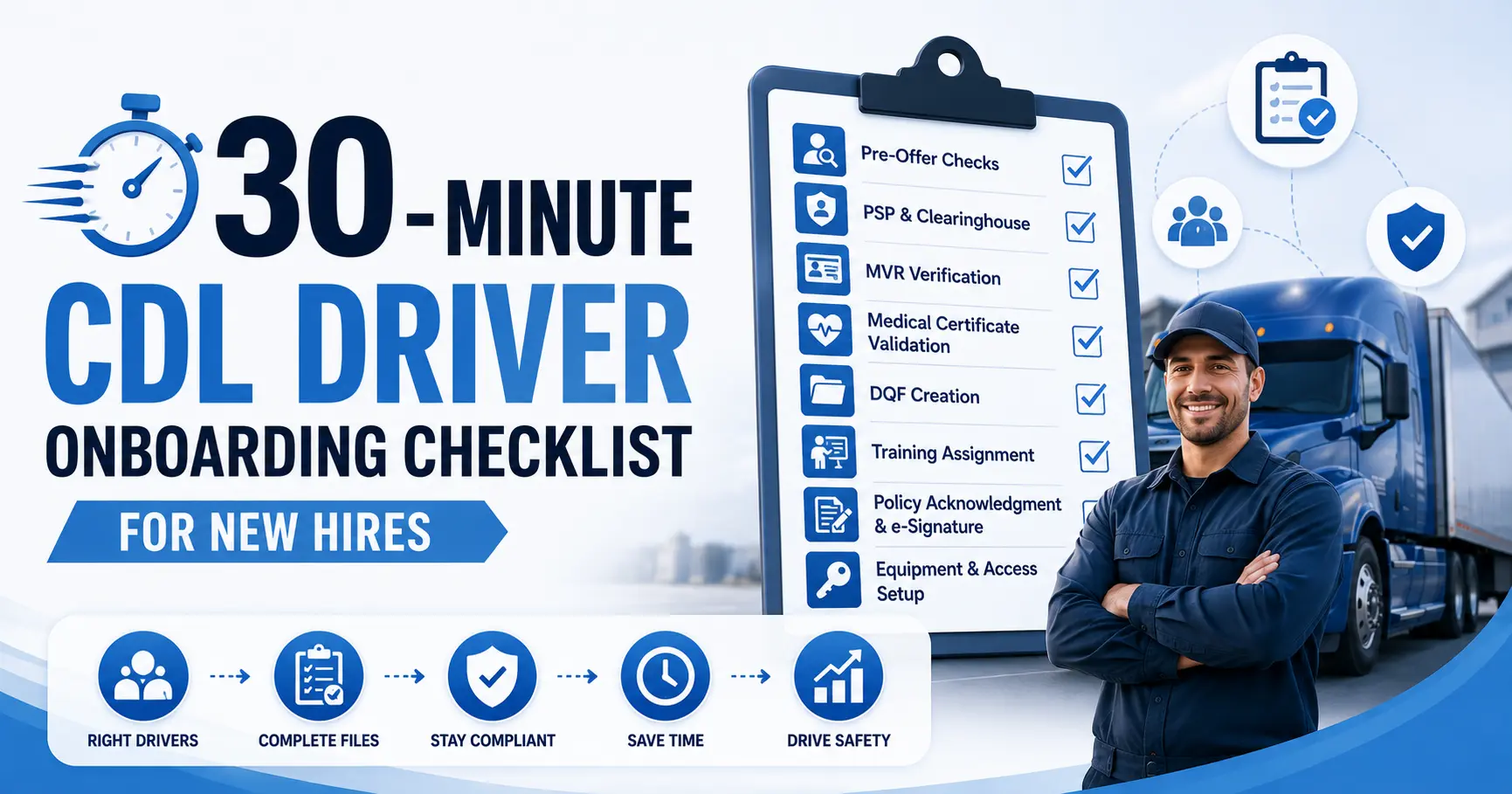
30-Minute CDL Driver Onboarding Checklist
Use this checklist to streamline new driver onboarding while helping ensure required qualification steps are completed.
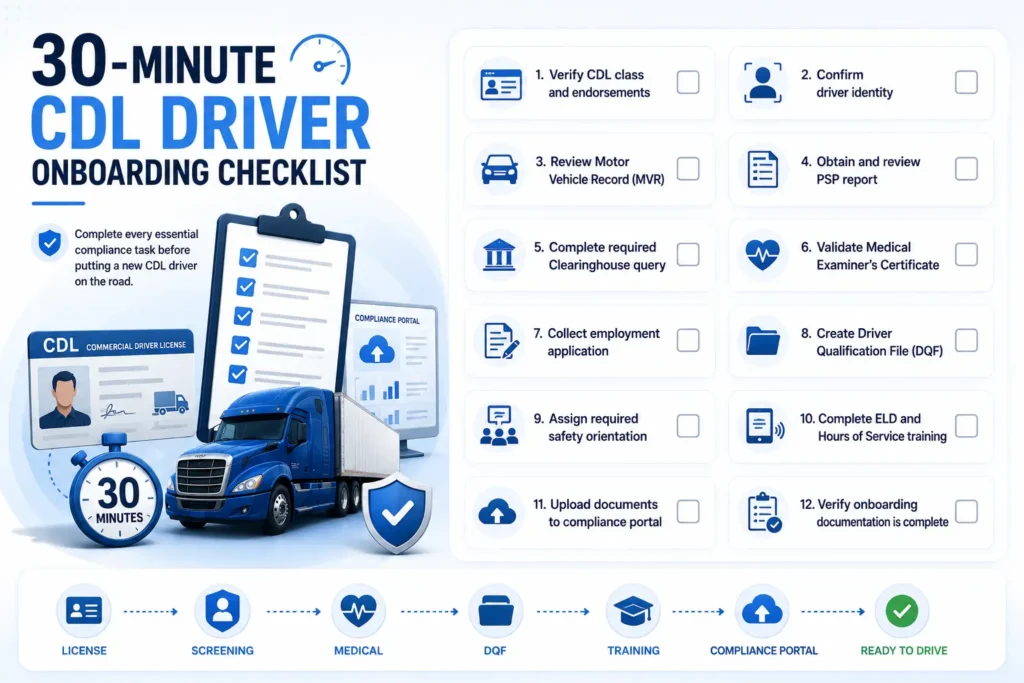
This checklist can also serve as a standard operating procedure (SOP) for safety managers and recruiting teams.
Expert Tips from SafeRoad Compliance
Driver onboarding should be viewed as the beginning of an ongoing compliance process rather than a one-time hiring event.
Our compliance specialists recommend:
- Build every Driver Qualification File before assigning the first load.
- Review MVRs and PSP reports together to obtain a more complete picture of driver history.
- Never assume documents collected by a previous employer remain valid.
- Keep onboarding records organized in a centralized digital system for quick retrieval.
- Periodically audit active driver files to identify missing or expired documents before an FMCSA audit.
These practices help carriers reduce compliance risks while creating a more efficient hiring workflow.
Conclusion
An organized onboarding process protects your company long before a driver completes their first trip. By following a standardized CDL driver onboarding checklist, carriers can verify qualifications, complete required FMCSA documentation, and establish consistent hiring procedures that support long-term compliance.
As your fleet grows, manual paperwork becomes increasingly difficult to manage. Standardized workflows, secure document storage, and routine compliance reviews help ensure every new hire meets regulatory requirements before getting behind the wheel.
If your company wants to simplify hiring while maintaining complete compliance, SafeRoad Compliance’s driver vetting services can help verify driver qualifications, organize required documentation, and support a more efficient onboarding process.
Key Takeaways
- A standardized onboarding process improves both compliance and hiring efficiency.
- Verify CDL credentials, MVRs, PSP reports, and Clearinghouse results before allowing a driver to operate.
- Always validate the driver’s Medical Examiner’s Certificate.
- Create a complete Driver Qualification File during onboarding, not afterward.
- Document all required orientation and safety training.
- Store qualification records securely in a centralized compliance system.
- Regular file reviews help keep drivers qualified and audit-ready.
Frequently Asked Questions
A CDL driver onboarding checklist is a standardized hiring workflow that helps motor carriers complete required FMCSA qualification steps before a new driver begins operating a commercial motor vehicle.
Common documents include the employment application, Commercial Driver’s License (CDL), Medical Examiner’s Certificate, Motor Vehicle Record (MVR), Driver Qualification File documents, and other records required under FMCSA regulations.
The Pre-Employment Screening Program (PSP) is voluntary, but many carriers use it to review an applicant’s roadside inspection and crash history before making a hiring decision.
Employers must complete the required pre-employment Clearinghouse query before allowing a CDL driver to perform safety-sensitive functions when the Clearinghouse regulations apply.
FMCSA record retention requirements vary depending on the type of document. Carriers should follow the applicable retention periods for Driver Qualification Files and related records.
A complete Driver Qualification File demonstrates that a carrier has properly qualified its drivers and helps support compliance during FMCSA audits, investigations, and roadside enforcement activities.
Yes. Many carriers now use secure digital document management systems to organize Driver Qualification Files, track expiration dates, and retrieve records quickly during compliance reviews, provided all required records are maintained in accordance with FMCSA requirements.
Using a standardized onboarding checklist, completing qualification reviews early, centralizing document storage, and regularly monitoring compliance records can significantly reduce delays while improving audit readiness.