Disclosure: Informational only. We are not FMCSA or USDOT. Always verify your status directly through official FMCSA systems.
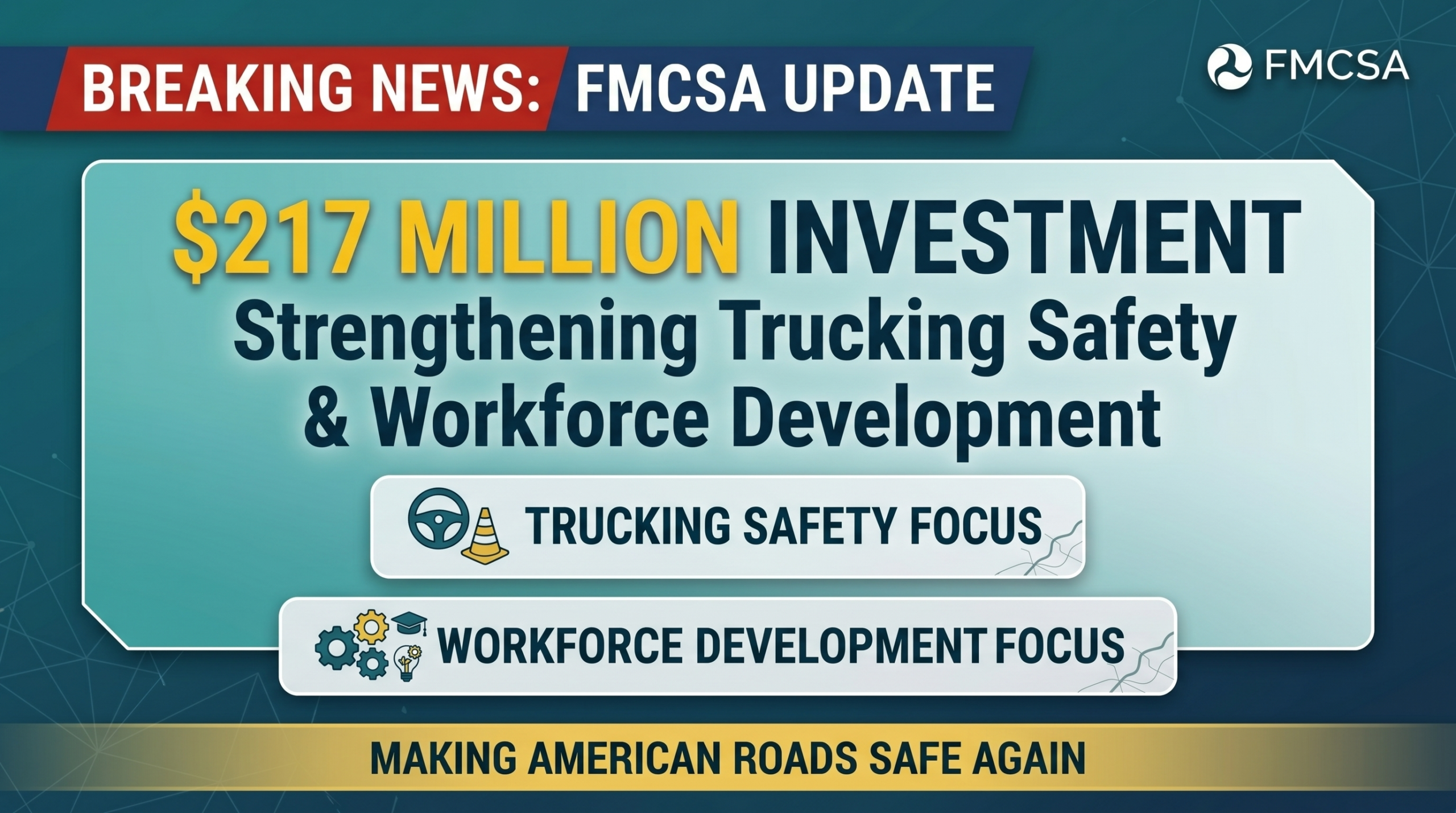
On Monday, May 18, 2026, The Federal Motor Carrier Safety Administration has announced a major $217 million investment aimed at strengthening trucking safety enforcement, improving CDL system integrity, expanding workforce development programs, and modernizing compliance technology across the United States.
According to the announcement, the funding will support multiple grant programs focused on improving roadway safety, enhancing state CDL systems, increasing enforcement capabilities, and preparing the next generation of commercial drivers.
The initiative reflects FMCSA’s broader push toward stricter compliance oversight, stronger qualification standards, and technology-driven enforcement throughout the trucking industry.
Key Highlights of the FMCSA Investment
The funding will support several major initiatives, including:
- Modernization of state CDL systems
- Enforcement training for law enforcement agencies
- Commercial driver workforce development programs
- Military-to-trucking career transition training
- Deployment of advanced roadside inspection technologies
- Technology integration between federal and state CMV systems
- Safety programs targeting high-risk crash corridors
According to FMCSA, these investments are intended to improve both safety outcomes and operational efficiency across the commercial transportation sector.
Major FMCSA Grant Programs Included
High Priority (HP) – Commercial Motor Vehicle Grant Program
This grant program supports:
- Commercial motor vehicle safety initiatives
- Hazardous material transportation safety
- Safety awareness campaigns
- Data improvement projects
- New CMV safety technologies
- PRISM participation support
Source:
High Priority CMV Grant Program
High Priority – Innovative Technology Development (ITD) Grant Program
This program focuses on:
- Intelligent transportation technologies
- Federal and state safety system integration
- Digital enforcement improvements
- Transportation information network upgrades
Source:
Innovative Technology Development Grant Program
CDL Program Implementation Grant Program (CDLPI)
The CDLPI program supports:
- CDL system modernization
- Licensing integrity improvements
- Federal compliance enhancements
- State CDL performance upgrades
Source:
CDL Program Implementation Grant Program
Commercial Motor Vehicle Operator Safety Training (CMVOST) Grant Program
This program supports:
- Commercial driver training programs
- Veteran workforce transition initiatives
- Entry-level transportation career development
Source:
CMV Operator Safety Training Grant Program
What This Means for Trucking Companies
This investment signals a major shift toward:
- Stronger compliance oversight
- Technology-driven enforcement
- Higher driver qualification standards
- Increased safety monitoring
- Expanded data integration between agencies
For carriers, this means FMCSA is continuing to build a more connected and enforcement-focused compliance environment.
Companies should expect:
- More sophisticated audits
- Faster verification systems
- Improved roadside enforcement technologies
- Greater scrutiny of driver qualification records
- Increased expectations for digital compliance accuracy
What This Means for CDL Drivers
For drivers, these investments could lead to:
- Improved training opportunities
- More consistent CDL standards nationwide
- Increased enforcement activity
- Enhanced roadside inspection technology
- Stricter verification of qualifications and documentation
Drivers transitioning from military service may also gain expanded access to career development and training opportunities under the CMVOST program.
SafeRoad Compliance – Expert Analysis & Take
This announcement is not just about grants or government funding.
From a compliance and operational perspective, this investment reveals where FMCSA is strategically moving the trucking industry over the next several years.
The biggest takeaway is this:
FMCSA is building a far more integrated, technology-driven, and enforcement-focused compliance ecosystem.
The Real Industry Shift Happening
Many carriers still view compliance as:
- Basic paperwork
- Periodic audits
- Manual recordkeeping
- Reactive issue management
But this investment shows FMCSA is accelerating toward:
- Real-time enforcement systems
- Connected federal and state databases
- Digital qualification monitoring
- Technology-assisted inspections
- Data-driven compliance oversight
This changes the risk environment for every carrier operating in interstate commerce.
Why CDL System Modernization Matters
One of the most important parts of this announcement is the continued investment in CDL system modernization.
This suggests FMCSA is prioritizing:
- License authenticity
- Qualification verification
- Fraud prevention
- Cross-state data sharing
- Faster detection of non-compliant records
Historically, inconsistencies between state systems created loopholes that allowed:
- Duplicate records
- Invalid licensing
- Delayed enforcement actions
- Qualification gaps
Modernized systems reduce those gaps significantly.
For carriers, this means there will be less room for documentation errors or outdated records moving forward.
Technology-Based Enforcement Is Expanding Rapidly
Another major signal in this announcement is FMCSA’s investment in innovative enforcement technology.
This is important because roadside inspections are evolving beyond traditional manual reviews.
FMCSA and state enforcement agencies are increasingly using:
- Digital safety systems
- Automated verification tools
- Integrated databases
- Advanced roadside inspection technologies
- Real-time compliance validation
This means violations that previously took months to discover during audits may now become visible much faster.
The Hidden Risk Many Carriers Ignore
Many small and mid-sized fleets are still operating with:
- Outdated compliance processes
- Weak document management systems
- Inconsistent driver file maintenance
- Limited digital oversight
As FMCSA modernizes enforcement systems, those weaknesses become significantly more dangerous.
The industry is moving toward a future where:
- Missing records
- Invalid medical certifications
- Incorrect CDL data
- Training inconsistencies
- HOS documentation gaps
…can potentially trigger faster enforcement actions and increased audit exposure.
Workforce Development Also Signals Future Enforcement Priorities
The workforce development portion of this investment is also highly strategic.
FMCSA is not only increasing enforcement, it is also attempting to improve:
- Driver quality
- Training consistency
- Industry professionalism
- Safety culture
This indicates the agency wants stronger control over both:
- Who enters the industry
- How compliance is maintained afterward
Carriers relying on weak onboarding systems or minimal qualification checks may struggle in this environment.
SafeRoad’s Strategic Recommendation
The smartest carriers will use this transition period to strengthen their internal compliance infrastructure now, before enforcement systems become even more advanced.
Recommended priorities include:
- Digitizing driver qualification file management
- Improving internal audit processes
- Verifying CDL and medical records proactively
- Strengthening onboarding verification systems
- Monitoring FMCSA technology and enforcement updates regularly
- Preparing for faster, more data-driven audits
Compliance is no longer just an administrative function.
It is becoming a core operational risk-management system.
Final Industry Insight
This $217 million investment confirms that FMCSA is rapidly modernizing the entire trucking compliance environment.
The industry is moving toward:
- Greater digital oversight
- Stronger qualification enforcement
- Faster compliance verification
- More connected safety systems
- Increased accountability for carriers and drivers
The companies that adapt early will be in a far stronger position operationally, financially, and legally over the next several years.
The carriers that continue relying on outdated systems and reactive compliance strategies will likely face increasing enforcement pressure as FMCSA’s modernization efforts continue expanding.
How SafeRoad Compliance Can Help
The trucking industry is entering a new era of digital enforcement and stricter compliance oversight.
At SafeRoad Compliance, we help trucking companies:
- Maintain audit-ready compliance systems
- Manage driver qualification files
- Stay compliant with FMCSA regulations
- Strengthen DOT safety programs
- Prepare for evolving enforcement requirements
Our expert DOT compliance services help carriers reduce risk, avoid costly violations, and operate with confidence in today’s rapidly changing regulatory environment.
Contact SafeRoad Compliance today to strengthen your compliance systems before enforcement pressures increase further.
Schedule an Appointment Today
Book your 30-minute compliance consultation with our DOT experts.
Sources
Official FMCSA Announcement:
FMCSA Announces $217 Million Investment in Trucking Safety & Workforce Development
FMCSA Grants Information:
FMCSA Grants Programs Overview
Federal Grants Portal:
Grants.gov Official Website