Disclosure: Informational only. We are not FMCSA or USDOT. Always verify your status directly through official FMCSA systems.
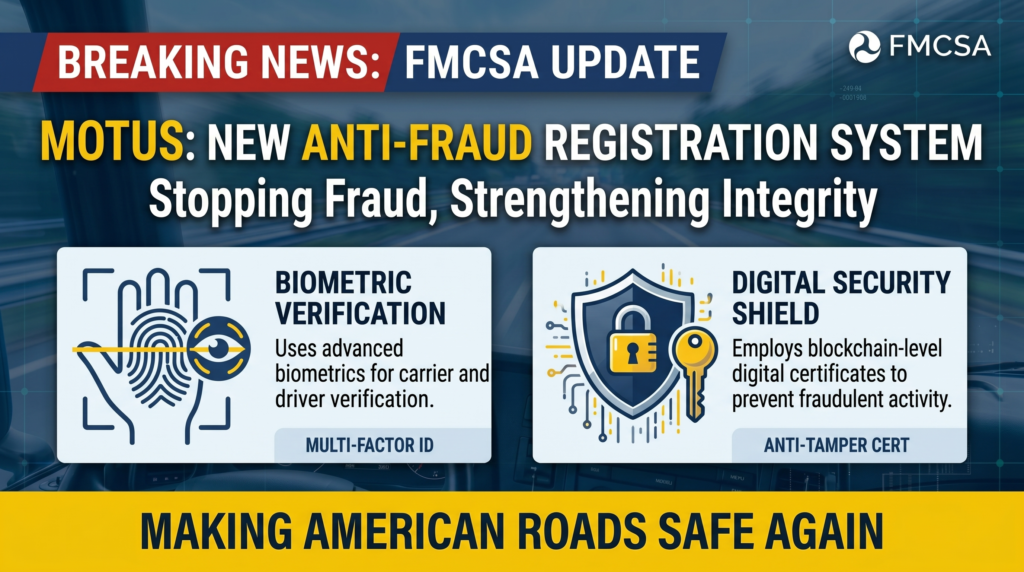
On Tuesday, May 19, 2026, The Federal Motor Carrier Safety Administration has officially launched a new anti-fraud registration platform called Motus, designed to modernize carrier registration systems and strengthen oversight across the trucking industry.
According to the announcement, Motus replaces FMCSA’s outdated legacy registration infrastructure with a unified, technology-driven system that uses biometrics, identity verification, and advanced data analytics to prevent fraud and improve compliance enforcement.
The agency says the system is intended to stop fraudulent carriers, shell companies, and “chameleon carriers” from exploiting loopholes that previously allowed unsafe operators to evade oversight.
What Is Motus?
Motus is FMCSA’s new digital registration system for:
- Truck drivers
- Motor carriers
- Freight operators
- School bus operators
- Other commercial transportation entities
The platform replaces multiple disconnected legacy systems with a centralized registration environment designed to:
- Improve data accuracy
- Enhance identity verification
- Reduce fraud
- Streamline registration management
- Strengthen enforcement capabilities
Why FMCSA Replaced the Old Registration System
According to FMCSA, the previous registration system had several major weaknesses:
- Minimal identity verification
- Disconnected applications and databases
- Weak validation standards
- Fragmented compliance data
- Limited fraud prevention capabilities
The agency stated that bad actors could previously:
- Create fraudulent carrier identities
- Hide negative safety histories
- Re-register under new company names
- Evade enforcement actions
FMCSA estimates that thousands of suspicious registration numbers may be tied to fraudulent carrier activity.
How Motus Works
FMCSA says Motus introduces multiple new security and compliance features, including:
Biometric Identity Verification
The system now uses:
- Government-issued identification
- Digital facial scans
- Identity validation tools
This is intended to confirm:
- Applicants are who they claim to be
- Businesses are legitimate legal entities
Unified Registration Infrastructure
Motus consolidates previously fragmented systems into a single digital platform.
This helps eliminate:
- Data silos
- Duplicate records
- Inconsistent registration data
- Oversight gaps
Enhanced Fraud Detection
The platform uses:
- Modern analytics tools
- Cross-system verification
- Risk monitoring capabilities
These features are designed to identify:
- Fraudulent carriers
- Chameleon carriers
- Reincarnated entities
- Unsafe operators attempting to avoid enforcement
Streamlined Compliance Management
For legitimate carriers, FMCSA says Motus offers:
- Simplified registration workflows
- Mobile-friendly access
- Faster updates and renewals
- Improved transparency
- Easier biennial filing management
What This Means for Trucking Companies
The launch of Motus is a major development for carriers operating in interstate commerce.
This system will likely increase:
- Registration scrutiny
- Identity verification requirements
- Compliance validation
- Data accuracy expectations
Carriers should expect:
- Stronger onboarding verification
- Faster detection of inconsistencies
- Increased oversight of registration records
- More accountability for ownership and operational data
What This Means for Drivers & Brokers
Drivers, brokers, and freight operators may also experience:
- Stricter identity verification procedures
- Additional documentation requirements
- Greater scrutiny during registration updates
- More accurate enforcement tracking
Legitimate operators may benefit from:
- Faster processing
- Reduced administrative confusion
- More reliable system access
- Improved customer support
SafeRoad Compliance – Expert Analysis & Take
The launch of Motus is one of the most important FMCSA modernization developments in recent years.
This is not simply a website redesign or software upgrade.
From a compliance and enforcement perspective, Motus represents a fundamental transformation in how FMCSA will oversee the trucking industry moving forward.
Schedule an Appointment Today
Book your 30-minute compliance consultation with our DOT experts.
The Real Shift Happening Behind Motus
Historically, FMCSA’s registration environment was fragmented and reactive.
Many systems:
- Operated independently
- Shared limited data
- Relied heavily on manual verification
- Allowed delays in enforcement visibility
That environment created opportunities for:
- Fraudulent carriers
- Reincarnated companies
- Identity manipulation
- Safety record evasion
Motus changes that completely.
FMCSA is now moving toward:
- Unified digital oversight
- Real-time identity validation
- Integrated compliance monitoring
- Technology-based enforcement
This is a major strategic shift.
Why “Chameleon Carriers” Are a Huge Industry Problem
One of the most important parts of this announcement is FMCSA’s direct focus on “chameleon carriers.”
These are companies that:
- Shut down after violations or poor safety records
- Reappear under new names or registrations
- Continue operating while avoiding enforcement consequences
This has been a long-standing issue within the trucking industry.
Historically, weak system integration made it difficult to:
- Track ownership relationships
- Verify operator identities
- Detect repeat offenders quickly
Motus appears specifically designed to reduce those loopholes.
If implemented effectively, this could significantly increase accountability across the industry.
Biometrics & Digital Identity Verification Signal a New Enforcement Era
The use of:
- Facial scans
- Identity verification
- Cross-platform analytics
…signals something much larger than registration modernization.
FMCSA is moving toward:
- Digital identity-based enforcement
- Automated compliance validation
- Data-driven carrier oversight
This means compliance is becoming increasingly tied to:
- Verified ownership
- Traceable operational history
- Connected regulatory records
For carriers, this reduces the ability to:
- Hide operational history
- Manipulate registration records
- Evade compliance responsibility
The Hidden Compliance Risk Most Small Carriers Ignore
Many small and mid-sized fleets still operate with:
- Incomplete registration records
- Outdated business information
- Weak documentation controls
- Poor ownership tracking
- Inconsistent compliance management
Under a system like Motus, those weaknesses become far more visible.
Because data systems are becoming increasingly integrated, inconsistencies may trigger:
- Delays in registration approvals
- Additional scrutiny
- Compliance investigations
- Enforcement attention
Technology-Driven Enforcement Is Accelerating
Motus is also another clear signal that FMCSA is accelerating toward technology-based enforcement infrastructure.
Combined with:
- ELD enforcement
- Digital medical certification systems
- DataQs modernization
- State CDL integration
- Analytics-driven oversight
…the trucking industry is rapidly moving into a fully digital compliance environment.
This means carriers must begin treating:
- Data accuracy
- System integrity
- Digital recordkeeping
- Compliance technology
…as critical operational priorities.
SafeRoad’s Strategic Recommendation
Carriers should use this transition period to strengthen internal registration and compliance systems immediately.
Recommended action steps include:
- Reviewing registration records for accuracy
- Verifying ownership and company information
- Auditing DOT and MC registration details
- Updating compliance management systems
- Improving document organization
- Preparing for stronger digital verification requirements
Companies that proactively modernize their compliance operations will be in a much stronger position as FMCSA continues expanding digital enforcement systems.
Final Industry Insight
Motus confirms that FMCSA is moving toward a future defined by:
- Centralized oversight
- Real-time verification
- Fraud-resistant registration systems
- Data-driven enforcement
- Increased accountability across the trucking industry
The era of fragmented systems and weak verification is rapidly ending.
Going forward, carriers with strong compliance infrastructure, accurate records, and transparent operational systems will have a major advantage in navigating the industry’s evolving regulatory environment.
Stay Compliant & Avoid FMCSA Penalties
As FMCSA modernizes its registration and enforcement systems, accurate compliance management has never been more important.
At SafeRoad Compliance, we help carriers:
- Maintain compliant DOT registration records
- Manage FMCSA filings and updates
- Audit driver and carrier documentation
- Prepare for modern enforcement systems
- Strengthen overall DOT compliance operations
Our expert DOT compliance services help trucking companies reduce risk, improve operational stability, and stay ahead of evolving FMCSA regulations.
Contact SafeRoad Compliance today to strengthen your compliance systems before enforcement standards become even stricter.
Schedule an Appointment Today
Book your 30-minute compliance consultation with our DOT experts.
Sources
Official FMCSA Announcement:
FMCSA Launches Motus Anti-Fraud Registration System
FMCSA Official Website:
Federal Motor Carrier Safety AdministrationLogin.gov Information:
Login.gov Official Website