Disclosure: Informational only. We are not FMCSA or USDOT. Always verify your status directly through official FMCSA systems.
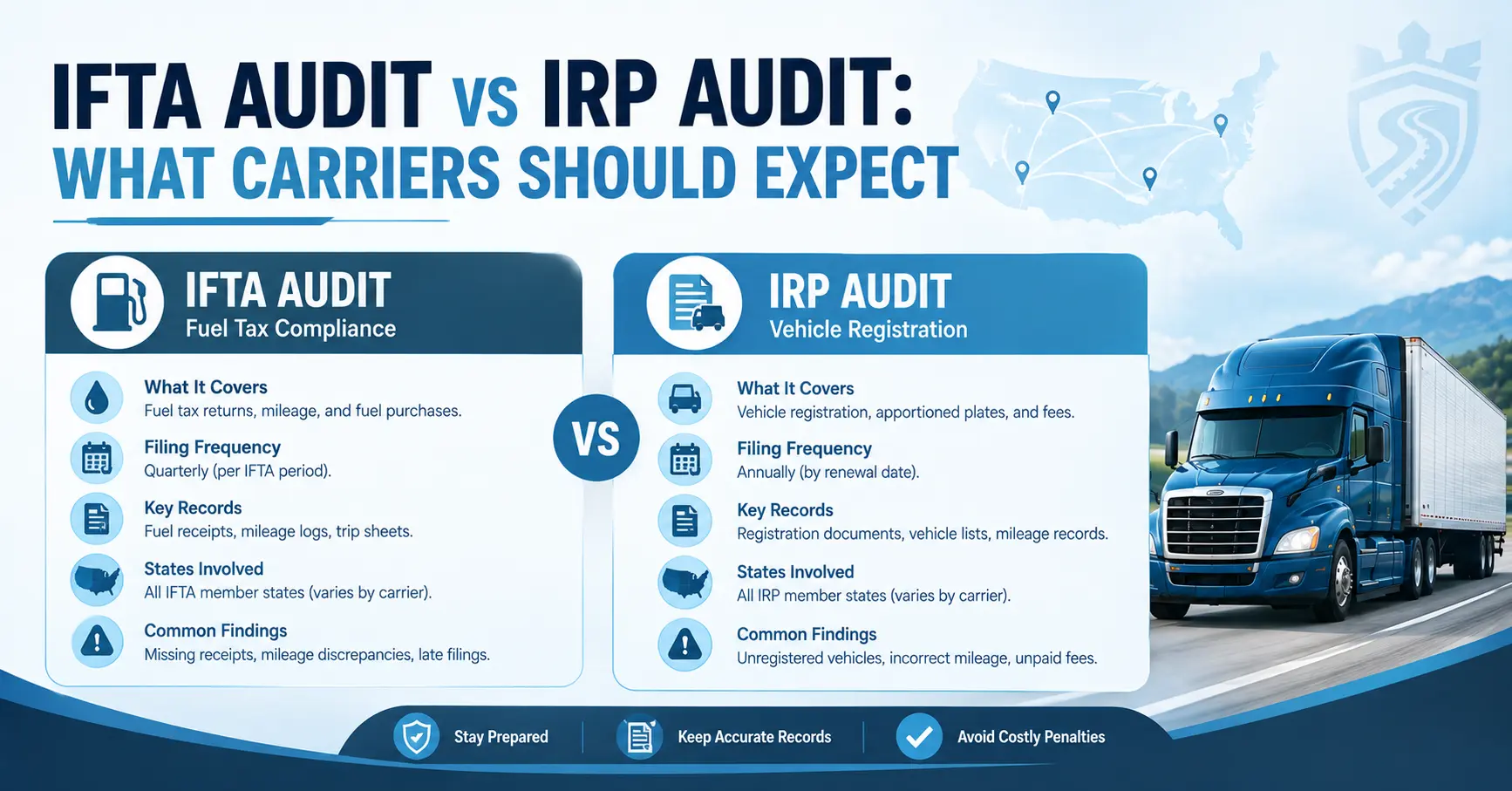
An IFTA audit and an IRP audit can both involve mileage records, jurisdiction data, vehicles, and supporting documentation, but they are not the same audit. The main difference is what the auditor is trying to verify.
An IFTA audit focuses primarily on the accuracy of a carrier’s fuel tax reporting and jurisdictional mileage calculations. An IRP audit focuses on whether the carrier’s apportioned registration records, distance data, and related registration information support the fees and registration requirements reported to the jurisdiction.
Because the same trip and mileage data may support both systems, discrepancies can sometimes appear across both audit processes.
IFTA Audit vs IRP Audit: Quick Comparison
| Audit Area | IFTA Audit | IRP Audit |
|---|---|---|
| Primary focus | Fuel tax reporting | Apportioned registration |
| Main question | Were fuel taxes correctly reported? | Were registration fees and distance allocations properly supported? |
| Mileage review | Jurisdictional distance used for IFTA calculations | Jurisdictional distance used for IRP calculations |
| Fuel documentation | Major audit evidence | Generally not the central focus |
| Fuel tax returns | Reviewed | Not the primary audit record |
| Registration records | Limited relevance | Major audit evidence |
| Trip records | Reviewed | Reviewed |
| Vehicle records | Used when relevant | Commonly relevant |
| Cross-checking | Mileage, fuel, and tax reporting | Mileage, registration, and distance reporting |
The exact audit procedures and documentation requirements can vary by base jurisdiction and the circumstances of the audit.
What Is an IFTA Audit?
An IFTA audit is a review of a carrier’s fuel tax records to determine whether the reported information is accurate and adequately supported.
The auditor may compare the carrier’s reported jurisdictional miles, taxable miles, fuel purchases, tax-paid gallons, and other supporting records.
The central audit question is:
Do the carrier’s IFTA returns accurately reflect its actual operations and supporting records?
An IFTA audit may therefore involve more than simply checking whether quarterly returns were submitted.
The auditor may trace reported figures back to the underlying operational records used to prepare those returns.
What Does an IFTA Audit Examine?
The exact scope can vary, but an IFTA audit may examine several connected categories of information.
1. IFTA Tax Returns
Auditors may review the IFTA returns filed by the carrier and compare reported figures against supporting documentation.
They may look for inconsistencies involving:
- Total miles
- Jurisdictional miles
- Taxable miles
- Fuel gallons
- Tax-paid gallons
- Tax calculations
- Credits or adjustments
The objective is to determine whether the filed returns are supported by the carrier’s records.
2. Fuel Purchase Records
Fuel documentation can be important evidence during an IFTA audit.
Depending on the jurisdiction’s requirements, auditors may review records such as:
- Fuel receipts
- Fuel invoices
- Electronic fuel transaction records
- Date and location of purchase
- Number of gallons purchased
- Vehicle or unit information
- Tax information associated with the purchase
The auditor may compare fuel purchases with the carrier’s reported fuel activity.
3. Mileage and Trip Records
Mileage records provide the operational foundation for calculating jurisdictional activity.
An auditor may examine:
- Beginning and ending odometer readings
- Trip reports
- Route information
- Jurisdictional mileage
- ELD-derived information
- GPS records
- Dispatch records
- Supporting trip documentation
The question is not simply whether mileage exists. The auditor may need to determine whether the mileage is sufficiently detailed and reliable to support the reported calculations.
4. Vehicle-Level Information
The auditor may connect mileage and fuel information to individual vehicles.
For example:
Vehicle 102 → Trip records → Jurisdiction miles → Fuel purchases → IFTA return
If the numbers do not reasonably reconcile, the carrier may need to explain the discrepancy and provide additional evidence.
Need Help With DOT Compliance?
Get reliable guidance and support to keep your DOT compliance on track.
What Is an IRP Audit?
An IRP audit examines whether a carrier’s apportioned registration information and supporting distance records are accurate.
The audit may focus on whether the carrier’s reported distance by jurisdiction can be supported by its operational records.
The central question is:
Do the carrier’s IRP records support the distance and registration information used to determine apportioned registration fees?
An IRP audit therefore has a different compliance objective from an IFTA audit, even though mileage records may appear in both.
What Does an IRP Audit Examine?
An IRP audit may involve several categories of carrier records.
1. IRP Registration Records
Auditors may review information associated with the carrier’s apportioned registration.
This can include records relating to:
- Registered vehicles
- Fleet information
- Registration documentation
- Jurisdictional information
- Reported distance
- Registration transactions
The auditor may compare registration information with the carrier’s underlying operational records.
2. Distance Records
Distance is a major component of an IRP audit.
Auditors may examine records that demonstrate where vehicles traveled and how the reported distance was determined.
Potential evidence can include:
- Trip records
- Dispatch records
- Mileage reports
- Odometer records
- ELD records
- GPS information
- Fuel records when relevant for corroboration
The precise records accepted and required can depend on the applicable jurisdiction and audit period.
3. Vehicle Records
An IRP audit may connect reported distance to specific vehicles.
The auditor may need to determine whether the vehicles listed in the carrier’s records correspond with the vehicles actually operated during the audit period.
Changes involving vehicles, fleets, registration status, or operational activity may therefore require supporting documentation.
IFTA Audit vs IRP Audit: What Is the Auditor Trying to Verify?
The easiest way to distinguish the two audits is to look at the audit objective.
IFTA Audit
The auditor is primarily concerned with whether the carrier correctly reported its fuel tax activity.
The review may connect:
Trips → Jurisdiction Miles → Fuel Purchases → Taxable Activity → IFTA Return
IRP Audit
The auditor is primarily concerned with whether the carrier’s apportioned registration information is supported by its distance records.
The review may connect:
Vehicles → Trips → Jurisdiction Miles → Reported Distance → IRP Records
The underlying operational data can overlap, but the compliance question is different.
Why Can the Same Records Appear in Both Audits?
A carrier does not operate separate vehicles for IFTA and IRP purposes.
The same truck may generate:
- ELD data
- GPS data
- Trip records
- Fuel transactions
- Odometer readings
- Dispatch records
That operational information can then be used to support different compliance calculations.
This creates an important audit issue:
The same source data should not produce unexplained differences when used for related reporting purposes.
For example, suppose a carrier’s ELD records show 125,000 miles during an audit period, but its supporting reports show substantially different jurisdictional mileage.
That discrepancy may require further investigation regardless of whether it appears during an IFTA audit, an IRP audit, or an internal reconciliation.
How IFTA and IRP Audit Findings Can Differ
A discrepancy does not automatically mean the same issue exists in both programs.
Consider a carrier with accurate jurisdictional mileage but incomplete fuel purchase documentation.
The issue may be particularly relevant to an IFTA audit because fuel records are directly connected to the fuel tax calculation.
Now consider a carrier with strong fuel documentation but inadequate support for reported jurisdictional distance used for registration purposes.
That issue may be more directly relevant to an IRP audit.
The important point is that audit findings depend on the records being tested and the requirements applicable to that audit.
Common IFTA Audit Issues
Potential IFTA audit concerns can include:
- Unsupported fuel purchases
- Incomplete fuel documentation
- Mileage that cannot be adequately supported
- Incorrect jurisdiction allocation
- Differences between reported and source mileage
- Incorrect taxable mileage
- Inconsistent fuel and mileage information
- Records that cannot be traced back to individual vehicles
- Missing or incomplete supporting documentation
The specific treatment of an issue depends on the applicable IFTA requirements and the auditor’s findings.
Common IRP Audit Issues
Potential IRP audit concerns can include:
- Unsupported jurisdictional distance
- Incomplete trip records
- Mileage discrepancies
- Vehicle records that do not reconcile with reported operations
- Inadequate supporting documentation
- Differences between reported and operational mileage
- Inconsistent fleet or vehicle information
- Records that do not adequately establish where a vehicle traveled
Again, the precise findings depend on the jurisdiction, audit period, records reviewed, and applicable IRP requirements.
What Records Should a Carrier Prepare Before an IFTA Audit?
A carrier preparing for an IFTA audit should organize the records used to support its fuel tax reporting.
A practical audit file may include:
- Filed IFTA returns
- Fuel receipts and invoices
- Fuel transaction records
- Mileage reports
- Trip records
- ELD or electronic mileage data
- GPS records when used
- Odometer records
- Vehicle-level reports
- Supporting calculations
- Documentation for adjustments or corrections
The goal is not simply to collect documents.
The goal is to establish a clear path from the source record to the reported figure.
What Records Should a Carrier Prepare Before an IRP Audit?
For an IRP audit, the carrier should organize records that demonstrate the distance traveled and support the registration information being audited.
Depending on the applicable requirements, this may include:
- IRP registration records
- Vehicle records
- Mileage reports
- Trip records
- ELD records
- Odometer documentation
- Dispatch records
- GPS records
- Fleet records
- Supporting distance calculations
The carrier should be able to explain how reported jurisdictional distance was determined.
How to Prepare for an IFTA or IRP Audit
The strongest preparation process is to reconcile records before an auditor identifies a discrepancy.
Step 1: Identify the Audit Period
Start with the exact period covered by the audit.
Do not mix records from different periods without documenting why they are relevant.
Step 2: Gather the Source Records
Collect the original or authoritative records used to prepare the company’s reports.
This may include ELD, fuel, mileage, trip, vehicle, registration, and filing records.
Step 3: Reconcile Mileage
Compare reported jurisdictional mileage with the underlying operational records.
Look for unexplained differences rather than assuming every report should be identical.
Step 4: Trace Calculations
For IFTA, trace reported figures back to fuel and mileage records.
For IRP, trace reported distance back to trip and vehicle records.
Step 5: Investigate Exceptions
Create an exception list for:
- Missing records
- Mileage differences
- Fuel discrepancies
- Vehicle mismatches
- Data gaps
- Manual adjustments
- Corrections
Step 6: Preserve Supporting Evidence
Keep the documentation that explains how discrepancies were resolved.
A clean audit trail is easier to defend than a number that cannot be explained.
IFTA Audit vs IRP Audit: Can One Problem Affect Both?
Yes, a common underlying data problem can potentially affect both systems.
For example, suppose a carrier’s mileage system consistently underreports travel in one jurisdiction.
That underlying data problem could affect:
- IFTA mileage calculations
- IRP distance reporting
- Internal fleet reports
- Other compliance records relying on the same source data
However, the existence of a discrepancy in one program does not automatically establish a violation in the other.
Each program has its own requirements, calculations, and audit process.
This is why carriers should investigate the underlying data source, rather than simply correcting one report.
What Happens When an Auditor Finds a Discrepancy?
The next steps depend on the type and significance of the discrepancy, the records available, and the applicable jurisdictional requirements.
A carrier may need to:
- Explain the discrepancy.
- Provide additional supporting records.
- Reconstruct missing information where permitted.
- Correct inaccurate reporting where required.
- Address additional amounts identified through the audit.
- Maintain documentation supporting the explanation or correction.
Carriers should avoid making unsupported assumptions about the outcome of an audit before the auditor has completed the review.
Internal IFTA and IRP Audit: What Should Carriers Check?
A useful internal review can focus on whether the company’s records tell a consistent story.
IFTA Internal Audit
Check whether:
- IFTA returns reconcile to source data
- Fuel purchases are properly documented
- Jurisdictional mileage is supported
- Vehicle-level information is available
- Adjustments are documented
- Reporting calculations can be reproduced
IRP Internal Audit
Check whether:
- Reported distance is supported
- Vehicle records are complete
- Jurisdictional mileage can be reconstructed
- Trip records are available
- ELD or other source data is retained
- Registration information matches operational records
This type of internal review can identify documentation gaps before they become audit-response problems.
IFTA Audit vs IRP Audit: The Key Difference
The simplest way to remember the distinction is:
IFTA audit → verify fuel tax reporting.
IRP audit → verify apportioned registration and distance records.
Both may examine mileage and vehicle-level operational data, but they are testing different compliance purposes.
For carriers subject to both programs, the best preparation is therefore not to maintain two completely separate sets of operational data.
Instead, maintain reliable source records and make sure the different compliance reports can be traced back to those records.
IFTA and IRP Audit Readiness Checklist
Before an audit, confirm that you can:
- Identify the exact audit period
- Locate filed IFTA or IRP records
- Produce supporting mileage data
- Trace jurisdictional miles to source records
- Locate vehicle-level information
- Produce fuel documentation when relevant
- Explain significant discrepancies
- Document manual adjustments
- Reconcile electronic and manual records
- Preserve supporting evidence
A carrier that can quickly connect reported information → source data → supporting documentation is in a stronger position to respond to audit questions efficiently.
Conclusion
IFTA and IRP audits may review some of the same mileage and operational records, but each audit focuses on different compliance requirements. Understanding what auditors examine helps carriers identify documentation gaps, reconcile discrepancies, and respond with organized supporting records.
If you want to keep your IFTA records accurate and audit-ready, SafeRoad Compliance can help with mileage review, fuel record verification, and quarterly IFTA reporting.
Get professional IFTA reporting support and keep your fuel tax records organized before an audit occurs.
Need Help With DOT Compliance?
Get reliable guidance and support to keep your DOT compliance on track.
FAQs
No. An IFTA audit primarily examines fuel tax reporting, while an IRP audit focuses on apportioned registration and supporting distance information.
Some records can overlap, particularly mileage, trip, vehicle, ELD, and operational records. However, the auditor uses those records for different compliance purposes.
ELD data may be relevant as supporting operational and mileage information, depending on the audit and applicable requirements.
Mileage can be used to allocate activity among jurisdictions. IFTA uses jurisdictional activity in fuel tax calculations, while IRP uses distance information in the apportioned registration framework.
Not automatically. A discrepancy should be evaluated against the requirements of the specific program and the records involved.
Identify the audit period, gather source records, reconcile mileage and vehicle information, verify supporting documentation, and investigate unexplained discrepancies before responding to the audit.