Disclosure: Informational only. We are not FMCSA or USDOT. Always verify your status directly through official FMCSA systems.
A lease between a motor carrier and an owner-operator should clearly explain how the business relationship works, how the owner-operator gets paid, and who is responsible for operating costs.
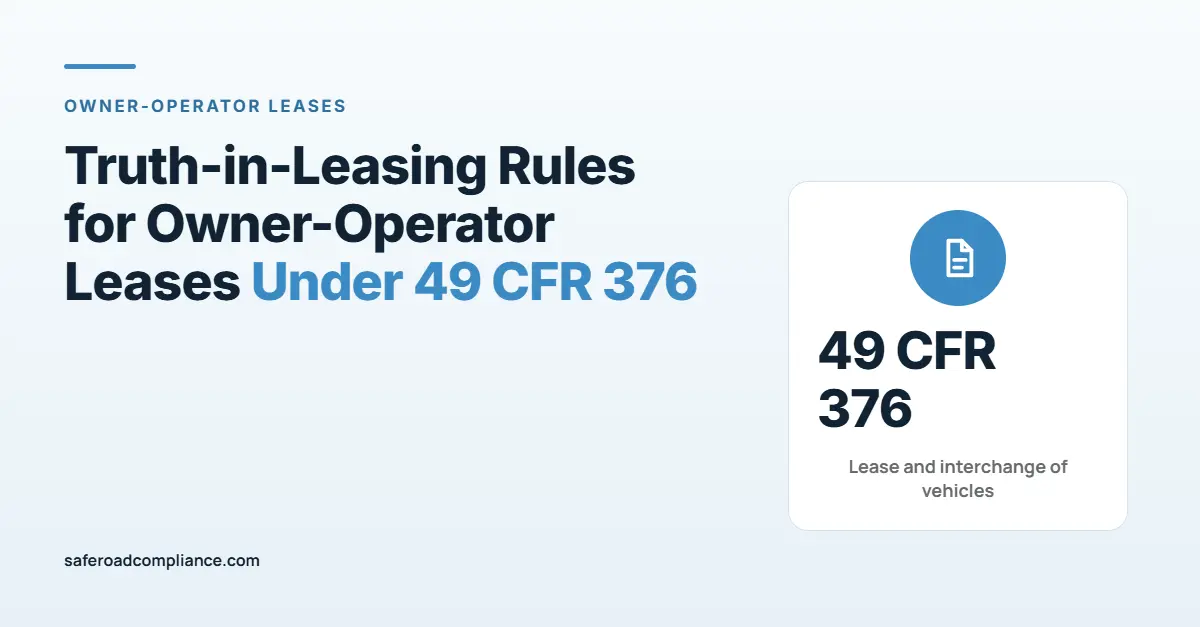
For certain authorized carriers using equipment they do not own in regulated transportation, federal Truth-in-Leasing rules under 49 CFR Part 376 establish requirements for written leases, compensation disclosures, deductions, insurance, escrow funds, and supporting records.
These rules are important for both parties. A carrier needs a compliant leasing process, while an owner-operator needs to understand the financial and operational terms before signing.
What Do Truth-in-Leasing Rules Cover?
Truth-in-Leasing rules govern qualifying equipment leases between authorized motor carriers and equipment owners.
The main purpose is to establish clear leasing terms and protect owner-operators from unclear compensation arrangements, unexplained deductions, and inadequate documentation.
The primary regulations include:
- 49 CFR §376.11: General leasing requirements.
- 49 CFR §376.12: Required written lease provisions.
- 49 CFR §376.22: Motor carrier identification requirements.
- 49 CFR §376.23: Required insurance endorsements and related filings.
Part 376 includes exemptions and specific conditions, so not every equipment arrangement is covered in the same way.
Written Lease Requirements Under 49 CFR §376.12
A qualifying lease must be in writing and contain the required provisions. The agreement should identify the parties, explain when the lease begins and ends, and clearly describe the financial and operational responsibilities.
Key requirements include:
1. Identify Both Parties
The lease must identify the authorized carrier and the equipment owner. Both parties, or their authorized representatives, must sign it.
The agreement should clearly identify the equipment covered by the arrangement.
2. Specify the Lease Duration
The lease must state when the arrangement begins and ends, either through specific dates and times or clearly defined circumstances.
These details should correspond with the equipment possession receipts required under §376.11.
3. Explain Exclusive Possession and Control
Under §376.12(c), the lease must provide that the authorized carrier has exclusive possession, control, and use of the equipment during the lease term and assumes responsibility for its operation.
Important: This leasing provision does not, by itself, determine whether an owner-operator is an employee or an independent contractor. That classification involves separate legal considerations.
4. Disclose Compensation
The lease must clearly state how much the carrier will pay for the equipment and driver’s services.
Compensation can be structured as:
- A percentage of gross revenue
- A flat rate per mile
- Different rates based on direction or commodity
- Another mutually agreed compensation method
The compensation terms must appear in the lease or an attached addendum delivered before the owner-operator begins a trip for the carrier.
Payment, Settlements, and Freight Documentation
Payment terms are a major area of potential disagreement between carriers and owner-operators.
Under §376.12(f), the lease must specify payment within 15 days after submission of the necessary delivery documents for a trip.
The regulation limits the documentation that can be required as a prerequisite to payment to applicable DOT-required logbooks and documents necessary for the carrier to obtain payment from the shipper.
A carrier cannot make payment contingent on submitting a bill of lading with no exceptions.
When compensation is based on a percentage of shipment revenue, §376.12(g) also requires the carrier to provide the applicable rated freight bill or qualifying shipment documentation before or at settlement.
The lease must permit the owner-operator to examine applicable rate documents, subject to the regulation’s provisions.
Which Expenses and Deductions Must Be Disclosed?
The lease must explain which party is responsible for operating costs and how deductions will be handled.
Under §376.12(e), the agreement should address responsibilities for:
- Fuel and fuel taxes
- Empty mileage
- Permits
- Tolls and ferries
- Detention and accessorial services
- Base plates and licenses
- Loading and unloading
- Identification-device removal and return
Under §376.12(h), any item initially paid by the carrier and later deducted from the owner’s compensation must be identified in the lease. The agreement must also explain how each deduction is calculated.
The owner-operator must be given the documents necessary to determine whether a charge is valid.
Common dispute: A settlement statement shows a deduction for insurance, equipment, maintenance, or another expense, but the lease does not clearly explain the charge or how it was calculated.
Insurance Requirements
Under §376.12(j), the lease must explain the carrier’s legal obligation to maintain public-protection insurance under applicable federal requirements.
It must also identify who is responsible for other insurance coverage, such as bobtail insurance.
If the carrier charges the owner-operator for insurance, the lease must specify the amount of the charge. Additional disclosure requirements apply when insurance is purchased from or through the carrier.
Cargo or property-damage deductions also require clear contractual conditions and a written explanation and itemization delivered before the deduction is made.
Escrow Funds and Refund Requirements
Some carrier leases require owner-operators to contribute money to an escrow account or performance fund.
When escrow is required, §376.12(k) establishes specific disclosure and accounting requirements.
The lease must identify:
- The amount required for the escrow fund
- The specific purposes for which the money can be used
- How transactions will be reported
- The owner’s right to request an accounting
- The interest requirements
- The conditions for returning the funds
The carrier must provide an accounting through settlement statements or a separate monthly accounting. The owner-operator can also request an accounting at any time.
After the lease ends, the carrier must provide a final accounting and return the remaining escrow funds no later than 45 days after termination, subject to permitted deductions for previously specified obligations.
Common Owner-Operator Lease Problems
Certain contract provisions can create disputes when they are unclear, incomplete, or inconsistent with Part 376.
Potential Problems in an Owner-Operator Lease
Contract details that can lead to payment, documentation, and termination disputes.
| Potential Problem | Why It Matters |
|---|---|
| Compensation is not clearly stated | The owner may not understand the agreed payment calculation. |
| Undisclosed charge-backs | Deductions may be disputed. |
| Missing freight documentation | The owner may struggle to verify percentage-based settlements. |
| Unclear insurance charges | Responsibility and costs may be misunderstood. |
| Incomplete escrow terms | Accounting and refund disputes can arise. |
| Vague lease duration | Equipment possession and termination dates may be unclear. |
| Missing signed lease copies | Both parties may lack reliable evidence of the agreement. |
A contract should not rely on general statements such as “other expenses may apply” when the regulation requires specific disclosure of charge-back items and calculation methods.
Two-Sided Owner-Operator Lease Compliance Checklist
Both parties should review the agreement before the equipment begins operating under the carrier’s authority.
Motor Carrier Checklist
- Confirm that Part 376 applies to the leasing arrangement.
- Prepare a written lease with the required provisions.
- Identify the carrier and equipment owner.
- Define the lease start and end conditions.
- State the compensation method clearly.
- Disclose charge-back items and calculation methods.
- Explain insurance responsibilities and charges.
- Include applicable escrow terms and accounting procedures.
- Provide required freight documentation and settlement information.
- Maintain the required lease and equipment records.
Owner-Operator Checklist
- Read the complete lease before signing.
- Confirm the compensation rate and calculation method.
- Understand responsibility for fuel, permits, tolls, and other expenses.
- Review insurance coverage and deductions.
- Understand escrow contributions and refund conditions.
- Confirm how settlements and supporting documents will be provided.
- Obtain and retain a signed lease copy.
- Keep settlement statements and supporting records.
- Ask for clarification about unclear or disputed terms.
Keeping Owner-Operator Lease Records Audit-Ready
A signed lease is only one part of the carrier’s leasing documentation.
Under §376.11, qualifying arrangements also involve equipment possession receipts, identification requirements, and records documenting trips made by leased equipment while operating in the carrier’s service.
A practical recordkeeping system should organize:
- Signed lease agreements and addenda
- Equipment identification details
- Possession and termination receipts
- Trip and freight documentation
- Settlement statements
- Charge-back supporting documents
- Insurance documentation
- Escrow account statements and final accounting
Records should be accessible and consistent with the applicable regulatory retention requirements.
FAQs
Truth-in-Leasing rules are federal regulations governing certain equipment leases between authorized motor carriers and owner-operators. They establish requirements for written agreements, compensation, deductions, insurance, escrow, and recordkeeping.
Yes. Under 49 CFR §376.12, qualifying leases must be written and include required terms covering compensation, responsibilities, equipment control, and other applicable conditions.
A qualifying lease must address the parties, lease duration, compensation, payment terms, expenses, deductions, insurance responsibilities, and applicable escrow requirements.
Under 49 CFR §376.12(f), the lease must provide for payment within 15 days after the owner-operator submits the necessary delivery documents for a trip, subject to the regulation’s documentation provisions.
Yes, when permitted by the agreement and applicable regulations. The lease must identify charge-back items, explain how deductions are calculated, and address applicable supporting documentation.
Carriers should maintain applicable signed leases, equipment possession receipts, trip documentation, settlement statements, deduction records, insurance documents, and escrow account records in accordance with federal retention requirements.
Don’t Let Compliance
Slow Your Business Down.
Stay organized, keep required records current, and stay ahead of important DOT compliance requirements with professional support.