Disclosure: Informational only. We are not FMCSA or USDOT. Always verify your status directly through official FMCSA systems.
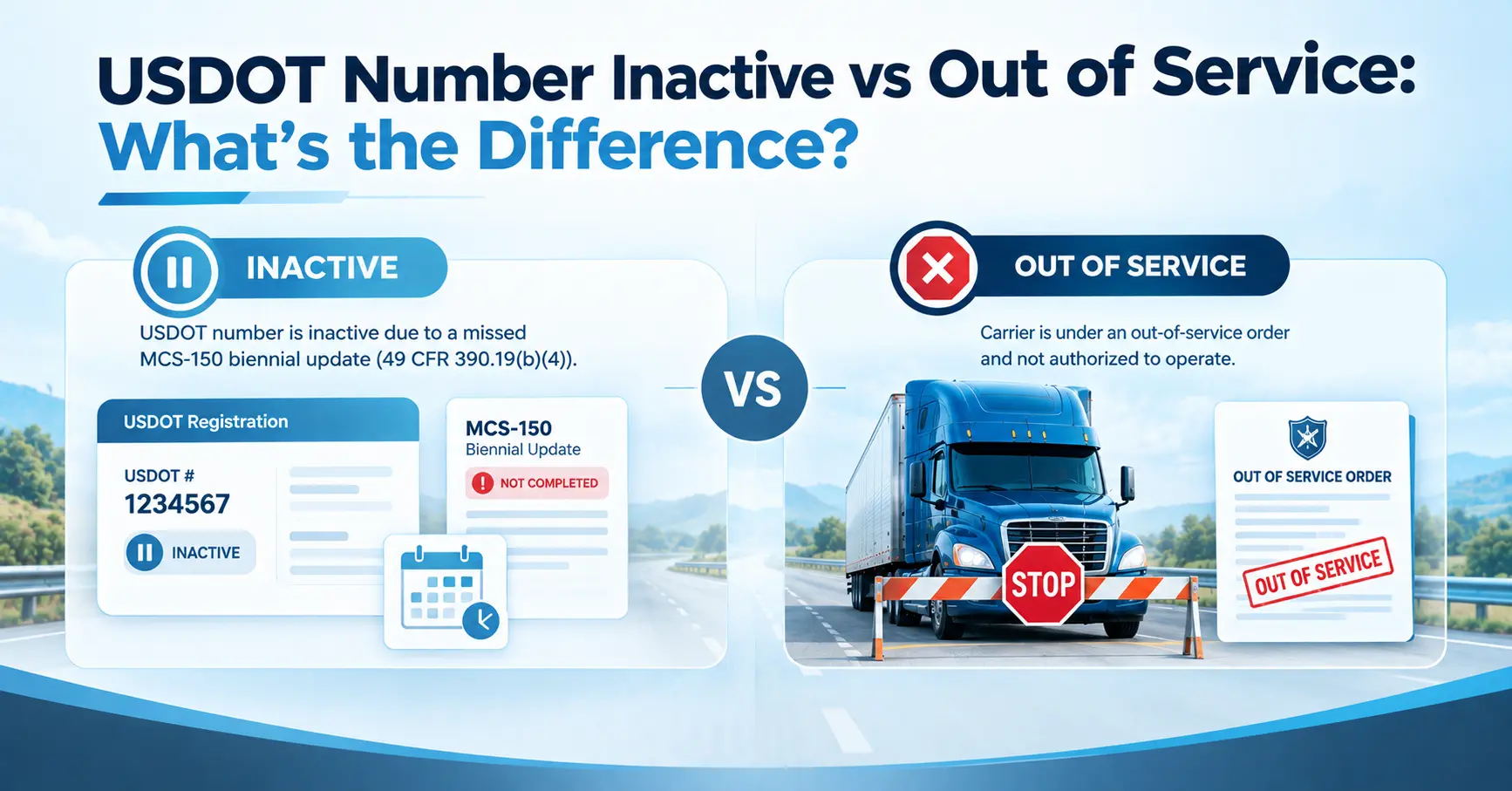
A USDOT inactive status and an out-of-service status are not the same thing. An inactive USDOT number generally relates to the carrier’s registration or operating status, while an out-of-service condition is associated with a safety enforcement action that prevents a carrier, driver, or vehicle from operating until the applicable issue is addressed.
Understanding the difference matters because the recovery process depends on why the status exists.
USDOT Inactive vs Out of Service: Quick Difference
| Status | What It Generally Means | Main Issue |
|---|---|---|
| USDOT Inactive | The USDOT record is not currently active for the carrier’s registration status. | Registration or administrative status |
| Out of Service | A carrier, driver, or vehicle has been prohibited from operating because of a safety-related enforcement condition. | Safety compliance and enforcement |
The two statuses should not be treated as interchangeable.
What Does an Inactive USDOT Number Mean?
An inactive USDOT number means the carrier’s USDOT record is not currently active in FMCSA’s registration system.
The reason can vary. For example, a carrier may have ceased operations, failed to maintain required registration information, or otherwise have a registration status that needs to be addressed.
An inactive USDOT number is primarily a registration/status issue, not automatically a finding that the carrier has been placed out of service for a safety violation.
What Should a Carrier Do?
The first step is to determine the reason for the inactive status and identify what FMCSA requires to restore the carrier’s active status.
Depending on the situation, this may involve:
- Reviewing the carrier’s FMCSA record
- Confirming whether required registration information is current
- Completing the appropriate update or reactivation process
- Checking whether other registration requirements remain outstanding
- Verifying the status after submitting the required information
The correct process depends on the reason for the inactive status.
What Does Out of Service Mean?
Out of service is a safety-enforcement concept. It can apply to a motor carrier, commercial motor vehicle, or driver depending on the circumstances.
An out-of-service condition means the affected party cannot legally continue the operation covered by that order until the applicable conditions for returning to service are satisfied.
Examples can include:
- A vehicle placed out of service during a roadside inspection
- A driver placed out of service for a qualifying violation
- A motor carrier subject to an out-of-service order
The specific requirements for returning to operation depend on the type of out-of-service action.
Inactive USDOT Number vs Out of Service
The simplest way to distinguish the two is to ask:
Is the problem primarily about the carrier’s registration status, or has a safety enforcement action prohibited operation?
An inactive USDOT number points toward a registration/status issue.
An out-of-service order points toward a safety enforcement issue.
One status should not automatically be interpreted as the other.
Can an Inactive USDOT Number Be Reactivated?
In many situations, a carrier can take steps to restore an inactive USDOT number, but the required process depends on the reason for inactivity.
Carriers should first determine the specific status shown in FMCSA’s records rather than submitting forms without understanding the underlying issue.
If the issue is an inactive USDOT number, use the appropriate USDOT reactivation process rather than treating the matter as an out-of-service violation.
For a detailed walkthrough, see How to Reactivate an Inactive USDOT Number.
Does an Inactive USDOT Number Mean the Carrier Is Unsafe?
No. An inactive USDOT status should not automatically be interpreted as a safety finding.
The status primarily tells you something about the carrier’s registration or operating status. Safety performance, inspections, violations, and enforcement actions are separate compliance concepts.
A carrier should review its complete FMCSA record to understand what each status or enforcement action actually represents.
Does Out of Service Mean the USDOT Number Is Inactive?
Not necessarily.
An out-of-service action and USDOT registration status are separate concepts. A carrier can have an enforcement issue without that automatically meaning its USDOT number has become inactive.
The specific order, violation, or enforcement notice should be reviewed to determine what operations are restricted and what corrective action is required.
What Should a Carrier Check When Its Status Looks Wrong?
If a carrier sees an unexpected status, avoid assuming that the terms mean the same thing.
Check:
- USDOT registration status
- Operating authority status, if applicable
- Safety rating or enforcement information
- Inspection and violation records
- Any out-of-service order or notice
- Required registration updates or corrective actions
This helps identify whether the issue is administrative, operational, or enforcement-related.
The Correct Recovery Path Depends on the Status
Use the status itself to determine where to start:
Inactive USDOT number
→ Review the reason for inactivity
→ Complete the applicable registration/reactivation process
→ Verify the updated status
Out-of-service action
→ Review the specific enforcement or inspection action
→ Correct the underlying safety issue
→ Complete the applicable return-to-service requirements
Do not use an inactive-status recovery process to resolve an out-of-service order, or assume that correcting a registration issue automatically resolves a safety enforcement action.
Conclusion
Knowing whether your USDOT number is inactive or your operation is subject to an out-of-service action is essential because each requires a different response. If you’re unsure which status applies or what to do next, SafeRoad Compliance can review your compliance status and help identify the appropriate next steps.
Get professional DOT compliance service to help resolve registration and compliance issues and keep your carrier operating on the right track.
Don’t Let Compliance
Slow Your Business Down.
Stay organized, keep required records current, and stay ahead of important DOT compliance requirements with professional support.
Frequently Asked Questions
An inactive USDOT number generally relates to the carrier’s registration or operating status. Out-of-service status refers to a safety-related restriction that prevents the affected carrier, driver, or vehicle from operating until applicable requirements are satisfied.
No. An inactive USDOT number should not automatically be interpreted as an out-of-service order or a safety finding. The carrier should review the reason for the inactive status and its FMCSA record.
Depending on the reason for inactivity, a carrier may be able to restore its active status by completing the applicable FMCSA registration or reactivation requirements.
Not necessarily. USDOT registration status and an out-of-service enforcement action are separate compliance concepts and should be reviewed independently.
First, determine why the USDOT number is inactive. Then follow the appropriate FMCSA registration or reactivation process rather than assuming that the issue is an out-of-service violation.
An out-of-service order can prohibit the affected carrier, driver, or vehicle from operating until the conditions associated with the order have been addressed and any applicable return-to-service requirements are satisfied.
Review the specific status, notice, order, and FMCSA records associated with the carrier. Registration information points toward an administrative issue, while an out-of-service order indicates a safety-enforcement matter.
Yes. SafeRoad Compliance can help carriers review their compliance status, identify the applicable registration or compliance issue, and determine the appropriate next step.