Disclosure: Informational only. We are not FMCSA or USDOT. Always verify your status directly through official FMCSA systems.
How does a speeding violation affect your CSA score?
A speeding violation recorded during a roadside inspection counts in the motor carrier’s Unsafe Driving BASIC in FMCSA’s Safety Measurement System (SMS). Under the current methodology, speeding carries a severity weight of 4, 7, or 10 depending on how far over the limit the driver was. Work zone speeding is weighted 10. The effect on a carrier’s percentile depends on its full inspection history, so no single ticket produces a fixed score change.
Speeding violations carry some of the highest severity weights in the Unsafe Driving BASIC. They are also among the most controllable. This guide explains how speeding violations are classified, how SMS weighs them, when a speeding conviction can cost a driver their CDL, and which fleet controls reduce the risk before an inspector ever writes one up.
Every regulatory point links to the FMCSA, eCFR, or NHTSA source it comes from. Where FMCSA has not published a detail, we say so rather than guess.
What Counts as a Speeding Violation Under FMCSA Rules?
The FMCSRs do not set their own speed limits. Instead, 49 CFR 392.2 requires every CMV to be operated in line with the laws of the jurisdiction it is in. When an officer documents speeding on a roadside inspection report, it is recorded as a 392.2 violation tied to state or local speed law.
Three federal rules are relevant:
| Rule | Who It Applies To | What It Prohibits |
|---|---|---|
| 49 CFR 392.2 | Drivers | Operating a CMV in violation of applicable state or local operating laws, including speed limits. |
| 49 CFR 392.6 | Motor Carriers | Scheduling a run, or permitting or requiring CMV operation, in a way that would require exceeding applicable speed limits. |
| 49 CFR 392.71 | Drivers & Carriers | Using a radar detector in a CMV, operating a CMV equipped with or containing one, or permitting a driver to do so. |
392.6 is the one carriers often overlook. If dispatch sets a delivery window that only works at speeds above the posted limit, the scheduling itself is a violation, separate from any ticket the driver gets.
How speeding reaches FMCSA data. SMS draws on roadside inspection reports. When an officer stops a truck for speeding and completes an inspection report, the speeding violation is listed on it and uploaded to FMCSA. For a full rundown of the other violations in this category, see our guide to FMCSA unsafe driving violations.
How Are Speeding Violations Classified in SMS?
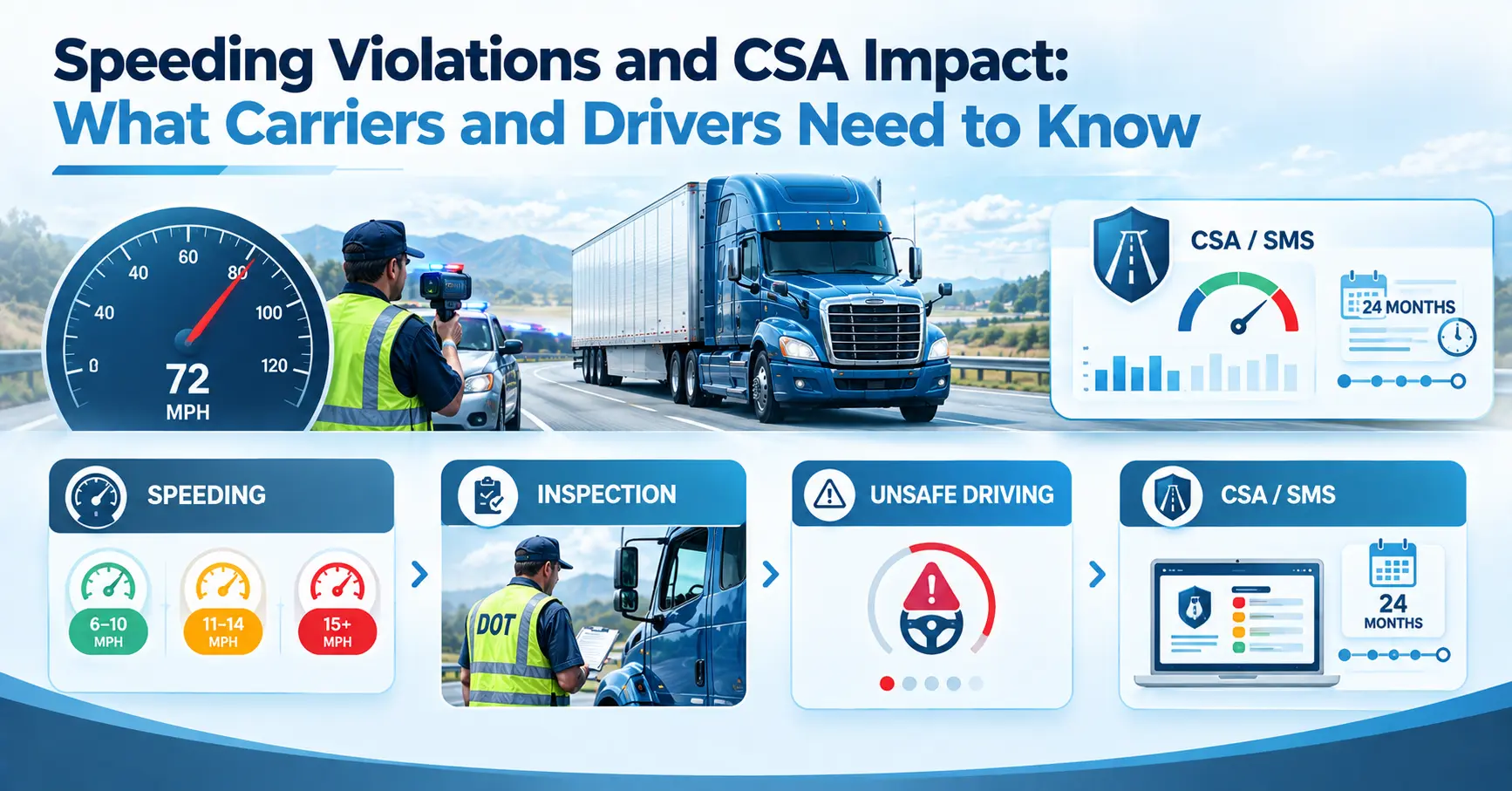
SMS sorts speeding violations by how far over the limit the driver was, and gives each band its own code and severity weight. A severity weight is a number from 1 to 10 that reflects how strongly FMCSA links that violation to crash risk within a BASIC. Speeding sits in the Unsafe Driving BASIC.
| Violation Code | Description | Severity Weight |
|---|---|---|
| 392.2-SLLS2 | Speeding 6 to 10 mph over the speed limit | 4 |
| 392.2-SLLS3 | Speeding 11 to 14 mph over the speed limit | 7 |
| 392.2-SLLS4 | Speeding 15 or more mph over the speed limit | 10 |
| 392.2-SLLSWZ | Speeding in a work or construction zone | 10 |
| 392.6 | Scheduling a run that requires speeding | 5 |
| 392.71(a) | Using or equipping a CMV with a radar detector | 5 |
We confirmed the four 392.2 codes and weights on FMCSA’s live SMS carrier pages in 2026 (example 1, example 2). The 392.6 and 392.71(a) weights come from the SMS Appendix A violation table (Table A-1); confirm them against your own SMS profile if they matter to a decision.
For context, other common Unsafe Driving violations carry lower weights. Failing to obey a traffic control device is weighted 5, and a lane restriction violation is weighted 3. A 15-mph speeding violation counts twice as heavily as a red-light or stop-sign violation in the same BASIC.
FMCSA notes that severity weights reflect relative importance within a BASIC and cannot be meaningfully compared or added across BASICs.
How Does a Speeding Violation Affect a CSA Score?
A speeding violation adds weighted points to the carrier’s Unsafe Driving measure for up to 24 months. How much that moves the carrier’s percentile depends on fleet size, mileage, other violations, and how peer carriers score. That is why no one can honestly promise a specific score change from one ticket.
Under SMS Methodology version 3.21 (June 2026), the Unsafe Driving measure works like this:
- Severity × time. Each violation’s severity weight is multiplied by a time weight: 3 if it occurred in the past 6 months, 2 if 6 to 12 months ago, and 1 if 12 to 24 months ago.
- Per-inspection cap. The severity weights from any one inspection in one BASIC are capped at 30.
- Normalize for exposure. The total is divided by the carrier’s average power units multiplied by a utilization factor based on vehicle miles traveled.
- Compare with peers. The result is ranked against carriers in the same safety event group to produce a percentile from 0 to 100.
\text{Unsafe Driving measure} = \frac{\sum (\text{severity weight} \times \text{time weight})}{\text{average power units} \times \text{utilization factor}}
How one violation fades. Take a single 392.2-SLLS4 violation (15 mph or more over, weight 10). It contributes 30 to the top of that formula for its first 6 months, 20 for the next 6, and 10 for the following 12. After 24 months it drops out. This shows the violation’s weight in the measure, not a percentile change.
When a percentile appears. A carrier needs at least three inspections with Unsafe Driving violations in 24 months to receive an Unsafe Driving percentile. The intervention threshold is the 65th percentile for general carriers, 60th for hazmat carriers, and 50th for passenger carriers. Above the threshold, FMCSA may prioritize the carrier for intervention.
The methodology is changing. FMCSA has approved SMS changes that regroup violations and replace the 1 to 10 severity scale with weights of 1 or 2. We did not find an official go-live date in FMCSA’s published documents. Check the CSA website for the version in effect when you read this.
For more on percentiles and interventions, see how CSA scores work and our guide to the FMCSA Safety Measurement System.
Can a Speeding Violation Lead to CDL Disqualification?
Yes, if the driver is convicted of excessive speeding more than once. Under 49 CFR 383.51, speeding 15 mph or more over the posted or regulated limit is a “serious traffic violation.” Repeat convictions within three years trigger disqualification.
| Serious Traffic Violation Convictions in 3 Years | CDL Disqualification |
|---|---|
| Second conviction | 60 days |
| Third or later conviction | 120 days |
A few details matter here:
- Convictions, not citations. Disqualification is based on convictions. The SMS violation, by contrast, is recorded at inspection whether or not the driver is later convicted.
- Other serious violations count toward the total. Reckless driving, improper lane changes, following too closely, and texting or hand-held phone use while driving a CMV are also on the list. Any combination adds up.
- Personal vehicles can count. Serious violations in a non-CMV count toward disqualification when the conviction results in revocation, cancellation, or suspension of the driver’s license.
- The CSA and CDL tracks are separate. CSA affects the carrier’s safety measurement. CDL disqualification affects the driver’s ability to drive a CMV at all.
Why Speeding Carries So Much Weight: The Safety Impact
Speed shortens reaction time and lengthens stopping distance, and a loaded tractor-trailer has far less margin than a car. FMCSA’s CMV Safe Speed campaign notes that a fully loaded truck at highway speed needs roughly two football fields to stop.
The national numbers show the scale of the problem:
- 11,775 people died in speeding-related crashes in 2023, 29% of all U.S. traffic fatalities (NHTSA, Speeding: 2023 Data).
- 7% of large-truck drivers in fatal crashes were speeding in 2023, the lowest share of any vehicle type. The comparable figure was 22% for passenger car drivers (NHTSA).
- Speeding of any kind was the most frequent driver-related factor recorded for large-truck drivers in fatal crashes in FMCSA’s Large Truck and Bus Crash Facts 2022.
Professional drivers speed less often than other motorists. But when speeding shows up in a truck crash, it is the factor investigators record most often, and the consequences are more severe because of the truck’s mass.
Preventive Controls That Reduce Speeding Violations
The most effective speeding controls combine realistic dispatch, technology, and consistent follow-up. Only a few of these are legal requirements. Most are best practices that help a carrier show it does not permit or encourage speeding.
Legal requirements:
- Do not schedule runs that require speeding (392.6).
- Do not require or permit radar detector use (392.71(b)).
- Review each driver’s motor vehicle record at least once every 12 months, as required by 49 CFR 391.25, and act on what it shows.
There is no federal speed limiter mandate. FMCSA and NHTSA withdrew the proposed heavy-vehicle speed limiter rule on July 24, 2025. At the federal level, governing truck speed is a carrier choice.
Recommended best practices:
- Build realistic schedules. Plan routes at posted speeds with time for traffic, weather, and hours-of-service breaks. Audit loads that arrive consistently early, which can point to speeding.
- Set governed speeds. Many fleets set the engine’s road speed limit below common highway limits. This caps top-end speed but does not prevent speeding in lower-limit zones.
- Use telematics speed alerts. Most ELD and telematics platforms can flag speed-over-posted-limit events. Review them weekly rather than only after a ticket.
- Focus on work zones and curves. Work zone speeding carries the maximum weight of 10. Train drivers to slow down at the first sign, even if traffic is light.
- Coach, then escalate. Use a written policy with clear steps: coaching, retraining, and discipline for repeat events. Apply it the same way to every driver.
- Watch your own SMS data. Check your carrier’s SMS profile monthly for new speeding entries, and check each new hire’s PSP record for past speeding violations.
- Recognize good records. Incentives for violation-free quarters give drivers a reason to care about the data, not just the ticket.
Can You Challenge a Speeding Violation on Your CSA Record?
Yes, through FMCSA’s DataQs system, but the outcome depends on what happened in court. The violation is removed only if the citation is dismissed or the driver is found not guilty. A conviction on a different charge lowers its weight. Otherwise it stays, unless the inspection data itself is wrong.
FMCSA’s adjudicated citations policy sets out three outcomes:
| Court Outcome | What Happens in SMS |
|---|---|
| Dismissed or found not guilty | Violation removed |
| Convicted of a different charge | Violation marked as a different-charge conviction, and its severity weight drops to 1 |
| Convicted, or dismissed with a fine | Violation stays |
To use this process:
- Wait for the court case to finish.
- Get certified court documents showing the outcome.
- File a Request for Data Review (RDR) on the inspection in DataQs, with the documents attached.
- The state agency that did the inspection reviews the request and updates the record, which flows through to SMS and PSP.
Note the third row. In many states, simply paying a ticket is treated as a conviction, and a dismissal that still requires a fine keeps the violation on file. Talk to a traffic attorney before paying if the SMS record matters to you. This article is not legal advice.
DataQs can also correct data errors that have nothing to do with court, such as a violation assigned to the wrong carrier or a wrong speed band.
Keep Speeding Out of Your Safety Data
Speeding violations are one part of a carrier’s safety picture, alongside driver qualification files, hours of service, drug and alcohol testing, and vehicle maintenance. SafeRoad Compliance helps owner-operators and small fleets build written safety policies, monitor SMS data, and file DataQs requests when records are wrong. If you want a second look at your Unsafe Driving data, contact SafeRoad Compliance.
Don’t Let Compliance
Slow Your Business Down.
Stay organized, keep required records current, and stay ahead of important DOT compliance requirements with professional support.
Speeding CSA Violation FAQs
SMS does not use “points” in the driver’s-license sense. A speeding violation has a severity weight of 4 (6 to 10 mph over), 7 (11 to 14 mph over), or 10 (15 mph or more over, or in a work zone). That weight is multiplied by a time weight of 1 to 3 and normalized for the carrier’s size and mileage.
No. SMS uses roadside inspections of CMVs. A personal-vehicle conviction can still count toward CDL disqualification under 49 CFR 383.51 if it results in the loss of your license.
It counts in SMS for 24 months from the inspection date, with less weight as it ages. It can appear on the driver’s PSP record for three years.
SMS percentiles are calculated for carriers, so the violation counts in the carrier’s Unsafe Driving BASIC. The driver also carries it on their PSP record, and a conviction goes on their state driving record.
Not by itself in most cases. A carrier needs at least three inspections with Unsafe Driving violations in 24 months to receive a percentile, and interventions are tied to percentiles above set thresholds. One severe violation can still move a small carrier’s measure noticeably.
The speeding bands confirmed on FMCSA’s current SMS pages start at 6 mph over the limit. An officer can still write a state ticket at a lower speed.
15 mph or more over the posted or regulated limit. Two serious traffic violation convictions within three years bring a 60-day disqualification. Three or more bring 120 days.
Yes, under 49 CFR 392.71. Drivers may not use a radar detector in a CMV or operate a CMV that has one on board, and carriers may not require or permit it.