Disclosure: Informational only. We are not FMCSA or USDOT. Always verify your status directly through official FMCSA systems.
Starting Your FMCSA Authority? Don’t Overlook This Required Filing
Obtaining FMCSA operating authority involves more than applying for a USDOT Number or Motor Carrier (MC) Number. Before your authority can become active, you must satisfy several federal requirements, including insurance filings and the BOC-3 filing.
Many first-time carriers focus on obtaining their MC Number but are surprised to learn that their authority remains inactive because a required filing is still missing. One of the most common reasons for delayed authority activation is failing to submit a valid Form BOC-3 through an FMCSA-approved blanket process agent.
Although the filing itself is straightforward, its purpose is significant. It establishes a legal point of contact in every state where your business may operate, ensuring courts and government agencies can deliver legal notices and official documents when necessary.
Whether you’re launching a new trucking company, applying for broker authority, reinstating an inactive MC Number, or expanding your transportation business, understanding the BOC-3 requirement is essential for staying compliant with FMCSA regulations.
What Is a BOC-3 Filing?
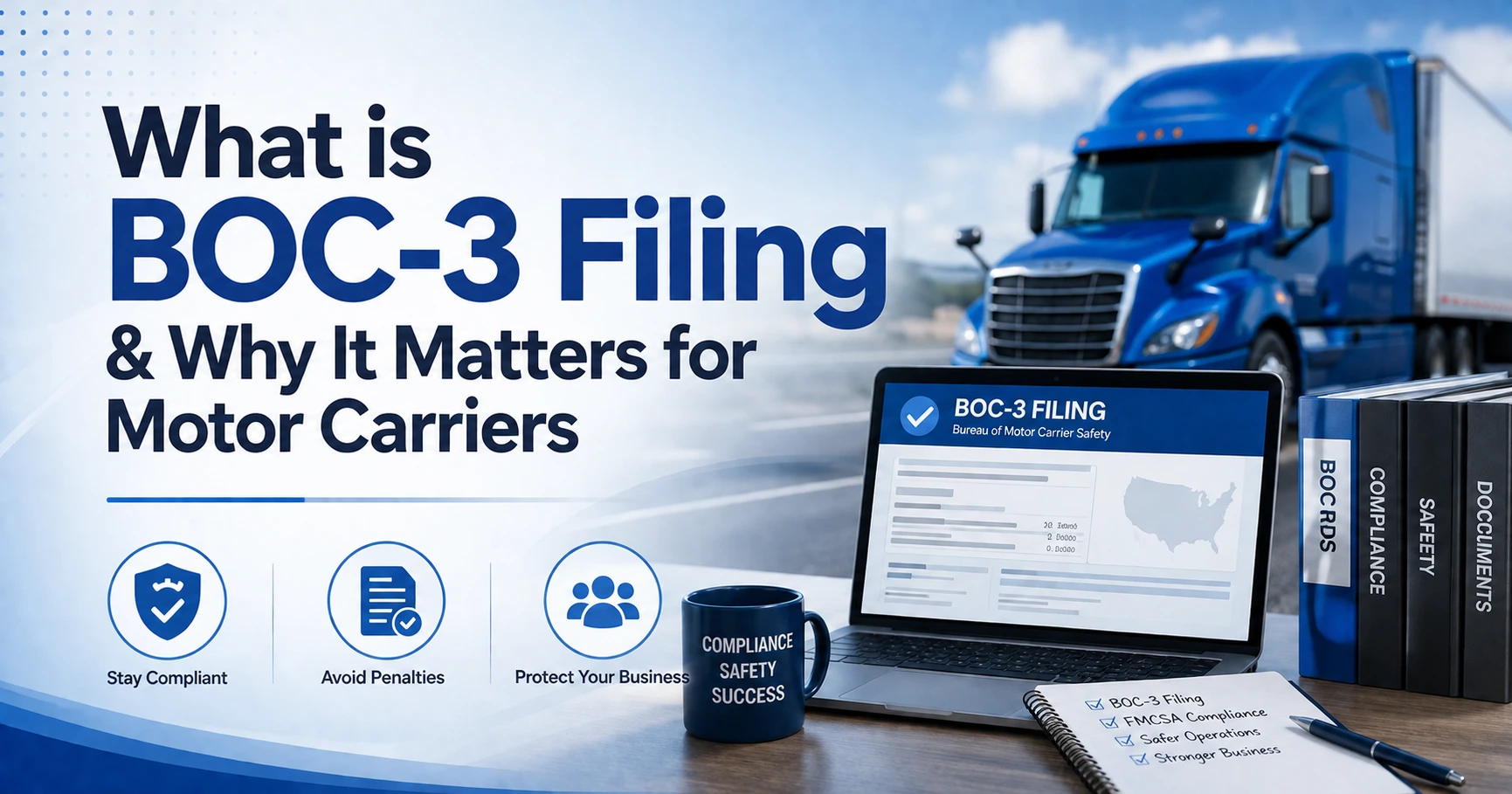
A BOC-3 filing is an FMCSA-required form that designates a process agent in every U.S. state where a motor carrier, freight broker, or freight forwarder may receive legal documents.
- Required before FMCSA operating authority can become active.
- Must be submitted electronically.
- Can only be filed by an FMCSA-approved blanket process agent.
What Is a BOC-3 Filing?
A BOC-3 filing, officially called the Designation of Agents for Service of Process, is a federal filing required by the Federal Motor Carrier Safety Administration (FMCSA) for businesses applying for operating authority.
Its primary purpose is to ensure that every regulated transportation business has an authorized representative who can legally receive court documents, legal notices, or official government correspondence on the company’s behalf.
Instead of appointing separate representatives in each state, businesses typically use a blanket process agent, which provides nationwide coverage across all 50 states and the District of Columbia.
Once submitted and accepted, the BOC-3 becomes part of your FMCSA operating authority record.
In simple terms:
Think of the BOC-3 as your company’s nationwide legal contact network. If legal action or official correspondence needs to be delivered, the designated process agent can accept those documents for you, regardless of where your company is headquartered.
What Does “Service of Process” Mean?
Many new carriers find this term confusing.
Service of process refers to the legal procedure of delivering official documents to a business or individual involved in a legal matter.
Examples include:
- Court summons
- Civil lawsuits
- Regulatory notices
- Legal complaints
- Administrative orders
- Official government correspondence
The designated process agent accepts these documents on behalf of your company, helping ensure important legal notices are received through an authorized representative.
Why Does FMCSA Require a BOC-3 Filing?
FMCSA regulates interstate motor carriers, brokers, and freight forwarders operating throughout the United States.
Because these businesses may conduct operations across multiple states, regulators need a standardized way to ensure they remain legally reachable.
The BOC-3 filing provides that framework.
Instead of requiring courts or agencies to locate a company’s physical office, the filing establishes authorized representatives who can receive legal documents wherever the issue arises.
This supports:
- Legal accountability
- Due process
- Regulatory enforcement
- Interstate commerce oversight
- Efficient communication between businesses and government agencies
For transportation companies, the filing is not simply another administrative requirement. It is one of the legal conditions that must be satisfied before operating authority becomes active.
Why It Matters for Your Operating Authority
Many first-time applicants assume receiving an MC Number means they can begin hauling freight.
That’s not the case.
An MC Number alone does not authorize interstate operations.
Before authority becomes active, FMCSA generally requires:
- Approved operating authority application
- Insurance filings (when applicable)
- Approved BOC-3 filing
- Satisfaction of all other regulatory requirements
If your BOC-3 has not been filed, your authority typically remains inactive until the requirement is met.
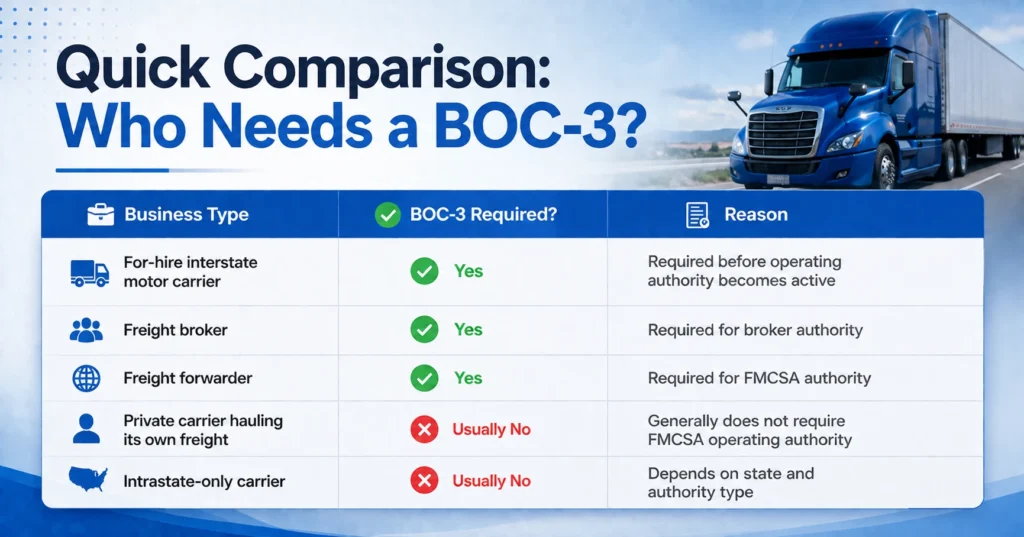
Who Needs a BOC-3 Filing?
The BOC-3 requirement applies to businesses operating under FMCSA operating authority.
Generally, the following entities must file:
For-Hire Motor Carriers
Companies transporting regulated property or passengers across state lines for compensation.
Freight Brokers
Businesses that arrange transportation between shippers and motor carriers without operating commercial vehicles themselves.
Freight Forwarders
Businesses that assume responsibility for shipments while coordinating transportation through one or more carriers.
Carriers Reinstating Authority
If your operating authority has been revoked or voluntarily surrendered and you’re seeking reinstatement, you may need to submit a new BOC-3 if your previous filing is no longer valid or your designated process agent has changed.
Who Does NOT Need a BOC-3?
Not every trucking business requires this filing.
Generally, a BOC-3 is not required for:
- Private carriers transporting only their own goods
- Companies operating exclusively under state regulations without FMCSA operating authority
- Businesses that do not require federal operating authority
- Intrastate carriers operating solely within one state (unless federal authority is required)
However, whether you need a BOC-3 depends on your specific operating authority and business model, not simply where you operate.
If you’re unsure, it’s best to verify your requirements before applying for authority.
Quick Comparison: Who Needs a BOC-3?
BOC-3 vs USDOT Number vs MC Number
One of the biggest sources of confusion for new transportation businesses is understanding how these three requirements differ.
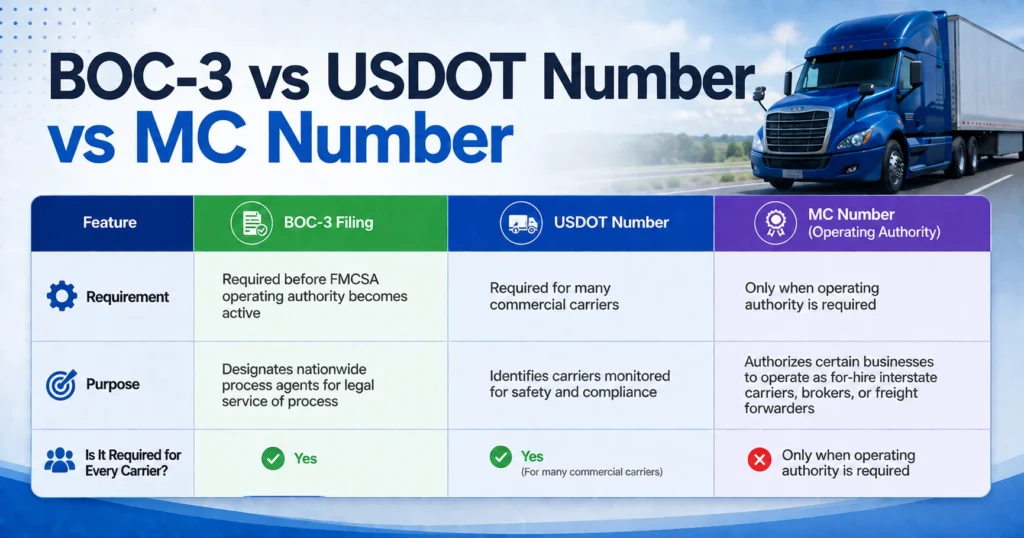
Think of it this way:
- Your USDOT Number identifies your business.
- Your MC Number grants operating authority (when applicable).
- Your BOC-3 filing satisfies one of the legal requirements needed to activate that authority.
Without all applicable requirements in place, your business may not be authorized to begin interstate operations.
Who Can File a BOC-3 Form?
One of the most common misconceptions among new carriers is that they can complete and submit Form BOC-3 themselves. In most cases, that isn’t permitted.
Unlike many FMCSA applications, a BOC-3 filing must generally be submitted electronically by an FMCSA-approved blanket process agent. These organizations maintain a network of designated process agents across all 50 states and the District of Columbia.
This nationwide coverage ensures that your company has an authorized representative available to receive legal documents wherever a legal matter may arise.
What Is a Blanket Process Agent?
A blanket process agent is a company authorized to file BOC-3 forms on behalf of regulated transportation businesses.
Instead of finding individual agents in every state, carriers and brokers work with one provider that offers nationwide representation.
A qualified blanket process agent typically:
- Files your BOC-3 electronically with the FMCSA
- Maintains designated process agents nationwide
- Updates filings when necessary
- Helps prevent filing errors that could delay authority activation
Choosing an experienced provider can simplify the filing process and reduce the risk of administrative delays.
Can You File a BOC-3 Yourself?
For most motor carriers and freight forwarders, no.
The FMCSA generally requires the filing to be submitted through an approved blanket process agent.
Attempting to self-file or using an unapproved provider may result in delays or rejection of the filing.
If you’re applying for operating authority for the first time, it’s important to verify that the company handling your filing is recognized by the FMCSA.
Avoid Delays in Your Operating Authority
Before paying for any BOC-3 filing service, verify that the provider is an FMCSA-approved blanket process agent.
When Should You File Your BOC-3?
Timing matters.
Your BOC-3 filing should be completed after applying for FMCSA operating authority but before your authority becomes active.
Many new applicants mistakenly assume their work is finished after receiving an MC Number. However, FMCSA will not activate operating authority until all required filings, including insurance (when applicable) and the BOC-3, have been received and processed.
Typical Authority Activation Timeline
Completing each step promptly helps avoid unnecessary delays in launching your business.
How to File a BOC-3: Step-by-Step
Although the filing itself is handled by your process agent, understanding the overall process helps ensure everything moves forward smoothly.
Step 1: Apply for FMCSA Operating Authority
Before a BOC-3 can be filed, you must first submit your application for operating authority through the FMCSA.
This creates the authority record associated with your MC Number.
Step 2: Choose an FMCSA-Approved Blanket Process Agent
Select a provider that is authorized to file BOC-3 forms electronically.
Be cautious of companies advertising unusually low prices without confirming they are approved.
Step 3: Provide Your Business Information
Your process agent will typically request:
- Legal business name
- USDOT Number (if assigned)
- MC Number
- Business address
- Contact information
Accurate information helps prevent processing delays.
Step 4: The Process Agent Files the BOC-3
After reviewing your information, the blanket process agent submits the filing electronically to the FMCSA.
Once accepted, the filing becomes part of your official operating authority record.
Step 5: Monitor Your Authority Status
The FMCSA reviews all required filings before activating your authority.
If your insurance filings and BOC-3 are complete, your operating authority can proceed toward activation.
How Long Does a BOC-3 Filing Take?
The electronic filing itself is often completed quickly by the process agent.
However, the time required for your operating authority to become active depends on whether all FMCSA requirements have been satisfied.
In many cases, authority activation occurs within several business days after all required filings, including insurance (when applicable) and the BOC-3, have been accepted.
Processing times can vary based on application volume and whether additional information is required.
How Much Does a BOC-3 Filing Cost?
The cost of a BOC-3 filing varies depending on the provider and the services included.
Most blanket process agents charge a one-time filing fee, although some also offer broader compliance packages.
These packages may include services such as:
- Compliance reminders
- Address updates
- Additional FMCSA filings
- Ongoing compliance support
When comparing providers, consider more than just the initial price.
Evaluate:
- FMCSA approval status
- Customer support
- Filing accuracy
- Industry experience
- Additional compliance services
A reputable provider can help minimize delays and ensure your filing is completed correctly.
What Happens If You Don’t File a BOC-3?
Failing to complete a required BOC-3 filing can have significant consequences for your business.
Your Operating Authority Will Not Become Active
One of the most immediate impacts is that FMCSA generally will not activate your operating authority until all required filings have been received.
Without active authority, you cannot legally operate as a for-hire interstate carrier, broker, or freight forwarder when operating authority is required.
Business Launch Delays
Missing the BOC-3 can postpone:
- Customer contracts
- Freight opportunities
- Insurance activation timelines
- Driver onboarding
- Revenue generation
For a new carrier, even a short delay can affect startup plans and cash flow.
Compliance Issues
An incomplete authority application may also create unnecessary administrative work if corrections or additional filings are required.
Submitting accurate information the first time helps reduce delays and keeps your application moving forward.
Does a BOC-3 Expire?
Generally, no.
A valid BOC-3 filing remains on record unless changes require a new filing.
However, you should update your filing if:
- You change your blanket process agent.
- Your previous filing is no longer valid.
- Your authority is reinstated and a new filing is required.
- Your process agent advises that updated information is needed.
Maintaining current information helps ensure legal notices continue reaching the appropriate representative.
Can You Change Your Process Agent?
Yes.
Businesses may choose a different blanket process agent if their needs change.
When switching providers, the new process agent typically submits a replacement BOC-3 filing to the FMCSA.
The new filing supersedes the previous designation, ensuring your company continues to have valid nationwide representation.
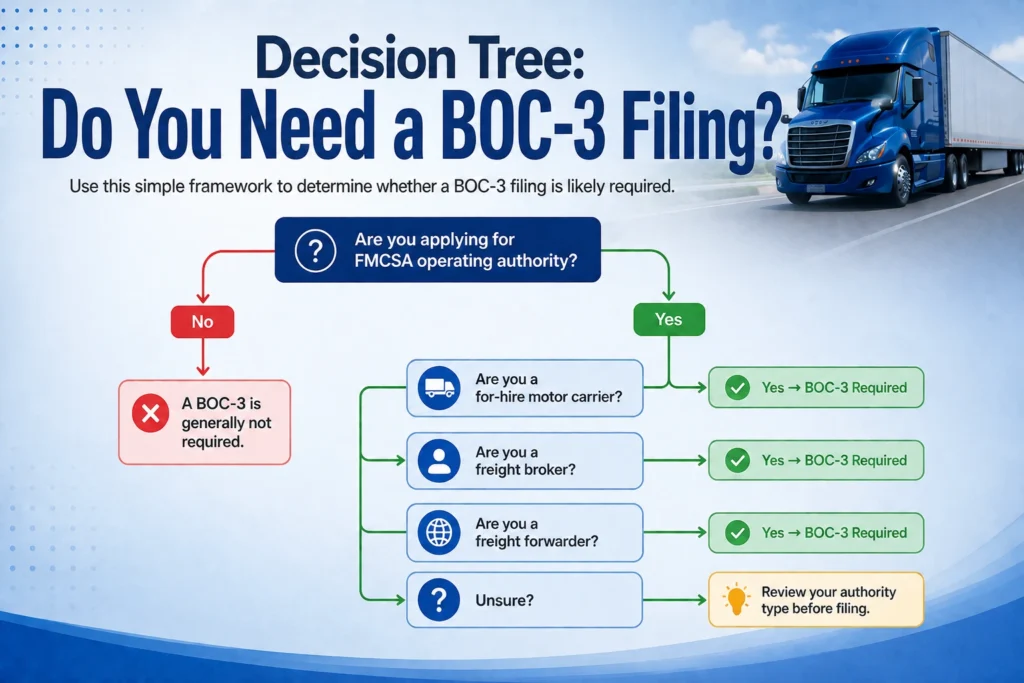
Decision Tree: Do You Need a BOC-3 Filing?
Use this simple framework to determine whether a BOC-3 filing is likely required.
Real-World Examples
Example 1: New Motor Carrier
A company forms an LLC and applies for interstate operating authority.
They receive an MC Number but forget to arrange a BOC-3 filing.
Result: Their operating authority remains inactive until an approved blanket process agent submits the required filing.
Example 2: Freight Broker
A logistics company plans to arrange freight transportation but does not own trucks.
Although it won’t operate commercial vehicles, it still applies for broker authority.
Result: A BOC-3 filing is still required before broker authority can become active.
Example 3: Private Carrier
A manufacturing company uses its own trucks to deliver its own products and does not transport freight for compensation.
Result: Depending on its operations, FMCSA operating authority, and therefore a BOC-3 filing, may not be required.
BOC-3 Myths vs. Facts
Common BOC-3 Filing Mistakes (and How to Avoid Them)
Although the BOC-3 filing process is relatively straightforward, mistakes can delay operating authority, create unnecessary administrative work, and slow down a new business launch.
Understanding the most common issues can help you avoid setbacks.
1. Waiting Too Long to File
Some applicants focus on obtaining their MC Number and postpone the BOC-3 until later.
Because FMCSA generally requires all necessary filings before activating operating authority, waiting to complete your BOC-3 can delay the entire process.
Best Practice: Arrange your BOC-3 filing as soon as you’ve applied for operating authority.
2. Choosing an Unapproved Provider
Not every company advertising BOC-3 services is authorized to file electronically with the FMCSA.
Working with an unapproved provider can result in rejected filings and additional delays.
Best Practice: Always verify that your provider is an FMCSA-approved blanket process agent before purchasing the service.
3. Providing Incorrect Business Information
Errors such as an incorrect business name, MC Number, or address can slow processing and may require corrective filings.
Common mistakes include:
- Misspelled company names
- Incorrect MC or USDOT Numbers
- Outdated mailing addresses
- Mismatched business information
Best Practice: Review every detail carefully before authorizing the filing.
4. Forgetting to Update Your Filing
Although a BOC-3 does not typically expire, certain business changes may require an updated filing.
Examples include:
- Changing your blanket process agent
- Reinstating operating authority
- Updating legal business information when required
Keeping your records current helps maintain uninterrupted compliance.
5. Treating the BOC-3 as the Final Step
Many new carriers assume that once the BOC-3 has been submitted, they’re ready to begin operating.
In reality, the BOC-3 is only one component of the authority activation process.
Depending on your operation, you may also need:
- Insurance filings
- Unified Carrier Registration (UCR)
- Driver Qualification Files
- Drug and Alcohol Program enrollment
- Vehicle maintenance records
- Additional FMCSA compliance requirements
Think of the BOC-3 as one piece of a broader compliance program rather than a standalone requirement.
BOC-3 Filing and DOT Audits
Although the BOC-3 is primarily associated with obtaining operating authority, it also plays an important role in demonstrating regulatory compliance.
During a compliance review or other FMCSA verification process, investigators may confirm that your authority records are complete and accurate.
They may review whether:
- A valid BOC-3 is on file
- The designated process agent is properly recorded
- Business information is consistent across FMCSA records
- Authority status is active
- Supporting compliance documentation is maintained
For new entrants, maintaining complete authority records helps establish a strong compliance foundation from the beginning.
Why Accurate Records Matter
Keeping organized compliance records offers several operational benefits.
It allows your business to:
- Respond more efficiently to compliance reviews
- Verify important filings when needed
- Reduce administrative confusion
- Maintain accurate company records
- Support long-term regulatory compliance
A centralized compliance system can make document management significantly easier as your business grows.
BOC-3 Compliance Checklist
Use this checklist before beginning interstate operations.
Operating Authority
- Apply for FMCSA operating authority
- Receive your MC Number
- Determine whether insurance filings are required
- Complete your BOC-3 filing
- Confirm your operating authority is active before hauling freight
Business Information
- Verify legal business name
- Confirm business address
- Verify USDOT and MC Numbers
- Keep contact information current
Compliance Documentation
- Save a copy of your BOC-3 confirmation
- Maintain organized authority records
- Keep insurance documentation
- Maintain Driver Qualification Files (when applicable)
- Track renewal and compliance deadlines
Completing these steps helps create a stronger compliance foundation for future growth.
Best Practices for BOC-3 Compliance
Following a few simple practices can reduce administrative issues and help keep your authority records accurate.
Choose an Experienced Process Agent
Work with a provider that understands FMCSA filing requirements and has experience supporting transportation businesses.
Keep Digital Compliance Records
Store important documents in a secure, organized location, including:
- BOC-3 confirmation
- Insurance filings
- Authority letters
- FMCSA correspondence
- Compliance documentation
Digital recordkeeping makes documents easier to retrieve when needed.
Review Your Authority Records Regularly
Periodically review your FMCSA information to ensure:
- Company details remain accurate
- Contact information is current
- Process agent information is up to date
- No important compliance items have been overlooked
Routine reviews help prevent avoidable administrative issues.
Build Compliance Into Daily Operations
Rather than viewing compliance as a one-time task, make it part of your regular business processes.
This includes:
- Monitoring deadlines
- Maintaining accurate records
- Updating required information promptly
- Performing periodic internal compliance reviews
Consistent habits are easier to maintain than correcting problems after they occur.
Expert Tips
Apply Early
Don’t wait until the last minute to complete required authority filings.
Submitting documents promptly can help avoid delays in launching operations.
Verify Every Submission
Simple data-entry mistakes can create unnecessary setbacks.
Always review business information before any filing is submitted.
Understand the Entire Compliance Picture
A BOC-3 filing is only one part of FMCSA compliance.
Successful carriers also stay current with:
- Driver Qualification Files
- Vehicle maintenance
- Hours of Service compliance
- Drug and Alcohol Program requirements
- Insurance filings
- UCR registration
- MCS-150 updates
Looking at compliance as a complete system reduces the likelihood of missed requirements.
Keep Compliance Organized From Day One
New carriers often find it easier to establish organized processes early rather than reorganize years of paperwork later.
A structured compliance workflow supports long-term growth and makes audits less stressful.
Final Thoughts
A BOC-3 filing is more than a form required to activate FMCSA operating authority. It establishes the legal framework that allows motor carriers, freight brokers, and freight forwarders to receive official legal documents through designated process agents across the United States.
While the filing itself is straightforward, failing to complete it correctly can delay your authority and postpone the start of your operations.
More importantly, the BOC-3 should be viewed as one part of a comprehensive DOT compliance strategy. Staying organized, maintaining accurate records, and completing required FMCSA filings on time will help position your business for long-term success.
If you’re applying for new authority or need assistance with the filing process, SafeRoad Compliance can help you complete your BOC 3 Filing accurately while supporting your broader DOT compliance needs.
Key Takeaways
- A BOC-3 filing is required before the FMCSA operating authority can become active.
- The filing designates a blanket process agent to receive legal documents on behalf of your business.
- Most motor carriers, freight brokers, and freight forwarders operating under FMCSA authority need a BOC-3.
- The filing is generally submitted electronically by an FMCSA-approved blanket process agent.
- A valid BOC-3 typically remains on file unless changes require a replacement filing.
- Filing errors or delays can postpone authority activation.
- Maintaining organized compliance records supports smoother audits and long-term regulatory compliance.
- The BOC-3 is one component of a broader FMCSA compliance program.
FAQs
A BOC-3 filing is an FMCSA-required designation of process agents who are authorized to receive legal documents on behalf of a motor carrier, freight broker, or freight forwarder in every U.S. state.
No. It is generally required only for businesses that need FMCSA operating authority, such as for-hire interstate motor carriers, freight brokers, and freight forwarders.
In most cases, no. The filing is generally submitted electronically by an FMCSA-approved blanket process agent.
Pricing varies by provider and any additional compliance services included. Many providers charge a one-time filing fee, while others offer broader compliance packages.
Electronic filings are often submitted quickly, but the activation of your operating authority depends on all required FMCSA filings being completed and accepted.
Generally, no. However, if your process agent changes or certain business information requires an update, a replacement filing may be necessary.
If a BOC-3 is required but not on file, your FMCSA operating authority generally will not become active, preventing you from legally operating under that authority.
No. A USDOT Number identifies your business, an MC Number grants operating authority when required, and a BOC-3 filing designates nationwide process agents needed to activate that authority.
Ready to Stay Compliant?
Starting a trucking business involves more than obtaining authority, it requires keeping up with ongoing FMCSA compliance obligations.
If you need help completing your BOC 3 Filing or managing other DOT compliance requirements, SafeRoad Compliance offers professional guidance to help carriers, brokers, and freight forwarders navigate the process with confidence.