Disclosure: Informational only. We are not FMCSA or USDOT. Always verify your status directly through official FMCSA systems.
Your CSA percentiles can change every month, but your safety rating changes only when an FMCSA investigator walks through your records. Mixing the two up is a common source of confusion about a carrier’s safety status.
What Is an FMCSA Safety Rating?
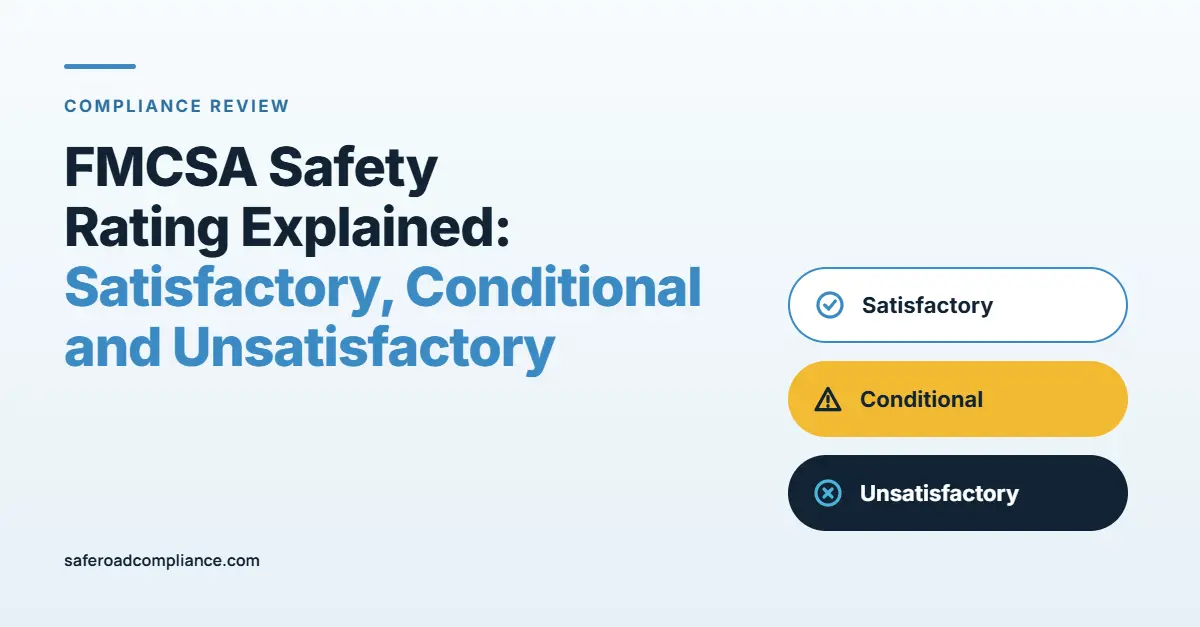
An FMCSA safety rating is FMCSA’s formal decision on whether a motor carrier has adequate safety management controls to meet the federal safety fitness standard. It is issued only after an onsite investigation (a compliance review), and it has three possible results: Satisfactory, Conditional, or Unsatisfactory. Carriers that have never been rated are listed as Unrated. An Unsatisfactory rating that becomes final prohibits the carrier from operating in interstate commerce. CSA/SMS percentiles do not set or change the rating.
This guide explains what each rating means, how investigators arrive at it, what happens after a Conditional or Unsatisfactory rating, and how it differs from the CSA data and inspection reports carriers see every month.
Safety Rating vs CSA/SMS vs Inspection Data
Three different FMCSA records describe a carrier’s safety, and they answer different questions. The safety rating is a legal fitness decision. SMS percentiles are a monthly ranking. Inspection reports are the raw roadside events.
Safety Rating vs. SMS (CSA) vs. Roadside Inspection Data
Three connected but distinct parts of FMCSA’s carrier safety oversight system.
| Comparison | Safety Rating | SMS (CSA) Percentiles | Roadside Inspection Data |
|---|---|---|---|
| What it is |
Formal determination FMCSA’s determination of a carrier’s safety fitness under 49 CFR Part 385. |
Risk prioritization A comparison of a carrier’s safety performance with that of peer carriers in applicable BASICs. |
Inspection record The record of each roadside inspection and any violations or out-of-service findings. |
| How it’s produced | Generally follows an FMCSA compliance review or other qualifying investigation that supports a safety rating. | Calculated using applicable inspection, crash, and investigation data under the SMS methodology. | Recorded by an authorized inspector during a roadside inspection. |
| Possible results | Satisfactory, Conditional, Unsatisfactory, or no rating assigned (Unrated). | Percentile rankings from 0 to 100 in applicable BASICs; not every carrier has a percentile in every BASIC. | Violations, out-of-service orders, or an inspection with no recorded violations. |
| How often it changes | When FMCSA issues or changes a rating through an applicable review or rating action. | Typically updated monthly, subject to the SMS data and methodology. | Whenever a new inspection record is added or an existing record is updated. |
| Legal effect | An Unsatisfactory rating generally prohibits a carrier from operating in interstate commerce under applicable federal rules, subject to the rule’s scope and exceptions. | Used to prioritize carriers for possible intervention; a percentile alone is not a safety rating or an automatic operating prohibition. | Out-of-service orders can restrict operation immediately. Inspection violations may also affect SMS results and future enforcement decisions. |
FMCSA is direct about the link between the first two: BASIC percentiles do not affect a carrier’s safety rating, and a rating reflects the date of the investigation rather than a monthly update. High SMS percentiles can, however, lead FMCSA to schedule the investigation that produces a rating. For more on the monthly side, see our guide to the FMCSA Safety Measurement System.
Satisfactory, Conditional, Unsatisfactory, and Unrated
All three ratings measure the same thing: whether the carrier’s safety management controls are adequate. The difference is whether weak controls have only created risk or have already led to problems. Definitions below follow FMCSA’s Safety Planner and safety ratings fact sheet.
Satisfactory safety rating
The carrier has functional and adequate safety management controls to meet the safety fitness standard. FMCSA judges adequacy against the size and type of the operation, so a one-truck carrier is not held to a large fleet’s systems. Only an Onsite Comprehensive Investigation can produce a Satisfactory rating.
Conditional safety rating
The carrier does not have adequate controls, and that gap could lead to the kinds of problems listed in 49 CFR 385.5, such as violations or crashes. A Conditional rating does not stop a carrier from operating. It does signal that FMCSA found real weaknesses, and FMCSA provides guidance on how to improve.
Unsatisfactory safety rating
The carrier does not have adequate controls, and that gap has already resulted in the problems listed in 385.5. A proposed Unsatisfactory rating starts a clock. If it becomes final, the carrier is prohibited from operating CMVs in interstate commerce.
Unrated
FMCSA has not assigned the carrier a rating. Unrated is not a judgment either way; it means no rated investigation has been completed. New carriers and many small carriers are Unrated.
You can check any carrier’s current rating on FMCSA’s SAFER Company Snapshot.
How FMCSA Assigns a Safety Rating
A rating is the result of a scoring process in 49 CFR Part 385, Appendix B. The investigator reviews the carrier’s records, groups any violations into six factors, scores each factor, and then applies a rating table. FMCSA describes this process in its safety fitness determination materials.
Step 1: Group the regulations into six factors.
DOT Safety Audit Factors
Six areas used to organize key federal motor carrier safety requirements.
| Factor | Regulations Covered |
|---|---|
|
1
General
|
Part 387
Part 390
Financial responsibility, general applicability, registration-related and general motor carrier rules.
|
|
2
Driver
|
Part 382
Part 383
Part 391
Drug and alcohol testing, commercial driver’s licenses, and driver qualification.
|
|
3
Operational
|
Part 392
Part 395
Safe driving practices, operating rules, and hours-of-service compliance.
|
|
4
Vehicle
|
Part 393
Part 396
Required vehicle parts and accessories, inspections, repairs, and maintenance records.
|
|
5
Hazardous Materials
|
Part 397
Part 171
Part 177
Part 180
Hazmat transportation safety, shipping requirements, highway transportation, and packaging inspection or maintenance, as applicable.
|
|
6
Accident
|
Recordable accident rate Recordable crashes evaluated in relation to vehicle miles traveled, typically expressed per million miles. |
Step 2: Score acute and critical violations. An acute violation is one so severe it needs immediate correction. A critical violation points to a breakdown in management or operational controls. According to FMCSA, each acute violation, or each pattern of a critical violation, adds one point to its factor. Patterns of hours-of-service violations add two points. A pattern generally means more than one violation, or at least 10 percent of the records reviewed when many are examined.
Step 3: Rate each factor. Zero points rates a factor Satisfactory, one point rates it Conditional, and two or more points rate it Unsatisfactory. The Vehicle factor also considers the carrier’s out-of-service rate, and the Accident factor compares the carrier’s recordable accident rate against a threshold.
Step 4: Apply the rating table.
FMCSA Safety Rating Decision Matrix
How Unsatisfactory and Conditional factor ratings combine to determine the overall safety rating under the applicable rating methodology.
| Factors Rated Unsatisfactory | Factors Rated Conditional | Overall Safety Rating |
|---|---|---|
| 0 | 2 or fewer | Satisfactory |
| 0 | More than 2 | Conditional |
| 1 | 2 or fewer | Conditional |
| 1 | More than 2 | Unsatisfactory |
| 2 or more | Any | Unsatisfactory |
Review 49 CFR Part 385
The math shows how quickly records problems add up. A pattern of hours-of-service violations (two points) makes the Operational factor Unsatisfactory on its own. If the Driver factor also picks up two points, for example from two acute driver violations, the carrier has two Unsatisfactory factors and an overall Unsatisfactory rating. To prepare your records before an investigator arrives, see how to prepare for a DOT audit.
From Compliance Review to Rating Outcome
The whole process runs from one onsite investigation to one of three outcomes. Monthly CSA data plays no part in the scoring itself.
[embed: node/906d3da1-9110]
FMCSA sends written notice of the rating within 30 days after the compliance review, according to its Safety Planner. A Satisfactory rating, or one that upgrades a proposed Unsatisfactory, is final on the date of the notice. Any other result arrives as a proposed rating that becomes final if the carrier does not improve it in time.
What Happens After Each Rating
The legal effect of a rating depends on which one you receive. Only Unsatisfactory carries an automatic operating prohibition, but Conditional has practical consequences too.
Safety Ratings: Legal vs. Practical Effects
Understand what each rating means for your operating authority and business relationships.
| Safety Rating | Legal Effect | Practical Effect |
|---|---|---|
| Satisfactory | Effective on the date of the safety-rating notice, subject to applicable review procedures. | Displayed in FMCSA public safety information, where shippers, brokers, insurers, and other parties may review it. |
| Conditional | The carrier may generally continue operating, but the rating indicates that deficiencies were identified. The carrier should address them promptly. | Publicly visible and may affect shipper, broker, and insurer confidence until the rating changes. |
| Unsatisfactory — Proposed | The carrier generally has an opportunity to take corrective action before a proposed unsatisfactory rating becomes final. The usual period is 45 days for passenger or placarded hazardous-material carriers and 60 days for other carriers, subject to applicable rules and exceptions. | Treat the notice as urgent. Review the findings, correct deficiencies, document corrective actions, and follow the notice’s deadlines and instructions. |
| Unsatisfactory — Final | Generally prohibits the carrier from operating CMVs in interstate commerce once the prohibition takes effect, subject to applicable procedures and exceptions. | Continuing operations in violation of the prohibition can lead to additional enforcement and penalties. Confirm the effective date and requirements in the official notice. |
Sources: FMCSA’s Safety Planner on rating notices and Conditional and Unsatisfactory ratings, and the safety ratings fact sheet.
On a proposed Unsatisfactory rating, the deadline matters more than anything else. A carrier that corrects its deficiencies and shows FMCSA the evidence before the deadline can avoid the rating becoming final. A carrier that waits risks being shut down for interstate work. Our guide to a DOT corrective action plan after a failed audit walks through how to build that evidence.
On a Conditional rating, there is no shutdown clock, but the rating stays on your record until another rated investigation or an approved upgrade replaces it. That alone is a reason to pursue an upgrade.
How to Upgrade or Challenge a Safety Rating
FMCSA gives carriers two ways to change a proposed or final rating, described in its Safety Planner. Which one fits depends on whether you think the rating is wrong or you have fixed the problems behind it.
Two Ways to Challenge or Improve a Safety Rating
Choose the procedure that matches your situation: an alleged rating error or deficiencies corrected after the review.
| Option | Rule | Use It When | What You Submit |
|---|---|---|---|
| 01 Administrative Review You dispute the basis for the rating. | 49 CFR 385.15 | You believe FMCSA made an error in assigning the safety rating. | A written request identifying the alleged error, explaining why the rating should be reviewed, and providing relevant supporting information. |
| 02 Request for Change Based on Corrective Action You accept the findings but have addressed them. | 49 CFR 385.17 | The findings were accurate, and you have since corrected the safety deficiencies. | A written description of the corrective actions taken, supported by documents and other evidence demonstrating that the deficiencies have been addressed. |
Both processes have strict time limits set in the regulations, so act as soon as the notice arrives. For a proposed Unsatisfactory rating, do not assume a pending request stops the 45- or 60-day clock; confirm the deadline that applies to your carrier type.
A strong corrective action request usually shows three things for each violation: what went wrong, what the carrier changed (policy, process, system, training), and proof the change is working, such as new driver files, clean logs, or completed maintenance records.
Prepare for the Investigation That Sets Your Rating
A safety rating is decided by what an investigator finds in your files on the day of the review. Driver qualification files, drug and alcohol testing records, hours-of-service logs, and maintenance records are the core of that review.
SafeRoad Compliance helps owner-operators and small fleets prepare for compliance reviews, respond to Conditional and proposed Unsatisfactory ratings, and build corrective action plans, as part of our DOT compliance services. If you have a rating notice or an upcoming investigation, contact SafeRoad Compliance.
Don’t Let Compliance
Slow Your Business Down.
Stay organized, keep required records current, and stay ahead of important DOT compliance requirements with professional support.
This article is general information about FMCSA safety ratings. It is not legal advice. Rating deadlines and review procedures are set in 49 CFR Part 385; confirm them for your situation.
FMCSA Safety Rating FAQ
Satisfactory, Conditional, and Unsatisfactory. A carrier that has never been rated is listed as Unrated.
No. FMCSA states that BASIC percentiles do not affect a carrier’s safety rating. High percentiles can lead to an investigation, and that investigation can produce a rating.
Only through an FMCSA onsite investigation (compliance review). Not every investigation results in a rating, and only an Onsite Comprehensive Investigation can result in Satisfactory.
It means FMCSA found inadequate safety management controls that could lead to violations or crashes. It does not stop you from operating, and you can request an upgrade after correcting the problems.
You receive a proposed rating first. You have 45 days (passenger or placarded hazmat carriers) or 60 days (all others) to correct the deficiencies. If the rating becomes final, you are prohibited from operating in interstate commerce.
No. Unrated means FMCSA has not completed a rated investigation of the carrier. It says nothing about safety either way.
On FMCSA’s SAFER Company Snapshot, searchable by USDOT number, MC number, or company name.
Yes. Under 49 CFR 385.17, a carrier can request a rating change in writing, with evidence of the corrective actions it has taken.