Disclosure: Informational only. We are not FMCSA or USDOT. Always verify your status directly through official FMCSA systems.
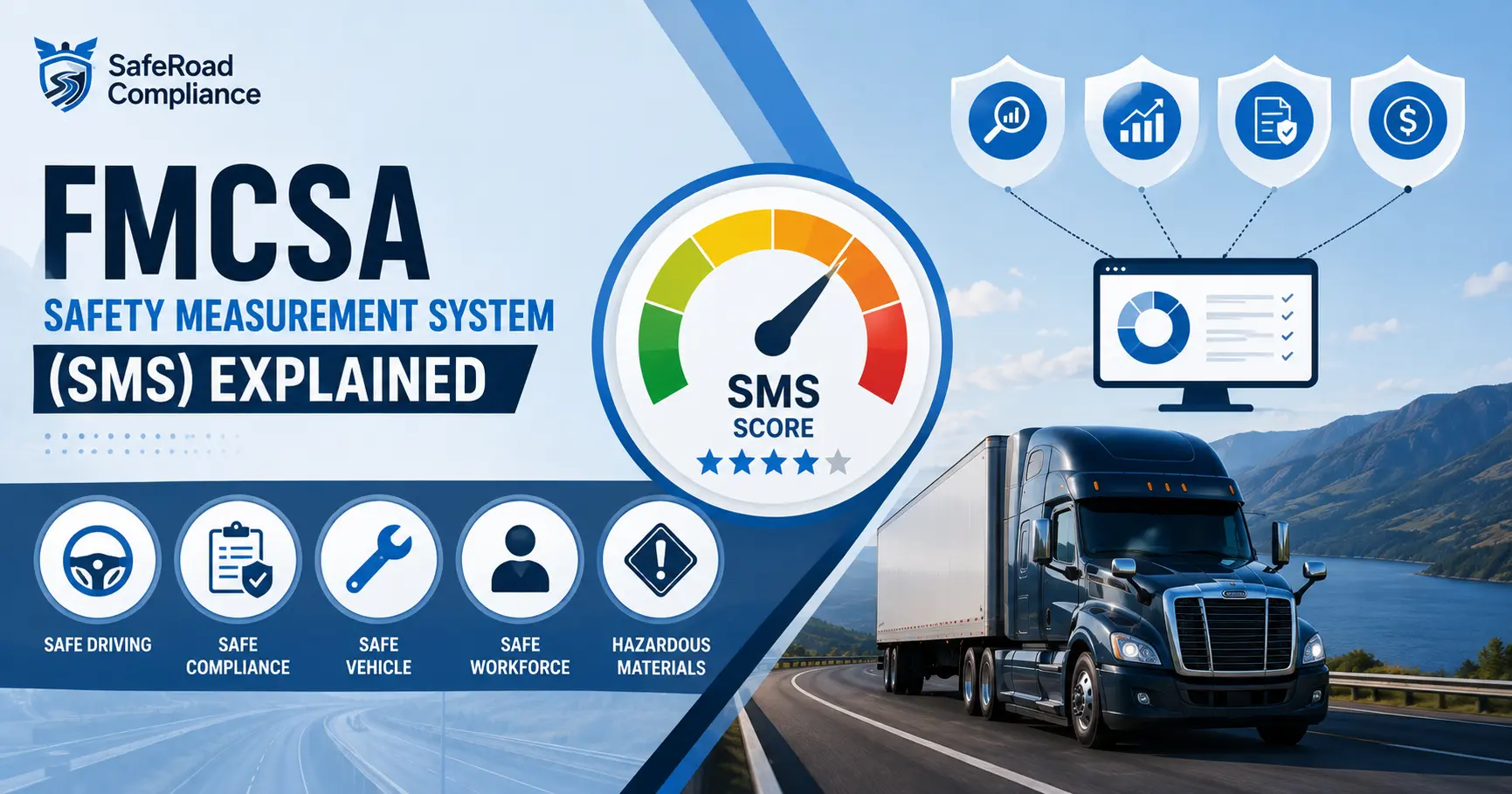
The FMCSA Safety Measurement System (SMS) is a data-driven system used by the Federal Motor Carrier Safety Administration to identify carriers with safety performance concerns and prioritize them for intervention.
SMS uses information such as roadside inspection results, crash data, and investigation findings to evaluate a carrier’s performance in specific safety categories known as Behavior Analysis and Safety Improvement Categories (BASICs).
For motor carriers, understanding SMS matters because safety data can influence how regulators identify carriers for intervention and where a company should focus its compliance efforts. However, an SMS percentile is not the same thing as a safety rating, and it should not be treated as a simple pass-or-fail score.
Quick Answer: The FMCSA Safety Measurement System analyzes a carrier’s safety-related data and organizes violations into BASIC categories. Carriers can use this information to identify compliance weaknesses, prioritize corrective actions, and reduce the risk of future safety problems.
This guide explains how SMS works, what the BASIC categories mean, how safety data is evaluated, what carriers should monitor, and what practical steps can improve safety performance.
What Is the FMCSA Safety Measurement System?
The FMCSA Safety Measurement System is a monitoring and prioritization system operated by FMCSA. It uses available safety data to identify patterns that may indicate a carrier requires closer attention or intervention.
The system evaluates safety-related information within defined BASIC categories rather than reducing a carrier’s entire safety record to one universal score.
SMS data can include information from:
- Roadside inspections
- Inspection violations
- Reportable crashes
- Investigations
- Safety-related enforcement information
- Other data maintained by FMCSA
The purpose is to help FMCSA identify carriers that may pose safety concerns and determine where intervention resources should be directed.
For carriers, SMS is also useful as a compliance management tool. Reviewing the information regularly can help safety managers identify recurring violations before they develop into larger operational problems.
What SMS Does Not Mean
One of the most important points to understand is that an SMS percentile is not automatically a declaration that a carrier is unsafe.
A carrier’s SMS information is used within FMCSA’s safety monitoring and intervention framework. It should therefore be interpreted in context, including the carrier’s fleet size, inspection history, violation history, crashes, and the BASIC involved.
This distinction is especially important when discussing CSA scores with drivers, customers, insurers, or business partners.
What Are FMCSA SMS BASICs?
BASIC stands for Behavior Analysis and Safety Improvement Category.
Each BASIC focuses on a particular area of motor carrier safety. Instead of looking at every violation as unrelated information, the SMS framework groups relevant safety violations into categories that help identify patterns.
The BASIC categories are designed around major areas of carrier and driver safety, including:
| BASIC | What It Evaluates |
|---|---|
| Unsafe Driving | Dangerous driving behaviors and related violations |
| Crash Indicator | Patterns associated with reportable crashes |
| Hours-of-Service Compliance | HOS and record-of-duty-status compliance |
| Vehicle Maintenance | Vehicle inspection, maintenance, and mechanical violations |
| Controlled Substances/Alcohol | Drug and alcohol testing and related compliance |
| Hazardous Materials Compliance | HM-related transportation and handling requirements |
| Driver Fitness | Driver qualification and fitness-related requirements |
Not every BASIC is treated identically for every carrier, and FMCSA’s methodology determines how available data is evaluated.
This means a carrier should avoid looking at one category in isolation.
FMCSA SMS BASIC Categories Explained
1. Unsafe Driving
The Unsafe Driving BASIC focuses on violations involving unsafe operation of commercial motor vehicles.
Examples can include certain speeding violations, reckless driving, improper lane changes, and other unsafe driving-related violations.
For fleets, this category highlights the importance of:
- Driver coaching
- Roadside inspection preparation
- Speed management
- Defensive driving
- Consistent driver supervision
A recurring pattern of unsafe driving violations should trigger a management review rather than simply waiting for the next inspection.
2. Crash Indicator
The Crash Indicator BASIC looks at information associated with reportable crashes involving a carrier’s vehicles.
A crash appearing in SMS does not necessarily mean the carrier caused the crash. This is an important distinction when reviewing safety data.
Carriers should carefully review crash information for accuracy and understand how reported incidents are represented within FMCSA systems.
If information appears incorrect or incomplete, the carrier may have options for requesting a review through FMCSA DataQs.
3. Hours-of-Service Compliance
The Hours-of-Service Compliance BASIC focuses on violations related to driver hours and records of duty status.
Potential issues include:
- Driving beyond permitted hours
- HOS record violations
- False records of duty status
- Certain ELD-related violations
- Improper duty-status records
Strong HOS management requires more than simply installing an ELD.
Carriers should have procedures for reviewing logs, addressing violations, handling ELD malfunctions, training drivers, and responding to recurring patterns.
4. Vehicle Maintenance
The Vehicle Maintenance BASIC addresses violations involving the mechanical condition and maintenance of commercial motor vehicles.
Examples may include issues involving:
- Brakes
- Tires
- Lighting
- Steering components
- Required equipment
- Inspection and maintenance practices
Preventive maintenance programs are therefore directly connected to SMS performance.
A carrier that waits until a vehicle fails a roadside inspection is reacting too late. Regular inspections and documented maintenance can help identify defects before they become roadside violations.
5. Controlled Substances/Alcohol
This BASIC covers certain violations involving controlled substances and alcohol requirements.
For employers, compliance can involve several operational areas, including:
- Pre-employment testing
- Random testing
- Post-accident testing when required
- Reasonable-suspicion procedures
- Return-to-duty requirements
- Clearinghouse-related responsibilities
- Required records and documentation
Drug and alcohol compliance should be managed as an ongoing program rather than treated as a one-time hiring requirement.
6. Hazardous Materials Compliance
The Hazardous Materials Compliance BASIC relates to applicable hazardous materials transportation requirements.
Depending on the carrier’s operations, compliance may involve:
- Hazardous materials handling
- Shipping papers
- Marking and labeling
- Placarding
- Packaging
- Loading and securement requirements
Not every carrier transports hazardous materials, so this category may have limited relevance to fleets outside the hazmat sector.
Useful Link: How to Comply with Federal Hazardous Materials Regulations
7. Driver Fitness
The Driver Fitness BASIC focuses on violations related to whether drivers are properly qualified and fit to operate commercial motor vehicles.
This area can connect directly to a carrier’s Driver Qualification File (DQF) process.
Depending on the applicable requirements, carriers may need to maintain documentation such as:
- Driver applications
- Motor vehicle records
- Medical qualification documentation
- Road test records or equivalent documentation
- Previous-employer inquiry records
- Required qualification certifications
A strong driver qualification process helps prevent administrative problems from becoming larger compliance issues.
How Does the FMCSA Safety Measurement System Calculate Performance?
SMS does not simply add up the number of violations and assign every carrier a basic numerical grade.
FMCSA’s methodology considers factors such as the severity and timing of violations, inspection exposure, and other elements relevant to the BASIC being evaluated.
In simplified terms, the process can be understood as:
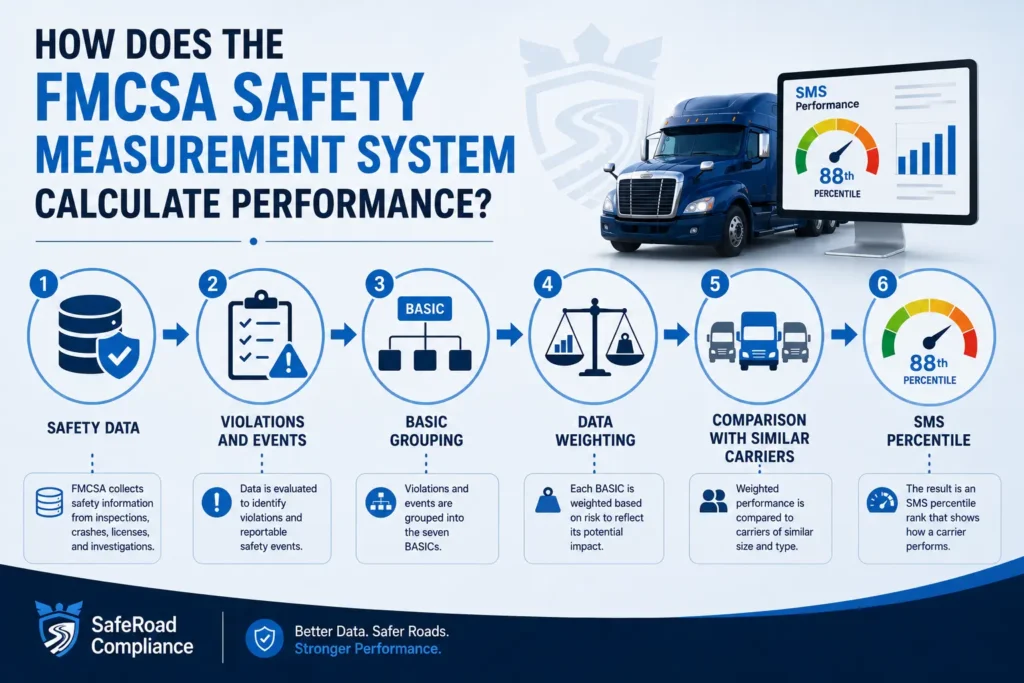
This is why two carriers with the same number of violations may not necessarily have identical SMS results.
Why Inspection Exposure Matters
A carrier’s safety data must be interpreted in relation to its inspection activity.
For example, a fleet with many inspections has more opportunities for violations to be identified than a carrier with very limited inspection exposure.
SMS methodologies account for these types of differences when calculating BASIC performance.
SMS Scores vs. FMCSA Safety Ratings
These concepts are often confused.
SMS percentiles and FMCSA safety ratings are not the same thing.
A carrier can therefore have concerning SMS data without automatically having an Unsatisfactory Safety Rating.
Likewise, a company should not assume that improving one SMS BASIC automatically changes its formal safety rating.
Important: SMS Data Is Not the Same as a CSA “Score”
The trucking industry commonly uses the phrase “CSA score“, but the terminology can create confusion.
CSA refers to the Compliance, Safety, Accountability program, while SMS is the system FMCSA uses to analyze safety performance data within that program.
For accurate compliance discussions, it is better to identify the specific BASIC, violation, inspection data, or safety rating being discussed instead of treating everything as one overall score.
How Can SMS Affect Your Trucking Company?
The FMCSA Safety Measurement System can affect how regulators identify carriers for further monitoring or intervention. It can also help a carrier’s management team identify recurring safety problems before those problems become more serious.
SMS information may be relevant when evaluating areas such as:
- Driver safety performance
- HOS compliance
- Vehicle maintenance
- Driver qualification
- Drug and alcohol compliance
- Inspection trends
- Crash patterns
- Corrective action priorities
However, carriers should avoid treating an SMS percentile as a simple business scorecard.
A high percentile in a BASIC does not automatically mean a carrier has been declared unsafe, and a lower percentile does not mean the carrier can ignore individual violations.
Why SMS Matters Operationally
Consider a carrier that repeatedly receives brake-related violations during roadside inspections.
The individual violations may appear manageable when reviewed separately. But when the carrier examines its SMS data and sees a recurring Vehicle Maintenance pattern, the issue becomes easier to identify as a systemic maintenance problem.
The appropriate response is not simply to repair the truck that failed inspection.
A stronger response would include:
- Identifying the recurring defect.
- Reviewing maintenance procedures.
- Determining why inspections did not catch the problem earlier.
- Updating preventive maintenance procedures.
- Training drivers or maintenance personnel where necessary.
- Documenting corrective actions.
- Monitoring future inspections for improvement.
This is the difference between reactive compliance and effective safety management.
How to Improve FMCSA SMS Performance
Improving SMS performance starts with understanding why violations are occurring.
Simply telling drivers to “avoid violations” is rarely enough. Management needs to identify the operational process behind the violation.
Step 1: Review Your SMS Data Regularly
Do not wait for an audit or enforcement notice before reviewing safety information.
Establish a recurring process for reviewing:
- BASIC performance
- Recent roadside inspections
- Violations
- Crash information
- Driver-related issues
- Vehicle defects
- HOS records
- Inspection trends
The goal is to identify patterns early.
Step 2: Identify Repeat Violations
A single violation may require corrective action, but repeated violations deserve a deeper investigation.
Ask:
Is this a driver problem, vehicle problem, training problem, dispatch problem, documentation problem, or management-system problem?
For example, repeated HOS violations could indicate more than driver mistakes. The root cause might be unrealistic delivery schedules or insufficient management review of available driving hours.
Step 3: Correct the Root Cause
Effective compliance management focuses on the underlying cause.
| Problem | Weak Response | Better Response |
|---|---|---|
| Repeated brake violations | Repair individual trucks | Review preventive maintenance program |
| HOS violations | Warn the driver | Analyze dispatch and log-review procedures |
| Driver qualification deficiencies | Add missing documents | Improve the DQF workflow |
| Unsafe driving violations | Issue one warning | Implement coaching and monitoring |
| Drug/alcohol documentation issue | Replace missing record | Review the entire testing process |
The stronger response is the one that prevents the same problem from happening again.
What Happens When a Carrier Finds Incorrect SMS Data?
Not every piece of information in a carrier’s safety record is necessarily beyond review.
If a carrier believes that an inspection violation, crash record, or other safety information is inaccurate, it should investigate the underlying record and determine whether the information can be challenged.
This is where FMCSA DataQs becomes important.
DataQs is an FMCSA system that allows users to request a review of federal and state data believed to be incomplete or incorrect.
For example, a carrier may identify:
- An incorrectly attributed inspection
- Incorrect carrier identification
- A violation recorded inaccurately
- A crash record containing incorrect information
- Documentation that does not match the inspection record
A DataQs request should be based on evidence rather than simply arguing that the violation is unfair.
How to Challenge an Incorrect DOT Violation
A strong DataQs request should clearly explain what is incorrect, why it is incorrect, and what documentation supports the request.
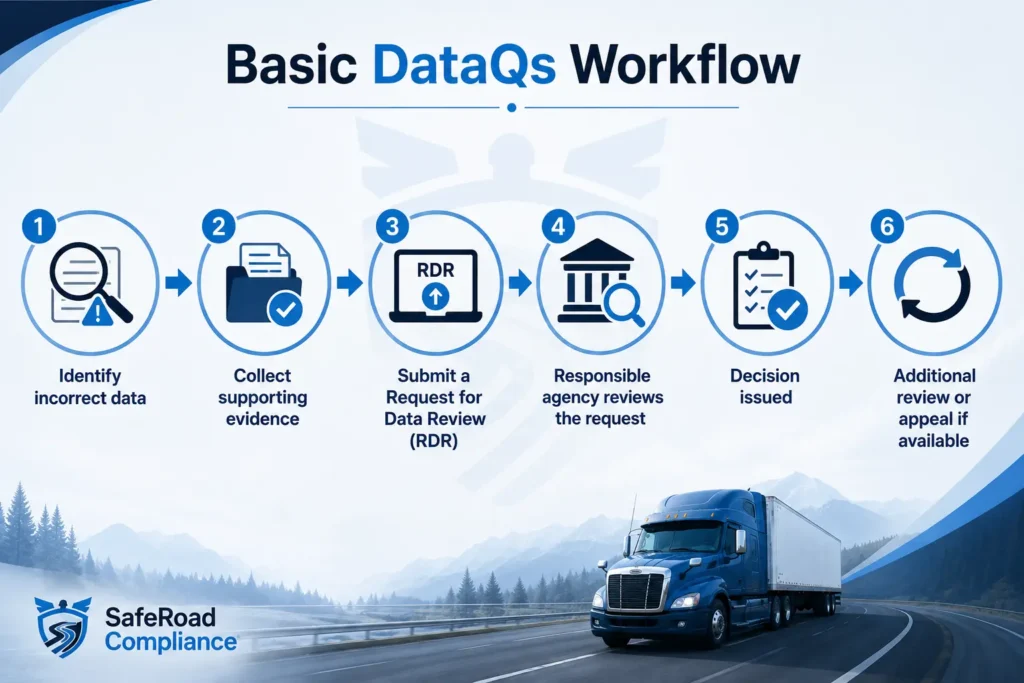
The exact review process and timeline can vary depending on the type of data and responsible agency.
What Evidence Should You Gather?
Evidence should directly support the specific correction being requested.
Potential documentation may include:
- Inspection reports
- Repair invoices
- Maintenance records
- Driver statements
- Photographs
- ELD records
- Bills of lading
- Crash documentation
- Official correspondence
- Registration records
- Other records relevant to the disputed information
The best evidence is specific, contemporaneous, and directly connected to the disputed record.
Can a Carrier Remove a CSA or SMS Violation?
A carrier cannot simply ask FMCSA to “delete” an unfavorable violation because it affects safety performance.
A DataQs request is a data review process. The carrier needs to demonstrate that the information is inaccurate, incomplete, improperly attributed, or otherwise eligible for correction under the applicable review process.
If the underlying information is accurate, the appropriate strategy is usually corrective action and ongoing compliance, not attempting to remove the violation.
This distinction is important.
DataQs vs. Corrective Action
| Situation | Appropriate Response |
|---|---|
| Incorrect inspection information | Consider DataQs |
| Incorrectly attributed violation | Consider DataQs |
| Accurate violation | Correct the underlying compliance issue |
| Repeated violations | Investigate root cause |
| Poor BASIC performance | Implement safety improvements |
| Missing documentation | Correct records and procedures |
A DataQs request should never replace a genuine compliance improvement program.
How Long Does It Take to Improve SMS Performance?
There is no universal timeline for improving a carrier’s SMS performance.
The timeline depends on factors such as:
- Type of violation
- Number of violations
- Recency of violations
- Inspection activity
- BASIC involved
- New safety data entering the system
- Whether incorrect information is successfully corrected
SMS is dynamic. As new inspection and safety information enters the system and older events become less influential under the applicable methodology, a carrier’s performance can change.
That means compliance improvement should be treated as an ongoing process, not a one-time campaign.
A Practical SMS Improvement Framework
For carriers trying to improve safety performance, use this five-step framework:
1. Measure
Review current SMS and inspection information.
2. Prioritize
Identify the BASICs and violations creating the greatest operational concern.
3. Investigate
Determine the root cause behind recurring violations.
4. Correct
Implement specific changes in training, maintenance, hiring, dispatch, or documentation.
5. Monitor
Continue reviewing inspections and safety data to determine whether the corrective measures are working.
This approach gives management a repeatable process instead of reacting to each violation independently.
SMS Compliance Decision Tree
Use this simplified decision framework when reviewing an unfavorable safety record:
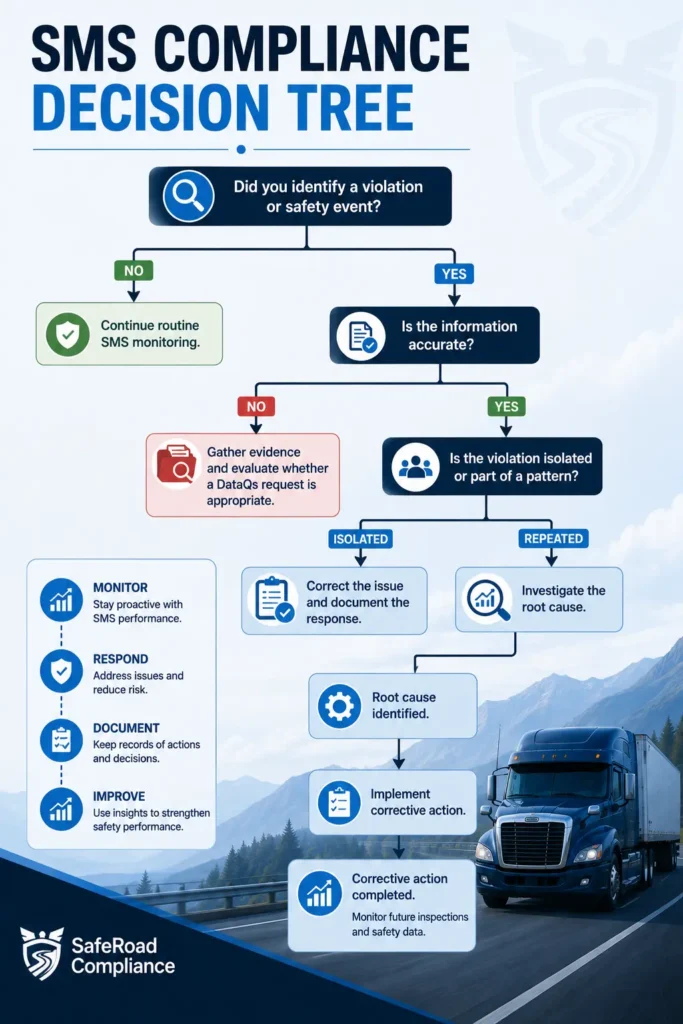
This process helps prevent carriers from confusing data correction with compliance improvement.
Common SMS Management Mistakes
1. Treating SMS Like a Single Overall Score
SMS evaluates different BASIC categories. Looking only at a general “score” can hide the actual compliance problem.
Better approach: Review each relevant BASIC and the underlying inspection data.
2. Waiting Until an Audit
An audit should not be the first time management reviews safety performance.
Better approach: Establish a recurring internal review process.
3. Challenging Accurate Violations
Not every negative inspection result is a DataQs case.
Better approach: Challenge information only when you have a legitimate factual or procedural basis supported by evidence.
4. Fixing the Driver Instead of the System
Repeated violations can sometimes reflect weaknesses in company procedures.
Better approach: Look beyond the individual driver and examine dispatch, maintenance, training, supervision, and documentation.
5. Ignoring Inspection Trends
One inspection may reveal an isolated problem. Multiple similar inspections can reveal a systemic weakness.
Better approach: Track recurring violation types across drivers, vehicles, locations, and time periods.
6. Assuming ELDs Guarantee HOS Compliance
An ELD records information, but it does not replace management oversight.
Better approach: Review logs, train drivers, investigate exceptions, and address recurring HOS issues.
Best Practices for Managing FMCSA SMS Performance
A practical carrier SMS program should include the following:
Monthly or Regular Safety Review
Review:
- Recent inspections
- Violations by BASIC
- Crash information
- HOS trends
- Vehicle defects
- Driver qualification issues
- Drug and alcohol compliance
- Open corrective actions
Driver-Level Monitoring
Identify recurring violations by individual driver.
Use findings for coaching and training rather than relying exclusively on disciplinary measures.
Vehicle-Level Monitoring
Track defects by vehicle and identify units that repeatedly generate inspection problems.
Documentation
Keep evidence showing what your company did after identifying a compliance issue.
Documentation can demonstrate that management is actively monitoring and correcting safety problems.
Management Accountability
Assign responsibility for each corrective action.
A compliance program is much stronger when someone is responsible for completing, documenting, and verifying each action.
SMS Compliance Checklist
Use this checklist as a starting point for your internal safety review:
- Review current FMCSA SMS information.
- Review each applicable BASIC.
- Examine recent roadside inspection reports.
- Identify recurring violations.
- Review crash information for accuracy.
- Investigate potentially incorrect safety data.
- Determine whether a DataQs request is appropriate.
- Review HOS and ELD compliance.
- Review vehicle maintenance trends.
- Audit driver qualification documentation.
- Verify drug and alcohol compliance procedures.
- Provide targeted driver training.
- Document corrective actions.
- Assign responsibility for follow-up.
- Monitor future inspection results.
Expert Tip: Focus on Patterns, Not Just Percentiles
SafeRoad Compliance recommends looking behind the SMS percentile.
A percentile tells you where performance stands within the applicable comparison framework, but the underlying violations tell you why the carrier is performing that way.
For example, if Vehicle Maintenance is a concern, management should identify whether the underlying issue involves brakes, tires, lighting, inspection procedures, maintenance intervals, or another recurring defect.
That information is far more useful for building a corrective action plan.
When Should You Get Professional DOT Compliance Support?
Some SMS issues can be handled internally, particularly when the violation is isolated and the corrective action is straightforward.
Professional assistance can be useful when:
- Multiple BASICs show recurring concerns.
- The carrier is preparing for an FMCSA intervention.
- Inspection data appears inaccurate.
- The company is considering a DataQs request.
- A compliance review has identified systemic deficiencies.
- Management needs help developing corrective actions.
- The carrier lacks an internal compliance specialist.
The objective should be to understand the underlying compliance problem and build a sustainable solution.
For carriers that need broader assistance across inspections, documentation, safety management, and regulatory requirements, DOT compliance management can provide a more structured approach.
Key Takeaways
- The FMCSA Safety Measurement System analyzes carrier safety data across defined BASIC categories.
- SMS percentiles are not the same as formal FMCSA safety ratings.
- Carriers should examine the underlying violations instead of focusing only on a percentile.
- Repeated violations may indicate weaknesses in training, maintenance, dispatch, hiring, or management controls.
- FMCSA DataQs provides a mechanism for requesting review of potentially inaccurate or incomplete safety data.
- DataQs should not be used to challenge accurate violations simply because they negatively affect a carrier’s record.
- Effective SMS improvement requires measurement, root-cause analysis, corrective action, and ongoing monitoring.
- Strong compliance management is proactive rather than reactive.
FAQs
The FMCSA Safety Measurement System is a safety monitoring system that uses carrier safety data to identify performance concerns and help FMCSA prioritize interventions.
BASICs, or Behavior Analysis and Safety Improvement Categories, organize safety-related violations and information into areas such as Unsafe Driving, HOS Compliance, Vehicle Maintenance, Driver Fitness, and other safety categories.
Not exactly. “CSA score” is commonly used in the trucking industry, but SMS uses BASIC-specific data and percentiles. Carriers should look at the specific BASIC and underlying safety information rather than treating SMS as one universal score.
You cannot simply remove an accurate violation because it negatively affects your safety performance. If the underlying information is inaccurate or otherwise eligible for review, you may be able to challenge it through FMCSA DataQs.
Start by identifying recurring violations, determining their root causes, implementing corrective actions, training personnel, and monitoring future inspections and safety data.
No. An SMS percentile should be interpreted within the applicable FMCSA methodology and alongside the underlying safety data. It is not itself a formal safety rating.
Carriers should establish a regular safety-monitoring process rather than waiting for an audit or enforcement action. The appropriate frequency depends on fleet size, operations, inspection activity, and existing compliance risks.
Review the underlying inspection record, gather supporting documentation, and determine whether a Request for Data Review through FMCSA DataQs is appropriate.