Disclosure: Informational only. We are not FMCSA or USDOT. Always verify your status directly through official FMCSA systems.
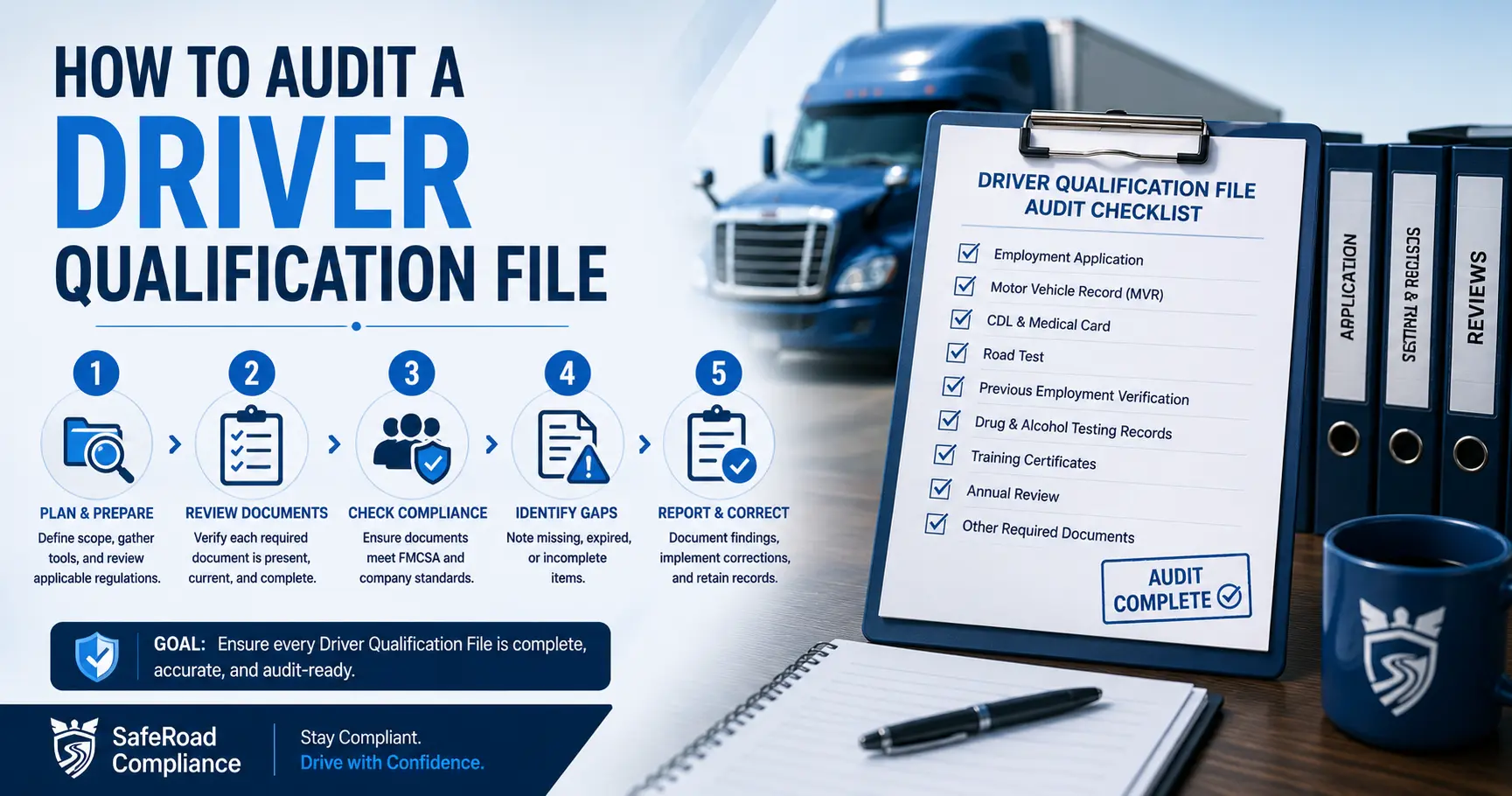
A Driver Qualification File (DQF) audit is a structured review of a driver’s records to determine whether the carrier has the documentation required to establish and maintain driver qualification.
For carriers, auditing a DQ file is more than checking whether documents exist. A proper review should confirm that each document is complete, valid, properly dated, signed when required, consistent with other records, and retained for the required period.
Quick Answer: To audit a DQ file, verify that required documents are present, current when applicable, properly completed, chronologically consistent, and supported by required evidence. Then classify deficiencies by severity and correct the highest-risk issues first.
What Is a DQ File Audit?
A DQ file audit is a systematic examination of a commercial driver’s qualification records to determine whether the carrier has properly documented the driver’s eligibility to operate a commercial motor vehicle.
The review should consider more than document presence.
An auditor should ask:
- Is the required document present?
- Is it complete?
- Was it obtained at the appropriate time?
- Is it still valid where applicable?
- Does the information match other records?
- Are required signatures or certifications present?
- Has the carrier retained the record for the required period?
- Is there evidence supporting the carrier’s qualification decision?
The objective is to determine whether the file tells a clear, consistent, and defensible story about the driver’s qualification.
What Should Be Checked During a DQF Audit?
The exact contents of a DQF depend on the driver’s circumstances and applicable FMCSA requirements. For drivers subject to the federal driver qualification rules, the audit commonly examines records associated with 49 CFR Part 391.
Important areas include:
| Audit Area | What to Review |
|---|---|
| Driver identification | Name and identifying information are consistent |
| Employment application | Required information is complete |
| Driving history | Required previous-employer and driving-record information |
| MVR | Required motor vehicle record documentation |
| Road test/equivalent | Required evidence is present |
| Medical qualification | Medical documentation where applicable |
| Annual review | Required annual review documentation |
| Violations | Annual certification/review records where applicable |
| Safety performance history | Required previous-employer inquiries and responses |
| Signatures | Required certifications and acknowledgments |
| Dates | Documents were completed and obtained appropriately |
| Retention | Records are retained for the applicable period |
A carrier should not assume every driver will have an identical DQF. Exceptions, exemptions, job duties, and the driver’s qualification circumstances can affect which records belong in the file.
Step-by-Step: How to Audit a DQ File
Step 1: Confirm the Driver’s Identity
Start with basic information.
Compare the driver’s name and identifying information across the DQF, MVR, medical documentation, employment records, and other relevant records.
Look for:
- Name inconsistencies
- Incorrect dates of birth
- Incorrect license information
- Duplicate driver records
- Documents belonging to another driver
Small identification errors can make an otherwise complete file difficult to defend during an audit.
Step 2: Check the Employment Application
Review the driver’s application for completeness and required information.
Do not simply confirm that an application exists.
Check whether:
- Required fields are completed
- Employment history is sufficiently documented
- Dates are logical
- Previous employers are identified where required
- The application is dated
- Required certifications or signatures are present
Pay particular attention to unexplained gaps in employment history or inconsistencies between the application and other records.
Step 3: Verify Driving Record Documentation
The driver’s motor vehicle record is an important part of the qualification process.
Review the MVR for:
- Correct driver identity
- Correct license information
- Date obtained
- Relevant violations
- License status
- Required annual review documentation
An auditor should also determine whether the carrier properly reviewed the driver’s record rather than merely storing the MVR.
This distinction is important: having an MVR in the file is not necessarily the same as documenting the required review of that record.
Step 4: Review Medical Qualification Records
Where applicable, review documentation demonstrating that the driver meets the applicable medical qualification requirements.
Check:
- Driver identity
- Medical documentation
- Dates
- Expiration or validity information where applicable
- Consistency with the driver’s qualification status
Medical qualification requirements can vary depending on the driver’s operation and applicable federal or state requirements, so avoid treating every driver file identically.
Step 5: Check the Road Test or Equivalent Documentation
Determine whether the file contains the required evidence of the driver’s road test qualification or an applicable equivalent.
Review:
- Driver identity
- Date
- Required certification
- Supporting documentation
- Any applicable exception or equivalent qualification
An auditor should also check whether the documentation actually supports the qualification being claimed.
Step 6: Review Previous-Employer and Safety History Records
Where required, verify that the carrier completed the appropriate inquiries into the driver’s previous employment and safety performance history.
Look for:
- Previous employers
- Required inquiry records
- Responses
- Documentation of attempts to obtain information
- Dates of inquiries
- Any follow-up actions
Missing evidence here can be particularly important because it may indicate that the carrier’s hiring process was incomplete rather than merely missing a piece of paperwork.
Step 7: Check Annual Review Documentation
A DQF audit should not stop at the driver’s hiring date.
Review the driver’s annual qualification review records and determine whether the carrier documented the required review of the driver’s driving record and qualification status.
Check the chronology carefully.
For example:
Hire → Initial qualification → MVR review → Annual review → Subsequent annual review
If a required annual review is missing, expired, or improperly documented, flag it for correction.
DQ File Audit: Severity Prioritization
Not every DQF deficiency carries the same compliance significance.
A useful audit system is to classify findings into three levels.
| Severity | Example | Recommended Action |
|---|---|---|
| High | Missing evidence affecting the driver’s qualification | Correct immediately and escalate internally |
| Medium | Missing required review, certification, or supporting documentation | Correct promptly and verify process |
| Low | Formatting, organization, or minor administrative inconsistency | Correct and monitor |
High-Priority Findings
These deserve immediate attention when they could affect whether the driver is properly qualified.
Examples may include:
- Missing critical qualification evidence
- Serious inconsistencies affecting qualification
- Expired or invalid documentation where current qualification is required
- Evidence suggesting the required hiring process was not completed
Medium-Priority Findings
These may not immediately establish that the driver is unqualified, but they indicate a weakness in the carrier’s compliance process.
Examples include:
- Missing review documentation
- Incomplete certifications
- Missing supporting records
- Incorrect dates
Low-Priority Findings
These are generally administrative issues that should still be corrected.
Examples include:
- Poor file organization
- Inconsistent naming conventions
- Duplicate copies
- Documents stored in the wrong section
Important: Severity should always be evaluated against the applicable regulation and the specific driver’s circumstances. An internal audit classification is not itself an FMCSA enforcement determination.
How to Check DQF Chronology and Consistency
One of the most useful techniques during a driver file audit is to review the records chronologically.
Instead of examining each document independently, create a timeline.
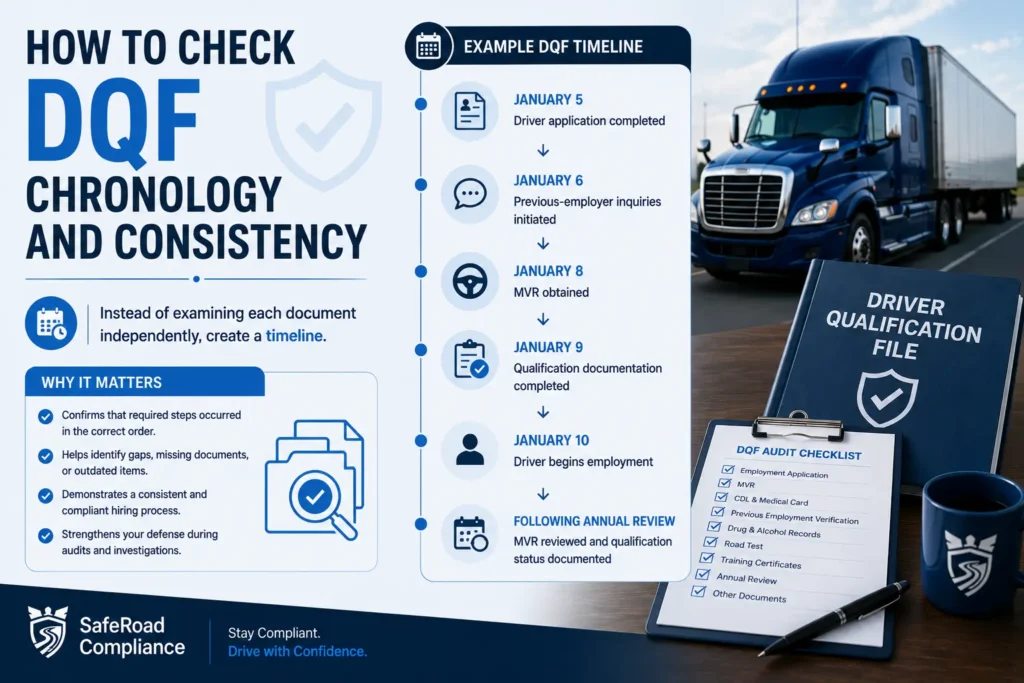
Now compare the dates.
If the file shows the driver began operating before required qualification steps were completed, that deserves investigation.
This chronological approach can expose problems that are easy to miss when documents are reviewed individually.
DQF Audit Questions an Auditor Should Ask
For every driver file, ask:
Completeness
- Are the required records present?
Validity
- Are applicable documents current and valid?
Chronology
- Were required steps completed at the appropriate time?
Consistency
- Do names, dates, license information, and employment details match?
Signatures
- Are required certifications and signatures present?
Evidence
- Does the file prove that the carrier completed the required process?
Retention
- Are records being retained for the applicable regulatory period?
This approach turns a simple document review into an actual driver file compliance audit.
Internal Compliance Resource
If you are building a DQF audit process from scratch, first understand how the files should be maintained on an ongoing basis. Our guide on how to maintain Driver Qualification Files can be used alongside this audit checklist.
For carriers preparing for a broader FMCSA review, a DQF audit should also be part of the company’s overall DOT audit preparation.
Common DQ File Audit Findings
A strong driver file compliance audit should identify both missing documents and weaknesses in the carrier’s qualification process.
Some of the most common findings include:
1. Missing Required Documentation
The file may contain several documents but still lack one or more records required for that particular driver.
The auditor should compare the file against a standardized DQF checklist rather than assuming that a mostly complete file is compliant.
2. Missing or Incomplete Signatures
A document may be present but incomplete because a required signature, certification, or date was omitted.
This is especially important when the signature demonstrates that a required review or certification actually occurred.
3. Expired or Outdated Information
A file can become noncompliant over time even when it was properly created during hiring.
Annual reviews, medical qualification information, and other recurring requirements should be monitored according to the applicable rules.
4. Incorrect Dates
Dates should tell a logical story.
For example, if a record appears to have been completed after the event it was supposed to document, the auditor should investigate rather than simply mark the document as present.
5. MVR Review Not Properly Documented
One recurring weakness is having an MVR in the file without adequate evidence that the carrier completed the required review.
The audit should distinguish between obtaining a record and documenting the required compliance action.
6. Previous-Employer Inquiry Gaps
If required safety-performance or employment-history inquiries are missing, incomplete, or unsupported, the carrier should investigate the gap and determine whether additional documentation is required.
7. Poor File Organization
Disorganized DQFs increase the chance that required records will be overlooked during an internal review or FMCSA investigation.
A consistent structure makes missing or outdated documents easier to identify.
How to Audit a DQ File Efficiently
For fleets with multiple drivers, reviewing every document manually without a standard process can become inefficient.
A better approach is to use a repeatable audit workflow.
DQF Audit Workflow
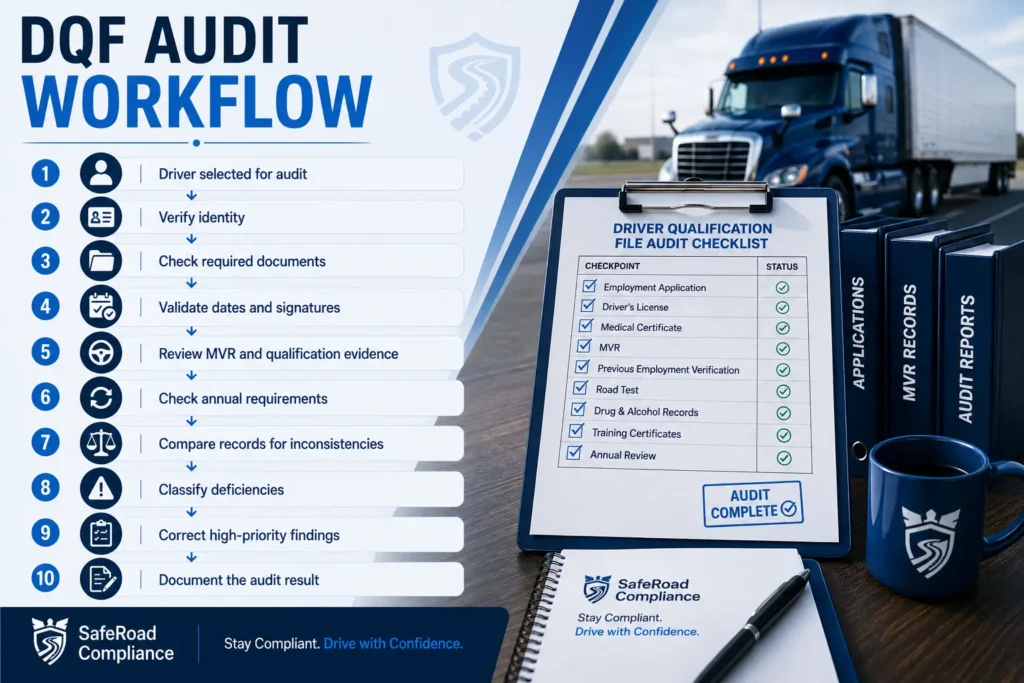
This creates an auditable trail showing not only what was corrected, but also how the carrier monitors its driver qualification program.
DQ File Audit Example
Consider a carrier reviewing the file of a driver who has been employed for several years.
The initial hiring documentation is present, including the application, MVR, medical qualification documentation, and road-test evidence.
However, the internal audit discovers that the carrier cannot locate documentation for one required annual review.
Auditor’s Finding
The problem is not necessarily that the driver was never reviewed.
The problem is that the carrier cannot produce adequate evidence showing that the required review was completed.
Recommended Response
The carrier should:
- Identify the missing review period.
- Determine whether the review actually occurred.
- Locate supporting evidence if it exists elsewhere.
- Correct the recordkeeping process.
- Document the internal finding and corrective action.
- Review other driver files for the same weakness.
That final step is important.
If one driver’s file has a recurring problem, the issue may exist across the fleet.
How to Determine Whether a DQF Problem Is Isolated or Systemic
An auditor should not automatically stop after correcting one driver’s file.
Ask:
Could this same problem exist in other DQFs?
For example, if one driver is missing annual review documentation, audit a sample of other drivers.
If several files have the same deficiency, the carrier may have a process problem rather than an individual file problem.
Individual Problem
One driver’s document was misplaced.
Response: Locate or replace the appropriate record and correct the filing process.
Systemic Problem
Twenty driver files lack evidence of the same required review.
Response: Investigate the underlying workflow, retrain responsible personnel, audit the remaining files, and implement a monitoring system.
This distinction is critical for effective compliance management.
DQF Audit Checklist
Use the following checklist as a starting point for an internal review.
Driver Information
- Driver identity is consistent throughout the file
- License information is accurate
- Employment information is complete
- No unexplained inconsistencies exist
Hiring Documentation
- Employment application is complete
- Required employment history is documented
- Required previous-employer inquiries are documented
- Safety-performance information is properly addressed where applicable
- Required certifications are present
Driving Record
- Required MVR is present
- MVR information matches the driver
- Required review is documented
- Annual review records are maintained as required
Qualification Evidence
- Required road-test documentation or applicable equivalent is present
- Medical qualification documentation is maintained where applicable
- Required certifications are complete
- Qualification status can be supported by the file
Recordkeeping
- Required dates are documented
- Required signatures are present
- Records are organized chronologically
- Applicable retention requirements are being followed
- Missing records have been investigated
Best Practices for Driver File Audits
1. Audit Before an FMCSA Audit
Don’t wait for an investigator to identify weaknesses.
Schedule periodic internal DQF reviews so deficiencies can be discovered and corrected before they become part of an external compliance review.
2. Use the Same Checklist Every Time
A standardized checklist reduces the risk of overlooking the same requirement repeatedly.
It also makes audits easier to delegate and document.
3. Review High-Risk Files First
Prioritize drivers with:
- Recent hiring activity
- Recent license changes
- Recent qualification changes
- Previous compliance concerns
- Missing or incomplete documentation
- Records approaching required review dates
4. Audit the Process, Not Just the Paperwork
Ask why a document is missing.
If the same document is repeatedly absent, adding another checklist won’t solve the underlying problem.
The carrier may need to change its onboarding workflow, responsibilities, reminders, or recordkeeping controls.
5. Maintain an Audit Trail
Document:
- Date of review
- Driver reviewed
- Auditor
- Findings
- Corrective actions
- Completion date
- Follow-up review
This creates evidence that the carrier actively monitors its compliance program.
Common Mistakes During DQF Audits
Treating Every Driver File as Identical
Not every driver has exactly the same qualification circumstances.
Better approach: Start with the applicable requirements, then determine which records apply to that driver.
Checking Only Whether Documents Exist
A file can contain every document and still have problems with dates, signatures, validity, or required reviews.
Better approach: Audit each record for presence, completeness, validity, chronology, and evidence.
Ignoring Older Records
A carrier may focus heavily on current documents while overlooking historical deficiencies.
Better approach: Review the entire applicable retention period.
Fixing the File Without Fixing the Process
Replacing a missing document solves the immediate problem but may not prevent recurrence.
Better approach: Determine the root cause and improve the workflow.
Waiting Until an Audit Is Announced
A rushed DQF review can reveal hundreds of issues at once.
Better approach: Use scheduled internal audits throughout the year.
Expert Tips From SafeRoad Compliance
A good DQF audit should answer one fundamental question:
Can the carrier clearly demonstrate why this driver was qualified and that the carrier continued monitoring that qualification as required?
To make your internal reviews more effective:
- Use a standardized DQF audit checklist.
- Review documents chronologically.
- Compare information across records.
- Flag missing evidence immediately.
- Prioritize deficiencies that could affect qualification.
- Look for patterns across multiple driver files.
- Document corrective actions.
- Re-audit corrected files.
- Use digital compliance systems to track recurring requirements.
Most importantly, don’t confuse having a document with having evidence of compliance.
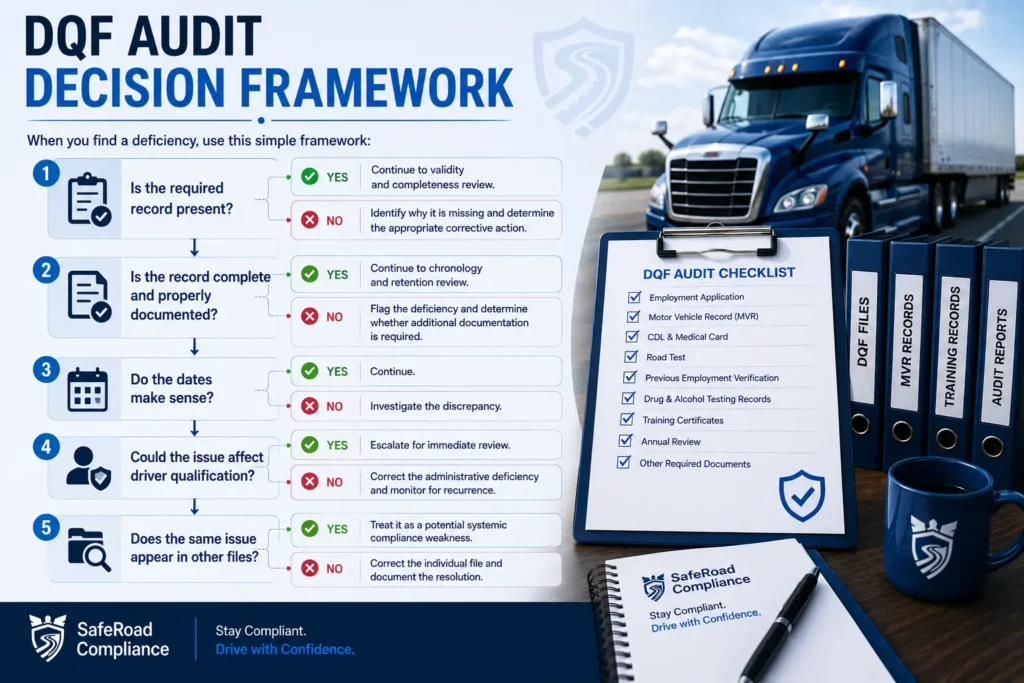
DQF Audit Decision Framework
When you find a deficiency, use this simple framework:
When a DQF Audit Reveals Multiple Problems
Finding several deficiencies does not necessarily mean the entire driver qualification program has failed.
Instead, categorize the findings.
Category 1: Missing Evidence
The carrier may have completed the required process but cannot produce sufficient documentation.
Category 2: Process Failure
The carrier did not consistently complete the required qualification or review step.
Category 3: Recordkeeping Failure
The process was completed, but records were not properly maintained.
Category 4: Potential Qualification Concern
The documentation raises a question about whether the driver met the applicable qualification requirements.
The fourth category deserves the most immediate attention because it can involve the driver’s actual qualification status rather than simply file organization.
Preparing DQ Files for an FMCSA Audit
A carrier preparing for an FMCSA audit should be able to retrieve DQFs efficiently and explain how its qualification system works.
Reviewers should be able to answer:
- Where are driver files stored?
- Who is responsible for reviewing them?
- How are annual requirements tracked?
- How are missing documents identified?
- How are corrections documented?
- How does management verify compliance?
- How are records protected and retained?
A strong compliance program is easier to defend when the carrier can demonstrate a repeatable process, rather than relying on individual employees’ memory.
For broader preparation, carriers can also review the driver qualification violations guide to understand common areas where DQF deficiencies can lead to compliance problems.
DQ File Audit: Final Compliance Framework
DQF Audit Worksheet
For a practical DQ file audit, use a simple worksheet that records the status of each requirement and the action needed.
| Audit Area | Status | Finding | Corrective Action |
|---|---|---|---|
| Employment application | Complete / Missing | Identify deficiency | Correct or obtain documentation |
| MVR | Complete / Missing | Check date and content | Obtain/review as applicable |
| Annual MVR review | Complete / Missing | Review documentation | Complete required process/documentation |
| Road test/equivalent | Complete / Missing | Verify qualification evidence | Correct file |
| Medical qualification | Current / Issue | Check applicable documentation | Resolve qualification issue |
| Previous-employer inquiry | Complete / Missing | Check required evidence | Investigate and document |
| Safety-performance history | Complete / Missing | Review supporting records | Correct deficiency |
| Signatures/certifications | Complete / Missing | Identify unsigned records | Obtain appropriate documentation |
| Retention | Compliant / Issue | Check record age | Correct retention process |
| Chronology | Consistent / Issue | Identify date conflict | Investigate discrepancy |
The purpose of the worksheet is not simply to mark documents as “present” or “missing.” It should help the carrier determine what the deficiency is, why it occurred, and what needs to happen next.
How to Correct DQ File Deficiencies
Once an audit identifies a problem, avoid making undocumented changes simply to make the file appear complete.
Instead, follow a controlled corrective-action process.
Step 1: Identify the Exact Deficiency
Write down what is missing or incorrect.
For example:
“Required annual review documentation could not be located for the applicable review period.”
This is more useful than simply writing “DQF incomplete.”
Step 2: Determine the Root Cause
Ask why the deficiency occurred.
Possible causes include:
- Employee oversight
- Poor onboarding workflow
- Missing reminder system
- Incorrect filing
- Inconsistent procedures
- Employee turnover
- Lack of management review
Step 3: Determine the Appropriate Correction
The corrective action should address the actual problem.
Do not create a backdated record simply because an audit revealed that an earlier document is missing.
If the underlying event occurred but evidence cannot be located, document the situation appropriately and determine what corrective steps are permissible under the applicable requirements.
Step 4: Check Other Driver Files
This is one of the most important steps.
If the deficiency resulted from a company-wide process, review additional DQFs to determine whether the same problem exists elsewhere.
Step 5: Document the Resolution
Record what was reviewed, what was found, what action was taken, and when the corrective action was completed.
Step 6: Re-Audit
After correcting the process, conduct a follow-up review.
The goal is not merely to close one finding. The goal is to prevent the same finding from appearing again.
DQF Evidence: What Makes a File Audit-Ready?
An audit-ready DQF should allow an independent reviewer to understand the driver’s qualification without having to reconstruct the carrier’s process from scattered information.
Strong evidence is generally:
- Complete – required records are available.
- Accurate – information matches the underlying records.
- Current – applicable recurring requirements are monitored.
- Chronological – dates establish a logical sequence.
- Traceable – the carrier can identify who completed required reviews.
- Organized – documents can be retrieved efficiently.
- Retained – records are maintained for the applicable regulatory period.
The exact retention period depends on the specific record and applicable FMCSA requirement, so carriers should verify retention requirements rather than applying one blanket period to every DQF document.
DQF Audit vs. Routine DQF Review
These two activities are related but serve different purposes.
| DQF Activity | Primary Purpose |
|---|---|
| Routine DQF review | Maintain ongoing compliance |
| Internal DQF audit | Test whether the overall process is working |
| Pre-audit review | Identify weaknesses before an external review |
| Corrective-action review | Verify previously identified issues were resolved |
A carrier should ideally use all four.
Routine maintenance keeps files current, while periodic audits test whether the underlying compliance system is actually functioning.
Compliance Checklist: Final DQF Audit
Before closing an internal driver file audit, confirm:
File Completeness
- Applicable DQF records are present.
- Required hiring documentation is complete.
- Required driving-record documentation is available.
- Applicable qualification evidence is present.
- Required previous-employer documentation is maintained.
Accuracy
- Driver identity matches across records.
- License information is consistent.
- Dates are logical.
- No unexplained contradictions exist.
Qualification
- Applicable medical qualification requirements have been addressed.
- Road-test or equivalent qualification evidence is available where required.
- Required reviews have been completed.
- Potential qualification concerns have been escalated.
Recordkeeping
- Required signatures/certifications are present.
- Applicable retention requirements are being followed.
- Records are organized and easily retrievable.
- Corrective actions are documented.
Management Controls
- The audit was documented.
- Findings were assigned a severity.
- Corrective actions have an owner.
- Completion dates are tracked.
- Systemic issues were investigated.
- Corrected files are re-audited.
Expert Recommendation: Audit by Risk, Not Just by Document
A common mistake is to treat every missing document as equally important.
A better approach is risk-based auditing.
Start with deficiencies that could potentially affect whether the driver is qualified to operate.
Then address documentation weaknesses, recurring review problems, and administrative issues.
For larger fleets, consider combining:
100% automated document checks + targeted human review + periodic sample audits.
This allows the carrier to monitor routine requirements without requiring compliance personnel to manually inspect every document every day.
How Often Should You Audit DQ Files?
There is no single universal internal-audit schedule that applies to every carrier.
The appropriate frequency depends on factors such as:
- Fleet size
- Driver turnover
- Compliance history
- Number of locations
- Staffing
- Document-management system
- Previous audit findings
- Complexity of operations
A carrier with frequent driver turnover may benefit from more frequent sampling than a small operation with a stable workforce.
The important principle is consistency.
Don’t perform a DQF audit only when an FMCSA audit is approaching.
A Simple Monthly DQF Monitoring System
Carriers looking for a practical starting point can divide monitoring into four activities:
Week 1: New-Hire Review
Review recently created DQFs for completeness and qualification evidence.
Week 2: Expiration Review
Identify records requiring upcoming action or review.
Week 3: Random File Audit
Select a sample of existing drivers and perform a complete DQF audit.
Week 4: Corrective-Action Review
Confirm that previously identified deficiencies were corrected and that recurring problems are being addressed.
This creates a continuous compliance cycle instead of a one-time audit.
Expert Tips From SafeRoad Compliance
At SafeRoad Compliance, we recommend treating driver qualification as an ongoing operational process, not simply a hiring requirement.
A few practical controls can make a significant difference:
Keep Qualification and Monitoring Connected
Don’t create the DQF and forget about it.
The same system should help your team identify recurring reviews, expiring documentation, and outstanding compliance tasks.
Use Standardized File Naming
For digital DQFs, consistent naming makes retrieval easier.
For example:
Driver Name → Qualification → Document Type → Date
This can reduce confusion when multiple employees access driver records.
Separate “Missing” From “Needs Review”
A missing document and a document that requires validation are different problems.
Your audit worksheet should distinguish between them.
Track Ownership
Every deficiency should have someone responsible for resolving it.
An audit finding without an assigned owner can remain unresolved indefinitely.
Look for Patterns
If several drivers have the same deficiency, stop treating each file independently.
Investigate the workflow that produced the problem.
When to Consider Professional DQF Support
An internal review may be enough for a small number of straightforward files.
Professional assistance can be useful when:
- You are preparing for an FMCSA audit.
- Your fleet has accumulated multiple DQF deficiencies.
- Driver turnover is high.
- Files are spread across multiple locations.
- Your company recently acquired another fleet.
- You have discovered recurring documentation problems.
- You are unsure whether your current DQF process is complete.
A third-party review can provide an outside perspective and help identify gaps that internal staff may overlook because they are accustomed to the existing workflow.
Conclusion
A proper DQ file audit is not simply a document checklist.
It is a structured examination of whether the carrier can demonstrate that its drivers were properly qualified, that required reviews were completed, and that the supporting records have been maintained appropriately.
The strongest audit process checks completeness, validity, chronology, signatures, consistency, retention, and evidence.
Most importantly, use audit findings to improve the underlying process. If the same deficiency appears across multiple driver files, correcting individual documents is not enough, the carrier should address the system that caused the problem.
For carriers preparing for an FMCSA review, regular DQF audits can provide an additional layer of compliance control and help identify documentation weaknesses before they become larger problems.
FAQs
A DQ file audit is a systematic review of a driver’s qualification records to determine whether the carrier has maintained the documentation required to establish and monitor the driver’s qualification.
Review applicable employment, driving-record, medical qualification, road-test or equivalent, previous-employer, annual review, certification, signature, chronology, and retention requirements.
The exact documents required depend on the driver’s circumstances and applicable regulations.
Start by determining whether the issue could affect the driver’s qualification. Potential qualification concerns should receive higher priority than administrative or organizational issues.
First determine whether the document exists elsewhere or whether the underlying compliance activity was actually completed. Do not simply create or backdate records to make an incomplete file appear compliant.
There is no single internal audit frequency appropriate for every carrier. Fleet size, driver turnover, compliance history, and operational complexity should influence the schedule. Regular sampling throughout the year is preferable to waiting for an external audit.
Not necessarily. Applicable requirements can vary based on the driver’s circumstances, operation, and exemptions. Use the applicable FMCSA requirements rather than assuming every file must contain an identical document set.
A routine DQF review helps maintain an individual driver’s records. An internal DQF audit evaluates whether the carrier’s broader qualification and recordkeeping process is consistently working.
Yes. SafeRoad Compliance can help carriers review driver qualification documentation, identify compliance gaps, and strengthen their overall DOT compliance processes before deficiencies become larger operational issues.