Disclosure: Informational only. We are not FMCSA or USDOT. Always verify your status directly through official FMCSA systems.
A single text at a red light can cost a commercial driver more than a ticket. Under FMCSA rules, it can add a maximum-weight violation to the carrier’s safety data and, if it happens again, take the driver off the road.
What Are the FMCSA Distracted Driving Rules for Commercial Drivers?
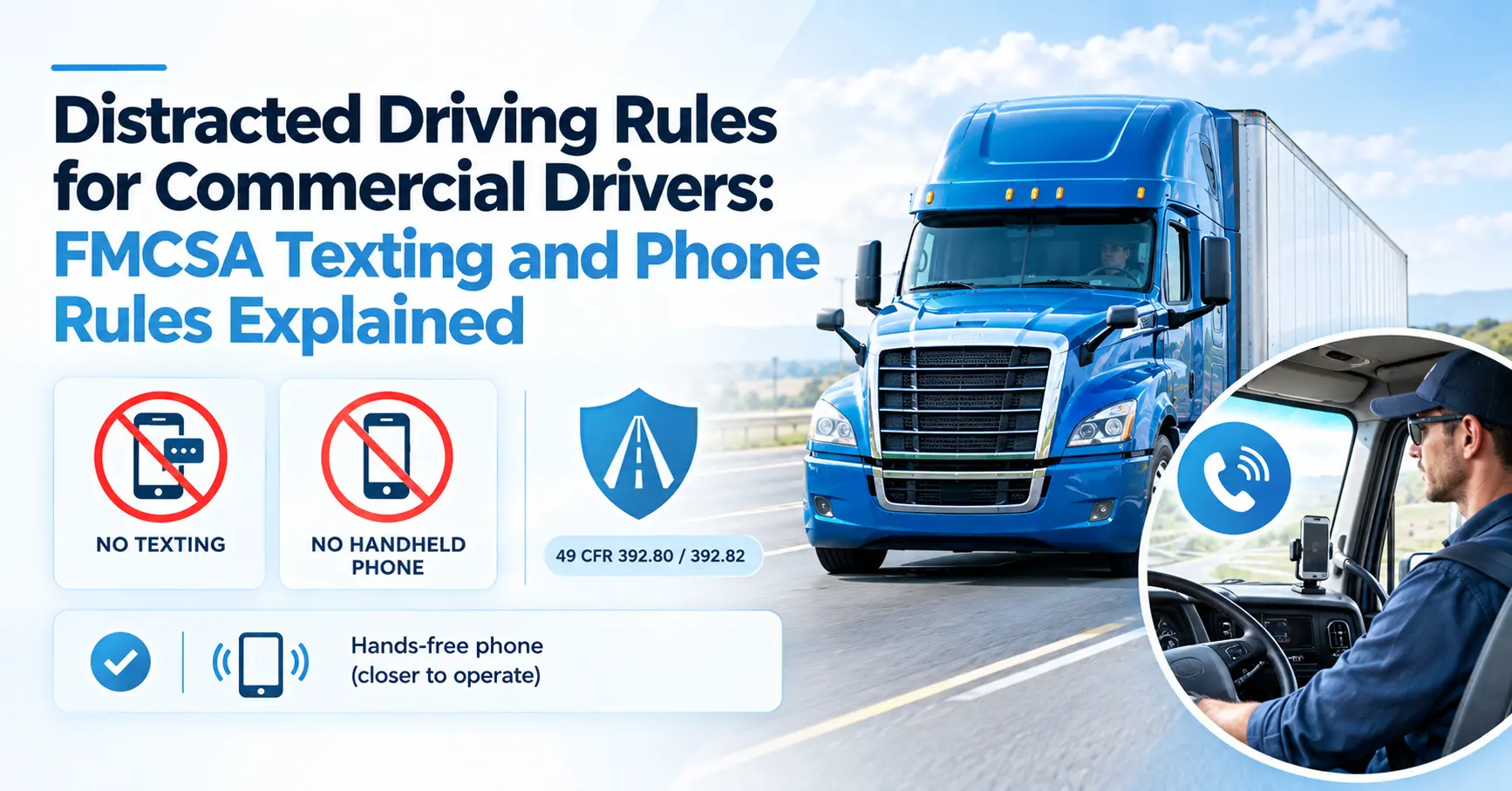
FMCSA bans commercial motor vehicle (CMV) drivers from texting while driving (49 CFR 392.80) and from using a hand-held mobile phone while driving (49 CFR 392.82). “Driving” includes sitting in traffic or at a red light with the engine running.
Drivers may use a hands-free phone within close reach and may press a single button to start or end a call. Carriers may not allow or require either violation. Both carry the maximum severity weight of 10 in FMCSA’s Safety Measurement System, and repeat convictions lead to disqualification.
These are not general distracted-driving tips. They are two specific federal rules with defined terms, a narrow emergency exception, and consequences that reach the driver’s record, the carrier’s CSA data, and the driver’s ability to keep driving. This guide explains each rule, how a violation travels into the carrier’s safety data, and what fleets can do to prevent it.
The FMCSA Texting Rule (49 CFR 392.80)
Under 49 CFR 392.80, no driver may text while driving a CMV, and no motor carrier may allow or require it. FMCSA issued the rule in September 2010.
FMCSA’s reasoning comes from its own research. In its No Texting Rule fact sheet, FMCSA reports that CMV drivers who text have 23.2 times greater odds of a safety-critical event, such as a crash, near-crash, or unintended lane departure, and take their eyes off the road for an average of 4.6 seconds. At 55 mph, that is about 371 feet driven without looking.
What counts as texting. 49 CFR 390.5 defines texting as manually entering text into, or reading text from, an electronic device. That includes:
- Text messages, email, and instant messages
- Requesting or reading a web page
- Pressing more than one button to start or end a phone call
- Any other manual text entry or retrieval, for now or later
What does not count as texting:
- Entering, selecting, or reading information on a GPS or navigation system
- Pressing a single button to start or end a call
- Using a multi-function device, such as a fleet management system, dispatch device, smartphone, CB radio, or music player, for a purpose the rules do not otherwise prohibit
What “driving” means here. Operating a CMV with the motor running, including while temporarily stopped for traffic, a traffic control device, or another momentary delay. It does not include a CMV pulled to the side of or off the highway and stopped where it can safely stay.
The only exception. Texting is allowed when needed to contact law enforcement or emergency services.
Read the multi-function device exclusion carefully. It covers using a device “for a purpose that is not otherwise prohibited,” and reading text is prohibited. So reading a load message on a dispatch tablet while rolling still fits the definition of texting. Navigation information is the carve-out, not dispatch messages.
The FMCSA Hand-Held Phone Rule (49 CFR 392.82)
Under 49 CFR 392.82, no driver may use a hand-held mobile phone while driving a CMV, and no carrier may allow or require it. FMCSA announced the final rule in November 2011.
What “use a hand-held mobile telephone” means under 49 CFR 390.5:
- Holding a mobile phone in at least one hand to talk
- Dialing or answering by pressing more than a single button
- Reaching for a phone in a way that takes you out of a seated driving position, restrained by a properly installed and adjusted seat belt
The third item is easy to overlook. A phone on the passenger seat or in a cup holder you have to lean over for can be a violation even if you never hold it to your ear.
What is allowed:
- ✓ A hands-free or voice-activated call
- ✓ A phone mounted close to the driver
- ✓ Pressing one button to answer or end a call
- ✓ Reaching for a phone without leaving your belted seat
- × Holding the phone to talk
- × Dialing a number by hand
- × Pressing more than one button to answer or end a call
- × Leaning or unbuckling to reach the phone
The definition of mobile phone excludes two-way and CB radio, so the hand-held rule does not cover CB use.
“Driving” and the exception work the same way as the texting rule: being stopped temporarily in traffic still counts, pulling off to a safe spot does not, and calls to law enforcement or emergency services are allowed. FMCSA’s mobile phone fact sheet summarizes the rule for drivers.
Who the Rules Cover and Who Is Responsible
The FMCSA texting and hand-held phone rules apply to drivers of CMVs in interstate commerce, and to the motor carriers that employ them. Related rules extend similar limits to intrastate hazmat drivers and to every CDL holder through state law.
| Who Is Covered? | How the Rules Apply |
|---|---|
|
↔
Interstate CMV Drivers
|
Federal restrictions under 49 CFR 392.80 and 49 CFR 392.82 apply to covered drivers, whether or not a CDL is required. The applicable CMV definition and exceptions matter. |
|
▣
Motor Carriers
|
Carriers may not allow or require drivers to text or use a hand-held mobile telephone in violation of 392.80(b) and 392.82(a)(2). |
|
⚠
Intrastate Hazmat Drivers
|
Applicable hazardous materials transportation requirements may also apply under PHMSA regulations, including 49 CFR 177.804. |
|
▤
CDL Holders
|
For CDL disqualification purposes, qualifying state-law convictions for texting or hand-held mobile phone use while operating a CMV can count as serious traffic violations under 49 CFR 383.51. |
|
✓
Owner-Operators
|
An owner-operator who is both the driver and motor carrier must comply with the applicable driver restrictions and carrier prohibitions. |
For carriers, “allow” is the word that matters. A dispatch practice that expects drivers to answer calls or messages immediately could be read as allowing phone use, even if no one ever told a driver to text. That is why the policy and dispatch practices later in this guide count as much as driver training.
Intrastate-only carriers should also check their state’s own rules. Many states restrict phone use by all drivers, and state rules for intrastate CMVs may mirror the federal ones.
From Behavior to Violation to CSA Impact
A phone violation travels down two tracks at once. The inspection report feeds the carrier’s CSA data, and the citation or conviction follows the driver.
[embed: node/45ab2888-44d7]
- Behavior. The driver texts or uses a hand-held phone while the CMV is being driven, including at a stop light.
- Roadside violation. An officer records 392.80 or 392.82 on the inspection report, which is uploaded to FMCSA.
- Carrier CSA data. The violation counts in the carrier’s Unsafe Driving BASIC at the maximum severity weight, multiplied by a time weight for up to 24 months. See how CSA scores work.
- Citation and conviction. The driver may get a state ticket, and FMCSA can assess civil penalties. The inspection violation also appears on the driver’s PSP record for three years.
- Disqualification. Repeat convictions take the driver out of a CMV for 60 or 120 days.
The carrier track does not wait for a conviction. The inspection violation counts in SMS when it is recorded, unless it is later removed or changed through DataQs.
Penalties and Disqualification
Phone violations have their own disqualification rule in Part 391, on top of the CDL serious-violation rules. Penalties hit the driver and the carrier separately.
Federal civil penalties. When FMCSA issued the rules, it set maximum civil penalties of $2,750 per offense for drivers and $11,000 for carriers that allow or require the behavior (FMCSA). Civil penalty maximums are adjusted for inflation, so check the current figures in 49 CFR Part 386, Appendix B before quoting a number.
FMCSA disqualification. Under 49 CFR 391.15, a driver convicted of violating 392.80 or 392.82 is disqualified from driving a CMV:
| Convictions in Separate Incidents Within 3 Years | Disqualification |
|---|---|
| Second | 60 days |
| Third or more | 120 days |
This rule applies to CMV drivers whether or not they hold a CDL.
CDL disqualification. For CDL holders, violating a state or local law that bans texting or restricts hand-held phone use while driving a CMV is a serious traffic violation under 49 CFR 383.51. Two serious traffic violations in three years bring a 60-day disqualification, and three bring 120 days. These count together with other serious violations such as excessive speeding.
State penalties. State fines and points vary. A driver can face a state ticket and a federal violation for the same event.
How Phone Violations Show Up in SMS
Every texting and hand-held phone violation code carries a severity weight of 10 in the Unsafe Driving BASIC, the top of FMCSA’s 1 to 10 scale. Only a few other Unsafe Driving violations, such as speeding 15 mph or more over the limit, carry the same weight.
| Code | Description | Group | Severity Weight |
|---|---|---|---|
| 392.80(a) | Driving a CMV while texting | Texting | 10 |
| 392.82(a)(1) | Using a hand-held mobile telephone while operating a CMV | Phone call | 10 |
| 392.82(a)(2) | Allowing or requiring a driver to use a hand-held mobile telephone while operating a CMV | Phone call | 10 |
| 392.2-SLLT | State/local law: operating a CMV while texting | Texting | 10 |
| 177.804B | Hazmat: failure to comply with 392.80 (texting) | Texting | 10 |
| 177.804C | Hazmat: failure to comply with 392.82 (hand-held phone) | Phone call | 10 |
Source: SMS Appendix A, Unsafe Driving BASIC violation table (Table A-1). Confirm codes against your own SMS profile, since FMCSA adds and adjusts codes over time.
What that weight means in practice:
- A recent violation counts 30. SMS multiplies the severity weight by a time weight of 3 for violations in the past 6 months, 2 for 6 to 12 months, and 1 for 12 to 24 months.
- One inspection is capped. Severity weights from a single inspection in one BASIC are capped at 30, so stacking a texting and a hand-held violation on the same report does not double the hit.
- No fixed score change. How much one violation moves a carrier’s percentile depends on fleet size, mileage, and peer carriers. For the full picture of this category, see our guide to FMCSA unsafe driving violations.
FMCSA has approved changes to the SMS methodology that will replace the 1 to 10 severity scale. Until those take effect, the weights above apply.
Fleet Controls That Prevent Phone Violations
The legal duty is simple: do not allow or require texting or hand-held phone use. The controls below are best practices that show a carrier is not “allowing” it, and they target common work reasons drivers pick up a phone: dispatch, load updates, and navigation.
- Write a phone policy tied to the rules. Quote 392.80 and 392.82, define “driving” the way FMCSA does (including at stop lights), and state the one-button limit. Have every driver sign it.
- Fix dispatch expectations. Tell dispatchers not to expect replies from a moving truck. Use the ELD’s driving status to see when a driver can respond, and route messages for when the truck is parked.
- Equip every cab for hands-free. Provide a phone mount within reach of the belted driver and a headset or Bluetooth connection. A phone the driver has to lean for is a violation waiting to happen.
- Set up navigation before rolling. GPS input is not texting, but routing changes on a phone in the driver’s hand can still become hand-held use. Make route entry part of the pre-trip.
- Use technology where it fits. Some fleets use in-cab cameras or apps that detect or limit phone use while moving. Treat these as coaching tools, and check state privacy rules before recording drivers.
- Screen at hiring. Check each applicant’s PSP record and MVR for prior phone violations. A driver with one conviction is one more away from a 60-day disqualification.
- Coach, then discipline. Review every roadside phone violation with the driver, document it, and apply the same consequences each time.
- Challenge errors. If an inspection report records a phone violation that did not happen, such as a single-button answer or a parked truck, file a DataQs request with any supporting evidence.
Keep Phone Violations Out of Your Safety Data
A phone violation is one of the fastest ways to add maximum-weight points to an Unsafe Driving BASIC, and one of the most preventable. SafeRoad Compliance helps owner-operators and small fleets write driver safety policies, monitor CSA data, review roadside inspections, and file DataQs challenges when a violation is recorded in error, as part of our DOT compliance services. If you want a second look at your Unsafe Driving data, contact SafeRoad Compliance.
This article is general information about federal motor carrier rules. It is not legal advice. State laws on phone use vary, so check the rules in the states you run.
Don’t Let Compliance
Slow Your Business Down.
Stay organized, keep required records current, and stay ahead of important DOT compliance requirements with professional support.
Distracted Driving FAQ
No, not hand-held. Both FMCSA rules count a CMV that is temporarily stopped for traffic or a signal as being driven. Hands-free use is allowed.
Yes. Hands-free calling is allowed, as long as the phone is within reach without leaving the belted seat and the driver presses no more than one button to start or end the call.
No. Entering, selecting, or reading navigation information is excluded from the definition of texting. Holding the phone to do it can still be a hand-held phone violation.
No. Reading text from an electronic device while driving is texting under FMCSA’s definition, even on a fleet device.
FMCSA originally set maximum civil penalties of $2,750 for drivers and $11,000 for carriers. These maximums are adjusted for inflation; check 49 CFR Part 386, Appendix B for current amounts. State fines are separate.
Texting and hand-held phone violations carry a severity weight of 10, the highest in the Unsafe Driving BASIC. A violation in the past 6 months counts 30 after the time weight.
Yes. A second conviction within three years leads to a 60-day disqualification, and a third leads to 120 days.
No. Once the truck is pulled to the side of or off the road and stopped where it can safely stay, the driver is not “driving” under either rule.