Disclosure: Informational only. We are not FMCSA or USDOT. Always verify your status directly through official FMCSA systems.
Driver safety training is more than a general employee development activity for commercial motor carriers. A structured driver safety training program can address specific compliance risks such as unsafe driving, fatigue, vehicle inspection failures, and hours-of-service violations.
For carriers, the goal is to connect training topics to actual operating risks and create evidence that drivers received appropriate instruction.
What Is Driver Safety Training?
Driver safety training is a structured process for teaching commercial drivers how to operate safely while following applicable DOT and FMCSA requirements.
For a motor carrier, effective training should be connected to the risks identified in daily operations, driver records, inspections, crashes, HOS data, and other compliance information.
Common training areas include:
- Defensive driving
- Speed and following-distance management
- Distracted driving prevention
- Fatigue awareness
- Hours-of-service compliance
- Pre-trip and post-trip inspections
- Vehicle defect reporting
- Cargo securement awareness
- ELD operation
- Accident prevention and response
- Safe backing and maneuvering
The specific training required depends on the carrier’s operation, drivers, vehicles, and applicable regulations.
Why Driver Safety Training Matters for Compliance
Driver behavior can directly affect a carrier’s safety performance and compliance exposure.
A driver who routinely speeds, exceeds available driving time, skips required inspections, or fails to report vehicle defects can create multiple operational risks.
Training provides a way to address those risks before they become recurring violations or safety events.
A practical training program should therefore answer three questions:
- What compliance or safety risk exists?
- What driver behavior needs to change?
- How will the carrier verify that the training was completed and understood?
This makes training part of the carrier’s broader safety management process rather than an isolated annual activity.
Driver Safety Risks That Training Can Address
Unsafe Driving
Unsafe driving behavior can include speeding, aggressive driving, improper lane changes, following too closely, distracted driving, and other behaviors that increase crash risk.
Training should focus on the specific behaviors identified through:
- Driver monitoring
- Crash records
- Roadside inspection findings
- Internal observations
- Telematics or camera data
- Safety complaints
- Company incident reports
Instead of giving every driver the same generic presentation, carriers can use identified risk patterns to determine where additional training is needed.
Fatigue and Drowsy Driving
Fatigue can affect reaction time, attention, decision-making, and overall driving performance.
Driver training should reinforce the relationship between adequate rest, HOS compliance, scheduling, and safe operation.
Training may cover:
- Recognizing fatigue symptoms
- Planning adequate rest
- Understanding available driving and on-duty time
- Avoiding pressure to continue driving when fatigued
- Proper use of sleeper-berth provisions when applicable
- Reporting fatigue-related concerns
Training should complement the carrier’s HOS management process rather than replace it.
Hours-of-Service Compliance
HOS violations can result from misunderstanding the rules, poor trip planning, incorrect duty-status changes, or improper use of an ELD.
Training can address:
- Driving limits
- On-duty limits
- Required off-duty periods
- The 14-hour window
- The 30-minute break requirement
- Sleeper-berth provisions
- ELD duty-status changes
- Personal conveyance policies
- Supporting documentation
The training should reflect the HOS rules that actually apply to the carrier’s operation.
Vehicle Inspection and Defect Reporting
Drivers play an important role in identifying vehicle conditions that may require attention.
Training should explain:
- What drivers should inspect
- How to identify obvious defects
- How to document defects
- When a defect should be reported
- How maintenance issues are communicated
- Why drivers should not ignore safety-related equipment problems
The objective is to connect driver inspection responsibilities with the carrier’s maintenance and corrective-action process.
Distracted Driving
Distracted driving training should address behaviors that can take a driver’s attention away from the roadway.
Depending on the carrier’s operation, training may address:
- Mobile-device use
- Texting
- Navigation-device interaction
- Eating or drinking while driving
- Adjusting equipment while moving
- Other activities that reduce attention
A written company policy should support the training so drivers understand both the safety expectation and the carrier’s operating procedures.
Need Help With DOT Compliance?
Get reliable guidance and support to keep your DOT compliance on track.
Build Training Around Measurable Compliance Risks
A strong commercial driver training program starts with actual risk data.
For example:
| Risk Identified | Training Response | Verification |
|---|---|---|
| Repeated speeding events | Speed-management training | Follow-up monitoring |
| HOS violations | HOS and ELD refresher | Log review |
| Inspection violations | Inspection training | Roadside/internal inspection review |
| Preventable backing incidents | Backing and maneuvering training | Incident tracking |
| Fatigue-related concerns | Fatigue-awareness training | HOS and incident monitoring |
| Repeated vehicle defects | Defect identification/reporting training | Maintenance record review |
This approach makes training more relevant because the carrier can connect the training activity to a documented operational problem.
How Fleet Safety Training Can Reduce Recurring Problems
Training is most useful when it is part of a continuous process.
A carrier can use the following cycle:
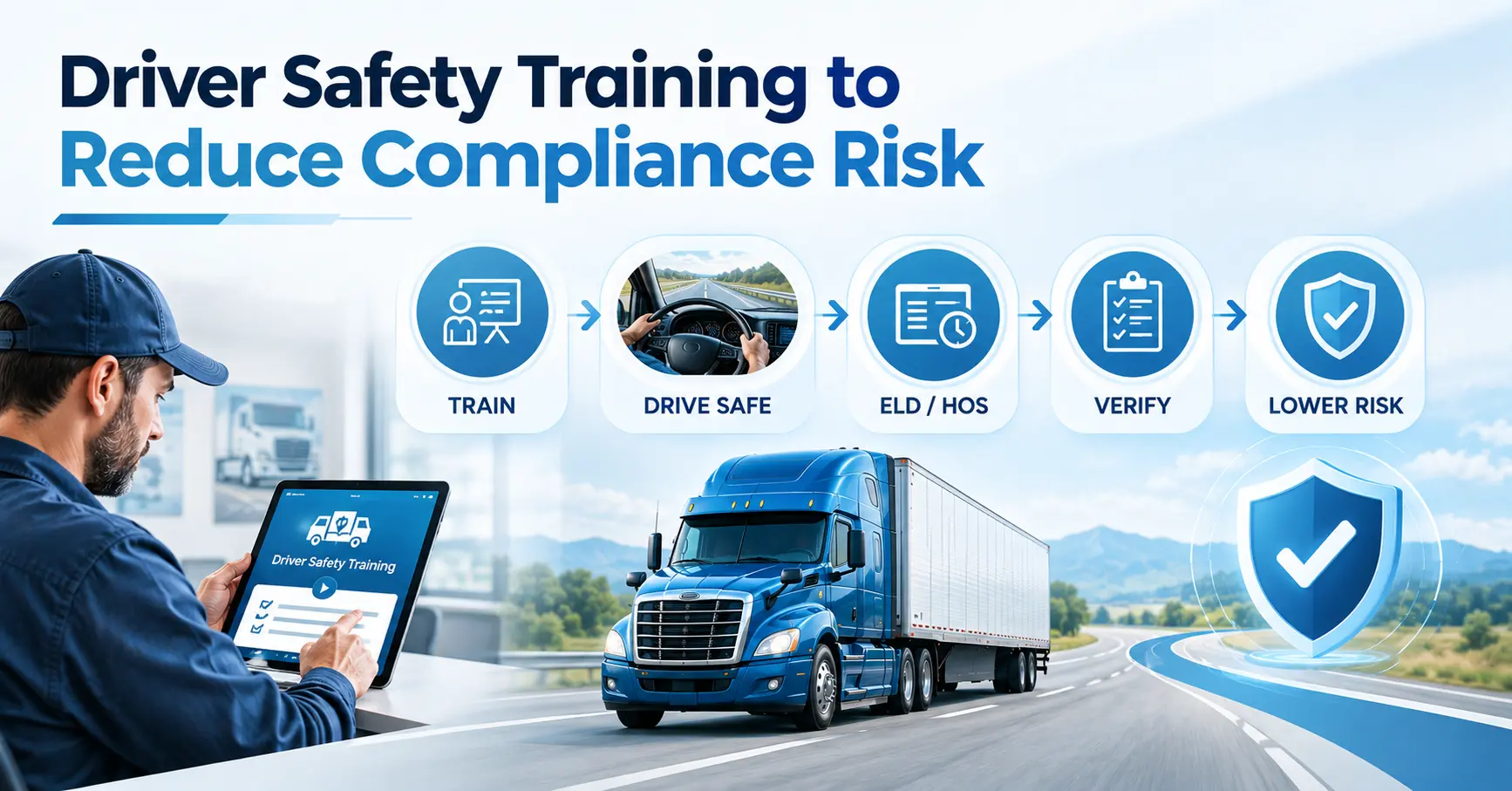
Identify → Train → Verify → Monitor → Correct
1. Identify
Review available safety and compliance information to determine where a driver or fleet has recurring problems.
2. Train
Provide targeted instruction addressing the specific behavior or compliance requirement.
3. Verify
Document completion and, where appropriate, confirm that the driver understands the relevant procedure.
4. Monitor
Review subsequent performance to determine whether the problem continues.
5. Correct
Provide additional coaching, retraining, or other appropriate corrective action when the risk remains.
This creates a documented feedback loop instead of treating training as a one-time event.
What Should Be Included in a Driver Safety Training Program?
The exact program should reflect the carrier’s operation, but a practical framework can include:
Safety Driving
Cover defensive driving, speed management, following distance, lane discipline, safe turns, backing, and hazard recognition.
Fatigue Management
Teach drivers how fatigue affects safe operation and how scheduling and HOS compliance support alert driving.
HOS and ELD
Make sure drivers understand the applicable HOS requirements and how to accurately use the carrier’s ELD procedures.
Vehicle Inspections
Train drivers on applicable inspection responsibilities, defect identification, and reporting procedures.
Incident Response
Explain what drivers should do after a crash, roadside inspection, vehicle breakdown, or other safety-related event.
Company Policies
Connect regulatory requirements with the carrier’s internal policies and escalation procedures.
Training Documentation Matters
Completing training is only one part of the process. The carrier should also maintain appropriate evidence that the training occurred.
Depending on the training program, records may include:
- Driver name
- Training date
- Training topic
- Reason for training
- Trainer or training provider
- Training materials
- Completion confirmation
- Assessment or acknowledgment, when used
- Follow-up or corrective-action notes
Records should be organized according to the carrier’s applicable recordkeeping requirements and internal compliance procedures.
The purpose is not simply to create paperwork. Documentation helps the carrier demonstrate what training was provided and when it occurred.
When Should a Driver Receive Additional Training?
Additional training may be appropriate when a carrier identifies a recurring or significant safety concern.
Potential triggers include:
- A preventable crash
- Repeated speeding events
- HOS violations
- Repeated inspection violations
- Unsafe driving observations
- Repeated vehicle inspection problems
- ELD-related errors
- A change in operating procedures
- Introduction of new equipment
- A significant change in the driver’s responsibilities
Training should be based on the actual risk rather than automatically assigning the same course to every driver.
Driver Safety Training and CSA Risk
Driver training can support a carrier’s broader safety-management efforts, but training by itself does not guarantee a lower CSA score or eliminate violations.
A more useful approach is to identify the behaviors contributing to safety concerns, address them through appropriate training, and then monitor whether driver performance changes.
For example, if a carrier identifies repeated unsafe-driving events, the response could include:
Risk identification → Driver review → Targeted training → Performance monitoring → Follow-up
This creates a connection between training and measurable operational behavior.
How to Measure Training Effectiveness
A carrier should evaluate whether training actually changes driver behavior.
Useful measures can include:
- Number of preventable incidents
- Unsafe-driving events
- HOS violations
- Roadside inspection findings
- Vehicle defect trends
- ELD-related errors
- Driver coaching events
- Repeat violations after training
For example, if a driver receives training after repeated HOS errors, the carrier can review subsequent logs to determine whether the same type of error continues.
Training effectiveness should therefore be measured through post-training performance, not simply course completion.
Driver Safety Training vs. Generic Driver Orientation
Driver orientation introduces a driver to the company’s policies, procedures, equipment, and expectations.
Safety training focuses more specifically on developing or correcting behaviors related to safe operation and compliance.
A carrier may use both:
Driver onboarding → Safety orientation → Role-specific training → Risk-based refresher training → Ongoing monitoring
This structure helps prevent safety training from becoming a one-time event during onboarding.
A Practical Driver Safety Training Checklist
Before considering a training program complete, carriers can verify:
- Training topics match identified safety risks
- Drivers receive applicable HOS and ELD instruction
- Fatigue risks are addressed
- Vehicle inspection responsibilities are covered
- Unsafe-driving behaviors are addressed
- Company safety policies are explained
- Training completion is documented
- Follow-up monitoring is defined
- Recurring problems trigger additional review
- Training records are organized and accessible
Conclusion
Effective driver safety training connects driver behavior with specific compliance and operational risks.
Targeted training, documentation, and follow-up monitoring can help carriers address recurring safety issues before they become larger compliance problems.
SafeRoad Compliance provides a DOT compliance service to help carriers organize and manage their ongoing compliance responsibilities.
Need Help With DOT Compliance?
Get reliable guidance and support to keep your DOT compliance on track.
Frequently Asked Questions
Driver safety training teaches commercial drivers how to operate safely while following applicable DOT, FMCSA, and company requirements. It can address risks such as unsafe driving, fatigue, HOS violations, vehicle inspections, and distracted driving.
Driver safety training helps carriers address specific driver behaviors that may create safety or compliance risks. Training can be especially useful when combined with monitoring, documentation, and follow-up.
Commercial driver training may cover defensive driving, fatigue awareness, HOS and ELD procedures, vehicle inspections, distracted driving, accident prevention, backing, and company safety policies.
Targeted training can help address recurring behaviors associated with compliance problems. Its effectiveness depends on whether the training is relevant to the identified risk and whether the carrier monitors driver performance afterward.
Additional training may be appropriate after preventable incidents, repeated violations, unsafe-driving events, inspection problems, HOS or ELD issues, or changes in equipment or operating procedures.
Training records can include the driver’s name, training date, subject, reason for training, trainer or provider, completion confirmation, and follow-up documentation when applicable.
Fleet safety training can address behaviors associated with safety performance, such as unsafe driving, HOS issues, and inspection problems. Training should be combined with ongoing monitoring rather than treated as a standalone CSA strategy.
A carrier can compare post-training performance with the original risk, such as changes in unsafe-driving events, HOS violations, inspection findings, vehicle defects, or repeat incidents.
No. Driver orientation generally introduces a driver to company procedures and expectations, while safety training focuses more specifically on safe operating practices, risk areas, and corrective or refresher instruction.
FMCSA Driver Safety Guides
For additional guidance on commercial driver training and safe driving practices, refer to these official FMCSA resources:
- FMCSA Safety Programs: Commercial vehicle safety and training resources from the National Training Center.
- FMCSA Driver Resource Hub: Guidance covering CDL requirements, driver training, drug and alcohol testing, medical certification, and safety resources.
- FMCSA Entry-Level Driver Training (ELDT): Official information on federal entry-level driver training requirements.
- FMCSA General Safe Driving Resources: Safety guidance and resources for commercial drivers and motor carriers.