This article is general information about federal regulations. It is not legal advice. Confirm current requirements with FMCSA, the eCFR, and your state enforcement agency.
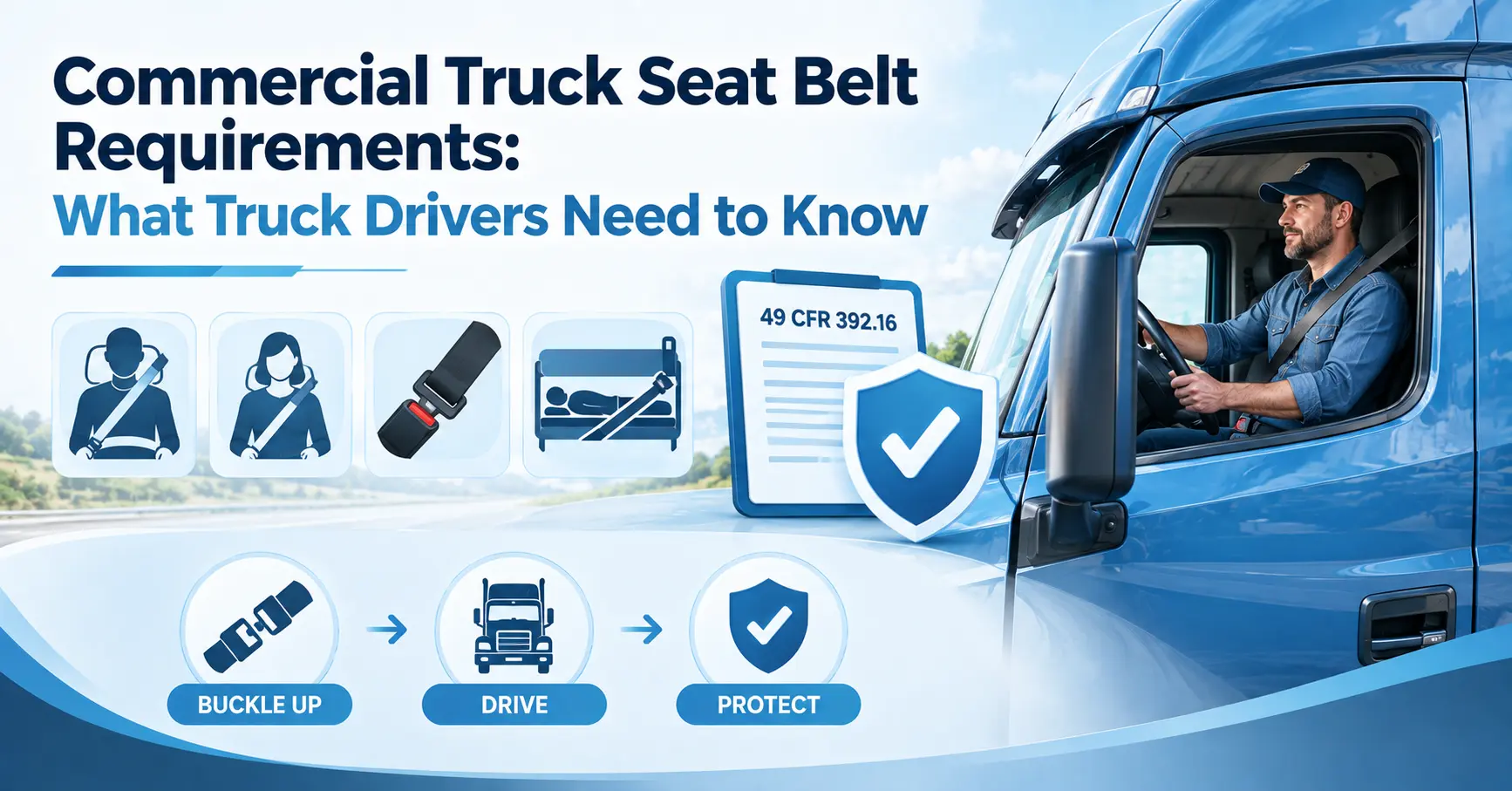
Short answer: Yes. Federal rules require every driver of a commercial motor vehicle (CMV) to wear the seat belt installed at the driver’s seat. In property-carrying trucks, any other occupant sitting in a belted seat must be buckled too. The rule is 49 CFR 392.16, and it binds both the driver and the motor carrier.
Commercial truck seat belt requirements are one of the simplest rules in the Federal Motor Carrier Safety Regulations (FMCSRs). They are also one of the easiest to violate without thinking. A driver who buckles up after pulling out of the yard, or lets a ride-along passenger skip the belt, can pick up a violation at a roadside inspection. That violation lands on the driver’s record and on the carrier’s safety data.
This guide explains what the FMCSA seat belt rule says, who it covers, what equipment trucks must have, how violations are enforced, and how a seat belt citation connects to your CSA data. Every regulatory point below links to the FMCSA or eCFR source it comes from.
Do Commercial Truck Drivers Have to Wear Seat Belts?
Yes. Under 49 CFR 392.16(a), no driver may operate a CMV that has a seat belt installed at the driver’s seat unless the driver is properly restrained by it. The same paragraph bars a motor carrier from requiring or permitting a driver to operate that way.
This is not a new rule. The U.S. Department of Transportation noted in 2016 that federal rules have long required commercial drivers to use seat belts. What changed in 2016 was the addition of passengers, covered below.
In practice, “properly restrained” means the belt is fastened and worn as designed while the truck is being driven. A belt tucked behind the driver’s back, or buckled with no one in it, does not meet the rule.
What Is the FMCSA Seat Belt Rule?
The FMCSA seat belt rule is 49 CFR 392.16, “Use of seat belts.” It sits in Part 392 of the FMCSRs, the part that governs how CMVs are driven. It has two paragraphs:
- 392.16(a), Drivers. The driver must be properly restrained by the seat belt at the driver’s seat. The motor carrier may not require or permit the driver to operate otherwise.
- 392.16(b), Passengers. In a property-carrying CMV, the driver may not operate the truck unless every other occupant in a belted seat is properly restrained. The motor carrier may not require or permit operation otherwise.
The passenger paragraph came from an FMCSA final rule published June 7, 2016 (81 FR 36479), which took effect August 8, 2016. A short correction followed in July 2016. We found no later amendment to the section in the current eCFR as of September 2026.
What counts as a CMV? Under 49 CFR 390.5, a CMV is a vehicle used on a highway in interstate commerce that meets any one of these tests:
- A gross vehicle weight rating or gross combination weight rating (or actual weight) of 10,001 pounds or more
- Designed or used to carry more than 8 passengers, including the driver, for compensation
- Designed or used to carry more than 15 passengers, including the driver, not for compensation
- Used to haul hazardous materials in a quantity that requires placards
That 10,001-pound threshold matters. The seat belt rule reaches many trucks that do not require a CDL, such as a Class 5 box truck or a pickup pulling a heavy trailer in interstate commerce.
Who Must Wear a Seat Belt in a Commercial Truck?
The driver of any CMV with a driver’s seat belt must wear it. In property-carrying CMVs, other occupants in belted seats must wear theirs too. Here is how that plays out by role.
| Who | Required under 392.16? | Notes |
|---|---|---|
| CDL drivers | Yes | The rule turns on operating a CMV, not on holding a CDL. |
| Non-CDL drivers of CMVs | Yes | Applies from 10,001 lbs GVWR in interstate commerce. |
| Company drivers | Yes | The carrier also may not require or permit unbelted driving. |
| Owner-operators | Yes | You are both the driver and, if you run under your own authority, the carrier. |
| Passengers in a property-carrying CMV | Yes, in belted seats | Added by the 2016 final rule. |
| Occupants of a sleeper berth | Not by 392.16(b) | FMCSA left sleeper berth restraint use out of the 2016 rule. |
| Passengers on buses and other passenger-carrying CMVs | Not by 392.16(b) | The passenger paragraph covers property-carrying CMVs only. The driver rule still applies. |
Two points in that table deserve a closer look.
Sleeper berths. In the 2016 final rule, FMCSA explained that sleeper berth restraints serve two purposes: crash protection and helping a resting driver stay in the berth. The agency chose not to hold up the passenger rule while it studied that issue (81 FR 36479). So the 2016 rule does not require a team driver resting in the berth to use its restraint. Using it is still the safer choice.
Buses. The final rule states plainly that it does not require seat belt use by passengers in passenger-carrying CMVs. Bus drivers must still buckle up under 392.16(a), and bus passenger belt use may be covered by state law, but it falls outside 392.16(b).
Passengers need authorization first. Separate from the seat belt rule, 49 CFR 392.60 generally requires written authorization from the carrier before an unauthorized person rides in a CMV. FMCSA pointed to this in 2016: because carriers authorize riders in writing, they know who is in the cab and can set belt expectations up front.
What Are the Seat Belt Requirements for Commercial Trucks?
Commercial truck seat belt rules cover two things: wearing the belt (392.16) and having the right belt installed (393.93). Trucks, truck tractors, and buses built on or after January 1, 1965 must have seat belts, according to FMCSA. The standard a truck must meet depends on when it was built.
| Truck or Tractor Built | Requirement under 49 CFR 393.93(b) |
|---|---|
| Jan 1, 1965 to before July 1, 1971 | Type 1 or Type 2 belt meeting FMVSS 209 at the driver’s seat and the right front outboard seat (if present), with FMVSS 210 anchorages. |
| On or after July 1, 1971 | Must meet FMVSS 208 (belt installation) and FMVSS 210 (anchorages). |
| On or after Jan 1, 1972 | Must also meet FMVSS 207 (seating systems). |
FMVSS stands for Federal Motor Vehicle Safety Standards, the National Highway Traffic Safety Administration’s equipment standards that truck manufacturers build to. For most carriers, this means the belts the truck left the factory with must stay in place and in working order.
A few practical points follow from these rules:
- Belts must work. A cut, frayed, unlatching, or missing belt is an equipment problem, separate from whether the driver wore it. FMCSA’s safety planner lists seats, belt assemblies, anchors, and warning systems among required occupant protection features (Safety Planner 5.1.10).
- Passenger seats need belts too. FMCSA guidance under 393.93 says that if a CMV other than a motorcoach has a passenger seat, a seat belt is required for that seat.
- Sleeper berths need restraints. A truck built on or after July 1, 1971 with a sleeper berth must have an occupant restraint system designed to keep the occupant from being ejected in a crash, under 49 CFR 393.76(h).
- One narrow equipment exception. A truck being moved in a driveaway-towaway operation with an incomplete seating and cab configuration is excepted from the post-1971 belt installation standards in 393.93(b).
- Modified seats. Conformity is judged by the standard in effect on the date of manufacture or the date of modification, whichever is later (393.93(c)). Swapping a seat means the replacement setup still has to meet the applicable standard.
For Hawaii, 393.93(d) set a later compliance date (January 1, 1976) for older trucks built between 1965 and 1971. That detail rarely matters today but explains the exception language in the rule.
Are There Exceptions to the FMCSA Seat Belt Rule?
392.16 itself contains no exceptions for drivers. There is no carve-out for short trips, yard moves on public roads, low speeds, or local delivery routes. The limits on the rule come from its scope and from the general FMCSR exemptions.
Limits built into the rule’s scope:
- No belt installed, no belt violation under 392.16. The rule applies to a seat “that has a seat belt assembly installed.” This is rare in practice, since trucks built since 1965 must have belts under 393.93, and a missing belt is its own equipment violation.
- Passenger paragraph is limited. 392.16(b) covers property-carrying CMVs only, and sleeper berth use was not included in the 2016 rule.
- Interstate commerce. The FMCSRs apply to CMVs in interstate commerce. Intrastate trucking falls under state rules, discussed below.
General FMCSR exemptions. 49 CFR 390.3(f) lists operations that Subchapter B (which includes Part 392) does not apply to, unless another rule says otherwise. Examples include:
- Transportation performed by federal, state, or local government
- Occasional transportation of personal property by individuals not for compensation or in furtherance of a commercial enterprise
- Fire trucks and rescue vehicles during emergencies
- Transportation of human corpses or sick and injured persons
- Certain school bus operations
These exemptions are about the type of operation, not about seat belts. They are also detailed and have conditions, so read the full text before relying on one.
What is not an exemption: a medical note, discomfort, or a company policy. The federal rule has no medical exemption for truck drivers, and 390.3(d) allows employers to set stricter safety rules, not looser ones. Some state seat belt laws do contain medical exemptions for general motorists. Whether any of those would matter for a CMV driver in interstate commerce is a question for counsel, not an assumption to make.
What Happens If a Truck Driver Does Not Wear a Seat Belt?
A driver seen operating a CMV unbelted can be cited for a 392.16 violation during a roadside inspection or traffic stop. The violation goes on the inspection report, feeds into FMCSA’s safety data for the carrier, and can bring a state traffic ticket as well. The consequences come from several separate systems.
1. Federal regulatory violation. Failing to wear the belt breaks 392.16(a). If a passenger in a property-carrying truck is unbelted, that breaks 392.16(b). Because the rule says the carrier may not “require or permit” either, the carrier is also exposed, not just the driver.
2. Roadside enforcement. Most roadside inspections are done by state enforcement officers under FMCSA’s Motor Carrier Safety Assistance Program (MCSAP). An officer who observes an unbelted driver can record the 392.16 violation on the inspection report. That report is uploaded to FMCSA and becomes part of the carrier’s inspection history.
3. State traffic citations. Separately, the officer may write a ticket under the state’s own seat belt or traffic law. Fine amounts are set by each state and vary, so we do not list them here.
4. Federal civil penalties. FMCSA can assess civil penalties for FMCSR violations, typically after a compliance investigation. Maximum amounts are set in 49 CFR Part 386, Appendix B and are adjusted for inflation, so check the current table rather than relying on a figure you saw in an older article.
5. CDL record. A seat belt violation is not on the list of serious traffic violations or disqualifying offenses in 49 CFR 383.51, so by itself it does not trigger a federal CDL disqualification. A state conviction can still appear on the driver’s motor vehicle record under state rules.
6. Driver history. FMCSA’s Pre-Employment Screening Program (PSP) gives prospective employers, with the driver’s written consent, up to three years of a driver’s roadside inspection data and five years of crash data. A seat belt violation recorded at inspection can show up there.
The biggest consequence is not a citation. FMCSA reports that in 2020, nearly half of large truck occupants who were not wearing a seat belt in fatal crashes died. In the data behind the 2016 passenger rule, unbelted non-driver truck occupants in fatal crashes died at a rate of 24.6%, compared with 4.9% for belted occupants (81 FR 36479).
Do Seat Belt Violations Affect a Driver’s CSA Score?
Yes, a 392.16 violation recorded at a roadside inspection counts in FMCSA’s Safety Measurement System (SMS). Under the published SMS methodology, it falls in the Unsafe Driving BASIC with a severity weight of 7 on a 1 to 10 scale. How much it moves a carrier’s percentile depends on the carrier’s full inspection history, so there is no fixed “points per ticket” result.
Some plain-English definitions help here:
- CSA (Compliance, Safety, Accountability) is FMCSA’s enforcement program for identifying and intervening with higher-risk carriers.
- SMS (Safety Measurement System) is the tool inside CSA that turns inspection, violation, and crash data into measures for each carrier.
- BASICs are the seven categories SMS groups violations into. Unsafe Driving is one of them. See our guide to common unsafe driving violations for the other violations in this category.
On FMCSA’s SMS website, the driver seat belt violation appears as code 392.16-D, “Driver – Failed to use seat belt while operating a CMV,” with a severity weight of 7 (example SMS listing). For comparison, speeding 15 or more mph over the limit carries a weight of 10 in the same BASIC.
How that weight is used: SMS multiplies each violation’s severity weight by a time weight. Under SMS Methodology version 3.21 (June 2026), violations from the past 6 months get a time weight of 3, those 6 to 12 months old get 2, and those 12 to 24 months old get 1. Violations older than 24 months drop out. The result is normalized against the carrier’s exposure and compared with peer carriers to produce a percentile.
Three cautions:
- Carrier scores, not driver scores. SMS percentiles are calculated for motor carriers. Individual drivers do not have a public “CSA score,” though their violations follow them through PSP.
- No automatic outcome. One seat belt violation does not by itself set off an intervention or a specific percentile change. The effect depends on the carrier’s other data and peer group.
- The methodology is changing. FMCSA has approved changes to SMS that regroup violations into about 100 groups, reorganize BASICs into revised compliance categories, and replace the 1 to 10 severity scale with simpler weights of 1 or 2. FMCSA had not published a firm go-live date in the documents we reviewed. Check the CSA website for the version in effect when you read this.
For a full walk-through of percentiles, thresholds, and interventions, see how CSA scores work.
What Are Motor Carriers Responsible For?
A motor carrier may not require or permit a driver to operate a CMV unbelted, or to operate a property-carrying CMV with unbelted occupants in belted seats. Carriers must also keep belts installed and working under 393.93. Beyond that, the rule does not spell out how a carrier must prove it is not “permitting” violations. That is where policy and practice come in.
Legal requirements (from the regulations):
- Do not require or permit unbelted driving (392.16(a)).
- Do not require or permit unbelted occupants in property-carrying CMVs (392.16(b)).
- Keep seat belts and anchorages that meet the applicable standards, plus sleeper berth restraints where required (393.93, 393.76).
- Authorize passengers in writing before they ride (392.60), unless an exception applies.
Recommended best practices (not specific legal mandates):
- Written policy. State in the driver handbook that belts are worn by everyone in a belted seat whenever the truck moves. FMCSA’s Increasing Safety Belt Use in Your Company manual is a practical starting point for building one.
- Monitoring. Review roadside inspection reports and SMS data for 392.16 entries. Some fleets also use camera or telematics belt alerts.
- Communication. Remind drivers during onboarding, safety meetings, and after any inspection that cites a belt violation.
- Corrective action. Apply a consistent, documented response to belt violations, the same way you handle other safety policy breaches.
- Safety culture. Managers who ride along should buckle up. Drivers notice.
The 2016 rulemaking shows why this matters. Industry commenters argued carriers could not practically monitor passengers. FMCSA disagreed, noting that carriers already manage compliance with other driver rules and already authorize passengers in writing (81 FR 36479). The agency expects carriers to take ownership.
Seat Belt Training for Truck Drivers
Federal rules do not prescribe a specific seat belt training course for truck drivers. Training is a best practice that helps a carrier show it does not “permit” violations. A short, repeatable module covers most of what drivers need.
- Buckle before the wheels move. The rule applies while operating the CMV, and that includes pulling out of a lot onto a public road. Make it part of the pre-trip routine, right after adjusting mirrors.
- Wear it correctly. The lap belt goes low and snug across the hips, not the stomach. The shoulder belt crosses the chest and collarbone, away from the neck.
- Adjust for the seat. Air-ride seats move up and down while driving. Set the seat and the belt’s height adjuster (if equipped) so the shoulder belt still sits correctly at the seat’s normal ride height.
- Avoid common misuse. No belt behind the back or under the arm, no clips that hold slack in the belt, and no buckling the belt behind the seat to silence a warning chime.
- Check passengers before departure. For property-carrying trucks, the driver confirms every authorized rider in a belted seat is buckled before leaving. FMCSA said in 2016 that this is a pre-departure check, not continuous monitoring while driving.
- Report damaged belts. Frayed webbing, a buckle that will not latch, or a retractor that locks up should be written up and fixed.
Document it. Keep a record of who was trained, when, and on what content. Have drivers acknowledge the belt policy in writing. If an inspection or crash investigation raises the question, records show what the carrier did.
Commercial Truck Seat Belt Requirements for Owner-Operators
Owner-operators must follow 392.16 exactly like company drivers. If you run under your own USDOT number and operating authority, you also carry the motor carrier’s side of the rule. A belt violation then counts against your own carrier SMS data.
How responsibility splits depends on your setup:
- Under your own authority. You are the driver and the carrier. The 392.16 violation, the equipment duty under 393.93, and any passenger authorization under 392.60 are all yours.
- Leased on to a carrier. The inspection is generally recorded under the carrier whose authority you are operating under. That carrier’s SMS data takes the hit, and many lease agreements address how the carrier handles safety violations. Read yours.
Practical points for owner-operators:
- Riders. Bringing a spouse, family member, or trainee along? Get written authorization if you are leased on, and make sure every rider in a belted seat is buckled before you move.
- Equipment. Older used trucks can have worn belts or aftermarket seats. Check both before an inspector does.
- Small fleets feel it more. A carrier with few inspections has less data to dilute a single violation. One belt citation can weigh more heavily in a small carrier’s Unsafe Driving measure than in a large fleet’s.
Keep Seat Belt Compliance Part of Your Wider DOT Program
Seat belt compliance takes seconds per trip, but it sits inside a larger set of FMCSA duties: driver qualification files, hours of service, drug and alcohol testing, vehicle maintenance, and monitoring your SMS data.
SafeRoad Compliance helps owner-operators and small fleets set up and maintain those programs, including written safety policies and regular reviews of inspection results. If you want help reviewing where your operation stands, contact SafeRoad Compliance.
Need Help With DOT Compliance?
Get reliable guidance and support to keep your DOT compliance on track.
FAQs
Yes. Any driver operating a CMV with a driver’s seat belt must wear it under 49 CFR 392.16(a). The rule applies based on the vehicle being a CMV, so it also covers drivers of 10,001-pound-plus trucks that do not require a CDL.
Yes. FMCSA’s rule at 49 CFR 392.16 requires drivers to be properly restrained, and since August 8, 2016, it also requires other occupants of property-carrying CMVs to be belted when their seats have belts.
Two rules do. 49 CFR 392.16 covers wearing belts. 49 CFR 393.93 covers having belts and anchorages installed, with standards based on the truck’s manufacture date. Sleeper berth restraints are covered by 393.76(h).
Yes. A driver can receive a state traffic citation under state law, and FMCSA can assess federal civil penalties for FMCSR violations. State fine amounts vary, and federal maximums are listed in 49 CFR Part 386, Appendix B, adjusted for inflation.
Trucks, truck tractors, and buses built on or after January 1, 1965 must have seat belts under 393.93. A narrow exception applies to a truck moved in driveaway-towaway operation with an incomplete seating and cab configuration.
Yes. A 392.16 violation recorded at inspection counts in the carrier’s Unsafe Driving BASIC in SMS, with a severity weight of 7 under the current methodology. The effect on a percentile depends on the carrier’s overall data. FMCSA has approved SMS changes that will revise how violations are weighted.
392.16 has no driver exemptions of its own. The general exemptions in 390.3(f), such as government-operated vehicles and emergency fire and rescue operations, take certain operations outside Part 392 entirely. The passenger rule does not cover bus passengers or sleeper berth occupants.
Yes, the whole time the CMV is being operated. The rule has no speed, distance, or trip-length threshold.
FMCSA and state enforcement agencies enforce the federal rule, largely through roadside inspections funded by MCSAP. Inside a company, the motor carrier is responsible for not requiring or permitting violations, and the driver is responsible for buckling up and for passengers.
Yes, generally. Truck drivers are subject to state traffic laws, including state seat belt laws, in addition to the FMCSRs. For intrastate carriers, states adopt their own versions of the federal rules. FMCSA gave states three years from August 2016 to adopt compatible passenger belt rules to stay eligible for MCSAP funding. Check your state’s rules if you operate only intrastate.