Disclosure: Informational only. We are not FMCSA or USDOT. Always verify your status directly through official FMCSA systems.
What Are the FMCSA BASICs?
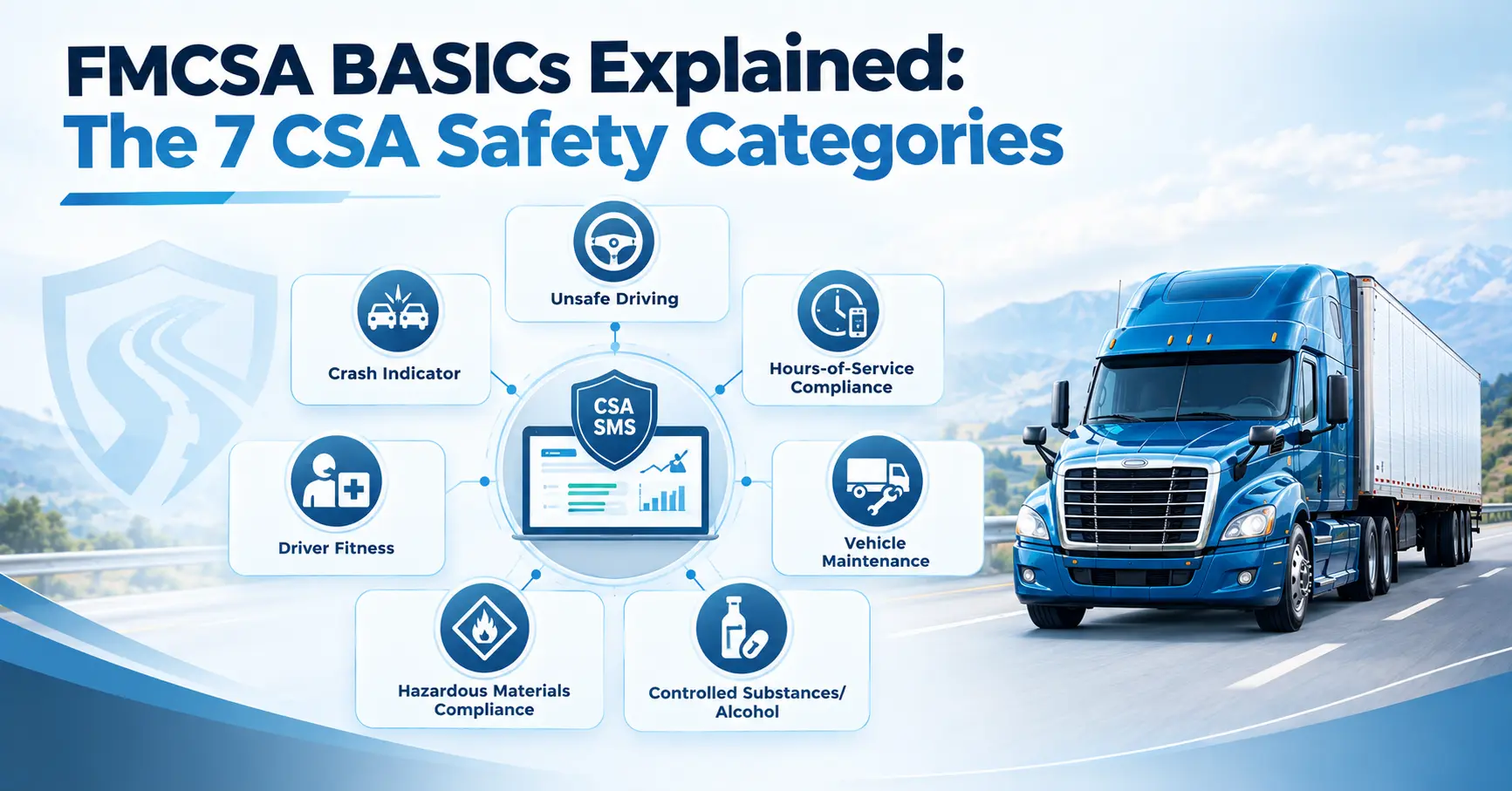
Short answer: The FMCSA BASICs (Behavior Analysis and Safety Improvement Categories) are the seven categories FMCSA’s Safety Measurement System (SMS) uses to sort a motor carrier’s safety data: Unsafe Driving, Crash Indicator, Hours-of-Service (HOS) Compliance, Vehicle Maintenance, Controlled Substances/Alcohol, Hazardous Materials (HM) Compliance, and Driver Fitness. Each BASIC has its own measure and percentile, which FMCSA uses as part of its process for prioritizing carriers for intervention.
Think of the BASICs as seven separate report cards rather than one overall score. A carrier can look fine in Unsafe Driving and be flagged in Vehicle Maintenance. Knowing which violations land in which BASIC is how you work out where your safety data is exposed.
This guide explains each BASIC as its own category, shows how a violation travels from a roadside inspection to an intervention, and lists the thresholds FMCSA uses. If you want the basics of how percentiles are calculated, see how CSA scores work.
The 7 FMCSA BASICs at a Glance
Each BASIC maps to a set of regulations and a type of safety behavior. The table below summarizes all seven, based on FMCSA’s SMS overview and SMS Methodology version 3.21.
FMCSA BASICs & General Intervention Thresholds
The BASICs group safety-related events into specific categories. General intervention thresholds vary by BASIC.
| BASIC | What It Measures | Main FMCSR Parts | Built From | General Carrier Threshold |
|---|---|---|---|---|
|
Unsafe Driving
|
Dangerous or careless driving | 392 , 397 | Inspection violations | 65% |
|
Crash Indicator
|
Pattern of crash involvement | Crash records | State-reported crashes | 65% |
|
HOS Compliance
|
Fatigued or ill driving, HOS violations | 392 , 395 | Inspection violations | 65% |
|
Vehicle Maintenance
|
Maintenance defects, cargo securement | 392 , 393 , 396 | Inspection violations | 80% |
|
Controlled Substances / Alcohol
|
Impairment from alcohol or drugs | 382 , 392 | Inspection violations | 80% |
|
HM Compliance
|
Unsafe handling of hazardous materials | 397 , 171–180 | Inspection violations | 80% |
|
Driver Fitness
|
Drivers not qualified to operate a CMV | 383 , 391 | Inspection violations | 80% |
All seven can also pick up “acute” and “critical” violations found during FMCSA investigations, not just roadside inspections. Passenger and hazmat carriers face lower thresholds, covered below.
Each BASIC Explained
Each BASIC has its own definition, data source, way of adjusting for fleet size, and minimum amount of data needed before a percentile is shown. The details below come from FMCSA’s SMS Methodology and SMS overview.
1. Unsafe Driving BASIC
The Unsafe Driving BASIC covers operating a CMV in a dangerous or careless way. Typical violations include speeding, reckless driving, improper lane changes, texting, hand-held phone use, and failing to wear a seat belt.
- Regulations: 49 CFR Parts 392 and 397
- Adjusted by: average power units multiplied by a mileage-based utilization factor
- Percentile needs: at least 3 inspections with Unsafe Driving violations in 24 months
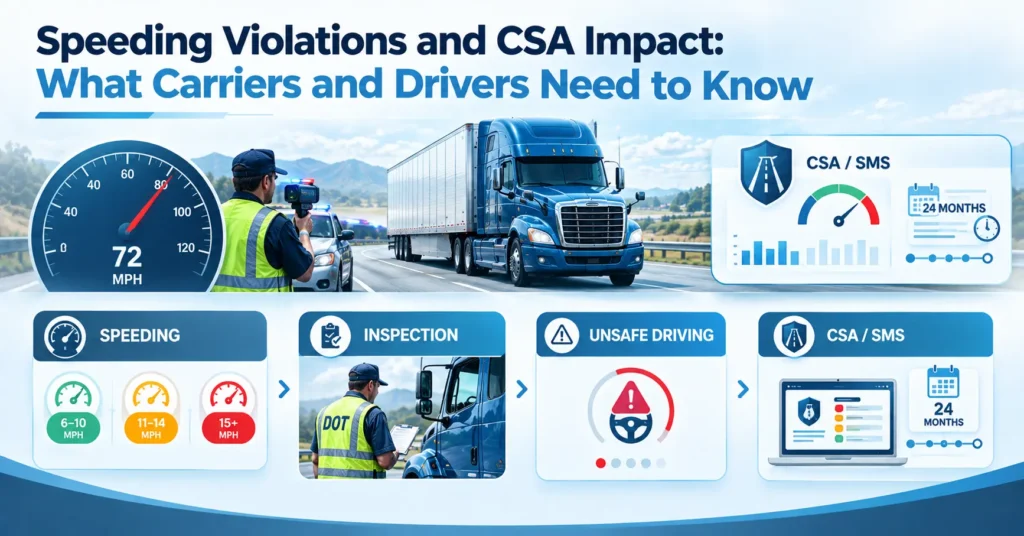
For the details, see our guides to common unsafe driving violations and speeding violations and CSA impact.
2. Crash Indicator BASIC
The Crash Indicator measures a carrier’s history of crash involvement, including how often and how severe. It is the only BASIC built from state-reported crash records rather than inspection violations. Crashes are weighted by severity, such as whether they involved an injury, a fatality, or a hazmat release.
- Adjusted by: average power units and utilization factor, like Unsafe Driving
- Percentile needs: at least 2 qualifying crashes
- Visibility: non-public; only the carrier (logged in) and enforcement can see it
3. Hours-of-Service (HOS) Compliance BASIC
The HOS Compliance BASIC covers driving while ill, fatigued, or out of compliance with hours-of-service rules. Violations include driving past the 11-hour or 14-hour limits, false records of duty status, and missing or incorrect ELD records.
- Regulations: 49 CFR Parts 392 and 395
- Adjusted by: number of relevant driver inspections
- Percentile needs: at least 3 relevant driver inspections
4. Vehicle Maintenance BASIC
The Vehicle Maintenance BASIC covers failing to maintain a CMV properly or to prevent shifting, spilled, or dropped cargo. Violations include brake, lighting, and tire defects, and cargo securement problems.
- Regulations: 49 CFR Parts 392, 393, and 396
- Adjusted by: number of relevant vehicle inspections
- Percentile needs: at least 5 relevant vehicle inspections
5. Controlled Substances/Alcohol BASIC
This BASIC covers operating a CMV while impaired by alcohol, illegal drugs, or misuse of prescription or over-the-counter medications. Having an alcoholic beverage in the cab also falls here.
- Regulations: 49 CFR Parts 382 and 392
- Adjusted by: number of relevant driver inspections
- Percentile needs: at least 1 inspection with a violation in this BASIC
6. Hazardous Materials (HM) Compliance BASIC
The HM Compliance BASIC covers unsafe handling of hazardous materials on a CMV. Violations include problems with packaging, marking, labeling, placarding, shipping papers, and load securement.
- Regulations: 49 CFR Part 397 and the Hazardous Materials Regulations, Parts 171 to 180
- Adjusted by: number of relevant HM inspections
- Percentile needs: at least 5 relevant HM inspections
- Visibility: non-public
7. Driver Fitness BASIC
The Driver Fitness BASIC covers drivers who are unfit to operate a CMV because of lack of training, experience, or medical qualification. Violations include driving without a valid CDL or the right endorsement, and without a valid medical certificate.
- Regulations: 49 CFR Parts 383 and 391
- Adjusted by: number of relevant driver inspections
- Percentile needs: at least 5 relevant driver inspections
The minimums above are the headline data sufficiency tests. The methodology adds further conditions in some BASICs, such as requiring a recent violation, so check the current methodology before relying on them.
How a Violation Becomes an Intervention
A violation affects a carrier only through the BASIC it lands in. SMS runs the same six-step chain for every BASIC each month, using the last 24 months of data.
How a Violation Becomes an Intervention
A violation does not automatically trigger an intervention. FMCSA evaluates safety events through several stages before an intervention threshold may be reached.
- Inspection or crash. A roadside inspector records violations on an inspection report, or a state reports a qualifying crash. Investigations can add acute and critical violations.
- Sorted into a BASIC. Each violation code belongs to one BASIC. A speeding violation goes to Unsafe Driving; a brake defect goes to Vehicle Maintenance.
- Weighted. Each violation’s severity weight (1 to 10) is multiplied by a time weight: 3 for the past 6 months, 2 for 6 to 12 months, 1 for 12 to 24 months. Severity weights from one inspection in one BASIC are capped at 30.
- Normalized. Unsafe Driving and Crash Indicator are divided by average power units adjusted for miles driven. The other five are divided by the number of relevant inspections, so a carrier is not penalized just for being inspected often.
- Ranked against peers. The result is compared with carriers that have a similar number of inspections or crashes (a “safety event group”) to produce a percentile. Higher is worse.
- Intervention. If a percentile is at or above the BASIC’s threshold, FMCSA may intervene. Early contact includes a warning letter or a targeted roadside inspection. More serious cases lead to an offsite, onsite focused, or onsite comprehensive investigation, and possibly a notice of violation or notice of claim.
The mechanics of step 5 are covered in our guide to the FMCSA Safety Measurement System.
BASIC Intervention Thresholds by Carrier Type
Each BASIC has its own intervention threshold, and the threshold is lower for passenger and hazmat carriers. The lowest thresholds apply to the three BASICs FMCSA treats as most closely linked to crash risk: Unsafe Driving, Crash Indicator, and HOS Compliance.
| BASIC | Passenger Carrier | HM Carrier | General Carrier |
|---|---|---|---|
| Unsafe Driving | 50% | 60% | 65% |
| Crash Indicator | 50% | 60% | 65% |
| HOS Compliance | 50% | 60% | 65% |
| Vehicle Maintenance | 65% | 75% | 80% |
| Controlled Substances/Alcohol | 65% | 75% | 80% |
| Driver Fitness | 65% | 75% | 80% |
| HM Compliance | 80% | 80% | 80% |
Source: SMS Methodology, version 3.21 (June 2026).
A percentile at or above the threshold marks that BASIC for possible intervention. It does not by itself mean a carrier is unsafe, and it does not change the carrier’s safety rating. If you run passengers or hazmat, you hit the threshold sooner.
What BASICs Are Not
BASIC percentiles are a prioritization tool. They are not a safety rating, and they are not a legal finding that a carrier is unsafe. Three distinctions matter.
BASICs are not your safety rating. A Satisfactory, Conditional, or Unsatisfactory safety rating comes from an FMCSA compliance investigation under 49 CFR Part 385. SMS percentiles help FMCSA decide whom to investigate. They do not change a rating on their own.
Not every BASIC is public. The Crash Indicator and HM Compliance BASICs are non-public for all carriers. Under the Fixing America’s Surface Transportation (FAST) Act of 2015, property carriers’ SMS results are also no longer shown on the public SMS website (SMS Methodology). Carriers can still see their own results by logging in, and enforcement can see everything.
No percentile is not the same as a clean record. A carrier below a BASIC’s data sufficiency minimum gets no percentile, but its inspections and violations are still recorded. Those violations still appear in its inspection history and in drivers’ PSP records.
If a violation on your record is wrong, you can challenge it through FMCSA’s DataQs system. A corrected or removed violation drops out of the BASIC calculation.
How the BASICs Are Changing
FMCSA has approved a revised SMS methodology that replaces the seven BASICs with seven “compliance categories.” The biggest changes are to Controlled Substances/Alcohol, which merges into Unsafe Driving, and Vehicle Maintenance, which splits in two. We did not find an official go-live date in FMCSA’s published materials as of September 2026, and the current methodology (version 3.21, June 2026) still uses the BASICs.
| Current BASIC | Approved Compliance Category |
|---|---|
| Unsafe Driving | Unsafe Driving, now also including Controlled Substances/Alcohol and operating-while-out-of-service violations |
| Controlled Substances/Alcohol | Merged into Unsafe Driving |
| Vehicle Maintenance | Split into Vehicle Maintenance: Driver Observed, and Vehicle Maintenance |
| Crash Indicator | Crash Indicator |
| HOS Compliance | Hours of Service |
| HM Compliance | Hazardous Materials |
| Driver Fitness | Driver Fitness |
Other approved changes, according to FMCSA’s summary of approved changes:
- Simpler severity weights. Violations are regrouped into about 100 violation groups, and the 1 to 10 severity scale becomes weights of 1 or 2.
- Proportionate percentiles. Safety event groups are replaced by percentiles based on each carrier’s exact number of safety events.
- New thresholds for some categories. The HM threshold rises from 80% to 90%. Driver Fitness rises to 90% for general carriers, 85% for hazmat, and 75% for passenger carriers.
- Stricter data sufficiency. A recent-violation requirement is extended to Hours of Service, Vehicle Maintenance, Hazardous Materials, and Driver Fitness.
The underlying logic stays the same: violations roll up into categories, categories produce percentiles, and percentiles drive interventions. Watch the CSA website for FMCSA’s announcement of the switch.
Know Where Your BASICs Stand
Each BASIC traces back to a specific compliance program: driver qualification files for Driver Fitness, logs and ELDs for HOS, inspections and repairs for Vehicle Maintenance, testing for Controlled Substances/Alcohol.
SafeRoad Compliance helps owner-operators and small fleets set up those programs, review their SMS data by BASIC, and file DataQs challenges when records are wrong. If you want a BASIC-by-BASIC review of your carrier’s data, contact SafeRoad Compliance.
Don’t Let Compliance
Slow Your Business Down.
Stay organized, keep required records current, and stay ahead of important DOT compliance requirements with professional support.
FMCSA BASICs FAQ
BASIC stands for Behavior Analysis and Safety Improvement Category. FMCSA uses seven of them in its Safety Measurement System to group a carrier’s safety data.
Unsafe Driving, Crash Indicator, Hours-of-Service Compliance, Vehicle Maintenance, Controlled Substances/Alcohol, Hazardous Materials Compliance, and Driver Fitness.
Unsafe Driving, Crash Indicator, and HOS Compliance. For general carriers the threshold is 65%, compared with 80% for the other BASICs. Passenger and hazmat carriers have lower thresholds.
No. SMS produces a separate percentile for each BASIC where the carrier has enough data. There is no combined score across BASICs.
Each BASIC has a data sufficiency minimum, such as 3 inspections with violations for Unsafe Driving or 5 relevant vehicle inspections for Vehicle Maintenance. Below that, SMS shows no percentile, but the violations are still on record.
Property carriers’ SMS results have not been publicly displayed since the FAST Act of 2015. Crash Indicator and HM Compliance are non-public for all carriers. Carriers can log in to see their own results.
FMCSA updates SMS results monthly, using the most recent 24 months of inspection and crash data.