This article is general information about federal motor carrier rules. It is not legal advice. State requirements vary and change, so confirm your obligations with your state’s motor carrier agency.
What Is the Difference Between Interstate and Intrastate DOT Compliance?
Short answer: Interstate carriers follow the federal Motor Carrier Safety Regulations (FMCSRs) and register with FMCSA for a USDOT number, plus operating authority if they haul for hire. Intrastate carriers mostly follow their state’s version of those rules, which may differ in weight thresholds, hours of service, and driver age. Some federal rules, including CDL standards and drug and alcohol testing for CDL drivers, apply to both.
The label that decides which rules apply is not where your truck drives. It is where the freight or passengers are going, or came from. A truck that never leaves Texas can still be in interstate commerce if its load started in Louisiana. That is why two trucks on the same road, doing similar work, can face different requirements.
This guide explains how FMCSA defines each type of commerce, compares the requirements side by side, and gives you a decision path to work out which rules apply to your operation. For a broader overview first, see what DOT compliance means.
What Counts as Interstate vs Intrastate Commerce?
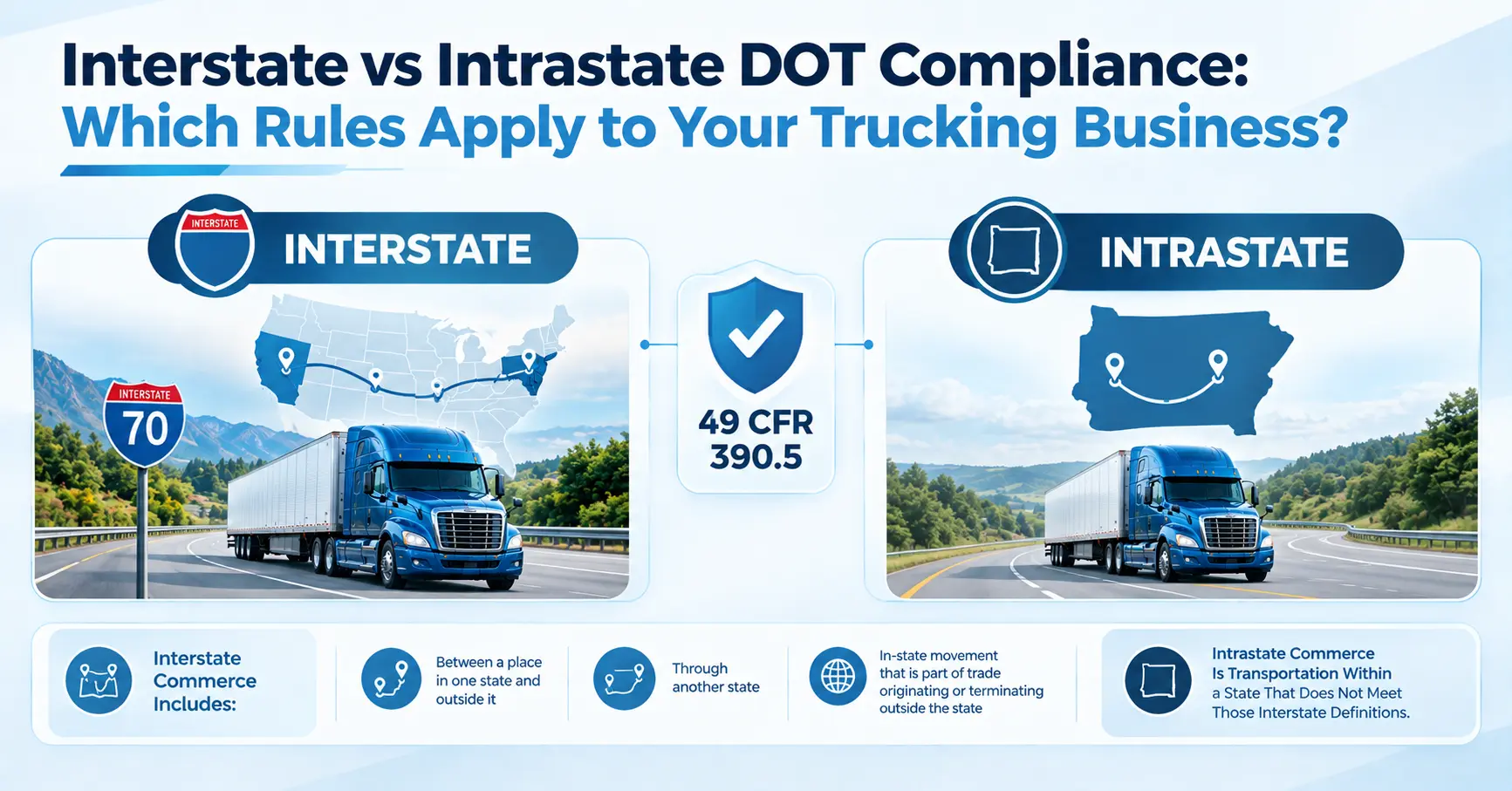
FMCSA defines interstate commerce in 49 CFR 390.5. Transportation is interstate if it falls into any one of three situations:
- It crosses a state line. The trip runs between a place in one state and a place outside it, including outside the United States.
- It passes through another state. The trip starts and ends in the same state but travels through another state or country on the way.
- It is one leg of a longer journey. The trip starts and ends in the same state, but it is part of a shipment that began or will end outside that state or the U.S.
Intrastate commerce is everything else: transportation within one state that does not fit any of those three situations.
The third situation is the one that catches carriers off guard. A local carrier that picks up containers at a port and delivers them 40 miles inland never crosses a state line. If those containers arrived from overseas, the move is still part of interstate or foreign commerce, and the federal rules apply.
Whether the federal rules apply also depends on the vehicle. Most FMCSRs apply only to commercial motor vehicles (CMVs), which 390.5 defines as vehicles with a gross vehicle weight rating or actual weight of 10,001 pounds or more, vehicles designed or used to carry more than 8 or 15 passengers (depending on compensation), or vehicles hauling placarded hazmat. For the full structure of these rules, see our guide to 49 CFR Parts 390 to 399.
Interstate vs Intrastate Requirements Side by Side
Interstate carriers answer to FMCSA. Intrastate carriers answer mainly to their state, with a handful of federal rules that apply regardless. The table below covers the main compliance areas.
| Requirement | Interstate Carrier | Intrastate-Only Carrier |
|---|---|---|
| Safety regulations | Federal FMCSRs, Parts 390 to 399 (§390.3) | State regulations compatible with the FMCSRs, with allowed variances |
| USDOT number | Required for CMVs of 10,001 lbs or more | Required for hazmat needing a safety permit, and in 38 states plus Puerto Rico (FMCSA guidance) |
| Operating authority (MC number) | Required for most for-hire carriers (FMCSA guidance) | Not required federally; some states have their own intrastate authority |
| Unified Carrier Registration (UCR) | Generally required for interstate carriers, brokers, and freight forwarders | Not required for intrastate-only operations (UCR Plan) |
| Weight threshold for safety rules | 10,001 lbs | States may apply rules only from 26,001 lbs, except for hazmat and 16+ passenger vehicles |
| Hours of service | Federal Part 395 | Federal rules, or state variances such as a 12-hour driving limit |
| Minimum driver age | 21 for interstate CMV drivers | States may allow 18 |
| Medical certification | Federal Part 391 medical card | State rules; states may grandfather some existing drivers |
| CDL (Part 383) | Required for qualifying vehicles | Required for qualifying vehicles |
| Drug and alcohol testing (Part 382) | Required for CDL drivers | Required for CDL drivers |
The intrastate variances come from 49 CFR 350.305, which sets the limits on how far a state’s rules may depart from the FMCSRs. They are options, not guarantees. Each state chooses which variances, if any, to adopt.
Why the Same Work Can Trigger Different Requirements
Two carriers can run the same trucks on the same roads and still fall under different rules, because interstate status follows the shipment, the vehicle, and the type of operation. These four examples show how.
Example 1: The port drayage carrier. A carrier moves containers from a seaport to a warehouse in the same state. The truck never crosses a state line, but the freight arrived from overseas. Under the third part of the 390.5 definition, the move is interstate or foreign commerce, and the FMCSRs apply.
Example 2: The local gravel hauler. A dump truck operator hauls gravel from an in-state quarry to in-state job sites. Nothing crosses a state line and the material did not come from out of state. This is intrastate commerce. The carrier follows state rules, which may include a state USDOT number requirement.
Example 3: The short trip through another state. A carrier delivers between two cities in the same state, but the fastest route cuts through a neighboring state for 20 miles. That trip is interstate commerce under 390.5, even though both ends are in the same state.
Example 4: The lighter truck. A contractor runs a pickup rated at 9,000 pounds GVWR across a state line to a job site. The trip is interstate, but the vehicle is under 10,001 pounds, so it is not a CMV under 390.5 and most FMCSRs do not apply. Add a trailer that takes the combination to 10,001 pounds or more, and they do.
A carrier that does both kinds of work, such as mostly local hauling with occasional out-of-state loads, has the hardest call. If any of your loads are interstate, the federal rules apply to those trips, and you need a USDOT number and, for most for-hire work, operating authority. Some mixed carriers choose to hold their entire operation to the federal standard, though this is a business choice rather than a legal requirement.
Federal Rules That Apply to Intrastate Carriers Too
Intrastate does not mean free of federal rules. Several federal requirements apply based on the vehicle, the driver, or the cargo, regardless of whether the trip crosses a state line.
CDL standards (Part 383). 49 CFR 383.3 applies the CDL rules to every person who operates a CMV in interstate, foreign, or intrastate commerce. A driver of a vehicle that needs a CDL must have one whether the route is local or cross-country.
Drug and alcohol testing (Part 382). Under 49 CFR 382.103, the testing rules apply to employers and drivers who operate a CMV in commerce in any state and are subject to the CDL requirements. An intrastate carrier with CDL drivers needs a compliant testing program, including pre-employment, random, and post-accident testing.
Intrastate hazardous materials. Under 49 CFR 390.3, intrastate carriers hauling hazmat must follow specific federal rules, including registration, vehicle marking, and financial responsibility to the extent Part 387 requires. Carriers hauling hazmat that requires a safety permit must get a USDOT number even if they never leave their state.
CDL self-certification. Under 49 CFR 383.71(b), every CDL applicant certifies one of four categories: non-excepted interstate, excepted interstate, non-excepted intrastate, or excepted intrastate. Non-excepted interstate drivers must meet the federal Part 391 qualifications and keep a federal medical certificate. Non-excepted intrastate drivers follow their state’s driver qualification rules instead. Choosing the right category matters, because it decides which medical rules apply.
The practical takeaway: an intrastate carrier with CDL drivers still runs a federal drug and alcohol program and checks CDLs against federal standards.
How State Rules Can Differ for Intrastate Carriers
Intrastate carriers follow state law, and states are allowed to depart from the FMCSRs only within limits FMCSA sets. To keep federal Motor Carrier Safety Assistance Program (MCSAP) funding, a state’s intrastate rules must be compatible with the FMCSRs, subject to the variances in 49 CFR 350.305:
- Weight threshold. A state may exempt intrastate vehicles under 26,001 pounds GVWR from its safety rules, except vehicles hauling placarded hazmat or designed to carry 16 or more people.
- Hours of service. A state may allow a 12-hour driving limit, a 16-hour on-duty limit, 70 hours in 7 days or 80 hours in 8 days, and a 150-air-mile radius for certain exceptions.
- Driver age. Intrastate CMV drivers must be at least 18. Interstate drivers must generally be 21.
- Medical qualification. A state may let existing intrastate drivers keep driving under its earlier standards if their condition has not worsened, and may grant other medical variances based on sound medical judgment.
States may not exempt carriers based on the type of transportation or the distance driven, apart from exemptions in place before April 1988.
State rules can also add requirements.
Many states require intrastate carriers to register for a USDOT number. FMCSA currently lists Alabama, Alaska, Arizona, California, Colorado, Connecticut, Delaware, Florida, Georgia, Hawaii, Idaho, Indiana, Iowa, Kansas, Kentucky, Maine, Maryland, Massachusetts, Michigan, Minnesota, Missouri, Montana, Nebraska, Nevada, New Jersey, New York, North Carolina, Ohio, Oklahoma, Oregon, Pennsylvania, South Carolina, Texas, Utah, Washington, West Virginia, Wisconsin, Wyoming, and Puerto Rico (FMCSA). Some states also require their own intrastate operating authority, permits, or insurance filings.
Because each state sets its own mix, the federal rules are the floor to compare against, not the full answer. For details on USDOT registration, see our guide to USDOT number registration requirements.
Decision Path: Which DOT Rules Apply to You?
Two questions settle most cases: is the vehicle a CMV, and is any part of the shipment’s journey interstate? Work through them for each type of trip you run, not just for your company as a whole.
- Is the vehicle a CMV under 390.5? If it is under 10,001 pounds, not built or used to carry more than 8 or 15 passengers, and not hauling placarded hazmat, most FMCSRs do not apply. State rules may still apply.
- Is any part of the shipment interstate? If the trip crosses a state line, passes through another state, or is one leg of a shipment that starts or ends out of state, it is interstate commerce. You need a USDOT number, compliance with the FMCSRs, operating authority for most for-hire work, and UCR registration.
- If not, you are intrastate. Follow your state’s rules and check whether your state requires a USDOT number or its own authority.
- Either way, check the cross-cutting rules. CDL drivers fall under federal CDL and drug and alcohol testing rules. Intrastate hazmat carriers have their own federal registration and marking duties.
When a carrier mixes local and out-of-state loads, the answer can differ trip by trip. That is the point where a second opinion is worth having.
Getting the Scope Right Before You Build Your Program
The interstate vs intrastate question decides almost everything that follows: which registrations you file, which hours-of-service rules your drivers log against, how old your drivers can be, and whether your medical and qualification files follow federal or state standards. Getting it wrong in either direction costs money. Over-complying wastes time, and under-complying leaves gaps that show up in an audit or a roadside inspection.
If you are not sure which side of the line your operation falls on, or you run a mix of both, a DOT compliance service can map each type of trip to the rules that apply. It can then set up the registrations, driver files, and testing program to match. SafeRoad Compliance provides DOT compliance services for owner-operators and small fleets, covering both interstate and intrastate carriers. If you want help confirming your scope and building the right program from the start, contact SafeRoad Compliance.
Don’t Let Compliance
Slow Your Business Down.
Stay organized, keep required records current, and stay ahead of important DOT compliance requirements with professional support.
Interstate vs Intrastate FAQs
Sometimes. Federal law requires one for intrastate carriers hauling hazmat that needs a safety permit. Beyond that, it depends on the state: FMCSA lists 38 states and Puerto Rico that require intrastate CMV registrants to get a USDOT number.
Yes. Under 49 CFR 390.5, a trip that stays inside one state is interstate if it passes through another state, or if it is part of a shipment that started or will end outside the state.
No federal MC number is needed for intrastate-only operations. FMCSA operating authority applies to for-hire interstate carriers of regulated commodities and passengers. Some states require their own intrastate authority.
Yes, for drivers who must hold a CDL. 49 CFR 382.103 applies the testing rules to CDL drivers operating in commerce in any state, which covers intrastate operations.
Federal rules let states allow intrastate CMV drivers from age 18. Interstate CMV drivers must generally be at least 21. Whether 18 is allowed depends on your state’s law.
Not always. States may allow intrastate variances such as a 12-hour driving limit and a 16-hour on-duty limit. Check your state’s adopted rules.
No. The UCR Plan states that carriers engaged only in intrastate commerce do not need to register.
Your interstate trips must meet federal requirements, so you need a USDOT number and, for most for-hire work, operating authority. Your intrastate trips follow state rules. Some mixed carriers choose to run their whole program to the federal standard.