Disclosure: Informational only. We are not FMCSA or USDOT. Always verify your status directly through official FMCSA systems.
Your MC number just arrived, and it’s tempting to start booking loads. Don’t yet: a few filings and setup steps decide whether your authority goes active on time and whether your first FMCSA audit goes smoothly.
What Should You Do After Getting an MC Number?
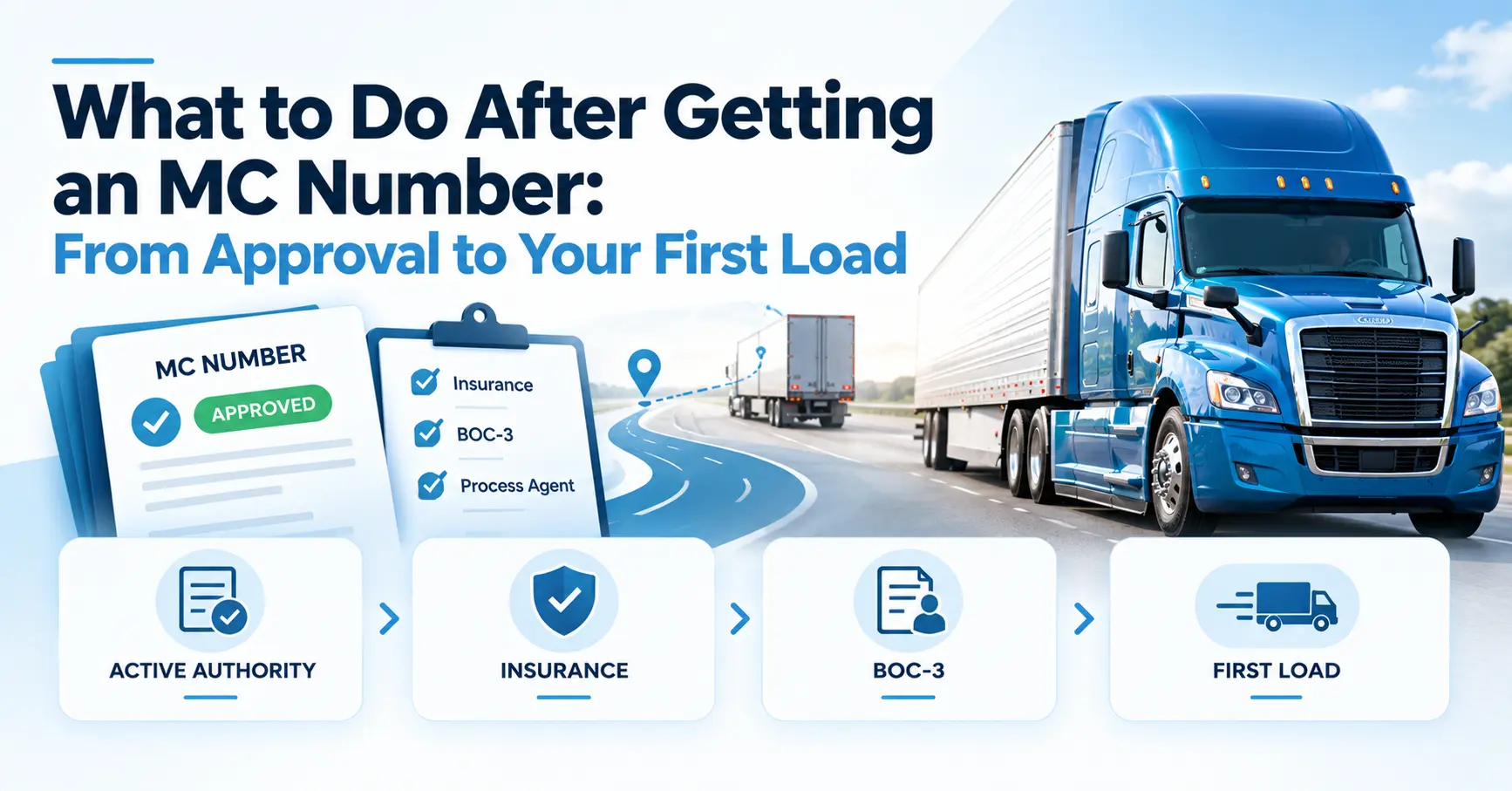
Short answerGetting an MC number does not mean you can haul yet. Next, have your insurance company file proof of coverage and file your BOC-3 process agent designation, both within 90 days of your application’s publication in the FMCSA Register. Wait out the 10-day protest period, and do not run a load until your authority shows Active in FMCSA’s Licensing and Insurance system.
- Within 90 days: insurance filing (BMC-91/91X) and BOC-3
- After publication: 10-day protest period
- Before your first load: drug and alcohol testing, Clearinghouse registration, driver qualification files, UCR, and vehicle and logbook records
The MC number is the start of a process, not the finish line. Between assignment and your first legal load, there are filings that make your authority active and a separate set of programs that make your first trip compliant. Then, within your first 12 months of operating, FMCSA will audit how well you set them up.
This guide walks through that lifecycle in order. It links to our detailed guides for each step rather than repeating them. If you are still unclear on how the two numbers differ, start with USDOT vs MC number.
MC Number Assigned vs Authority Active: What’s the Difference?
An assigned MC number means FMCSA has received and accepted your application. Active authority means FMCSA has approved it, your insurance and process agent filings are on file, and the protest period has passed. Only active authority lets you haul regulated freight for hire in interstate commerce.
| Status | What It Means | Can You Haul for Hire? |
|---|---|---|
| MC number assigned (pending) | Application received; insurance and BOC-3 not yet complete, or protest period not over | No |
| Dismissed | Insurance or BOC-3 not filed within about 90 days; FMCSA treats this as a rejection | No |
| Granted and Active | Certificate issued; status shows Active in FMCSA’s Licensing and Insurance system | Yes |
FMCSA’s OP-1 instructions say applicants should not begin operations until the certificate is issued and the registration status shows Active. Check your status yourself rather than relying on a letter or email.
A note on Motus. FMCSA replaced its old registration system with Motus, which launched in May 2026. New applicants now apply through Motus and must pass identity and business verification. FMCSA has proposed eventually phasing out MC numbers and identifying carriers by USDOT number alone, but said that change will not take effect with Motus’s first release. Until a final rule says otherwise, the steps in this guide still apply.
The Path From MC Number to Your First Load
The lifecycle runs in six steps. Steps 1 to 4 make your authority active. Step 5 makes your operation compliant. Step 6 is FMCSA checking that you did step 5 properly.
[embed: node/6410d57d-aab6]
The 90-day window in step 3 runs in parallel with the 10-day protest period in step 2, so you can start on insurance and the BOC-3 as soon as you apply. Step 5 work, such as enrolling in a drug and alcohol testing program, can also start before your authority goes active.
Steps 1 to 4: Getting Your Authority to Active
Three things must happen before FMCSA grants authority: your insurer files proof of insurance, you file a BOC-3, and the protest period ends without a successful protest. Miss the 90-day deadline and FMCSA dismisses the application, which it treats as a rejection, and you lose the fee.
- Have your insurer file proof of insurance. Your insurance company files the federal form electronically with FMCSA, typically a BMC-91 or BMC-91X for liability coverage. For-hire carriers of general freight in vehicles of 10,001 pounds or more need at least $750,000 in liability coverage under 49 CFR 387.9; hazmat carriers need $1 million or $5 million depending on the cargo. A certificate of insurance mailed to you does not count. See FMCSA insurance filings for the forms and limits.
- File your BOC-3. The BOC-3 names a process agent in each state where you operate, so legal papers can be served on your company there. Most carriers use a blanket company that covers all states. See what a BOC-3 filing is.
- Watch the protest period. Publication in the FMCSA Register starts a 10-calendar-day window for protests. Authority will not be granted until the window closes.
- Confirm Active status. Check FMCSA’s Licensing and Insurance system for your USDOT or MC number. Do not book a load until it shows Active for the authority type you applied for.
- Keep your grant letter and certificate. Brokers and shippers often ask for them in carrier packets.
Source for deadlines and steps: FMCSA’s OP-1 instructions and dismissal FAQ. For a printable version of these steps, use our new authority checklist.
Step 5: What to Set Up Before Your First Load
Active authority lets you operate. These programs make that operation compliant. Most of them are what the new entrant safety audit checks, so setting them up now is cheaper than fixing them later.
| Area | What to Set Up | Key Rule |
|---|---|---|
| Drug and Alcohol Testing | Enroll in a testing program; one-truck owner-operators with a CDL join a consortium for random testing. | 49 CFR Part 382 |
| Clearinghouse | Register as an employer and run a pre-employment full query on every CDL driver, including yourself. | 49 CFR 382.701 |
| Pre-Employment Drug Test | Get a verified negative result before any CDL driver performs safety-sensitive work. | 49 CFR 382.301 |
| Driver Qualification Files | Maintain an application, MVR, road test or CDL equivalent, medical certificate, and employment history checks for each driver. | 49 CFR Part 391 |
| Hours of Service | Set up an ELD or another logging method appropriate for your operation. | 49 CFR Part 395 |
| UCR | Register and pay for the current year before operating interstate, when required. | UCR Plan |
| IRP and IFTA | Obtain apportioned plates and a fuel tax license for qualified vehicles operating across jurisdictions. | Your Base State |
| Vehicle Files | Maintain a maintenance file for each truck, a current annual inspection, and a DVIR process. | 49 CFR Part 396 |
| Vehicle Marking | Display the legal name and USDOT number on both sides of each power unit, as applicable. | 49 CFR 390.21T |
| Heavy Vehicle Use Tax | File IRS Form 2290 for qualifying highway motor vehicles with a taxable gross weight of 55,000 pounds or more. | IRS Form 2290 |
A few notes:
- Owner-operators are employers too. If you drive under your own authority, you are both the employer and the driver for drug and alcohol testing and Clearinghouse purposes.
- Not everything applies to everyone. IRP, IFTA, and Form 2290 depend on vehicle weight, axles, and where you run. ELD exceptions exist for short-haul and some older engines.
- Leased-on drivers. If you lease drivers or equipment to or from another carrier, check the lease for who keeps the driver files and testing program.
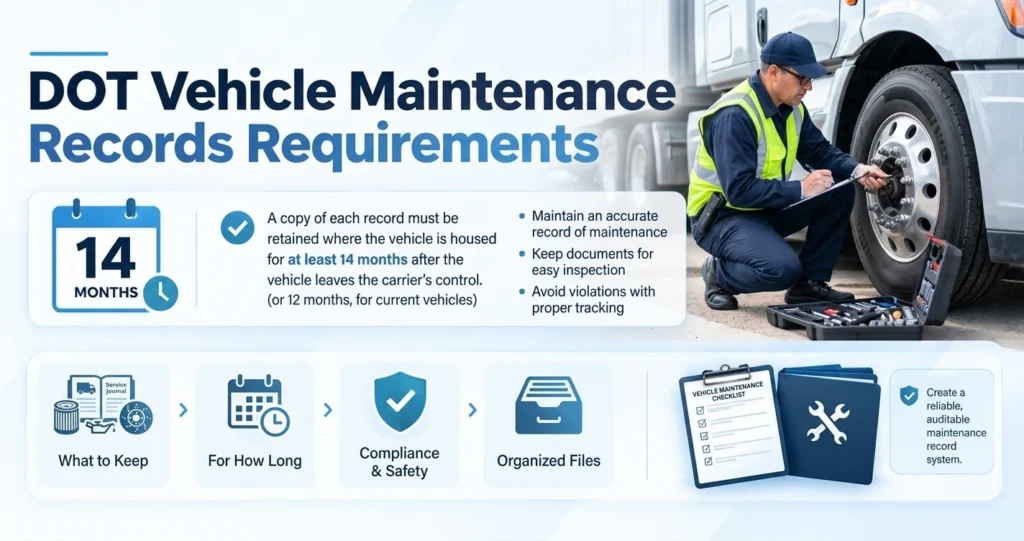
For maintenance file details, see our guide to DOT vehicle maintenance records requirements.
Step 6: The New Entrant Safety Audit
Every new carrier enters FMCSA’s New Entrant Safety Assurance Program. You are monitored for 18 months, and FMCSA conducts a safety audit within your first 12 months of operation. The audit reviews the records you set up in step 5.
FMCSA lists violations that cause an automatic audit failure, including:
- Drug and alcohol: no testing program or no random testing program, or using a driver who refused a test or failed one without completing return-to-duty steps.
- Drivers: knowingly using a driver without a valid CDL, a disqualified driver, or a medically unqualified driver.
- Operations: operating without the required insurance, or not requiring drivers to keep hours-of-service records.
- Vehicles: operating a vehicle placed out of service before it is repaired, not fixing out-of-service defects listed on a DVIR, or using a vehicle without a periodic inspection.
A carrier that fails must put a corrective action plan in place. FMCSA states that failure to do so will result in revocation of the carrier’s USDOT registration.
The pattern is clear: nearly every automatic failure maps to a step 5 item. A carrier that completes the step 5 table before its first load has already prepared for most of the audit.
Recurring Deadlines Once You’re Running
Active authority stays active only if you keep it current. These deadlines start the day you begin operating.
| Deadline | How Often | Why It Matters |
|---|---|---|
| Insurance Renewal | At each policy renewal | If your insurer cancels the federal filing and no replacement is filed, your authority can be revoked. |
| MCS-150 Biennial Update | Every 24 months | Missing the update can lead to USDOT number deactivation. The due date follows the schedule assigned to your USDOT number. |
| UCR Registration | Every year | Required for applicable interstate motor carriers and other covered entities. |
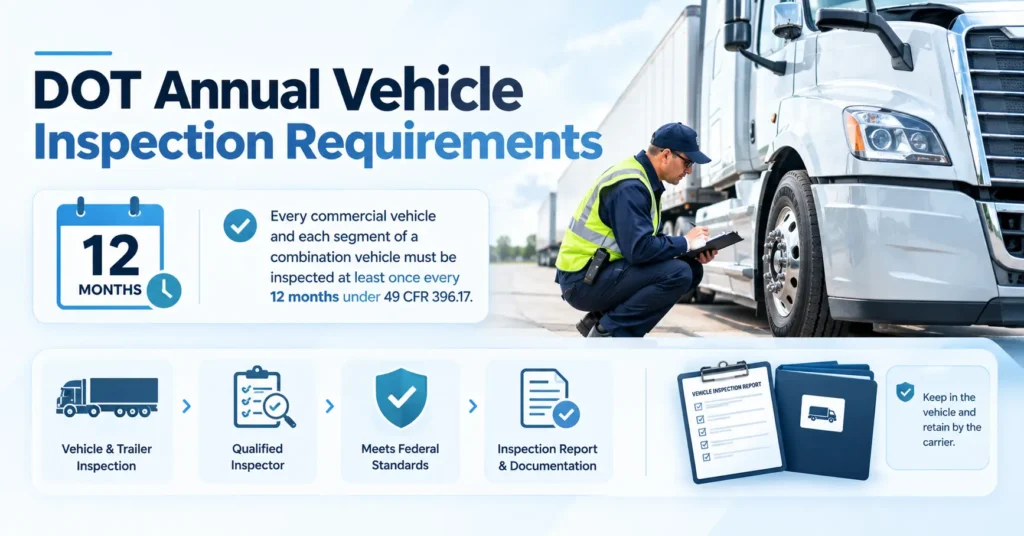
| Annual Vehicle Inspection | Every 12 months per vehicle | Using a vehicle without a current required inspection can result in a critical violation. |
| Clearinghouse Query | At least once a year | Employers must conduct a limited query at least annually for each current CDL driver under 49 CFR 382.701. |
| Driver MVR Review | At least every 12 months | Carriers must review each driver’s driving record at least annually under 49 CFR 391.25. |
| Driver Medical Certificates | At expiration | An expired medical qualification can make a driver ineligible to operate a CMV when medical certification is required. |
| IFTA Returns | Quarterly | Required for carriers licensed under IFTA, including periods when a return is required even if no tax is due. |
During the 2026 Motus transition, FMCSA temporarily suspended enforcement of biennial updates and USDOT number inactivation. Do not rely on that pause: keep your MCS-150 information current, because brokers and insurers check it.
Get From MC Number to First Load Without Gaps
The weeks after your MC number is assigned set up the rest of your first year. Miss the 90-day filing window and you start over. Skip a testing program or driver file and it shows up at your new entrant audit.
SafeRoad Compliance handles the post-authority steps for new carriers: BOC-3 filing, insurance filing coordination, UCR registration, drug and alcohol consortium enrollment, Clearinghouse registration, driver qualification files, vehicle maintenance file setup, and new entrant safety audit preparation. If you want those steps done in the right order, see our DOT compliance services or contact SafeRoad Compliance to start.
Don’t Let Compliance
Slow Your Business Down.
Stay organized, keep required records current, and stay ahead of important DOT compliance requirements with professional support.
This article is general information about FMCSA registration and new entrant requirements as of October 2026. It is not legal advice. FMCSA’s registration process is changing with Motus, so confirm current steps on FMCSA’s registration pages.
FAQs
No. You can haul for hire only after FMCSA grants your authority and it shows Active in the Licensing and Insurance system. That requires insurance and BOC-3 filings and the end of the 10-day protest period.
Your insurance company must file proof of coverage within 90 days of your application’s publication in the FMCSA Register. If it is not filed in time, FMCSA dismisses the application and you lose the fee.
No. Your insurer must file the federal form, such as a BMC-91 or BMC-91X, directly with FMCSA. The certificate you receive is not the filing.
At least the 10-day protest period after publication, plus however long your insurance and BOC-3 filings take. Filing both quickly is the main thing you control.
FMCSA treats a dismissal as a rejection. You can appeal if insurance was filed on time and the dismissal was an error, or file a new application and pay the fee again.
Yes, if you need a CDL. An owner-operator with a CDL must be in a testing program, typically through a consortium, and register in the Clearinghouse as an employer.
FMCSA conducts a new entrant safety audit within your first 12 months of operation, during an 18-month monitoring period.
FMCSA has proposed phasing out MC numbers and identifying carriers by USDOT number alone, but said this will not happen with Motus’s first release. MC numbers remain in use until a final rule changes that.