A fender bender can be a recordable crash, and a scary-looking one may not be. The difference is three outcomes, not who was at fault or how bad it looked.
Which Incidents Make a Crash DOT Recordable?
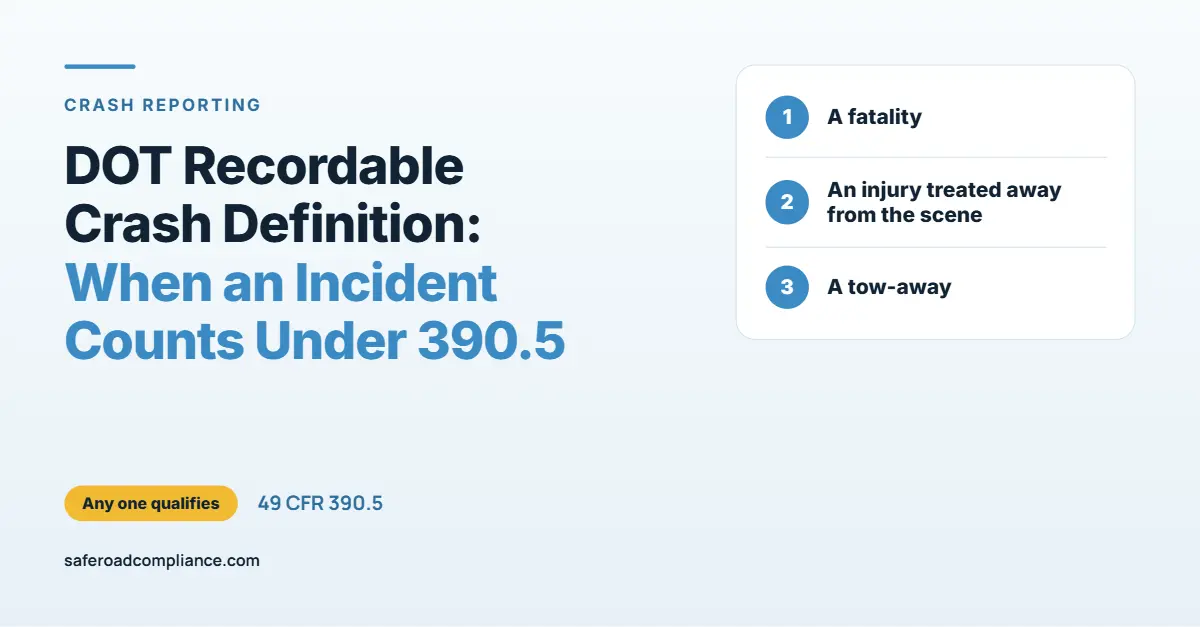
Short answer: Under 49 CFR 390.5, an incident involving a CMV is a recordable accident if it results in a fatality, an injury that needs immediate medical treatment away from the scene, or disabling damage that requires any vehicle to be towed away. Events that only involve boarding or alighting a stationary vehicle, or loading or unloading cargo, are excluded. Fault does not matter. A recordable crash goes on your accident register and may trigger post-accident drug and alcohol testing.
What Does 49 CFR 390.5 Say?
FMCSA’s Safety Planner summarizes the 390.5 definition this way. An accident is an event involving a CMV that results in:
- A fatality;
- Injury to a person who needs immediate medical treatment away from the accident site; or
- One or more vehicles being disabled due to the accident (disabling damage requiring tow-away).
Two exclusions. The term does not apply to events involving boarding and alighting from a stationary vehicle, or to events involving the loading or unloading of cargo.
“Crash” and “accident” mean the same thing. FMCSA uses the terms interchangeably. Its Safety Measurement System (SMS) describes a reportable crash as one involving a CMV operating on a public roadway that results in a fatality, an injury, or a tow-away.
How Do the Fatality, Injury, and Tow-Away Criteria Work?
DOT-Recordable Crash Criteria
Three criteria used to determine whether a crash is DOT-recordable.
| Criterion | What It Requires | What It Does Not Cover |
|---|---|---|
| Fatality | Any person dies as a result of the crash. | N/A |
| Injury | A person needs immediate medical treatment away from the scene. | Injuries treated only at the scene. |
| Tow-away | Any vehicle has disabling damage and is towed from the scene. | Tows not caused by disabling damage. |
What counts as disabling damage?
FMCSA’s crash data guidance quotes the federal definition: damage “which precludes departure of a motor vehicle from the scene of the accident in its usual manner in daylight after simple repairs.” It includes damage to vehicles that could be driven but would be further damaged by doing so. It excludes damage to tires, headlamps, or taillights.
In practice, ask: could this vehicle have been driven away normally after a simple fix? If yes, it is not disabling damage, even if it was towed.
Gray-Area Examples: Recordable or Not?
DOT-Recordable Crash Examples
Real-world scenarios illustrating recordable crashes and applicable exclusions.
| Incident | Recordable? | Why |
|---|---|---|
| Low-speed bump; the car driver is taken to the ER by ambulance. | Yes | Injury with immediate treatment away from the scene. |
| Your truck drives off; the other car is towed with a disabled front axle. | Yes | Any vehicle’s disabling-damage tow-away counts. |
| Your driver is rear-ended at a light and the truck is towed. | Yes | Fault does not matter. |
| EMTs bandage a cut at the scene; no one is transported and nothing is towed. | No | Injury criterion needs treatment away from the scene. |
| Truck towed only for a flat tire and broken headlamp. | No | Tire and headlamp damage are excluded. |
| Dock worker hurt while the truck is being unloaded. | No | Loading and unloading cargo is excluded. |
| Passenger falls while stepping off a parked bus. | No | Boarding and alighting a stationary vehicle is excluded. |
These are common gray areas. Each answer applies the three criteria and two exclusions above.
When an incident is borderline, document the facts that decided it: who was transported and where, and why each vehicle left the scene the way it did.
What Happens After a Crash Is Recordable?
It goes on your accident register
Under 49 CFR 390.15, motor carriers must keep a register of all recordable crashes from the past 3 years. Each entry needs:
- Date of the crash
- Nearest city or town and state
- Driver’s name
- Number of injuries
- Number of fatalities
- Whether hazardous materials, other than fuel from the vehicle’s fuel tanks, were released
New entrant carriers with a crash in the past 365 days must provide an accident register for the safety audit.
It may require post-accident testing
Recordable is not the same as testable. Under 382.303, the test depends on the outcome and whether the CMV driver got a citation:
Crash Outcomes and Post-Accident Testing
How the crash outcome and citation status relate to the testing requirement in the supplied scenarios.
| Crash Outcome | Citation to CMV Driver | Test Required? |
|---|---|---|
| Fatality | Yes or No | Yes |
| Injury with immediate treatment away from the scene | Yes | Yes |
| Injury with immediate treatment away from the scene | No | No |
| Disabling damage requiring tow-away | Yes | Yes |
| Disabling damage requiring tow-away | No | No |
If an alcohol test is not done within 8 hours, or a drug test within 32 hours, the employer must stop trying and record why. Missed or refused tests are covered in our guide to drug and alcohol violations.
It counts in SMS
Recordable crashes feed the Crash Indicator BASIC in FMCSA’s Safety Measurement System. Crashes with injuries, fatalities, or a hazmat release carry more weight, and crashes older than 24 months drop out. Crashes found not preventable through FMCSA’s Crash Preventability Determination Program are removed from the BASIC calculation but still listed.
Common Misclassifications and What to Document
Common DOT-Recordable Crash Reporting Mistakes
Five mistakes that can lead to inaccurate crash records and compliance decisions.
| Mistake | Fix |
|---|---|
| Leaving off crashes the driver didn’t cause |
✓ Correct approach Fault is not a criterion. Record the qualifying crash, then consider a CPDP request if the crash type is eligible. |
| Counting only your own truck’s tow |
✓ Correct approach Any vehicle’s disabling-damage tow-away can make the crash recordable. |
| Treating “went to the doctor” as automatic |
✓ Correct approach Check whether treatment was immediate and received away from the scene. |
| Recording every tow |
✓ Correct approach A tow for excluded damage, such as a flat tire, does not meet the disabling-damage criterion. |
| Assuming recordable means test |
✓ Correct approach Post-accident testing depends on the requirements in 49 CFR § 382.303, including the applicable citation rules. |
Document for every incident, recordable or not:
- Police report number and agency
- Who was transported, by whom, and to where
- Which vehicles were towed, and the damage that caused each tow
- Whether the CMV driver received a citation, and when
- Post-accident test times, or the written reason a test was not done
- Photos, dash camera video, and witness details
Keeping this file for non-recordable incidents is good practice. It shows an investigator why the incident was left off the register.
FAQs
An incident involving a CMV that results in a fatality, an injury needing immediate medical treatment away from the scene, or disabling damage requiring any vehicle to be towed away, as defined in 49 CFR 390.5.
FMCSA uses “reportable crash” in SMS with the same fatality, injury, and tow-away thresholds, so carriers often use the terms interchangeably.
Yes. Fault is not part of the definition. Eligible crash types can be submitted to FMCSA’s Crash Preventability Determination Program.
No. Damage to tires, headlamps, or taillights is excluded from disabling damage.
The register covers recordable crashes from the past 3 years.
No. A fatality always requires testing. Injury and tow-away crashes require testing only when the CMV driver receives a citation.
Get Every Crash Classified and Recorded Correctly
A crash left off the register, or a test that never happened, becomes an audit finding long after the incident. SafeRoad Compliance’s Accident Register Management service classifies each incident against 390.5, keeps your register current, and flags crashes that need post-accident testing. It’s one part of our DOT compliance services. To set it up, contact SafeRoad Compliance.
Don’t Let Compliance
Slow Your Business Down.
Stay organized, keep required records current, and stay ahead of important DOT compliance requirements with professional support.
This article is general information as of November 2026, not legal advice. Check the current regulation text on FMCSA’s website.