Disclosure: Informational only. We are not FMCSA or USDOT. Always verify your status directly through official FMCSA systems.
What DOT Maintenance Records Do Motor Carriers Have to Keep?
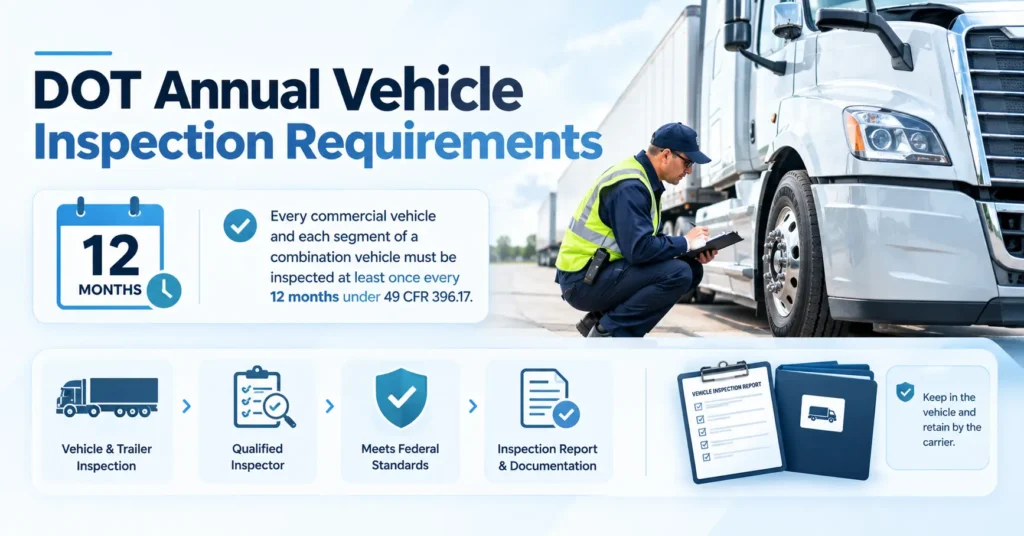
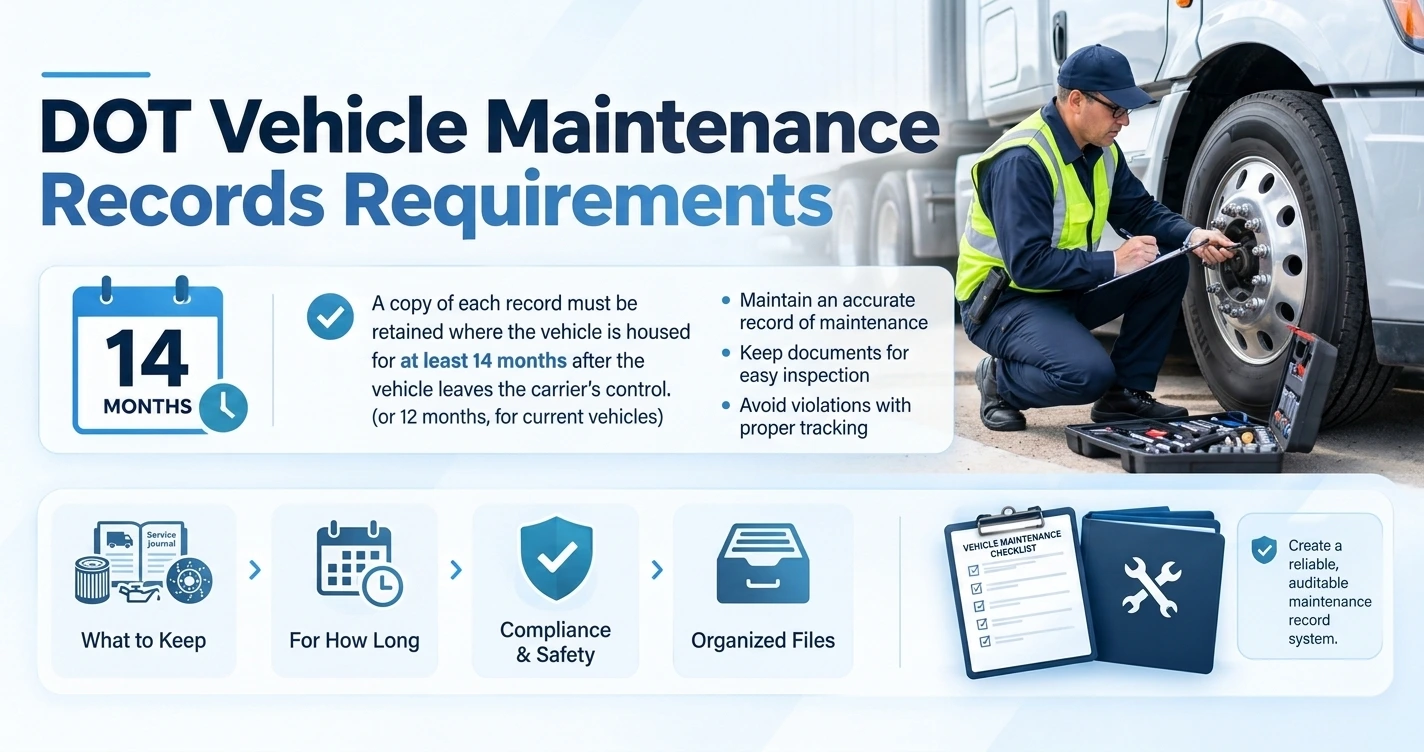
Short answer: Under 49 CFR Part 396, a motor carrier must keep a maintenance record for each CMV it controls for 30 days or more, showing the vehicle, the schedule of upcoming inspections and maintenance, and the date and nature of work done. Those records stay for 1 year, and 6 months after the vehicle leaves your control. Carriers must also keep driver vehicle inspection reports (DVIRs) for 3 months, annual inspection reports for 14 months, and roadside inspection reports for 12 months.
Maintenance records are how a carrier proves its trucks were maintained. During a compliance investigation, an FMCSA investigator does not inspect your fleet’s history. They read it. If the work was done but not documented, the investigator has no way to give you credit for it.
This guide maps each maintenance activity to the record it creates, how long you must keep it, and how investigators use it. For the violations side of the topic, see our guide to DOT vehicle maintenance violations.
Who Must Keep DOT Maintenance Records?
Every motor carrier subject to Part 396 must systematically inspect, repair, and maintain the CMVs under its control, and keep records proving it. The general duty is in 49 CFR 396.3(a). It covers owned, leased, and rented vehicles alike.
The written record requirement in 396.3(b) applies to each vehicle a carrier controls for 30 consecutive days or more. Short-term rentals under 30 days still have to be safe and maintained, but the carrier does not have to build a full 396.3(b) file for them.
A few details on scope:
- Leased and rented trucks. If you do not own the vehicle, the record must also name the person who supplied it. You can have the lessor or a vendor keep the records (“cause to be maintained”), but you remain responsible for them.
- Who is covered. Part 396 is part of the FMCSRs, so it applies to CMVs in interstate commerce. Intrastate carriers follow their state’s version, which often mirrors these rules. See our guide to DOT recordkeeping requirements for how maintenance files fit with your other required records.
- Owner-operators. A carrier running its own authority keeps its own maintenance file. A leased-on owner-operator usually supplies records to the carrier whose authority they run under, depending on the lease terms.
Maintenance Activity to Record: The Retention Map
Each maintenance activity in Part 396 produces a specific record with its own retention period and storage location. This table maps them. All citations are to 49 CFR Part 396.
| Maintenance Activity | Record It Creates | Keep For | Where | Rule |
|---|---|---|---|---|
| Scheduled inspection, repair, and maintenance | Vehicle maintenance file: ID, due-date schedule, dated work history | 1 year, and 6 months after the vehicle leaves your control | Where the vehicle is housed or maintained | 396.3(b), (c) |
| Driver’s end-of-day inspection | Driver vehicle inspection report (DVIR), when defects are found | 3 months from the report date | Carrier’s files | 396.11(a) |
| Repair of DVIR defects | Repair certification on the DVIR, and the next driver’s signed review | 3 months, with the DVIR | Carrier’s files | 396.11(a)(3), 396.13 |
| Annual (periodic) inspection | Periodic inspection report | 14 months from the inspection | Where the vehicle is housed or maintained | 396.17, 396.21 |
| Annual inspection proof on the truck | Inspection report or decal | Until the next annual inspection | On the vehicle | 396.17(c) |
| Annual inspector qualification | Evidence the inspector is qualified | While they inspect for you, plus 1 year | Carrier’s files | 396.19(b) |
| Brake inspection and repair by your inspectors | Evidence of brake inspector qualification | While employed as brake inspector, plus 1 year | Principal place of business or inspector’s work location | 396.25(e) |
| Roadside inspection | Inspection report with carrier certification that violations were fixed (within 15 days) | 12 months from the inspection | Principal place of business or where the vehicle is housed | 396.9(d) |
Two patterns stand out. First, the three “inspection” records run on different clocks: 3, 12, and 14 months. Second, inspector qualification records outlast the inspector, so they cannot be thrown out when someone leaves.
How a Maintenance Record Becomes Audit Evidence
Every maintenance record has a life cycle: the work happens, someone documents it, the file is kept for the required period, and an investigator may later use it to test your maintenance program. A break at any stage leaves a gap.
Add Wdiget
Here is how that chain works for one defect:
- Activity. A driver notes a cracked mirror bracket on the end-of-day DVIR. Your shop replaces it the next morning.
- Record. The mechanic certifies the repair on the DVIR. The next driver reviews and signs it before driving. The repair also goes into the truck’s 396.3 maintenance file.
- Retention. The DVIR with its signatures stays on file for 3 months. The maintenance file entry stays for at least 1 year.
- Audit use. If that truck is later cited at roadside for a mirror defect, an investigator can compare the inspection report with your DVIRs and repair records to see whether the defect was reported, fixed, and documented.
What Each Maintenance Record Must Contain
FMCSA sets minimum contents for each record. A file that exists but is missing a required element can still be cited.
Vehicle maintenance file (396.3(b))
For each CMV controlled 30 days or more:
- Vehicle identification: company unit number (if marked), make, serial number (VIN), and year. For a vehicle you do not own, the name of the person who furnished it.
- A schedule: a way to show the nature and due date of upcoming inspections and maintenance, such as PM intervals by mileage or date.
- A work history: a record of inspections, repairs, and maintenance with the date and nature of each.
- For buses only: records of tests on pushout windows, emergency doors, and emergency door marking lights.
The schedule is easy to overlook. A pile of repair invoices shows what was fixed, but not that inspections were planned.
Driver vehicle inspection report (396.11)
At the end of each day’s work, the driver reports on each vehicle driven, covering at least service brakes and trailer brake connections, parking brake, steering, lights and reflectors, tires, horn, wipers, mirrors, coupling devices, wheels and rims, and emergency equipment. The report must identify the vehicle, list any defect, and be signed by the driver.
- No defects, no report. The current rule says drivers do not have to prepare a DVIR if no defect is found or reported to them.
- Repairs are certified on the report. Before the vehicle runs again, the carrier must repair any defect likely to affect safe operation and certify on the DVIR that it was repaired or that repair was unnecessary.
- The next driver signs off. Under 396.13, the next driver reviews the last DVIR and signs to acknowledge the review and the certified repairs.
- Exceptions. The DVIR rules in 396.11(a) do not apply to a private motor carrier of passengers (nonbusiness), a driveaway-towaway operation, or a motor carrier operating only one CMV.
Annual inspection report (396.21)
The report must identify the inspector, the carrier, the date, and the vehicle, list the components inspected, describe the results (including any component that fails the Appendix A standards), and certify the inspection was performed under 396.17. Proof of the inspection, either the report or a decal showing the date, carrier, vehicle, and a pass certification, must be on the vehicle.
Inspector qualification evidence (396.19, 396.25)
If your own people perform annual inspections or brake work, keep proof they meet the qualification standards. A brake inspector who passed the CDL air brake knowledge and skills test does not need separate evidence for the brake inspections that test covers.
How Investigators Use Maintenance Records
In a compliance investigation, FMCSA uses maintenance records to decide whether a carrier has a working maintenance program. Missing or incomplete records can count as critical violations, which feed directly into the carrier’s safety rating.
FMCSA’s safety rating process in Appendix B to Part 385 lists six Part 396 violations as acute or critical:
| Regulation | Violation | Type |
|---|---|---|
| 396.3(b) | Failing to keep minimum records of inspection and vehicle maintenance | Critical |
| 396.11(a) | Failing to require a driver to prepare a DVIR | Critical |
| 396.17(a) | Using a CMV not periodically inspected | Critical |
| 396.9(c)(2) | Operating a vehicle declared out of service before repairs were made | Acute |
| 396.11(a)(3) | Failing to correct out-of-service defects listed on a DVIR before the vehicle runs again | Acute |
| 396.17(g) | Failing to promptly repair parts that do not meet periodic inspection standards | Acute |
An acute violation is serious enough to require immediate correction whenever it is found. A critical violation points to a breakdown in the carrier’s management controls, and FMCSA looks for a pattern of it.
A maintenance records review typically covers three steps:
- Sample the files. Pull maintenance files, DVIRs, and annual inspection reports for a selection of vehicles.
- Check completeness. Is each required element present? Are retention periods met? Is there a schedule, not just repair history?
- Cross-check against other data. Compare roadside inspection reports, out-of-service orders, and DVIRs with repair records to see whether defects were caught and fixed.
The same records help you outside an audit. Complete repair and DVIR records support a DataQs challenge when an inspection report is wrong, and they show a pattern of care if a crash is ever litigated.
Electronic Records and Organizing Your Maintenance File
Yes, DOT maintenance records can be electronic. Under 49 CFR 390.32, any document the FMCSRs require may be created, kept, and signed electronically, as long as it accurately reflects the required information, can be retained, and can be accurately reproduced within the required timeframes for anyone entitled to see it. Electronic signatures are allowed for DVIRs and repair certifications.
That means fleet maintenance software, telematics DVIR apps, and scanned paper all work, provided you can pull up the record when asked. The proof of annual inspection on the vehicle is the exception to “go digital” thinking: it must be physically on the vehicle, either as the report or a decal.
A practical file structure (recommended, not required):
- One folder per unit, named by unit number and VIN, holding the 396.3 file: identification, PM schedule, and work history.
- Annual inspection reports in the same unit folder, with the next due date tracked on a calendar or in your software.
- DVIRs by month, so the 3-month purge is simple and you never discard a report early.
- Roadside inspection reports with the signed certification of repairs, filed by date, kept 12 months.
- A personnel-style folder per inspector for annual and brake inspector qualifications, kept 1 year past their last inspection.
- A retention calendar that flags when each record type can be discarded, including the 6-month tail after a truck is sold or returned.
The retention periods are minimums. Some carriers keep maintenance histories for the life of the vehicle for warranty, resale, or litigation reasons, which is a business choice.
Build a Maintenance File That Holds Up
Good maintenance and good maintenance records are two different jobs. A carrier can do the first well and still fall short on the second: no PM schedule in the file, DVIRs without repair certifications, or annual inspection reports that cannot be found.
SafeRoad Compliance helps owner-operators and small fleets set up maintenance file systems, retention calendars, and audit-ready recordkeeping as part of broader DOT compliance services. If you want your maintenance files reviewed before an investigator does it, contact SafeRoad Compliance.
Don’t Let Compliance
Slow Your Business Down.
Stay organized, keep required records current, and stay ahead of important DOT compliance requirements with professional support.
This article is general information about federal maintenance recordkeeping rules. It is not legal advice. Intrastate carriers should confirm their state’s adopted rules.
DOT Maintenance Records FAQ
Vehicle maintenance records under 396.3 must be kept for 1 year where the vehicle is housed or maintained, and for 6 months after the vehicle leaves your control. Other records have their own periods: DVIRs 3 months, annual inspection reports 14 months, and roadside inspection reports 12 months.
Three months from the date the report was prepared, along with the repair certification and the next driver’s signed review.
Only when they find or are told about a defect or deficiency. Under the current rule, drivers do not have to prepare a DVIR when no defect is found. Drivers must still inspect and be satisfied the vehicle is safe before driving.
The DVIR requirements in 396.11(a) do not apply to a motor carrier operating only one CMV. That carrier still has to keep 396.3 maintenance records and pass an annual inspection.
14 months from the inspection date, at the place where the vehicle is housed or maintained. Proof of the current inspection must also be on the vehicle.
Yes. 49 CFR 390.32 allows electronic records and signatures if they accurately reflect the required information and can be reproduced when needed.
If you control it for 30 consecutive days or more, yes, and the record must name who furnished the vehicle. You can have the lessor keep the records, but you remain responsible for them.
Failing to keep minimum inspection and maintenance records under 396.3(b) is a critical violation in FMCSA’s safety rating process. A pattern of critical violations can affect the carrier’s safety rating.