Disclosure: Informational only. We are not FMCSAor USDOT. Always verify your status directly through official FMCSA systems.
Introduction: Why Confusing IFTA and IRP Can Cost You
Many interstate carriers assume IFTA and IRP are interchangeable. That misunderstanding is one of the most expensive compliance mistakes in the trucking industry.
Mixing up fuel tax reporting with vehicle registration can lead to incorrect filings, penalties, and even audits. For fleets operating across multiple U.S. states, the distinction is not just technical, it directly impacts your bottom line.
The reality is simple:
IFTA and IRP serve completely different purposes, yet they rely on similar data like mileage and jurisdiction tracking. This overlap is exactly where most errors happen.
If you are already familiar with what is IFTA, then this article will help you clearly understand how both systems work together, where they differ, and how to stay fully compliant.
What is IFTA? (Fuel Tax Reporting Explained)
The International Fuel Tax Agreement (IFTA) simplifies fuel tax reporting for carriers operating in multiple jurisdictions across the United States and Canada.
Instead of filing separate fuel tax reports for each state, carriers submit a single quarterly report through their base jurisdiction. This report calculates how much fuel tax is owed or credited based on miles traveled in each state.
Key components of IFTA include:
- Quarterly fuel tax filings
- Mileage tracking by jurisdiction
- Fuel purchase documentation
- Tax rate calculations per state
IFTA is directly tied to fuel usage, not vehicle registration.
For a detailed breakdown, refer to:
IFTA reporting guide.
Insight:
- IFTA ensures states receive the correct fuel tax based on where fuel is consumed, not purchased
Without proper IFTA reporting, carriers risk overpaying or underpaying taxes, both of which can lead to compliance issues.
What is IRP? (Vehicle Registration Explained)
The International Registration Plan (IRP) is a vehicle registration system that allows commercial vehicles to operate across multiple jurisdictions with a single registration.
Instead of registering your truck in every state separately, IRP distributes registration fees based on the distance traveled in each state.
Key features of IRP include:
- Annual vehicle registration
- Apportioned license plates
- Mileage-based fee distribution
- Jurisdictional reporting
Unlike IFTA, IRP focuses on vehicle registration fees, not fuel taxes.
Insight:
- IRP ensures fair distribution of registration fees based on actual road usage
Carriers must renew IRP annually and maintain accurate mileage records to ensure proper fee calculation.
IFTA vs IRP: Core Differences Explained
Understanding the difference between IFTA vs IRP is essential for compliance.
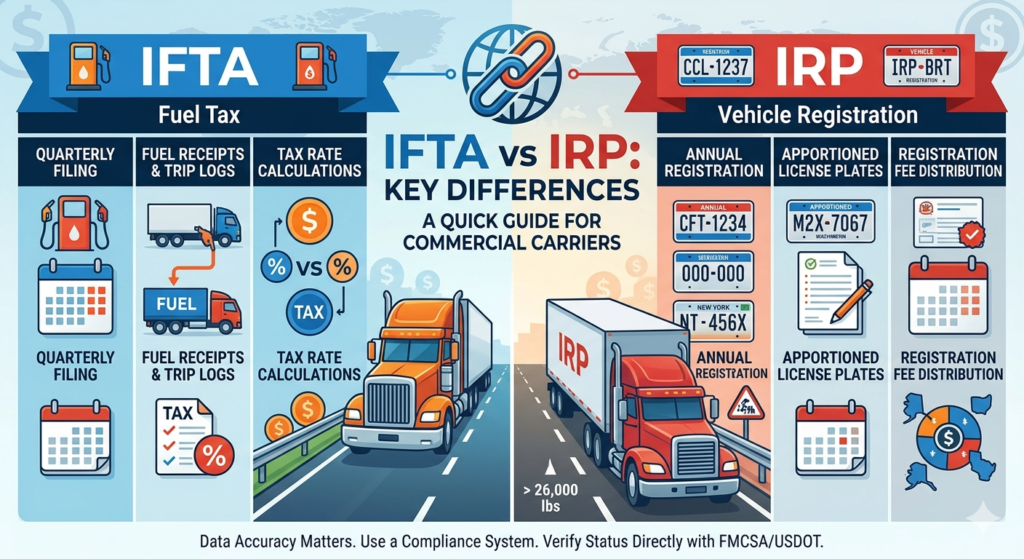
Here’s a clear comparison:
Purpose:
- IFTA → Fuel tax reporting
- IRP → Vehicle registration
Filing Frequency:
- IFTA → Quarterly
- IRP → Annually
Focus Area:
- IFTA → Fuel consumption
- IRP → Mileage-based registration fees
Documentation:
- IFTA → Fuel receipts, trip logs
- IRP → Mileage records, registration documents
Authority:
- Both are managed through your base state jurisdiction
Insight:
- While both systems rely on mileage data, they use it for completely different calculations
Mixing these systems is a common mistake that leads to reporting errors.
How IFTA and IRP Work Together
Although different, IFTA and IRP are closely connected. Both rely on accurate mileage tracking across jurisdictions.
For example:
- The same trip data used for IFTA fuel tax reporting is also used for IRP fee calculation
- Inconsistent mileage data can trigger discrepancies in both systems
- Audits often cross-check IFTA and IRP records
This is why carriers must maintain consistent and accurate records.
If your mileage reports do not align, it raises red flags and increases audit risk.
For deeper insights on avoiding errors, check IFTA reporting mistakes.
Pro Tip:
- Always reconcile mileage data before using it for both IFTA and IRP
Consistency is the key to staying compliant across both systems.
Common Mistakes Carriers Make with IFTA vs IRP
Many compliance issues arise from misunderstanding how these systems differ.
Here are the most common mistakes:
- Using the same reports without verification
- Misclassifying fuel tax as registration fees
- Failing to track jurisdiction-specific mileage
- Ignoring reconciliation between systems
- Poor recordkeeping practices
Real-world scenario:
A fleet submits accurate IFTA reports but inconsistent IRP mileage. During an audit, discrepancies are found, resulting in penalties and additional scrutiny.
To avoid such issues, review your audit readiness here:
IFTA audit checklist
Insight:
- Most compliance failures are process-related, not knowledge-related
Fixing your systems can eliminate most risks.
Recordkeeping Requirements for Both IFTA and IRP
Proper documentation is critical for both IFTA and IRP compliance.
For IFTA:
- Fuel receipts
- Trip reports
- Tax filings
- Fuel summaries
For IRP:
- Mileage records
- Vehicle registration documents
- Distance summaries
Best practices include:
- Maintaining records for at least 4 years
- Using digital storage systems
- Organizing records by quarter and vehicle
Pro Tip:
- Centralized recordkeeping ensures faster audits and fewer errors
Accurate records protect your business from penalties and improve operational efficiency.
Pro Tips to Stay Compliant with IFTA and IRP
Staying compliant requires more than just filing reports.
Here are expert tips:
- Use ELD or GPS systems for accurate mileage tracking
- Automate fuel tax calculations
- Reconcile data before submission
- Conduct internal audits regularly
- Train drivers on compliance requirements
Insight:
- Technology is the biggest advantage modern fleets have in compliance
Fleets that invest in automation and systems experience fewer errors and better efficiency.
Conclusion: Simplify Compliance and Avoid Costly Mistakes
Understanding IFTA vs IRP is essential for every interstate carrier. While they may seem similar, confusing the two can lead to serious compliance issues.
The key is having accurate data, strong systems, and a clear process for managing both fuel tax reporting and vehicle registration.
If you want to eliminate errors and streamline your compliance, it is time to take a smarter approach.
Start optimizing your operations today with professional IFTA reporting and ensure your fleet stays compliant, efficient, and audit-ready year-round.
Schedule your IFTA consultation today.
Key Takeaways
- IFTA and IRP serve completely different purposes
- IFTA focuses on fuel tax, IRP focuses on registration fees
- Both rely on accurate mileage tracking
- Errors often occur when data is not reconciled
- Strong recordkeeping is essential for compliance
- Automation reduces errors and improves efficiency
FAQs
IFTA is for fuel tax reporting, while IRP is for vehicle registration and fee distribution.
Yes, interstate carriers operating across multiple states typically require both.
IFTA is filed quarterly, while IRP is renewed annually.
Yes, but it must be accurate and reconciled to avoid discrepancies.
You may face penalties, audits, and incorrect tax or fee calculations.
Use automation tools, maintain accurate records, and reconcile data regularly.