Disclosure: Informational only. We are not FMCSA or USDOT. Always verify your status directly through official FMCSA systems.
DOT compliance documentation can become difficult to manage when driver records, vehicle records, and company records are stored together without a clear structure.
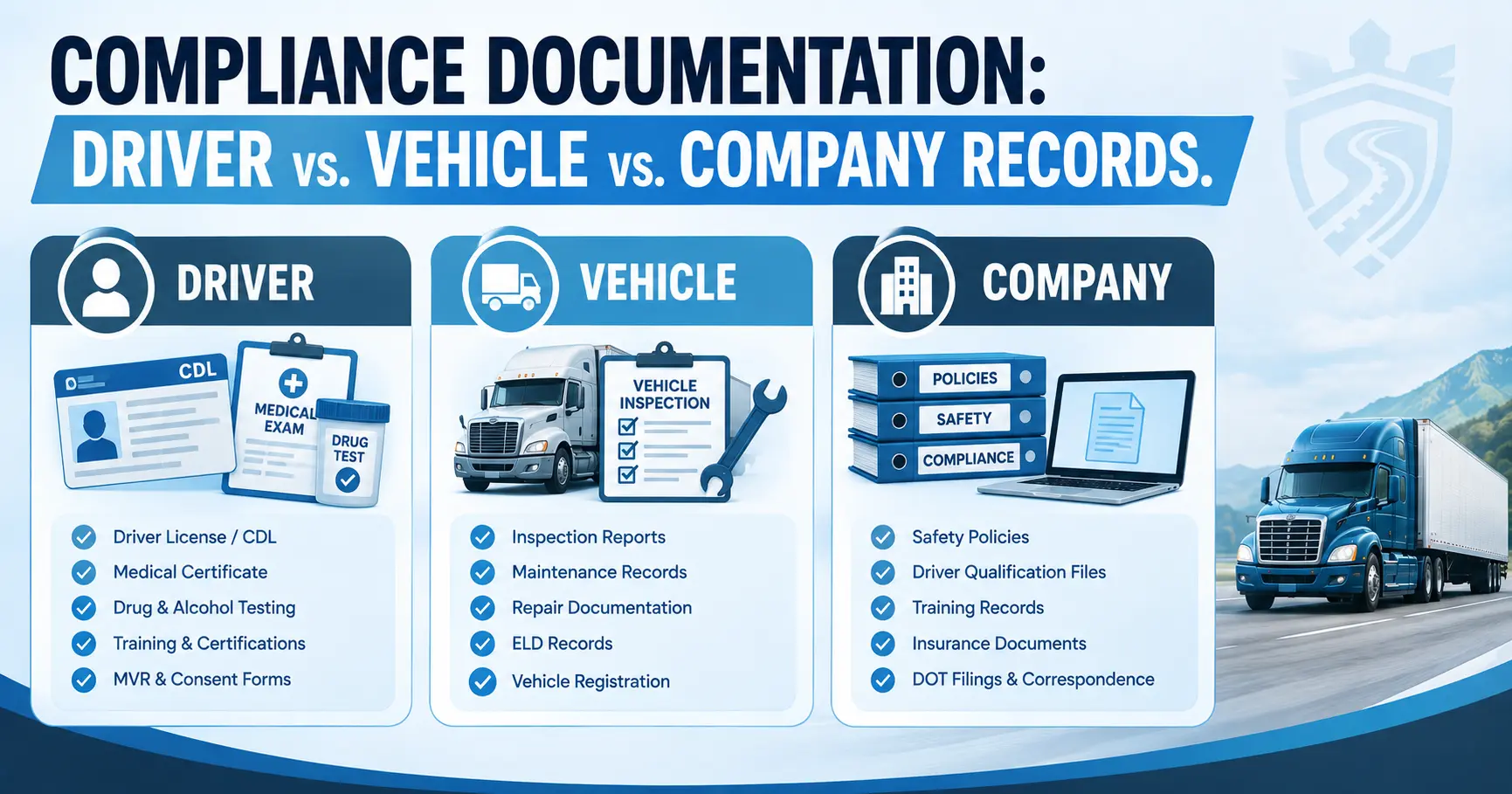
For a trucking company, these records are connected, but they serve different compliance purposes. A driver record documents the qualifications and compliance history of a person. A vehicle record documents the condition, inspection, maintenance, and operating history of equipment. A company record documents the carrier’s overall registration, operating authority, policies, systems, and compliance activities.
Understanding these categories helps carriers organize their compliance records, locate evidence faster, and build a more consistent DOT compliance system.
What Are Driver, Vehicle, and Company Records?
The simplest way to understand DOT compliance documentation is to separate records according to the entity they describe.
| Record Category | Primarily Describes | Examples |
|---|---|---|
| Driver Records | A specific driver | DQ file, MVR, medical qualification records, training records |
| Vehicle Records | A specific vehicle or equipment unit | Inspection records, maintenance records, repair records |
| Company Records | The motor carrier as an organization | USDOT registration, operating authority, policies, audit records |
These categories should not be viewed as completely independent.
A driver operates a vehicle. The vehicle operates under a carrier. The carrier is responsible for maintaining systems and records that connect these activities.
That relationship creates a useful compliance documentation structure:
Company → Driver → Vehicle → Compliance Evidence
Why the Record Category Matters
When a carrier receives a DOT compliance request, the first question should not always be:
“Where is the document?”
A better question is:
“Which entity does this document belong to?”
This distinction makes records easier to classify and retrieve.
For example:
- An MVR primarily belongs to the driver record.
- A brake inspection belongs to the vehicle record.
- A USDOT registration record belongs to the company record.
- A driver training record belongs to the driver record.
- A vehicle maintenance invoice belongs to the vehicle/equipment record.
- A company drug and alcohol policy belongs to the company compliance system, while individual testing documentation may relate to specific drivers.
The category helps determine where the document should live and how it should be connected to other evidence.
Driver Records
Driver records contain documentation associated with an individual commercial driver.
For many motor carriers, the driver’s qualification file is the central driver-record structure. Other compliance information may be connected to that driver without necessarily being the same document or record type.
Common Driver Records
Depending on the driver’s role and applicable requirements, driver-related documentation may include:
- Driver application
- Motor vehicle record (MVR)
- Driver’s license or CDL documentation
- Medical qualification documentation
- Road test documentation or equivalent qualification evidence
- Safety performance history information
- Required training documentation
- Driver qualification reviews
- Annual driving-record review documentation
- Drug and alcohol compliance records
- Clearinghouse-related records
- Driver disciplinary or corrective-action documentation, when applicable
The exact records required depend on the driver’s circumstances and the regulations applicable to the carrier.
The Driver Is the Primary Entity
A useful information-architecture rule is:
If the document primarily answers “Is this person qualified and compliant to perform the applicable driving work?” it probably belongs in the driver-record structure.
For example, an MVR tells the carrier about the driver’s driving history.
A medical qualification record addresses the driver’s medical qualification.
A training record documents training completed by that individual.
These documents may support different regulatory requirements, but they share the same primary entity: the driver.
Driver Records Can Connect to Other Records
A driver record should not be treated as an isolated folder.
For example:
Driver: John Smith
→ CDL information
→ MVR
→ Medical qualification
→ Training
→ Drug & alcohol records
→ Clearinghouse records
→ Assigned vehicle history
The final connection does not mean the vehicle’s maintenance records become part of John’s driver qualification file.
Instead, it establishes a relationship between the driver and the equipment operated.
That distinction becomes important when organizing compliance information at scale.
Vehicle Records
Vehicle records document a carrier’s equipment and its inspection, maintenance, and operating condition.
A vehicle record should generally be organized around the specific unit, rather than the driver who happens to operate it.
Common Vehicle Records
Depending on the equipment and applicable requirements, vehicle-related records may include:
- Vehicle identification information
- Inspection records
- Periodic inspection documentation
- Maintenance records
- Repair records
- Parts or service documentation
- Defect reports
- Annual inspection documentation
- Maintenance schedules
- Roadside inspection documentation
- Vehicle-related corrective actions
A carrier may also maintain records for trailers and other equipment separately or within an equipment-management system.
The Vehicle Is the Primary Entity
A useful classification question is:
“Does this document tell us something about the condition, inspection, maintenance, or history of this piece of equipment?”
If the answer is yes, it generally belongs within the vehicle/equipment record structure.
For example, if Truck 102 receives brake repairs, the repair documentation should be associated with Truck 102.
It should not become part of whichever driver’s permanent qualification record simply because that driver operated the truck.
Vehicle Records Follow the Equipment
Drivers can change.
Vehicles can be reassigned.
Equipment can move between drivers, terminals, or operating locations.
The vehicle record therefore needs to remain connected to the equipment itself.
A simple structure could look like:
Vehicle: Unit 102
→ Vehicle identification
→ Inspection history
→ Maintenance history
→ Repairs
→ Defects
→ Corrective actions
→ Related inspection evidence
This allows a carrier to understand the compliance history of the equipment independently from the people who operated it.
Company Records
Company records operate at a broader level.
Instead of describing one driver or one vehicle, these records describe the motor carrier’s organization, authority, policies, systems, and overall compliance program.
Common Company Records
Examples can include:
- USDOT registration information
- Operating authority documentation
- BOC-3 documentation
- Insurance filings
- UCR documentation
- MCS-150 information
- Company policies
- Compliance procedures
- Drug and alcohol program policies
- Audit correspondence
- Corrective action documentation
- Company-level training procedures
- Compliance program records
- Regulatory correspondence
The specific records required depend on the carrier’s operations and applicable regulations.
The Company Is the Primary Entity
A useful question is:
“Does this document describe how the carrier operates or demonstrates the carrier’s overall regulatory status or compliance system?”
If so, it generally belongs to the company-level record structure.
For example, a BOC-3 filing identifies process-agent designations associated with the carrier’s operating authority.
A company drug and alcohol policy describes the carrier’s program.
A DOT audit response concerns the carrier’s compliance position.
These are fundamentally different from a specific driver’s MVR or a specific truck’s maintenance record.
Driver vs. Vehicle vs. Company Records
The three categories become easier to distinguish when viewed side by side.
| Question | Driver Record | Vehicle Record | Company Record |
|---|---|---|---|
| Who or what does it describe? | Individual driver | Specific equipment | Motor carrier |
| Primary purpose | Qualification and driver compliance | Equipment safety and maintenance | Organizational and regulatory compliance |
| Typical identifier | Driver name/ID | Unit number/VIN | Legal entity/USDOT number |
| Examples | MVR, medical qualification, DQ documentation | Inspections, repairs, maintenance | Registration, authority, policies |
| Can it connect to another category? | Yes | Yes | Yes |
| Should it be stored only by another entity? | No | No | No |
The important concept is that a record can have relationships with multiple entities while still having one primary record category.
How the Three Record Categories Connect
Consider a carrier with:
- Company: ABC Transport LLC
- Driver: John Smith
- Vehicle: Unit 102
The compliance structure could look like this:
ABC Transport LLC
↳ John Smith
↳ MVR
↳ Qualification records
↳ Medical qualification
↳ Training
↳ Unit 102
↳ Inspection records
↳ Maintenance records
↳ Repair records
↳ Company Compliance
↳ Registration
↳ Operating authority
↳ Policies
↳ Audit records
John may operate Unit 102, but that does not mean Unit 102’s maintenance history belongs in John’s DQ file.
Likewise, John’s MVR does not become a company-level record simply because the company obtained it.
The records are related, but they remain different entities.
A Practical DOT Compliance Record Taxonomy
For information-architecture purposes, carriers can build their compliance system around three primary levels.
Level 1: Company
Company → Compliance Programs → Regulatory Records
Examples:
- USDOT
- Operating authority
- BOC-3
- Insurance
- UCR
- MCS-150
- Policies
- Audits
Level 2: Driver
Company → Drivers → Individual Driver → Qualification & Compliance Records
Examples:
- DQ documentation
- MVR
- Medical qualification
- Training
- Drug & alcohol documentation
- Clearinghouse-related records
Level 3: Vehicle
Company → Equipment → Individual Unit → Inspection & Maintenance Records
Examples:
- Vehicle inspections
- Maintenance
- Repairs
- Defects
- Corrective actions
This structure creates a clear hierarchy without forcing every document into one large “DOT compliance” folder.
What About Records That Involve More Than One Entity?
Some compliance records naturally connect multiple entities.
For example, a roadside inspection can involve:
- The carrier
- A specific driver
- A specific vehicle
- A particular inspection event
Instead of duplicating the same document in three or four folders, treat the inspection as an event record and associate it with the relevant entities.
Conceptually:
Roadside Inspection
→ Company: ABC Transport LLC
→ Driver: John Smith
→ Vehicle: Unit 102
→ Inspection date
→ Inspection findings
→ Corrective action, if applicable
This approach reduces duplicate documents while preserving the relationships needed to understand the event.
Records vs. Events vs. Entities
This distinction can make a compliance system much easier to manage.
Entity
An entity is the person, vehicle, or company being tracked.
Examples:
- Driver
- Vehicle
- Motor carrier
Record
A record is documentation associated with an entity.
Examples:
- MVR
- Maintenance record
- Operating authority documentation
Event
An event is something that happened and may involve multiple entities.
Examples:
- Roadside inspection
- Crash
- DOT audit
- Driver training event
- Vehicle repair
This creates a stronger compliance information model:
Entity → Record → Event → Evidence
Not every compliance system needs to be technically complex. The purpose of this model is simply to make relationships clear.
Why This Structure Helps During a DOT Audit
A well-organized record system can make it easier to locate supporting documentation when an auditor or regulator requests information.
For example, if the request concerns a driver, the carrier can begin with the driver’s record structure.
If the request concerns vehicle maintenance, the carrier can move directly to the relevant unit.
If the request concerns company registration or operating authority, the carrier can access the company-level records.
This prevents a common problem:
Searching the entire compliance archive for one document without knowing which entity it belongs to.
A clear taxonomy turns compliance documentation into an organized system rather than a collection of files.
Common Record-Organization Mistakes
Putting Everything Under “DOT Compliance”
A single folder called “DOT Compliance” may work for a very small operation, but it becomes difficult to manage as the fleet grows.
Separate company, driver, and vehicle structures make retrieval easier.
Filing Vehicle Records Under Driver Names
Drivers change vehicles.
If maintenance records are stored only under driver names, the equipment’s historical record becomes difficult to reconstruct.
Treating Every Document as a Driver Record
Not every document involving a driver belongs in the DQ file.
A vehicle inspection involving a driver does not automatically become a driver qualification document.
Duplicating Every Document
Duplicating the same file across company, driver, and vehicle folders can create version-control problems.
Where practical, maintain one authoritative record and establish relationships to the relevant entities.
Ignoring Identifiers
Consistent identifiers make compliance systems easier to navigate.
Useful identifiers include:
- Driver ID or full legal name
- Unit number
- VIN
- USDOT number
- Company legal name
Mixing Current and Historical Information
A record system should make it possible to distinguish current information from historical documents.
For example, a vehicle may have multiple repair events over several years. Those events should remain associated with the same unit without being confused with its current condition.
A Simple Compliance Documentation Workflow
Carriers can use a basic classification workflow whenever a new compliance document is received.
Step 1: Identify the Primary Entity
Ask whether the document primarily concerns:
A driver, a vehicle, or the company?
Step 2: Assign the Record Type
Examples:
- Driver → MVR
- Vehicle → Maintenance
- Company → Registration
Step 3: Identify Related Entities
Determine whether another driver, vehicle, company program, or event should be linked to the record.
Step 4: Record the Relevant Date
Use the appropriate document or event date so the record can be located chronologically.
Step 5: Store the Authoritative Version
Avoid unnecessary duplicate copies.
Step 6: Make the Record Retrievable
A compliance document is most useful when the carrier can quickly find it when needed.
Information Architecture Example for a Small Fleet
A practical digital structure might look like:
Company Compliance
- Registration & Authority
- Insurance
- BOC-3
- UCR
- Policies
- Audits & Corrective Actions
Drivers
- Driver 001
- Qualification
- MVR
- Medical
- Training
- Drug & Alcohol
- Driver 002
- Qualification
- MVR
- Medical
- Training
- Drug & Alcohol
Vehicles
- Unit 101
- Inspections
- Maintenance
- Repairs
- Unit 102
- Inspections
- Maintenance
- Repairs
Events
- Roadside Inspections
- Crashes
- Corrective Actions
- Other Compliance Events
The exact structure can vary by carrier, but the underlying principle remains the same: organize records around the entities and events they describe.
How a Compliance Portal Can Support This Structure
A DOT compliance system can make this taxonomy easier to maintain when records are indexed by driver, vehicle, and company.
Instead of relying on folders alone, a carrier can use searchable profiles and linked records so that one document can be associated with the correct entity without creating unnecessary duplicates.
For example, selecting a driver profile could provide access to that driver’s qualification and compliance records, while selecting a vehicle could provide its inspection and maintenance history.
The goal is not simply to store more documents.
The goal is to make the right compliance evidence easy to identify and retrieve.
For a broader overview of DOT recordkeeping requirements, see DOT Recordkeeping Requirements for Trucking Companies. You can also review DOT Compliance Records for additional context on maintaining compliance documentation.
Let Our DOT Compliance System Help
Simplify compliance tracking, organize records, and stay ahead of important DOT requirements.
FAQs
A useful organizational model separates records into driver records, vehicle records, and company records. Driver records concern individual drivers, vehicle records concern specific equipment, and company records concern the motor carrier’s overall regulatory and compliance activities.
An MVR is primarily a driver record because it documents an individual’s motor vehicle history. The carrier may obtain and review the MVR, but the record describes the driver.
Generally, no. Vehicle maintenance records primarily belong to the vehicle or equipment record. A driver may be associated with a maintenance or inspection event, but that does not automatically make the vehicle record part of the driver’s DQ file.
Examples can include USDOT registration information, operating authority documentation, BOC-3 records, insurance filings, company policies, audit correspondence, and other documentation concerning the carrier as an organization.
Yes. Some events, such as roadside inspections or crashes, can involve a company, driver, and vehicle. The record can be associated with all relevant entities while retaining a clear record type and primary purpose.
Separating them keeps documentation tied to the correct entity. Drivers can change vehicles and vehicles can be assigned to different drivers, so maintaining independent records preserves the historical relationship between people, equipment, and compliance events.
Not necessarily. Duplicating documents across multiple folders can create version-control problems. A better approach is often to maintain one authoritative record and associate it with the relevant driver, vehicle, company, or event.
There is no single folder structure that fits every carrier. A practical approach is to organize information around the primary entities, company, driver, and vehicle, and then connect event-based records such as inspections, crashes, audits, and corrective actions to the entities involved.