Disclosure: Informational only. We are not FMCSA or USDOT. Always verify your status directly through official FMCSA systems.
The Real Cost of Staying Compliant Without Software
Running a trucking company involves much more than keeping trucks on the road. Every driver, vehicle, inspection, qualification file, maintenance record, and regulatory deadline creates another compliance responsibility. Missing even one requirement can result in violations, penalties, operational disruptions, or increased scrutiny during a DOT audit.
For many carriers, compliance begins with spreadsheets, paper files, calendar reminders, and shared folders. That approach may work when managing a single truck or a small operation. As fleets grow, however, manual processes often become harder to maintain, increasing the risk of missed deadlines and incomplete documentation.
This raises an important question:
Is DOT compliance software actually worth the investment, or is it just another business expense?
The answer depends on several factors, including your fleet size, compliance workload, internal processes, and long-term growth plans. While software is not mandatory under Federal Motor Carrier Safety Administration (FMCSA) regulations, many carriers adopt it to organize records, automate reminders, improve audit readiness, and reduce administrative burdens.
This guide explains:
- What DOT compliance software actually does
- The true cost of manual compliance
- When software provides measurable value
- Situations where it may not be necessary
- How to determine whether your operation is ready for a compliance platform
Whether you’re an owner-operator evaluating your first software purchase or a fleet manager looking to streamline compliance across dozens of vehicles, this guide will help you make an informed decision.
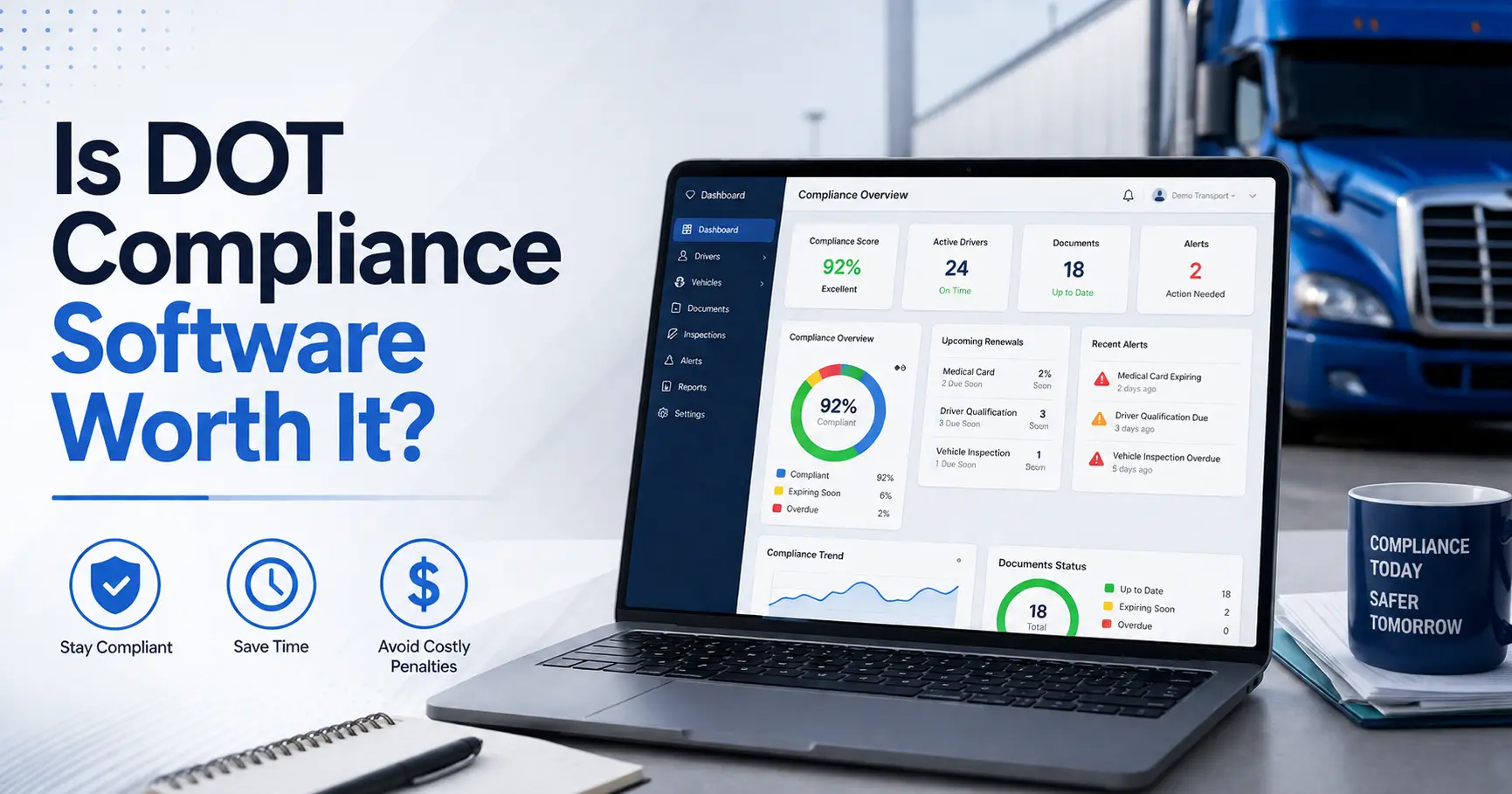
Is DOT Compliance Software Worth It?
Is DOT compliance software actually worth the investment, or is it just another business expense?
Yes. DOT compliance software is often worth the investment for fleets managing multiple drivers, vehicles, or compliance requirements. It helps organize records, automate reminders, improve audit readiness, and reduce the risk of missed compliance deadlines.
What Is DOT Compliance Software?
DOT compliance software is a digital platform designed to help motor carriers manage the records, deadlines, and documentation required to comply with FMCSA regulations.
Rather than storing compliance documents in filing cabinets, spreadsheets, or disconnected folders, software centralizes important information in one location.
Depending on the platform, it may help manage:
What DOT Compliance Software Helps Manage
| Compliance Area | Typical Software Function |
|---|---|
| Driver Qualification Files | Store and track required driver documents |
| Medical Certificates | Monitor expiration dates and send reminders |
| CDL Tracking | Record license renewals and status |
| Vehicle Maintenance | Schedule inspections and maintenance records |
| Drug & Alcohol Program | Track enrollment and testing documentation |
| Hours of Service | Integrate with ELD data where supported |
| Accident Records | Maintain required documentation |
| DOT Audit Preparation | Organize documents for quick retrieval |
| Compliance Calendar | Monitor deadlines and recurring requirements |
Instead of replacing FMCSA regulations, compliance software helps businesses manage the administrative work required to meet those obligations.
Think of it as a centralized operational system that improves visibility into compliance tasks while reducing reliance on manual reminders.
Why Manual Compliance Becomes Difficult
Many trucking businesses begin with manual compliance management because it is inexpensive and familiar.
A new authority operating one truck may only need to monitor a handful of recurring requirements each month. In that situation, spreadsheets and digital folders can often meet basic needs.
The challenge arises as operations expand.
Every new driver introduces additional qualification documents, medical certifications, annual reviews, motor vehicle records, and training records. Every additional truck increases inspection reports, maintenance schedules, and repair documentation.
At the same time, regulatory deadlines continue to accumulate.
A growing fleet may need to monitor:
- Driver qualification file updates
- Annual motor vehicle record reviews
- Medical certificate expirations
- CDL expiration dates
- Drug and alcohol testing records
- Preventive maintenance schedules
- Annual vehicle inspections
- Unified Carrier Registration (UCR) renewals
- MCS-150 biennial updates
- IFTA reporting deadlines
- IRP renewals
- Insurance documentation
Each requirement carries its own schedule, documentation standards, and retention requirements.
Without a centralized system, compliance managers often rely on:
- Excel spreadsheets
- Shared drives
- Email reminders
- Sticky notes
- Calendar alerts
- Individual employee knowledge
While these tools can work independently, they rarely provide a complete view of an organization’s compliance status.
As responsibilities become distributed across multiple employees or departments, the likelihood of overlooked deadlines or missing documentation increases.
The Hidden Cost of Manual DOT Compliance
When evaluating compliance software, many businesses compare the subscription price against the cost of continuing with their current process.
However, the more meaningful comparison is between software costs and the operational risks of manual compliance.
Manual systems often carry hidden costs that are easy to overlook because they accumulate gradually over time.
Administrative Time
Employees may spend hours each week:
- Searching for documents
- Updating spreadsheets
- Following up on missing paperwork
- Sending reminder emails
- Preparing files for audits
These recurring administrative tasks reduce the time available for higher-value work.
Missed Deadlines
Without automated reminders, businesses may overlook important compliance events such as:
- Medical certificate renewals
- Annual driver reviews
- License expirations
- Vehicle inspection schedules
- Required filings
Even a single missed deadline can create unnecessary compliance issues.
Audit Preparation Stress
During a DOT audit or compliance review, businesses must often produce records within a limited timeframe.
Organizations with paper files or scattered digital records may spend significant time locating documentation, while businesses using centralized systems can typically retrieve records much more efficiently.
Reduced Visibility
Manual tracking makes it difficult to answer simple operational questions, such as:
- Which drivers have expiring medical certificates?
- Which qualification files are incomplete?
- Which trucks are due for inspections?
- Which compliance tasks are overdue?
Without real-time visibility, problems may remain unnoticed until an audit, roadside inspection, or internal review uncovers them.
What DOT Compliance Software Typically Includes
Not all compliance platforms are the same. Some focus only on driver qualification files, while others provide a broader compliance management system.
Here are the features most carriers should evaluate:
Basic vs. Advanced DOT Compliance Software
| Feature | Basic | Advanced |
|---|---|---|
| Driver Qualification File Management | ✓ | ✓ |
| Medical Certificate Tracking | ✓ | ✓ |
| CDL Expiration Alerts | ✓ | ✓ |
| Vehicle Maintenance Scheduling | ✕ | ✓ |
| Annual Inspection Tracking | ✕ | ✓ |
| Drug & Alcohol Record Management | ✕ | ✓ |
| Audit-Ready Document Storage | ✓ | ✓ |
| Automated Reminders | ✓ | ✓ |
| Compliance Dashboard & Reporting | ✕ | ✓ |
For fleets comparing compliance tools value, the most important capabilities are usually:
- Automated expiration alerts
- Centralized document storage
- Audit-ready organization
- Driver and vehicle status visibility
- Role-based access for office staff and safety managers
These features directly affect day-to-day compliance management and audit preparation.
Cost vs. Risk: Is Software Worth the Investment?
This is the question most buyers are really asking.
The Software Cost
Most DOT compliance platforms charge a monthly or annual subscription fee. The price varies based on:
- Number of drivers
- Number of vehicles
- Features included
- User accounts
- Support level
- Integration options
For a small fleet, the annual cost may be comparable to a few hours of administrative labor each month.
The Risk Side of the Equation
The larger cost exposure often comes from compliance failures.
Potential consequences include:
- Out-of-service violations
- DOT audit findings
- Civil penalties
- Increased CSA scrutiny
- Insurance complications
- Delayed onboarding of drivers
- Lost productivity while gathering documents
- Reputational damage with shippers and brokers
A missed medical certificate or incomplete driver qualification file may seem minor until it is discovered during a roadside inspection or compliance review.
A Practical Comparison
| Manual Process | With Compliance Software |
|---|---|
| 📅 Track deadlines in spreadsheets | ✅ Automated alerts and reminders |
| 📁 Search multiple folders for documents | ✅ Centralized document storage |
| 📄 Prepare audit files manually | ✅ Audit-ready organization |
| ⚠️ Limited visibility into overdue items | ✅ Dashboard view of compliance status |
| 👤 Knowledge tied to one employee | ✅ Shared access across authorized staff |
The value becomes easier to justify when software prevents even one significant compliance issue or saves dozens of administrative hours each quarter.
Who Benefits the Most?
Not every trucking company experiences the same return on investment. The value typically increases as compliance complexity grows.
1. New Authorities (1–5 Trucks)
New carriers are often focused on dispatch, cash flow, and customer acquisition. Compliance can become reactive.
Software is usually worth it if:
- You are unfamiliar with FMCSA recordkeeping requirements
- You expect to add drivers within the next 6–12 months
- You want audit-ready files from day one
- You do not have a dedicated safety employee
It may not be necessary if:
- You are a true single-truck owner-operator
- You handle all paperwork yourself
- You have a simple operating structure
- You are comfortable managing deadlines manually
2. Growing Fleets (6–25 Trucks)
This is the group that typically sees the strongest return on investment.
At this stage:
- Multiple drivers are being onboarded
- Qualification files are growing quickly
- Maintenance tracking becomes more complex
- Administrative workload increases significantly
Recommendation: Software is usually a strong operational investment.
3. Established Fleets (25+ Trucks)
Larger fleets generally need:
- Standardized processes
- Multi-user access
- Reporting capabilities
- Integration with maintenance and ELD systems
- Central oversight across locations
For these operations, compliance software is often less about convenience and more about maintaining consistent processes at scale.
When DOT Compliance Software Is Not Worth It
While software offers substantial benefits, it is not the right solution for every operation.
Some carriers may not generate enough compliance complexity to justify the cost.
You may choose to postpone software adoption if:
You operate one truck with no employees
A single owner-operator with:
- one CDL,
- one medical certificate,
- one vehicle,
- and a manageable filing system
may be able to maintain compliance effectively without software.
You already have a reliable compliance process
If you have:
- organized digital folders,
- documented procedures,
- recurring calendar reminders,
- and regular internal reviews,
software may provide only marginal improvement.
Your operation is temporary or seasonal
A short-term operation with limited regulatory exposure may not benefit from a full compliance platform.
Warning Signs That Manual Tracking Is No Longer Working
The following warning signs often indicate that spreadsheets and paper files are becoming ineffective.
Driver Files Are Difficult to Manage
You frequently search through folders or emails to locate documents.
Deadlines Are Being Missed
Medical cards, annual reviews, inspections, or filings are occasionally overlooked.
Audit Preparation Takes Too Long
Preparing documentation for auditors requires significant effort.
Multiple Employees Manage Compliance
Compliance information is spread across several people, increasing the risk of communication gaps.
Fleet Growth Is Accelerating
As new drivers and vehicles are added, compliance administration becomes increasingly difficult.
If several of these conditions apply, compliance software may provide meaningful operational value.
DOT Compliance Software Decision Framework
Use this simple framework when evaluating your situation.
Should You Invest in DOT Compliance Software?
| Question | Yes | No |
|---|---|---|
| Do you manage multiple drivers? | Consider software | Manual may work |
| Do you manage multiple vehicles? | Consider software | Manual may work |
| Are compliance deadlines difficult to track? | Software likely beneficial | Manual may work |
| Have you experienced missing documentation? | Software likely beneficial | Lower urgency |
| Is fleet growth expected within 12 months? | Software strongly recommended | Reevaluate later |
| Do audits create significant stress? | Software likely valuable | Current process may suffice |
Expert Perspective: Focus on Risk Reduction
One of the biggest misconceptions in trucking compliance is viewing software solely as an administrative tool.
Its greatest value often comes from:
- Improving visibility
- Reducing missed deadlines
- Standardizing documentation
- Supporting audit readiness
- Helping managers identify issues earlier
In other words, software doesn’t create compliance.
People create compliance.
Software simply helps ensure important tasks are completed consistently and documented properly.
Real-World Scenarios
Which Scenario Matches Your Fleet?
| Scenario | Fleet Profile | Current Situation | Likely Decision |
|---|---|---|---|
|
🚛 Scenario 1 Owner-Operator |
• 1 Truck • Own Authority |
• Digital documents • Calendar reminders • Organized cloud folders |
Manual tracking is probably sufficient for now. |
|
🚚 Scenario 2 Small Fleet |
• 5 Drivers • 5 Trucks • 1 Office Administrator |
• Tracks expirations • Updates spreadsheets • Manages driver paperwork |
Compliance software can reduce administrative work and improve visibility. |
|
🏢 Scenario 3 Regional Carrier |
• Multi-state fleet • Growing operations |
• Driver files • Maintenance records • Drug & Alcohol program • Annual reviews • Vehicle inspections |
Compliance software is typically essential for centralized oversight and audit readiness. |
The Most Important Question
Instead of asking:
“How much does the software cost?”
Ask:
“What is the cost of missing a compliance requirement, and how much time are we spending managing compliance manually?”
That question usually leads to a more accurate business decision.
For many fleets, the value is not just avoiding penalties, it is gaining:
- better visibility,
- faster document retrieval,
- smoother onboarding,
- reduced administrative stress,
- and confidence that compliance tasks are being tracked consistently.
Questions to Ask Before Choosing DOT Compliance Software
Not every compliance platform is designed for the same type of carrier. Before investing in software, evaluate how well it fits your operation rather than focusing solely on price.
Use these questions as a decision framework.
1. Which Compliance Tasks Consume the Most Time?
Start by identifying where your team spends the most administrative effort.
For example:
- Managing Driver Qualification Files (DQFs)
- Tracking medical certificate expirations
- Monitoring CDL renewals
- Scheduling annual vehicle inspections
- Organizing maintenance records
- Preparing documents for DOT audits
- Tracking drug and alcohol program requirements
The right software should reduce manual work in these areas instead of adding another system to manage.
2. Will Your Fleet Grow Over the Next Few Years?
A spreadsheet may work for five drivers but become difficult to maintain when your fleet grows to twenty or fifty.
Consider whether the platform can support:
- Additional drivers
- More vehicles
- Multiple office users
- New terminals or locations
- Expanding compliance requirements
Choosing a scalable solution now can help avoid switching systems later.
3. Is It Easy to Find Documents?
During a DOT audit or internal review, every minute spent searching for paperwork increases stress and delays.
Ask yourself:
- Can I locate any driver document in under a minute?
- Can I quickly identify expired records?
- Can I see which compliance tasks are overdue?
If the answer is no, your current process may need improvement.
4. Does It Improve Audit Readiness?
The best compliance software doesn’t just store documents, it helps you stay prepared.
Look for features such as:
- Organized digital records
- Automatic expiration reminders
- Driver compliance dashboards
- Vehicle compliance tracking
- Secure cloud storage
- Permission-based user access
- Downloadable audit reports
These capabilities make responding to compliance reviews much more efficient.
5. What Level of Support Is Available?
Software is only part of the solution.
Consider whether the provider also offers:
- DOT compliance expertise
- Customer support
- Compliance guidance
- Regular platform updates
- Training resources
A knowledgeable support team can be especially valuable for newer carriers navigating FMCSA requirements.
Common Mistakes When Buying Compliance Software
Many fleets purchase software based on price alone. However, the lowest-cost option is not always the most cost-effective over time.
Avoid these common mistakes.
Choosing Software Based Only on Price
Less expensive software may lack essential features such as automated reminders, document management, or reporting.
Instead of asking, “What’s the cheapest option?”, ask:
“Which platform solves the compliance problems we’re actually facing?”
Buying Features You’ll Never Use
Some platforms include modules designed for very large enterprise fleets.
If you’re operating five trucks, you may not need advanced analytics or extensive integrations.
Choose software that matches your current needs while allowing room for growth.
Ignoring Ease of Use
A powerful platform has limited value if employees avoid using it.
Look for software with:
- Clear navigation
- Simple dashboards
- Logical document organization
- Fast search functionality
- Mobile-friendly access where appropriate
User adoption is often more important than having dozens of advanced features.
Failing to Consider Growth
Changing software every couple of years can require significant time and effort.
Think beyond today’s fleet size.
Choose a platform that can continue supporting your business as operations expand.
Assuming Software Replaces Compliance Knowledge
This is one of the biggest misconceptions.
DOT compliance software helps organize information and monitor deadlines, but it does not replace your responsibility to understand and follow FMCSA regulations.
Successful carriers combine:
- Well-trained staff
- Strong internal processes
- Accurate documentation
- Reliable compliance technology
Best Practices for Evaluating DOT Compliance Software
Before purchasing any platform, confirm that it can help you manage the compliance areas most relevant to your operation.
Use This Evaluation Checklist
| Evaluation Area | Questions to Ask |
|---|---|
| Ease of Use | Is the interface intuitive for everyday users? |
| Driver Management | Can you efficiently organize driver qualification files? |
| Vehicle Records | Does it track inspections and maintenance schedules? |
| Alerts | Are automated reminders available for upcoming deadlines? |
| Audit Readiness | Can documents be retrieved quickly during a compliance review? |
| Scalability | Will the platform support future fleet growth? |
| Security | Are compliance records stored securely with controlled access? |
| Customer Support | Is expert assistance available when needed? |
Comparing vendors against the same checklist makes it easier to identify the solution that best fits your operational needs.
Expert Tips
Start Before Compliance Becomes Difficult
Implementing software while your fleet is still manageable is usually easier than migrating years of records later.
Standardize Your Documentation
Use consistent naming conventions and filing structures for drivers, vehicles, inspections, and compliance records.
Good organization improves both efficiency and audit readiness.
Schedule Internal Compliance Reviews
Even with software, conduct periodic reviews of your:
- Driver Qualification Files
- Vehicle records
- Medical certificates
- Inspection documentation
- Maintenance files
Technology should support your compliance process, not replace oversight.
Train Everyone Who Uses the System
Dispatchers, safety managers, office administrators, and fleet managers should understand how compliance information is entered, updated, and monitored.
Consistent data entry leads to more reliable compliance tracking.
Final Thoughts
There isn’t a single answer to whether DOT compliance software is worth it because every carrier operates differently.
For a single owner-operator with one truck and straightforward recordkeeping, manual processes may be sufficient.
As fleets grow, however, compliance becomes increasingly complex. More drivers, vehicles, inspections, renewals, and regulatory requirements create additional administrative work and increase the risk of missed deadlines.
For many growing carriers, the real value of compliance software isn’t simply automation. It’s having a centralized system that improves visibility, organizes documentation, supports audit readiness, and helps teams stay on top of recurring compliance responsibilities.
If your business is spending more time managing paperwork than moving freight, it may be time to evaluate a dedicated DOT Compliance Portal that simplifies compliance management while supporting your long-term growth.
Key Takeaways
DOT compliance software is designed to organize compliance records and recurring regulatory tasks.
The value of software increases as fleets add more drivers, vehicles, and compliance responsibilities.
Manual processes often create hidden costs through administrative work, missed deadlines, and inefficient audit preparation.
The best software supports, not replaces, strong compliance processes and knowledgeable staff.
Growing fleets typically benefit the most from centralized compliance management.
Evaluate software based on usability, scalability, audit readiness, and customer support, not price alone.
Choosing the right compliance platform today can reduce administrative burden as your operation expands.
- DOT compliance software is designed to organize compliance records and recurring regulatory tasks.
- The value of software increases as fleets add more drivers, vehicles, and compliance responsibilities.
- Manual processes often create hidden costs through administrative work, missed deadlines, and inefficient audit preparation.
- The best software supports, not replaces, strong compliance processes and knowledgeable staff.
- Growing fleets typically benefit the most from centralized compliance management.
- Evaluate software based on usability, scalability, audit readiness, and customer support rather than price alone.
- Choosing the right compliance platform today can reduce administrative burden as your operation expands.
Frequently Asked Questions
No. FMCSA regulations do not require carriers to use compliance software. However, carriers are responsible for maintaining accurate records and meeting all applicable compliance requirements, regardless of the system they use.
It depends on the size and complexity of the operation. A single owner-operator may successfully manage compliance manually, while those planning to grow or streamline administrative work may benefit from a software solution.
Yes. A well-organized platform can make it easier to locate required documents, monitor expiration dates, and present records during compliance reviews or audits.
No. Driver Qualification Files are still required. Compliance software simply helps organize, manage, and monitor the documents that make up those files.
Software cannot guarantee compliance or prevent violations. However, automated reminders, centralized recordkeeping, and improved visibility can help reduce the likelihood of missed deadlines and incomplete documentation.
Most carriers should look for:
• Driver Qualification File management
• Medical certificate tracking
• CDL monitoring
• Vehicle maintenance records
• Automated compliance reminders
• Audit-ready document storage
• Compliance dashboards and reporting
Many carriers consider making the switch when manual tracking becomes difficult to maintain, compliance records are spread across multiple systems, or administrative time continues to increase as the fleet grows.
Yes. A scalable compliance platform can help growing fleets manage increasing documentation, recurring deadlines, and multiple users more efficiently while maintaining organized compliance records.