Disclosure: Informational only. We are not FMCSA or USDOT. Always verify your status directly through official FMCSA systems.
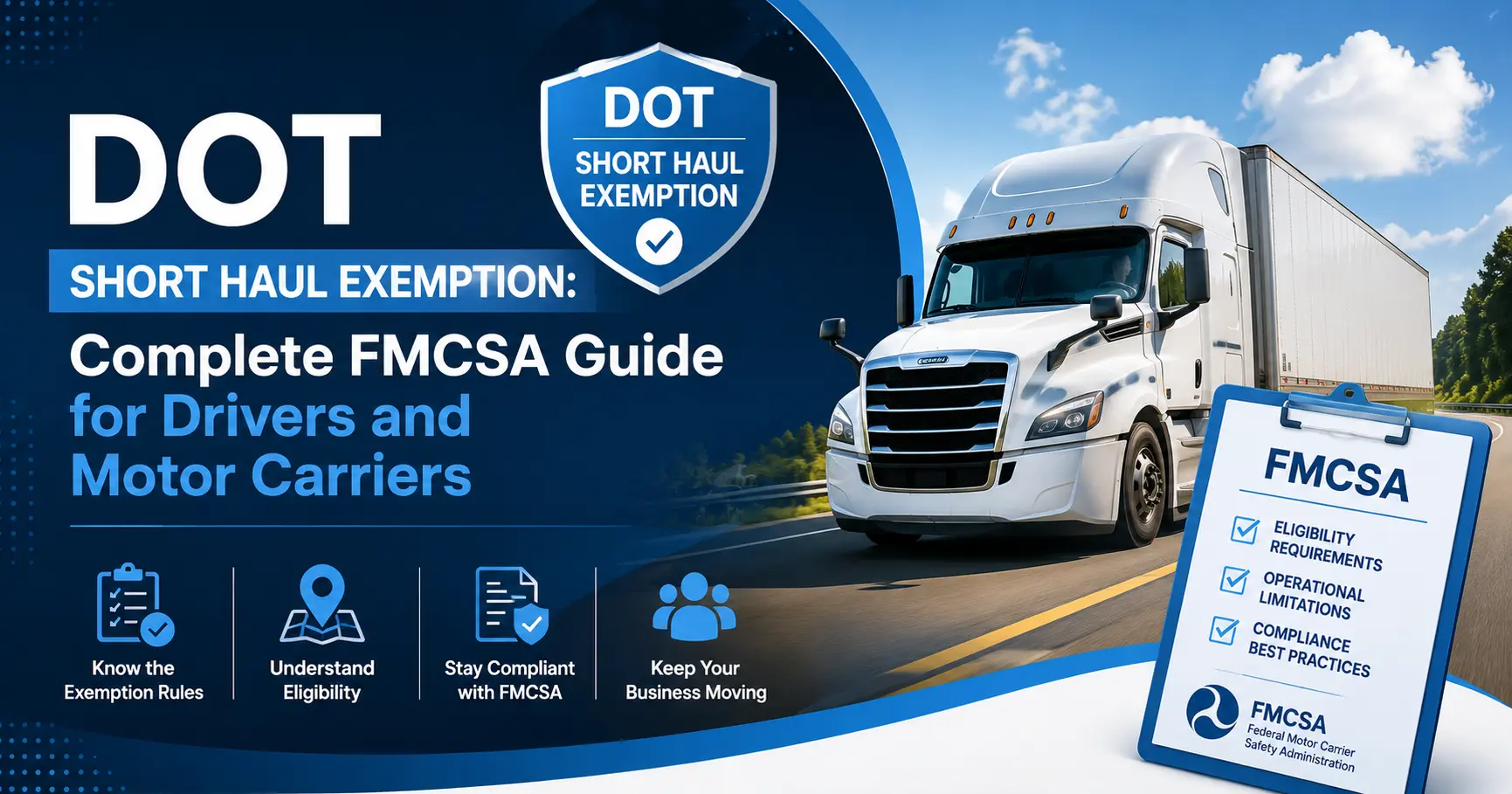
The DOT Short Haul Exemption is one of the most valuable Hours-of-Service (HOS) exceptions available to commercial drivers and motor carriers. It simplifies recordkeeping requirements, reduces paperwork, and allows eligible drivers to operate without maintaining traditional Records of Duty Status (RODS) or Electronic Logging Devices (ELDs) in certain situations.
However, many carriers misunderstand the exemption requirements and accidentally violate FMCSA regulations. Understanding when the short haul exemption applies, and when it does not, is essential for maintaining compliance and avoiding costly penalties.
In this guide, we’ll explain FMCSA short haul exemption rules, ELD exemptions, the 16-hour short haul exception, and common compliance mistakes.
What Is the DOT Short Haul Exemption?
The DOT Short Haul Exemption is an FMCSA Hours-of-Service exception that allows certain commercial drivers to operate without maintaining standard logbooks or using Electronic Logging Devices (ELDs).
The exemption was designed primarily for local drivers who operate within a limited geographic area and return to their work reporting location at the end of the day.
When drivers qualify for the short haul exemption, they are generally exempt from maintaining Records of Duty Status (RODS), significantly reducing administrative burden.
FMCSA Short Haul Exemption Requirements
To qualify for the FMCSA Short Haul Exemption, drivers must meet specific requirements.
1. Return to the Same Work Reporting Location
Drivers must start and end their workday at the same reporting location.
2. Remain Within the Air-Mile Radius
Drivers must operate within a 150 air-mile radius of their normal work reporting location.
An air-mile is different from a road mile and is measured as a straight-line distance.
3. Meet Maximum Duty Period Limits
Drivers must complete their workday within the allowable on-duty period established by FMCSA regulations.
4. Employer Maintains Accurate Time Records
Motor carriers must keep records showing:
- Driver start time
- Driver end time
- Total hours worked
- Driver identification
Failure to maintain these records can result in compliance violations.
What Is the 150 Air-Mile Short Haul Exemption?
The most commonly used short haul exemption allows drivers to operate within a 150 air-mile radius and return to their reporting location each day.
This exemption is particularly common among:
- Local trucking companies
- Construction fleets
- Utility service providers
- Delivery companies
- Municipal fleets
Drivers operating under this exemption may avoid many traditional HOS recordkeeping requirements.
What Is the 16-Hour Short Haul Exemption?
The 16-Hour Short Haul Exemption is a separate FMCSA exception that allows eligible drivers to extend their duty day from 14 hours to 16 hours under limited circumstances.
16-Hour Short Haul Exemption Requirements
Drivers may use this exemption when:
- They return to the same work reporting location.
- They are released from duty at the same location.
- The exemption is used no more than once during a rolling seven-day period (or once after any restart).
- The driver normally returns to the reporting location daily.
This exception provides flexibility for unexpected delays or unusually busy workdays.
Learn more: Driver’s Guide to HOS
Does the Short Haul Exemption Eliminate Hours-of-Service Rules?
No.
One of the biggest misconceptions is that drivers operating under the short haul exemption are exempt from Hours-of-Service regulations altogether.
Drivers must still comply with applicable HOS limits, including:
11-Hour Driving Limit
Drivers may drive a maximum of 11 hours after 10 consecutive hours off duty.
14-Hour Duty Window
Drivers generally may not drive beyond the 14th consecutive hour after coming on duty.
60/70-Hour Weekly Limits
Drivers must comply with FMCSA cumulative duty-hour restrictions.
The exemption only affects recordkeeping requirements, it does not eliminate safety regulations.
ELD Short Haul Exemption Explained
One of the most searched questions regarding compliance is whether short haul drivers need Electronic Logging Devices.
Are Short Haul Drivers Exempt from ELD Requirements?
In many cases, yes.
Drivers operating under the FMCSA short haul exemption are generally exempt from the ELD mandate if they continue to meet all exemption requirements.
Because they are exempt from maintaining Records of Duty Status (RODS), they are also typically exempt from ELD usage.
When Does the ELD Exemption End?
If a driver exceeds short haul exemption limits, they may be required to:
- Complete Records of Duty Status (RODS)
- Use an ELD if otherwise subject to the ELD mandate
- Follow standard HOS documentation requirements
Carriers should monitor operations carefully to ensure drivers remain within exemption limits.
Common Short Haul Exemption Mistakes
Many FMCSA violations occur because carriers misunderstand the exemption.
Exceeding the 150 Air-Mile Radius
Operating outside the approved radius may invalidate the exemption.
Failing to Return to the Reporting Location
Drivers must generally begin and end their workday at the same location.
Missing Time Records
Motor carriers must maintain accurate time records even when logbooks are not required.
Misusing the 16-Hour Exception
The 16-hour exemption has strict limitations and cannot be used regularly.
Assuming HOS Rules Do Not Apply
The exemption affects recordkeeping, not safety regulations.
Benefits of the FMCSA Short Haul Exemption
When used correctly, the short haul exemption provides several advantages.
Reduced Administrative Burden
Drivers spend less time maintaining logs.
Lower Compliance Costs
Reduced need for recordkeeping systems and administrative oversight.
Improved Operational Efficiency
Simplified compliance processes help local operations run more efficiently.
Less Driver Paperwork
Drivers can focus more on operations and customer service.
How Motor Carriers Can Stay Compliant
To safely use the DOT short haul exemption, carriers should:
- Verify driver eligibility regularly
- Monitor operating radius
- Maintain accurate time records
- Train dispatchers on exemption requirements
- Conduct periodic compliance reviews
- Track usage of the 16-hour exception
Proactive compliance management helps prevent costly violations and audit findings.
For a complete understanding of federal requirements, review our DOT Compliance Guide.
Key Takeaways
- The DOT Short Haul Exemption simplifies HOS recordkeeping for eligible drivers.
- Drivers must generally operate within a 150 air-mile radius and return to the same reporting location.
- Short haul drivers may qualify for ELD exemptions.
- The 16-hour short haul exemption provides limited flexibility for longer workdays.
- Hours-of-Service rules still apply even when logbooks are not required.
- Accurate employer time records remain mandatory.
- Understanding exemption requirements helps carriers avoid violations and audits.
Need Help With DOT Compliance?
Understanding short haul exemptions, Hours-of-Service requirements, ELD regulations, and FMCSA compliance rules can be challenging.
SafeRoad Compliance helps motor carriers stay compliant through DOT compliance management, audit preparation, driver qualification file support, FMCSA registration assistance, and ongoing regulatory guidance.
Schedule a consultation today and keep your fleet compliant, efficient, and audit-ready.
Schedule an Appointment Today
Book your 30-minute compliance consultation with our DOT experts.
Frequently Asked Questions
The DOT short haul exemption allows eligible drivers to operate without maintaining traditional logbooks or ELD records when specific FMCSA requirements are met.
Most eligible drivers must remain within a 150 air-mile radius of their normal work reporting location.
Drivers operating under the FMCSA short haul exemption are generally exempt from ELD requirements while they continue to meet exemption conditions.
The 16-hour short haul exemption allows eligible drivers to extend their duty window from 14 hours to 16 hours under limited circumstances.
No. Drivers must still comply with FMCSA driving and on-duty limitations.
Motor carriers must maintain accurate time records showing start times, end times, total hours worked, and driver information.
Yes. Exceeding exemption limits or failing to meet FMCSA requirements may require compliance with standard HOS and ELD rules.