Disclosure: Informational only. We are not FMCSA or USDOT. Always verify your status directly through official FMCSA systems.
Many owner-operator compliance problems come from a missed date, not an unknown rule. This calendar puts every recurring DOT deadline in one place.
What Deadlines Does an Owner-Operator Have to Track?
An owner-operator running under their own authority has deadlines on four cycles. Daily: driver vehicle inspection reports and hours-of-service records. Quarterly: IFTA fuel tax returns. Annually: UCR registration, the annual vehicle inspection, a Clearinghouse query and MVR review on yourself, IRP renewal, and Form 2290. Every two years: the MCS-150 biennial update and, at most, your DOT medical card. Insurance, BOC-3, and drug and alcohol consortium enrollment must stay active the whole time.
Each item below links to our detailed guide. For the full list of one-time setup requirements, see the owner-operator DOT compliance checklist.
The Owner-Operator Compliance Calendar at a Glance
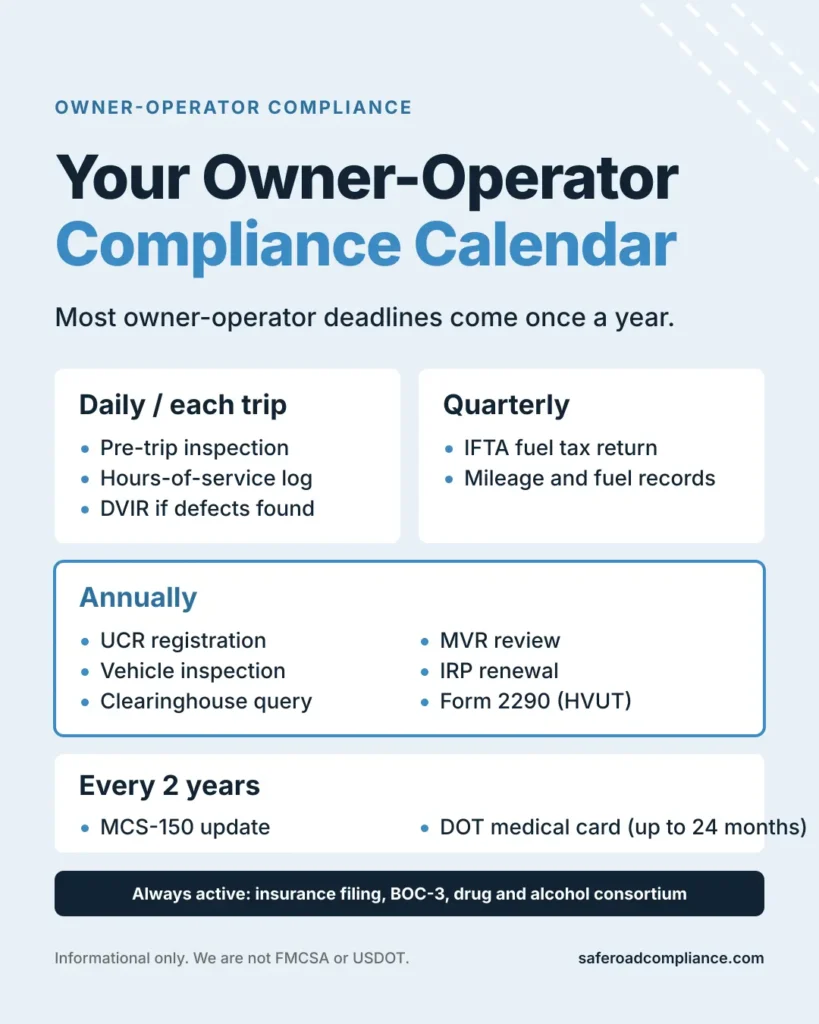
The annual column is the busiest. Where you control the timing, such as your annual inspection and MVR review, spread items across different months so they don’t all land at once.
Registrations: Annual and Biennial
Key Trucking Registration and Filing Deadlines
Track recurring filings and registration requirements to help keep your trucking business compliant.
| Filing | When | Notes |
|---|---|---|
|
MCS-150 Biennial Update Every 24 months |
By the end of the assigned month in the applicable filing year. |
The last digit of the USDOT number determines the month (1 = January through 0 = October); the second-to-last digit determines whether the filing is due in an odd- or even-numbered year. Update your information when required after changes, including changes to address or fleet size.
FMCSA filing schedule |
|
UCR Registration Annual |
For each applicable registration year. |
Generally applies to covered interstate motor carriers, brokers, freight forwarders, and leasing companies. Requirements and fees depend on the applicable UCR rules and registration year.
DOT Federal Register notice |
|
IRP Apportioned Plates Annual renewal |
According to your base jurisdiction’s renewal schedule. | Applies to qualifying vehicles operating in multiple IRP jurisdictions. Confirm vehicle eligibility, registration details, and renewal requirements with your base jurisdiction. |
|
Insurance Filing Maintain continuously |
Maintain required coverage and federal filings; review them at each policy renewal. |
A lapse in required insurance filings can lead to suspension or revocation of operating authority, depending on the circumstances. Confirm that replacement filings are submitted when needed.
Learn about FMCSA insurance filings |
|
BOC-3 Process Agent Filing Keep current |
Maintain the required filing and update it when applicable process-agent information changes. |
Verify that the designation remains on file and meets applicable requirements, particularly when applying for operating authority.
Learn what a BOC-3 filing is |
For how your USDOT number fits with these filings, see USDOT number registration requirements.
Driver Qualification and Testing Deadlines
As an owner-operator, you are both the employer and the driver, so these checks apply to you.
Ongoing DOT Requirements for Drivers and Owner-Operators
Track recurring medical, driving-record, Clearinghouse, and drug and alcohol testing obligations.
| Requirement | When | Rule and Details |
|---|---|---|
| Clearinghouse Query on Yourself Annual | At least once every 12 months. |
Employers must conduct the required annual limited query for each covered CDL driver. An owner-operator who is an employer must comply for themselves and any other covered CDL drivers they employ; a full query and driver consent are required when the limited query indicates that detailed information exists.
49 CFR § 382.701(b) FMCSA owner-operator guidance |
| Motor Vehicle Record (MVR) Review Annual | At least once every 12 months. |
The motor carrier must obtain and review the driver’s driving record in accordance with applicable qualification requirements and document the review.
49 CFR § 391.25 |
| DOT Medical Qualification Renew as required | Before the current medical qualification expires; certificates may be valid for less than 24 months. |
The medical examiner determines the certification period based on the driver’s medical status. Drivers must meet the applicable physical qualification requirements and maintain valid qualification documentation when required.
49 CFR § 391.45 |
| Medical Certification Record for CDL Holders When renewed | Follow the applicable state process whenever your medical certification changes or a new certificate is issued. | CDL medical-certification procedures have changed as FMCSA and states transition to electronic medical certification. Confirm whether your medical examiner’s submission updates your state record automatically or whether you must take additional action. |
| Random Drug and Alcohol Testing Ongoing | Throughout the year, whenever selected under the applicable random testing program. |
Covered employers must maintain a compliant random testing program. Owner-operators subject to the rules must participate through a consortium/third-party administrator (C/TPA) and designate the C/TPA in the Clearinghouse as required.
49 CFR Part 382 |
Add each new document to your driver qualification file as it comes in. For what that file must hold, see our guide to DOT recordkeeping requirements. If your medical card is shorter than 24 months, see DOT physical disqualifying conditions for why.
Vehicle Deadlines
Essential DOT Inspection and Maintenance Requirements
Track inspection intervals, maintenance records, and roadside inspection follow-up obligations.
| Requirement | When | Regulation |
|---|---|---|
| Annual (Periodic) Inspection Every 12 months | Each covered commercial motor vehicle must be inspected at least once during the preceding 12 months. Applicable inspection documentation must be maintained, and proof must be carried on the vehicle as required. | 49 CFR § 396.17 |
| Driver Vehicle Inspection Report (DVIR) Daily, when applicable | At the end of each day’s work, a driver operating a property-carrying CMV must prepare a report when a defect or deficiency is discovered or reported that would affect safe operation or result in a mechanical breakdown. Passenger-carrying vehicles have separate reporting requirements. | 49 CFR § 396.11 |
| Vehicle Maintenance Records Keep records current | Record required vehicle identification, inspection, repair, and maintenance information. Update records as maintenance and service work occurs, and retain them for the periods required by regulation. | 49 CFR § 396.3 |
| Roadside Inspection Report Follow-up required | Correct violations or defects as required. When the inspection report requires certification and return, the motor carrier must certify that violations have been corrected and return the report to the issuing agency within 15 days after the inspection. | 49 CFR § 396.9 |
An owner-operator running a single CMV is exempt from the written DVIR requirement, but still needs annual inspections and a maintenance file. Details are in our guide to DOT vehicle maintenance records requirements.
Tax Filings
Essential Fuel Tax and Heavy Vehicle Tax Filings
Track quarterly fuel tax reporting and annual federal heavy vehicle use tax obligations.
| Filing | When | Notes |
|---|---|---|
| IFTA Fuel Tax Return Quarterly | Every quarter, by the deadline established for the applicable reporting period. | Applies to qualified motor vehicles operating in multiple IFTA member jurisdictions. Maintain accurate distance traveled and fuel purchased by jurisdiction, along with supporting mileage and fuel records. File the return with your base jurisdiction, including when a no-tax-due return is required. |
| Form 2290 — Heavy Vehicle Use Tax Annual tax period | The tax period generally runs from July 1 through June 30. Filing and payment deadlines depend on when the vehicle is first used on public highways during the tax period. |
Generally applies to taxable highway motor vehicles with a gross taxable weight of 55,000 pounds or more. File Form 2290 with the IRS and retain the Schedule 1 proof when required for vehicle registration.
FHWA: What is Heavy Vehicle Use Tax? IRS Form 2290 information |
IFTA and Form 2290 are not FMCSA filings, but they are part of keeping a truck legally on the road. Confirm exact due dates with your base jurisdiction and the IRS each year.
How Long to Keep Records
Deadlines tell you when to file. Retention periods tell you when you can throw something away.
How Long Must You Keep DOT Compliance Records?
Use this retention guide to organize driver, hours-of-service, inspection, and vehicle maintenance records.
| Record | Retention Period | Regulation |
|---|---|---|
| Hours-of-Service Records and Supporting Documents | 6 months | 49 CFR § 395.8 |
| Driver Vehicle Inspection Reports (DVIRs) | 3 months | 49 CFR § 396.11 |
| Roadside Inspection Reports | 12 months | 49 CFR § 396.9 |
| Annual Inspection Reports | 14 months | 49 CFR § 396.21 |
| Vehicle Maintenance File | 1 year + 6 months after disposal or transfer | 49 CFR § 396.3 |
| Driver Qualification File (DQF) | During employment + 3 years after it ends | 49 CFR § 391.51 |
For the full retention picture, see DOT recordkeeping requirements for trucking companies.
Stay Ahead of Every Deadline
A calendar only works if someone watches it. SafeRoad Compliance tracks MCS-150, UCR, Clearinghouse, medical card, and inspection deadlines for owner-operators and small fleets, and sends reminders before they’re due, as part of our DOT compliance services. To hand off the tracking, contact SafeRoad Compliance.
Don’t Let Compliance
Slow Your Business Down.
Stay organized, keep required records current, and stay ahead of important DOT compliance requirements with professional support.
FAQ
Every 24 months, by the end of the month matching the last digit of your USDOT number (1 is January, 0 is October). If the second-to-last digit is odd, file in odd years; if even, in even years.
Yes. Owner-operators must query the Clearinghouse on every CDL driver they employ, including themselves, at least once a year.
At least once every 12 months for each truck and trailer, with proof of the inspection on the vehicle.
No. UCR is an annual registration for interstate carriers.
A motor carrier operating only one CMV is exempt from the written DVIR requirement. You still need to inspect the truck and keep a maintenance file.
Six months for hours-of-service records and supporting documents.